How to separate vehicle traffic lanes from personnel safety zones on a worksite.
Page text
· 2 pages · by U.S. Department of Labor, OSHA
The words on each page as the author wrote them, read from the file by software so they can be searched. Layout, pictures and tables are not shown here: the pages above and the download are the original.
- Page 1
Fact Sheet
- Longshoring in Marine
- Terminals
- Traffic Lanes and Personnel Safety Zones
- Workers involved in marine cargo handling are often exposed to being struck by moving vehicles or equipment.
- When longshore workers are coning, signaling or performing other tasks on foot near cranes, employers should take measures to ensure a safe work environment by providing traffic lanes and personnel safety zones.
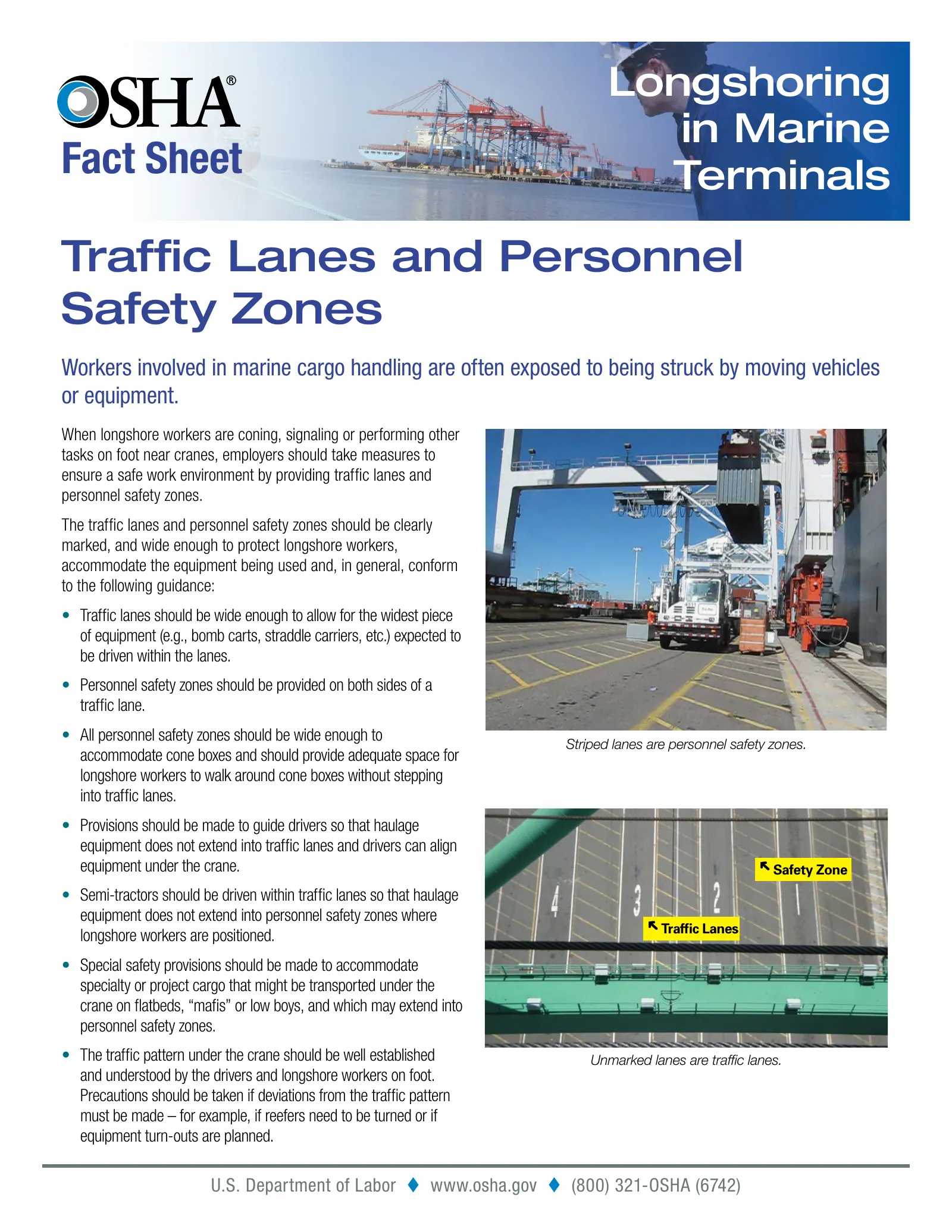
- The traffic lanes and personnel safety zones should be clearly marked, and wide enough to protect longshore workers, accommodate the equipment being used and, in general, conform to the following guidance:
- Traffic lanes should be wide enough to allow for the widest piece of equipment (e.g., bomb carts, straddle carriers, etc.) expected to be driven within the lanes.
- Personnel safety zones should be provided on both sides of a traffic lane.
- All personnel safety zones should be wide enough to accommodate cone boxes and should provide adequate space for longshore workers to walk around cone boxes without stepping into traffic lanes.
- Striped lanes are personnel safety zones.
- Provisions should be made to guide drivers so that haulage equipment does not extend into traffic lanes and drivers can align equipment under the crane.
- Semi-tractors should be driven within traffic lanes so that haulage equipment does not extend into personnel safety zones where longshore workers are positioned.
- Safety Zone
- Traffic Lanes
- Special safety provisions should be made to accommodate specialty or project cargo that might be transported under the crane on flatbeds, “mafis” or low boys, and which may extend into personnel safety zones.
- The traffic pattern under the crane should be well established and understood by the drivers and longshore workers on foot. Precautions should be taken if deviations from the traffic pattern must be made – for example, if reefers need to be turned or if equipment turn-outs are planned.
- Unmarked lanes are traffic lanes.
- U.S. Department of Labor t www.osha.gov t (800) 321-OSHA (6742)
- Page 2
Workers’ Rights
- Back Reach of Crane
- During bomb cart operations, cone bins and coning operations should be relocated from under the crane’s activity area.
- Under federal law, workers are entitled to working conditions that do not pose a risk of serious harm.
- For more information on how to assure a safe and healthful workplace, see OSHA’s Workers page.
- For questions or to get information or advice, to report an emergency, fatality, inpatient hospitalization, amputation, or loss of an eye, or to file a confidential complaint, contact your nearest OSHA office, visit www.osha.gov or call OSHA at 1-800-321- OSHA (6742), TTY 1-877-889-5627.
- How to Contact OSHA
- Crane
- Cone Box
- Safety Zone
- Traffic Lanes
- Striped traffic lanes and personnel safety zones under the crane.
- This is one in a series of informational fact sheets highlighting OSHA programs, policies or standards. It does not impose any new compliance requirements. For a comprehensive list of compliance requirements of OSHA standards or regulations, refer to Title 29 of the Code of Federal Regulations. This information will be made available to sensory-impaired individuals upon request. The voice phone is (202) 693-1999; teletypewriter (TTY) number: 1-877-889-5627.
- U.S. Department of Labor t www.osha.gov t (800) 321-OSHA (6742)
- DSG FS-3540 05/2012
- Hatch covers should not extend into traffic lanes or personnel safety zones.