1 / 84Use ← → to flip
Mobile Equipment Safety
Mobile equipment safety in work zones: blind spots, backing, spotters and operator checks.
Slide text
· 74 of 84 slides · by North Dakota Safety Council
The words on each slide as the author wrote them, read from the file by software so they can be searched. Layout, pictures and tables are not shown here: the slides above and the download are the original.
- Slide 1
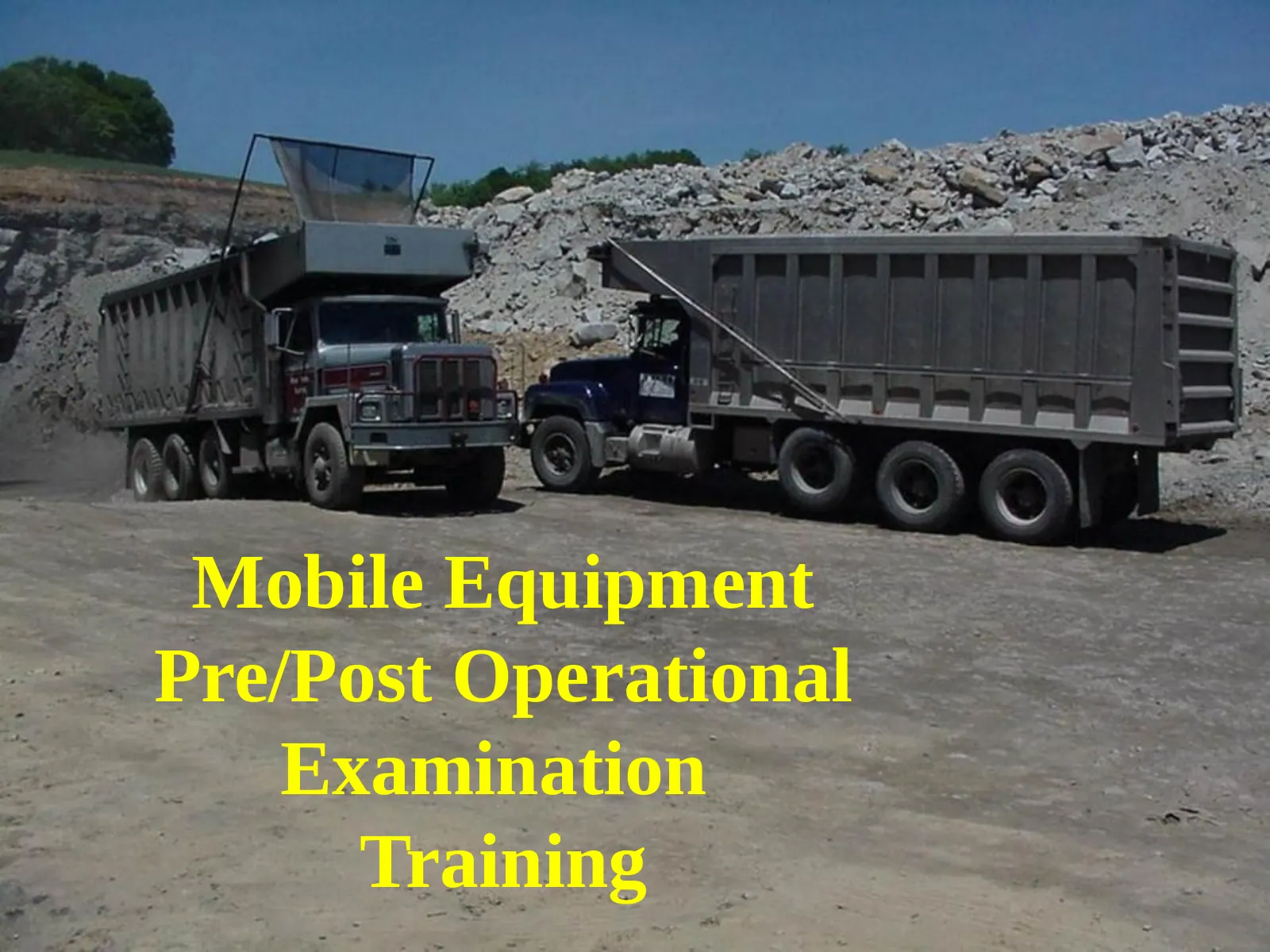
Mobile Equipment
- Pre/Post Operational
- Examination
- Training
- Slide 2
- Perform safety checks of heavy equipment before start of each shift. (Suggestions from Wayne State U.)
- Walk fully around equipment and look for hazards
- Inside cab remove trash, clean dirty windows, adjust mirrors, check fire extinguisher, turn on all exterior lights, make sure seatbelt is ready to use
- Outside, check lights, tires, suspension, steering, fluid levels, exterior hoses and filters. Look for unguarded moving parts or other unsafe conditions
- After starting engine, check gauges, warning lights and engine sounds
- Before moving, warn people in the area, test equipment’s movements and make sure back up alarms can be heard
- Slide 3
Pre Operational Examination
- Equipment operators should develop a “Zero Compromise” safety attitude. This means that they will not operate equipment that is not properly maintained.
- An operator’s knowledge of the machine and the functions is directly proportional to his/her ability to safely operate the machine and to control it in an emergency.
- Slide 4
- Inspecting the workplace for potentially hazardous conditions is an important part of every equipment operator’s job.
- This includes performing pre/post shift examination of their machine.
- Slide 5
- Using an equipment inspection system, will help the operator to make sure that the machine is mechanically sound and in safe operating conditions.
- Slide 6
You Should…
- Perform a systematic pre-operational examination of the machine using a designated examination report form to record findings and comments.
- Slide 7
Prepare the Machine
- Slide 8
Accumulations of combustible materials
- Unsafe condition
- Slide 9
Front and Rear
- Brakes
- Unsafe condition
- Slide 10
Tires-Wheels Front and Rear
- Slide 11
Steering System
- Slide 12
- Bed Pins
- Slide 13
Fifth Wheel
- Slide 14
Frame/Cross
- Members
- Slide 15
- Safety Props/Catches
- Slide 16
- Air Supply Lines
- Slide 17
Engine
- Compartment
- Slide 18
Engine
- Compartment
- Slide 19
Guards
- Slide 20
Exhaust
- Unsafe condition
- Slide 21
Battery
- Slide 22
Steps/Grab Rails
- Slide 23
Operators Cab
- Poor Housekeeping
- Slide 24
- Mirrors
- Slide 25
Windshield Wipers
- & Glass
- Slide 26
Examination of fire fighting equipment.
- Slide 27
Seat belts
- Slide 28
Electrical-
- Mechanical
- Retarder System
- Slide 29
Service Brake
- Slide 30
Park Brake
- Slide 31
Air Systems-
- Proper Operation
- Slide 32
Horns and Backup
- Alarms
- Slide 33
Steering
- Slide 34
Communications
- Slide 35
Blind Areas Around
- Construction
- Equipment
- Slide 36
Definition of Blind Area
- A blind area is the area around a vehicle or piece of construction equipment that is not visable to the operators, either by direct line-of-sight or indirectly by use of internal and external mirrors.
- Slide 43
Eye level 10 feet - 0 in above ground level
- 34’ 0”
- 36’ 4”
- 68’ 0”
- 95’ 0”
- Manlift
- Slide 44
Area of fully obstructed view Eye level 7 feet - 0 in above ground level
- 25’ 5”
- 17’ 8”
- 15’ 9”
- 10’ 0”
- 3’ 0”
- 16’ 4”
- 27’ 2”
- Hydraulic Crane
- Slide 45
Eye level 7 feet - 7 in above ground level
- 8’ 4”
- 29’ 1”
- 9’ 1”
- 7’ 7”
- 18’ 5”
- Tractor Backhoe
- Slide 46
Eye level 6 feet - 3 in above ground level
- 16’ 0”
- 8’ 2”
- 8’ 2”
- 3’ 10”
- 12’ 5”
- 12’ 1”
- 18’ 7”
- Bulldozer
- Slide 47
Eye level 10 feet - 0 in above ground level
- 28’11”
- 14’ 8”
- 16’ 2”
- 14’ 3”
- 21’ 11”
- 14’ 10”
- Front End Loader
- Slide 48
Eye level 5 feet - 5 in above ground level
- 11’ 7”
- 11’ 5”
- 21’ 8”
- 4’ 10”
- 6’ 1”
- 3’ 1”
- 6’ 3”
- Bobcat/Skid
- Steer
- Slide 49
Eye level 7 feet - 3 in above ground level
- 85’ 0”
- 18’ 2”
- 10’ 9”
- 7’ 9”
- 3’ 0”
- 39’ 0”
- 21’ 2”
- 14’ 10”
- Terex
- Telehandlers
- Slide 50
Eye level 6 feet above ground level
- 8’ 6”
- 3’ 1”
- 3’ 8”
- 5’ 7”
- 3 Ton Forklift
- Slide 51
Eye level 7 feet - 1 in above ground level Area of fully obstructed view
- 25’ 0”
- 22’ 0”
- 6’ 0”
- 24’ 2”
- 22’ 2”
- 5 Ton Dump Truck
- Slide 52
Eye level 6 feet - 10 in above ground level
- Area of fully obstructed view
- 27’ 1”
- 42’
- 8” 40’
- 6”
- 6’ 5”
- 36’ 8”
- Tractor Trailer
- Slide 53
Struck By
- Slide 54
- How do these injuries and fatalities occur among vehicle operators? (McCann, J. Safety Research, 2006)
- 63% involved operators falling or jumping from their vehicle and then being run over by it
- Don’t jump, ride it out wearing your seat belt
- Operators on foot who were struck by vehicles were run over by their own vehicle, mostly due to it being left in gear or failure to set brakes
- Slide 55
Rollovers caused nearly one-fourth of vehicle-related deaths!
- Bulldozers and loaders caused nearly half of rollover deaths
- Photo courtesy Robert
- Carr
- Slide 56
How do rollovers occur?
- (McCann, J. Safety Research, 2006)
- 37% of rollovers involving operators occurred when a vehicle went over an embankment or slope.
- Off-highway truck involved in fatality, courtesy of NIOSH
- Slide 57
How do rollovers occur?
- (McCann, J. Safety Research, 2006)
- 28% occurred while loading or unloading heavy equipment off trailer trucks
- Photo courtesy Robert Carr
- Slide 58
How can we prevent rollovers while loading and unloading equipment?
- Make sure the trailer is secure and on a level surface
- Inspect the deck for debris, blocking or chains
- Have a spotter help properly align the equipment up the ramps
- Be sure equipment is properly secured
- Slide 59
Wearing a seat belt!
- If a rollover occurs, what greatly improves your chances of surviving?
- 23% of the fatalities weren’t wearing their seat belt
- What level of the hierarchy of controls is this?
- A buckled seat belt keeps the operator within the zone of protection of the Rollover
- Protective Structure (ROPS). Courtesy CDC.
- Slide 60
What are the struck-by hazards of dumping trucks?
- Trucks can become unstable with the boxes raised
- If an end gate chain breaks, you could be covered in material (asphalt is 400° )
- Beds must be lowered for maintenance or properly blocked
- Truck that released two tons of hot asphalt on a driver inspecting the brakes.
- Courtesy Kentucky FACE reports
- Slide 62
Lessons learned from fatalities for workers on foot
- McCann
- Journal of Safety Research
- 2006
- Slide 63
Vehicles backing up caused 43% of struck-by vehicle deaths (McCann, J. Safety Research, 2006)
- Slide 64
How should we safely back up equipment?
- Have audible back-up alarms
- Have a spotter to direct the operator if visibility is restricted
- Keep adequate clearance behind the vehicle
- Always pay attention to backing equipment
- Consider electronic signaling devices or sensors on vehicles to monitor workers
- Slide 65
For workers who were struck by objects…
- 41% from vehicle parts like backhoe buckets
- 38% from falling vehicle loads
- 18% from vehicles falling onto workers in trenches
- Slide 66
Workers on foot
- 20% of fatalities involved crane loads or crane booms
- Slide 67
Everyone must stay out from under all loads!
- Slide 68
What causes crane rollovers?
- Soft ground
- Inadequate outrigger support
- Overload
- Crane out of level
- Booming out while swinging a load
- Fatality caused by crane tip-over at library expansion project. (Photo courtesy of NIOSH and The Blade/Toledo Ohio)
- Slide 69
The swing radius on a crane should be marked
- Slide 70
Why is the worker on foot at risk of being struck by the equipment?
- What is the right way to approach this loader?
- Slide 71
Why is a worker on foot at risk?
- What is the right way to approach this backhoe?
- Slide 72
81% - the brakes were not set or the parts they were working on were not locked out
- Conditions that contributed to the deaths of workers maintaining equipment? (McCann, J. Safety
- Research 2006)
- 19% - the vehicle was moved while being worked on
- Unsafe condition
- Slide 73
How can we reduce risks during maintenance work?
- Lockout/ tag-out before doing work
- Set parking brake
- Chock wheels
- If engine must be on, work with 2 people
- Block dump truck bed, following manufacturer’s recommendations
- Dump body lock from fatality case
- Unsafe conditions
- What’s wrong with this?
- Photo courtesy Laborers-AGC
- Slide 74
Dismantling equipment can be deadly
- Actual photo of boom collapse during crane disassembly that killed master mechanic (courtesy NIOSH)
- Slide 75
Unsafe condition
- Photo courtesy the Laborers-AGC Training Fund
- Slide 76
- On Thursday, April 21, 2005, a 22 year old contractor was fatally injured while repairing a Caterpillar 980 G front-end loader. The victim was working in the articulation area of the front-end loader when it unexpectedly pivoted, crushing the victim within the pinch point.
- Slide 77
- On May 27, 2004, a 37 year old truck driver with four years mining experience was fatally injured at a sand and gravel operation. The victim and two co-workers were dismantling a crusher for shipment to another mine site. A front-end loader, with a jib boom attachment, was being used to slightly lift the crusher discharge conveyor. During this operation, the conveyor support arm broke away from the fixed fastening base allowing the conveyor to suddenly swing upward. The victim, who was attempting to remove the pin from a support arm, was struck by a portion of the conveyor.
- Slide 78
- Unsafe Condition
- Slide 79
- Unsafe condition
- Slide 82
- Unsafe condition
- Slide 84
- Unsafe condition
More on Vehicles & Equipment
ppt
51 slidesHeavy Equipment
Heavy equipment hazards (struck-by, rollover, blind spots, maintenance) from the WVU oil and gas site-preparation course; applies to any earthmoving site.
West Virginia UniversityArchivedOSHA Harwood grant
pptx
46 slidesIntroduction to Work Zone Safety
Introduction to roadway work zone safety from the North Dakota Safety Council work zone course.
North Dakota Safety CouncilArchivedOSHA Harwood grant
pptx
343 slidesTraffic Control for Construction Workers
Temporary traffic control for workers: signs, channelizing devices, flagging and the parts of a work zone.
North Dakota Safety CouncilArchivedOSHA Harwood grant