1 / 39Use ← → to flip
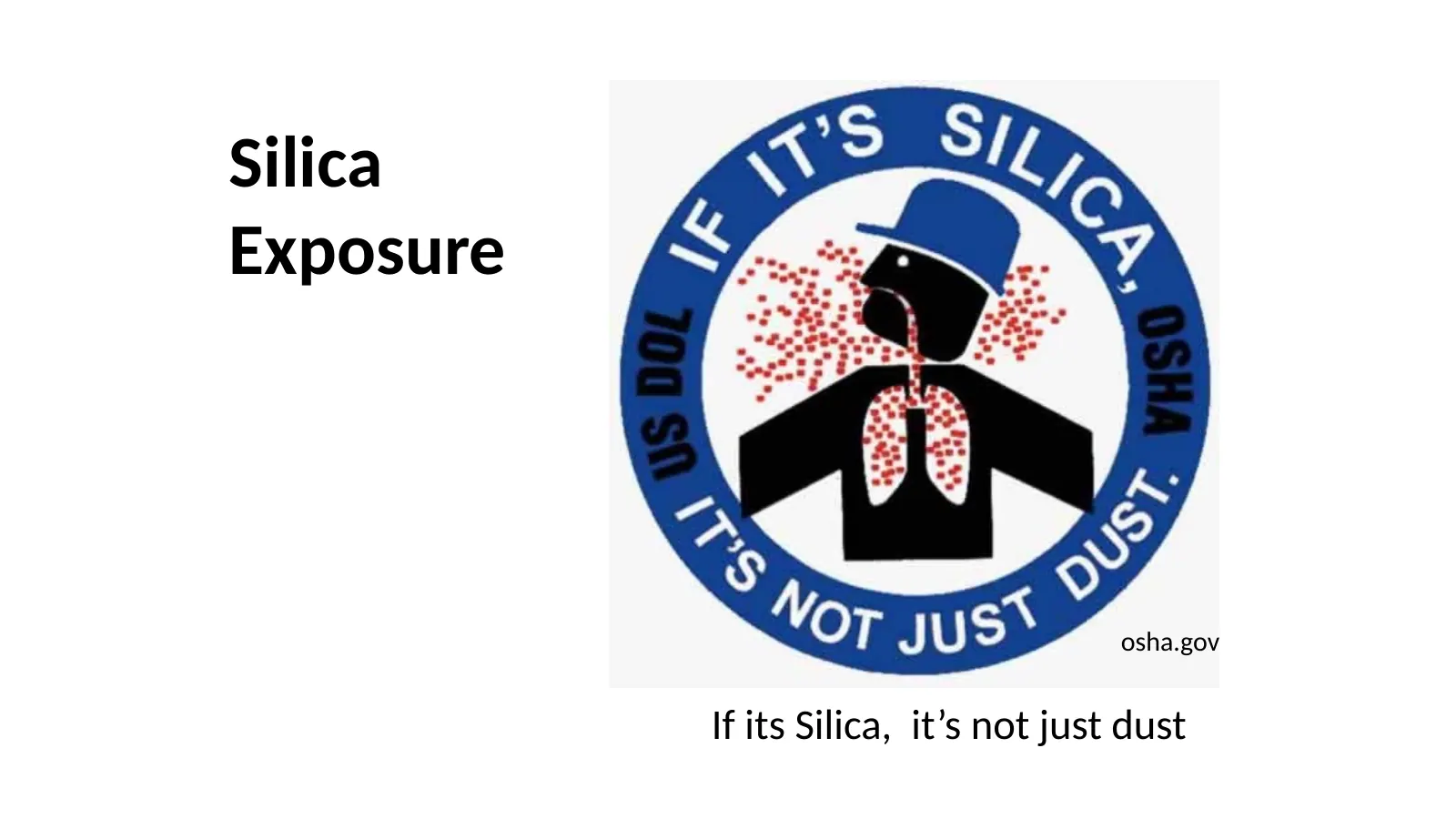
Silica Exposure
Short silica exposure deck from the University of Puerto Rico; fits the 30-minute Health Hazards block.
Slide text
· 39 slides · by University of Puerto Rico
The words on each slide as the author wrote them, read from the file by software so they can be searched. Layout, pictures and tables are not shown here: the slides above and the download are the original.
- Slide 1
Silica
- Exposure
- osha.gov
- If its Silica, it’s not just dust
- Slide 2
Disclaimer
- This material was produced under Susan Harwood grant number SH29650-SH6 Occupational Safety and Health Administration, U.S. Department of Labor. The contents in this presentation do not necessarily reflect the views or policies of the U.S. Department of Labor, nor does the mention of trade names, commercial products, or organizations imply endorsement by the U.S. Government
- Slide 3
What is silica?
- One of the most common naturally occurring minerals on the planet, also known as silicon dioxide (SiO 2 ).
- Usually found in two forms:
- Noncrystalline or amorphous.
- Crystalline, where most common examples are sand and quartz
- Slide 4
Where can I find silica-containing materials?
- Common construction and every day materials such as:
- asphalt, brick, cement, concrete, drywall, grout, mortar, stone, sand, and tile
- In general industry operations using sand products such as:
- glass manufacturing, jewelry production, paintings and coatings manufacturing, dental laboratories, foundries, sand blasting, and hydraulic fracturing.
- Slide 5
How are general industry employees exposed to crystalline silica dust?
- The most severe exposures to crystalline silica result from abrasive blasting done to:
- Clean and smooth irregularities from molds, jewelry, and foundry castings,
- Finish tombstones, etch or frost glass, or
- Remove paint, oils, rust, or dirt from objects needing to be repainted or treated
- China and ceramic manufacturing
- Slide 6
Where are construction industry employees exposed to crystalline silica dust?
- Exposures can occur in :
- cement and brick manufacturing,
- asphalt pavement manufacturing,
- tool and die, steel and foundry industries
- manufacturing household abrasives, adhesives, paints, soaps, and glass, and
- maintenance, repair and replacement of refractory brick furnace linings
- cutting and installation of kitchen countertops
- Slide 7
When is crystalline silica a hazard for workers?
- (materials)
- When materials that contain crystalline silica are disturbed in operations such as blasting, cutting, chipping, drilling and grinding operations, or in certain manufacturing processes, among others.
- cdc.gov
- Slide 8
When is crystalline silica a hazard for workers?
- (health)
- A fine dust cloud of respirable crystalline silica is generated posing a health hazard to the worker.
- This fine dust of respirable crystalline silica enters the lungs and causes the formation of scar tissue, which in turn reduces the lungs’ ability to take in oxygen.
- osha.gov
- Slide 9
When is silica a hazard for workers?
- (effects)
- Repeated exposures to crystalline silica can produce serious, sometimes fatal, illnesses such as silicosis, lung cancer, tuberculosis (in those with silicosis), and chronic obstructive pulmonary disease (COPD). There is no cure for silicosis.
- osha.gov
- Healthy lung
- vs.
- Silicosis
- Slide 10
Why is crystalline silica a health hazard?
- In 1996, the World Health Organization – International Agency on Cancer Research (IARC) identified crystalline silica as a “known human carcinogen” (they reaffirmed this position in 2009).
- Silica exposure has also been linked to renal disease and other cancers.
- Slide 11
How many types of silicosis are there?
- Chronic/classic - occurs after 15–20 years of moderate to low exposures to respirable crystalline silica.
- Accelerated – can occur after 5-10 years of high exposures to respirable crystalline silica
- Acute - occurs after a few months or as long as 2 years following exposures to extremely high concentrations of respirable crystalline silica.
- Slide 12
What are the symptoms for silicosis?
- Symptoms for chronic silicosis may or may not be obvious; therefore, workers need to have a chest x-ray to determine if there is lung damage.
- The worker may experience shortness of breath upon exercising, fatigue, extreme shortness of breath, chest pain, or respiratory failure. In accelerated and acute silicosis weight loss is also present.
- Slide 13
How is OSHA addressing exposure to crystalline silica?
- OSHA has established a new Silica Standard for Construction (1926.1153), and for General and Maritime industries (1910.1053), which includes, among other requirements:
- Permissible Exposure Limit (PEL), Action Limit (AL)
- Hazard communication training for workers
- Medical surveillance
- Respirator program until engineering controls are implemented or in addition to such controls
- Slide 14
What does the construction standard require?
- To limit worker exposures to respirable crystalline silica and to take other steps to protect workers.
- Employers can either
- Use a control method laid out in Table 1 of the construction standard, titled “Specified Exposure Control Methods When Working With Materials Containing Crystalline Silica” or
- Measure workers’ exposure to silica and independently decide which dust controls work best to limit exposures to the PEL in their workplaces.
- Slide 15
What does the construction standard require?
- (plan)
- All construction employers covered by the standard are required to:
- Establish and implement a written exposure control plan that identifies tasks that involves exposure and methods used to protect workers, including procedures to restrict access to work areas where high exposures may occur
- Slide 16
What does the construction standard require?
- (surveillance)
- Designate a competent person to implement the written exposure control plan
- Restrict housekeeping practices that expose workers to silica
- Offer medical surveillance as per standard requirements
- Slide 17
Medical surveillance requirements
- For workers who are required by the silica standard to wear a respirator for 30 or more days per year, employers must offer medical exams every three years, including:
- Tuberculosis baseline,
- chest X-rays,
- lung function tests, and
- any other test required by the physician
- Slide 18
Medical surveillance requirements -1
- Medical exams
- chest X-rays interpreted and classified by a NIOSH-certified
- B Reader and,
- lung function tests performed by a spirometry technician with a current certificate from a (NIOSH)-approved spirometry course
- eLCOSH.org
- Slide 19
Medical surveillance requirements - 2
- Medical exams…
- Tuberculosis baseline testing and any other test deemed necessary by physician
- Tests and results must be handled by a Physician or other licensed health care professional [PLHCP]
- eLCOSH.org
- Slide 20
What does the construction standard require?
- Train workers on work operations that result in silica exposure and ways to limit exposure.
- Keep records of workers’ silica exposure and medical exams.
- Slide 21
What are the Alternative exposure control methods?
- Employers who do not use control methods in Table 1 of the construction standard must:
- Measure the amount of silica that workers are exposed to if it may be at or above an action level of 25 μg/m 3 (micrograms of silica per cubic meter of air), averaged over an eight hour day.
- Protect workers from respirable crystalline silica exposures above the permissible exposure limit of 50 μg/m 3 , averaged over an eight-hour day.
- Slide 22
What are Alternative exposure control methods
- Employers who do not use control methods in Table 1 must:
- Use dust controls to protect workers from silica exposures above the PEL.
- Provide respirators to workers when dust controls cannot limit exposures to the PEL.
- Slide 23
What is 29CFR 1926.1153 Table 1 ?
- Table 1 consists of a list of common equipment and tasks done in the construction industry for which the engineering and work practice controls have been determined.
- Depending upon the time of the task, be it less than or more than 4 hrs, a requirement for respiratory protection can also be included.
- Slide 24
Equipment in 29CFR 1926.1153 Table 1
- Stationary masonry saws
- Handheld power saws for cutting fiber-cement board (with blade diameter of 8 inches or less)
- osha.gov
- osha.gov
- Handheld power saws (any blade diameter)
- osha.gov
- Slide 25
Equipment in 29CFR 1926.1153 Table 1
- Drivable saws
- Walk-behind saws
- osha.gov
- Rig-mounted core saws or drills
- osha.gov
- Slide 26
Equipment in 29CFR 1926.1153 Table 1
- Handheld and stand-mounted drills (including impact and rotary hammer drills)
- Vehicle-mounted drilling rigs for rock and concrete
- osha.gov
- Dowel drilling rigs for concrete
- cdc.gov
- Slide 27
osha.gov
- Equipment in 29CFR 1926.1153 Table 1
- eLCOSH.org
- Handheld grinders for uses other than mortar removal
- cdc.gov/niosh
- Handheld grinders for mortar removal (i.e., tuckpointing)
- Jackhammers and handheld powered chipping tools
- Slide 28
Equipment in 29CFR 1926.1153 Table 1
- Small drivable milling machines (less than half-lane)
- Walk-behind milling machines and floor grinders
- osha.gov
- osha.gov
- Large drivable milling machines
- (half-lane and larger)
- cdc.gov/niosh
- Slide 29
cdc.gov/niosh
- Equipment in 29CFR 1926.1153 Table 1
- Crushing machines
- Hoe-ramming, rock ripping
- eLCOSH.org
- Grading and excavating
- osha.gov
- Slide 30
Example of 29CFR 1926.1153 Table 1
- Equipment/
- Task
- (xii) Handheld grinders for uses other than mortar removal
- Engineering and Work Practice Control
- Methods
- Required Respiratory Protection and Minimum Assigned Protection Factor (APF)
- ≤ 4 hrs/ shift
- 4 hrs/ shift
- None
- None
- When used outdoors
- None
- None
- -When used indoors or in an enclosed area
- None
- APF10
- For tasks performed outdoors only:
- Use grinder equipped with integrated water delivery system that continuously feeds water to the grinding surface
- Operate and maintain tool in accordance with manufacturer's instructions to minimize dust emissions se grinder equipped with commercially available shroud and dust collection system
- Operate and maintain tool in accordance with manufacturer's instructions to minimize dust emissions
- Dust collector must provide 25 cubic feet per minute (cfm) or greater of airflow per inch of wheel diameter and have a filter with 99% or greater efficiency and a cyclonic pre-separator or filter-cleaning mechanism
- Slide 31
When are Construction employers required to comply with the standard?
- Construction employers must comply with all requirements of the standard by June 23, 2017, except requirements for laboratory evaluation of exposure samples, which begins on June 23, 2018.
- Construction
- Industry
- June 23, 2017
- Slide 32
What does the general/ maritime industry standard require? -1
- Measure the amount of silica that workers are exposed to if it may be at or above an action level of 25 μg/m 3 (micrograms of silica per cubic meter of air), averaged over an 8-hour day;
- Protect workers from respirable crystalline silica exposures above the permissible exposure limit of 50 μg/m 3 , averaged over an 8-hour day;
- Slide 33
What does the general/ maritime industry standard require?- 2
- Limit workers’ access to areas where they could be exposed above the PEL;
- Use dust controls to protect workers from silica exposures above the PEL;
- Provide respirators to workers when dust controls cannot limit exposures to the PEL;
- Slide 34
What does the general/ maritime industry standard require? -3
- Restrict housekeeping practices that expose workers to silica where feasible alternatives are available;
- Establish and implement a written exposure control plan that identifies tasks that involve exposure and methods used to protect workers;
- Slide 35
What does the general/ maritime industry standard require? -4
- Train workers on work operations that result in silica exposure and ways to limit exposure; and
- Offer medical tests to comply with medical surveillance.
- Keep records of workers’ silica exposure and medical exams
- Slide 36
What does the general/ maritime industry standard require? -5
- The employer shall
- include respirable crystalline silica in the Hazard Communication Standard (HCS) program.
- ensure that each employee has access to labels on containers of crystalline silica, safety data sheets, and is trained in accordance with the HCS.
- ensure that at least the following hazards are addressed: Cancer, lung effects, immune system effects, and kidney effects.
- Slide 37
When are employers required to comply with the standard?
- General industry and maritime employers must comply with all requirements of the standard by June 23, 2018, except for the following:
- General Industry June 23, 2018
- Hydraulic fracturing operations in the oil and gas industry must implement engineering controls to limit exposures to the new PEL by June 23, 2021.
- Slide 38
When are employers required to comply with the standard? (cont.)
- Medical surveillance must be offered to employees who will be exposed at or above the action level for 30 or more days a year starting on June 23, 2020.
- Medical surveillance must be offered to employees who will be exposed above the PEL for 30 or more days a year starting on June 23, 2018.
- Slide 39
References
- osha.gov – silica page; publications: OSHA FS 3627, 3629, 3630, 3633, 3902, 3928, 3929, 3931, 3932, 3933, 3936
- eLCOSH.org - silica page
- cdc/niosh.gov – silica page
More on Health Hazards
pptx
83 slidesCarbon Monoxide & Inhalation Hazards
Carbon monoxide and inhalation hazards on construction sites (gas-powered tools, enclosed spaces) from Western Iowa Tech Community College.
Western Iowa Technical Community CollegeOSHA Harwood grant
pptx
18 slidesRespiratory Protection
Respiratory protection instructor deck from the University of Puerto Rico Medical Sciences Campus.
University of Puerto Rico Medical Sciences CampusOSHA Harwood grant
pptxes
18 slidesProtección respiratoria
Spanish respiratory protection instructor deck.
University of Puerto Rico Medical Sciences CampusOSHA Harwood grant