1 / 83Use ← → to flip
Carbon Monoxide & Inhalation Hazards
Carbon monoxide and inhalation hazards on construction sites (gas-powered tools, enclosed spaces) from Western Iowa Tech Community College.
Slide text
· 83 slides · by Western Iowa Technical Community College
The words on each slide as the author wrote them, read from the file by software so they can be searched. Layout, pictures and tables are not shown here: the slides above and the download are the original.
- Slide 1
Dangers of
- Carbon Monoxide (CO) and Inhalation Hazards
- This material was produced under a grant (SH-27666-SH5) from the Occupational Safety and Health Administration, U.S. Department of Labor. It does not necessarily reflect the views or policies of the U.S. Department of Labor, nor does the mention of trade names, commercial products, or organization imply endorsement by the U.S. Government.
- Slide 2
Objectives
- Identify sources of CO and inhalation hazards in construction.
- Discuss what Carbon Monoxide is.
- Discuss the dangers of CO and other inhalation hazards in construction.
- Identify the physical characteristics of CO.
- Discuss the statistics of CO poisonings as they relate to construction.
- Discuss and Illustrate the Respiratory System.
- Describe the effects of CO on the bloods hemoglobin.
- Slide 3
Objectives
- List the effects of CO on the organ systems of the human body.
- Define OSHA’s permissible exposure limit (PEL) and parts per million (PPM) as related to CO.
- Outline the importance of monitoring for CO levels in work spaces.
- Discuss available methods for monitoring CO levels in work spaces.
- List the Signs and Symptoms of CO poisoning.
- Outline the approach and treatment of CO poisoning.
- State the effects of long term effects of CO poisoning.
- Differentiate the difference between Acute and Chronic CO poisoning.
- Slide 4
Objectives
- Discuss the inhalation hazards associated with Diesel Exhaust (DE)/Diesel Particulate Matter (DPM)
- Define Diesel Exhaust (DE)/Diesel Particulate Matter (DPM)
- Identify Diesel Exhaust (DE) and Diesel Particulate Matter (DPM) exposures.
- Discuss what controls for DE/DPM might reduce exposures.
- Identify what standards are in place to protect workers from DE/DPM. exposures.
- Discuss the inhalation hazards associated with Crystalline Silica.
- Define what crystalline silica is and how it evolves into silicosis.
- Identify the signs and symptoms associated with silica exposures
- Slide 5
The dangers of CO and other inhalation hazards in construction.
- Carbon Monoxide
- Diesel Exhaust/Diesel Particulate Matter
- Carbon monoxide (CO) is a deadly, colorless, odorless, and tasteless poisonous gas. It is produced by the incomplete burning of various fuels products and equipment powered by internal combustion engines such as portable generators, cars, lawn mowers, and power washers also produce CO.
- DPM is a component of diesel exhaust (DE) that includes soot particles made up primarily of carbon, ash, metallic abrasion particles, sulfates and silicates. Diesel soot particles have a solid core consisting of elemental carbon, with other substances attached to the surface, including organic carbon compounds known as aromatic hydrocarbons.
- Crystalline Silica
- Silicosis is caused by exposure to respirable crystalline silica dust. Crystalline silica is a basic component of soil, sand, granite, and most other types of rock, and it is used as an abrasive blasting agent. Silicosis is a progressive, disabling, and often fatal lung disease.
- Slide 6
Carbon Monoxide
- Inhalation Hazard
- Slide 7
Identify sources of CO and inhalation hazards in construction.
- Non-fire CO Sources
- Portable and Fixed
- Generators
- Space heaters
- Concrete saws
- Diesel Exhaust
- Welders
- Power washers/sprayers
- Power trowels
- Anywhere combustion takes place.
- Other examples??
- Engine Driven Tools
- Carbon Monoxide
- Power Washer
- Heater
- Slide 8
What is Carbon Monoxide?
- Carbon Monoxide (CO) = a chemical compound comprising of one carbon and one oxygen molecule.
- Carbo n
- Carbon
- Monoxid e
- Oxyge n
- Slide 9
What is Carbon Monoxide?
- Carbon Monoxide (CO)
- Is Invisible
- Is Colorless
- Is Odorless
- Is Tasteless
- Because it has no warning properties, it appears nonexistent.
- In the absence of identifiable warning properties, its absolutely undetectable and impossible for humans senses to be aware of it’s presences.
- Slide 10
What is Carbon Monoxide?
- Where does it come from?
- CO is a common industrial hazard resulting from the incomplete combustion of natural gas or any material containing carbon such as gasoline, kerosene, oil, propane, coal, or wood.
- Combustion with insufficient oxygen to complete the process will result in the production Carbon Monoxide.
- What is the most common source of
- CO in the workplace?
- Slide 11
Discuss the statistics of CO poisonings as they relate to construction.
- According to the Centers for Disease Control and Prevention, more than 400 workers every year die from unintentional carbon monoxide poisoning.
- More than 20,000 visit the emergency room.
- More than 4,000 others are hospitalized.
- During 1999--2004, CO poisoning was listed as a contributing cause of death on 16,447 death certificates in the United States.
- Slide 12
Discuss and Illustrate
- Respiratory System Anatomy.
- Naso/Oro pharynx
- Pharynx
- Epiglottis
- Larynx
- Vocal cords
- Trachea
- Esophagus
- Carina
- L&R Bronchi
- Cilia
- Cilia in the lungs catch potentially harmful particulates from the air and use a sweeping motion to push it out of the lungs. Phlegm then coughs it up.
- Slide 13
Discuss and Illustrate Respiratory System Anatomy.
- Cilia
- Bronchioles
- Alveolar Sac
- Capillaries
- Alveoli
- Slide 14
Describe the effects of CO on the blood.
- Red blood cells build up in bone marrow and flow in the body for about 120 days.
- There are 150 Billion red blood cells in one ounce of blood.
- There are 2.4 Trillion red blood cells in one pint of blood.
- In an adult of average size there is a little less than 10 pints (4.7 liters)
- How does the blood move
- Oxygen?
- How does Carbon Monoxide affect the blood?
- Slide 15
Describe the effects of CO on the bloods hemoglobin.
- When air is inhaled into your lungs the oxygen combines with a protein on your red blood cells called, Hemoglobin (Hgb)
- Once oxygen binds with the hemoglobin molecule. It forms Oxyhemoglobin
- Oxygen is then transported to the tissues and organs onboard that Hemoglobin.
- How does less blood or hemoglobin impact you?
- Slide 16
Describe the effects of CO on the bloods hemoglobin.
- When CO is inhaled into the lungs it combines with hemoglobin to form Carboxyhemoglobin (COHgb).
- Once combined, that hemoglobin is no longer available to transport oxygen to the tissues.
- The chemical bond attraction for CO to hemoglobin is 200 times stronger than that of oxygen’s bond with hemoglobin.
- Once established on the hemoglobin CO’s bond is 50 times tighter to the hemoglobin than oxygens
- Slide 17
Describe the effects of CO on the bloods hemoglobin.
- Chemical bond attraction for CO to the blood hemoglobin is 200 times stronger than oxygen.
- CO’s adhesive bond is 50 times tighter to the hemoglobin than oxygen.
- CO
- CO
- CO
- Slide 18
List the effects of CO on the organ systems of the human body.
- So how does this affect your body?
- CO inhibits your bloods ability to carry oxygen to the body’s tissues and vital organs
- What major organ systems are most likely affected?
- Your nervous system, brain, heart, and lungs are dramatically affected.
- Slide 19
Internal combustion engines in construction.
- Show video:
- https://www.osha.gov/dts/vtools/construction/carbonmonoxide_fnl_eng_web.html
- Slide 20
Exposure limits as defined under the PEL and PPM.
- [OSHA PEL]
- [NIOSH REL]
- The current Occupational Safety and Health Administration (OSHA) permissible exposure limit (PEL) for carbon monoxide is 50 parts per million (ppm) parts of air as an 8-hour time-weighted average (TWA) concentration.
- The National Institute for Occupational Safety and Health (NIOSH) has established a recommended exposure limit (REL) for carbon monoxide of 35 ppm as an 8-hour TWA and 200 ppm as a ceiling [NIOSH 1992]. The NIOSH limit is based on the risk of cardiovascular effects.
- [ACGIH TLV]
- The American Conference of Governmental Industrial Hygienists (ACGIH) has assigned carbon monoxide a threshold limit value (TLV) of 25 ppm as a TWA for a normal 8-hour workday and a 40-hour workweek
- The ACGIH limit is based on the risk of elevated carboxyhemoglobin levels.
- Slide 21
Define the exposure limits as defined under the PEL and PPM.
- Effects of CO Exposure Levels, Duration, CO Exposure Limits
- PPM
- Duratio n
- CO effects of exposure
- Source
- 0 – 4 ppm
- 8 hrs.
- Considered “Good” Air quality
- EPA
- 35 ppm
- 8 hrs.
- Recommended 8Hr. Max. workplace exposure.
- US NIOSH
- 50 ppm
- 8 hrs.
- US OSHA PEL
- 400 ppm
- 1-3 hrs.
- Healthy adults will suffer headaches, dizziness, and nausea in 1-2 hr. Life threating after 3 hrs.
- CDC/NIOSH
- 800 ppm
- < 2 hrs.
- Healthy adults will suffer headaches, dizziness, and nausea in 45 min.
- Unconsciousness/death in less than 2 hrs.
- CDC/NIOSH
- 3000 ppm
- < 30 Min.
- Death in less than 30 minutes
- CDC/NIOSH
- Slide 22
Outline the importance of monitoring for CO levels in work spaces.
- The best way of defending against Carbon Monoxide is by purchasing ands USING Carbon Monoxide detectors.
- Carbon Monoxide detectors are designed to measure Carbon Monoxide levels and sound an alarm before dangerous levels of CO accumulate, giving people adequate warning to safely ventilate or evacuate the area.
- Portable CO Detectors are perfect if you’re working or staying in a place where Carbon Monoxide is a possibility, and there isn’t any Carbon Monoxide detectors available.
- Slide 23
Discuss available methods for monitoring CO levels.
- Digital Read-out - The great thing about these detectors is that they have a display panel which lets you see the current, and previous, Carbon Monoxide concentration in parts per million.
- Portable / Hand Held Detectors - These are not necessary for the home environment. Their main application is in commercial or governmental safety inspection roles in workplaces.
- AC Plug-in -These are detectors that allow you to plug them into the electricity outlets in your home, but could be used in construction
- Slide 24
Discuss available methods for monitoring CO levels.
- Hardwired - These are connected directly to your building's power supply, and they come with battery backup. These can also come with digital read-outs.
- Combination Smoke/CO - Just as the name implies, these are detectors that have both smoke and carbon monoxide sensors.
- Interconnected - These can connect, either via cables or wireless, with other alarms and monitors - including ones for smoke, carbon monoxide, and burglar alarms.
- Slide 25
Advantages of a portable CO detector.
- If you’re engaged in work activities in a place where carbon monoxide levels have a opportunity to build and there isn’t any pre-existing carbon monoxide detectors consider using Portable CO Detectors.
- Advantages
- A portable CO detector can be held in one’s hand, clipped on a belt or pocket so its simple to carry.
- Some models alarm continually when detecting 200 ppm of CO Broad measurement range, from 0 – 1000 ppm depending on model
- Instantaneous readings
- Extremely simple to operate
- It is able to be used while you are on the move.
- Note: Please follow manufacturer guidelines on calibration for portable CO detectors.
- Slide 26
Signs and Symptoms of CO poisoning.
- How does Carbon Monoxide (CO) enter the body?
- Symptoms are often vague, subtle, and non-specific.
- Symptoms vary widely from person to person.
- People with lung and heart disease are more susceptible to elevated CO levels and acute exposures.
- These symptoms can easily be confused with other medical conditions and ignored.
- Slide 27
Signs and Symptoms of CO poisoning.
- Nausea
- Weaknes s
- FLU
- Slide 28
- Signs and Symptoms of CO poisoning.
- Dizziness
- Headache
- Dehydratio n
- Slide 29
List the Signs and Symptoms of CO poisoning.
- The most common symptoms of CO poisoning are
- Headache
- Confusion
- Dizziness
- Weakness
- Nausea
- Vomiting
- Chest pain
- Cardiac Dysrhythmias
- Hypotension
- Cardiac Arrest
- REMEMBER, it’s often hard to tell if someone has CO poisoning, because the symptoms may be like those of other illnesses.
- People who are sleeping can die from CO poisoning before they have symptoms.
- Slide 30
Outline the approach and treatment of CO poisoning.
- Warning: You may be exposed to fatal levels of CO poisoning in a rescue attempt.
- ENSURE you and others are safe!
- Move the victim immediately to fresh air in an open area.
- Call 911 or another local emergency number for medical attention or assistance.
- Administer 100-percent oxygen using a tight-fitting mask if the victim is breathing.
- Administer cardiopulmonary resuscitation if the victim has stopped breathing.
- Slide 31
Outline the approach and treatment of CO poisoning.
- Half-life of Carbon Monoxide is approximately 5 hours.
- What does the Half-life of Carbon Monoxide mean??
- Half life – Time required for half the quantity of a drug or substance to be metabolized or eliminated
- So, if the half-life of carboxyhemoglobin is 5hrs. It will take approx. 5 hours for the COHb levels in the blood to drop to half of it’s current level AFTER exposure was terminated.
- CO Half-life on 21% room air Oxygen = 4-6 hrs.
- CO Half-life on 100% Oxygen – approx. 80 min.
- CO Half-life with Hyperbaric Oxygen = approx. 22 min.
- Slide 32
Differentiate the difference between Acute and Chronic CO poisoning.
- Definition of acute exposure: Single exposure to a harmful substance (not lasting more than a day) that results in severe biological harm or death
- Definition of chronic exposure: repeated, continuous exposure to hazardous substance, over an extended period. (i.e. from 5 to 50 years or over a lifetime).
- Chronic CO poisoning can happen by,
- Smaller ppm CO exposures over a long periods of time.
- Larger ppm CO exposures over small periods of time.
- Slide 33
State the effects of long term effects of CO poisoning.
- Try and estimate victims exposure.
- Exposure is dependent on upon;
- Minute Ventilation
- Amount of air exchanged within a minute.
- Duration of exposure
- The longer the exposure, the more absorption.
- Concentration of CO in within exposure environment.
- The higher the concentration, the greater the toxicity.
- Concentration of oxygen in the environment.
- The lower the oxygen concentration, the faster poisoning and symptoms develop.
- High Altitudes
- Confined Spaces
- Slide 34
Neurological long term effects of CO poisoning.
- The long term effects of poisoning by carbon monoxide can be extremely serious.
- The long term neurological effects of breathing in carbon monoxide can affect:
- Brain function
- Memory loss
- Moods/Behavior
- Cognition/Thoughts
- It is thought that the section of the brain that deals with new memories, can be particularly susceptible to long term damage from CO poisoning.
- Slide 35
Cardiovascular effects of long term effects of CO poisoning.
- Heart muscle damage from lack of oxygen to the cardiac cell can lead to cardiac pump complications.
- Cardiac Ischemia
- Hypertension
- Pump failure
- Later development of cardiac complications (similar to an engine and its components)
- The heart and brain continuously talk to each other influencing the other's functioning.
- Neuro-Cardiology suggest the signals that the heart sends to the brain can influence perception, emotional processing, and cognition.
- Slide 36
How can employers and employees prevent CO poisoning.
- Employers
- Educate workers about the sources and conditions that may result in CO poisoning as well as the symptoms and control of CO exposure.
- Provide personal CO monitors with audible alarms if potential exposure to CO exists.
- Install an effective ventilation system that will remove CO from work areas.
- Install CO monitors with audible alarms.
- Slide 37
How can employers and employees prevent CO poisoning.
- Employers
- Test air regularly in areas where CO may be present, including confined spaces.
- See Title 29 of the Code of Federal
- Regulations(CFR) 1910.146 & 1926.1201-1213.
- Prohibit the use of gasoline-powered engines or tools in poorly ventilated areas.
- Consider switching from gasoline-powered equipment to equipment powered by electricity, batteries, or compressed air if it can be used safely.
- Slide 38
How can employers and employees prevent CO poisoning.
- Employees
- Report any situation to your employer that might cause CO to accumulate.
- Report promptly complaints of dizziness, drowsiness, or nausea.
- Avoid overexertion if you suspect CO poisoning and leave the contaminated area.
- Tell your doctor that you may have been exposed to CO if you get sick.
- Avoid the use of gas-powered engines, such as those in powered washers as well as heaters and forklifts, while working in enclosed spaces.
- Slide 39
Recap, Summary, Questions
- Recap
- Summar y
- Question s
- Slide 40
Diesel Exhaust (DE) and Diesel Particulate Matter(DPM)
- Construction Inhalation Hazard
- Slide 41
Diesel Exhaust/Diesel Particulate Matter (DE/DPM)
- The diesel engine was patented in 1892 to provide improved fuel efficiency as compared to gasoline engines.
- NIOSH estimates that more that 1.3 million workers are exposed to DE in more than 80,000 work places
- Diesel Exhaust contains thousands of chemical compounds.
- Awareness due to the potential health effects that can occur as a result of overexposure to diesel exhaust is needed.
- Slide 42
Define Diesel Exhaust/Diesel Particulate Matter (DPM)
- What is Diesel Particulate Matter (DPM)?
- Diesel exhaust is a mixture of gases and particulates produced during the combustion of diesel fuel.
- DPM is a component of diesel exhaust (DE) that includes soot particles made up primarily of carbon, ash, metallic abrasion particles, sulfates and silicates.
- Diesel soot particles have a solid core consisting of elemental carbon, with other substances attached to the surface, including organic carbon compounds known as aromatic hydrocarbons.
- Slide 43
How are workers exposed to DE/DPM?
- Most heavy and medium-duty trucks are equipped with diesel engines
- Heavy equipment such as bulldozers, graders, bucket loaders, and tractors are diesel powered.
- Other types of equipment such as bucket lifts and generators are also often powered by diesel engines
- Slide 44
Who can be exposed to DE/DPM?
- Occupations with potential exposure to DE/DPM include
- Construction workers
- Heavy equipment operators
- Bridge and tunnel workers
- Railroad workers
- Material handling operators
- Truck drivers
- Farmworkers
- Maintenance garage workers
- Slide 45
What are the health effects of DE/DPM?
- The toxic effects of the gaseous compounds of Carbon Monoxide, Carbon Dioxide, and the oxides of Nitrogen & Sulfur in diesel exhaust have been well studied.
- Carbon Monoxide,
- Nitrogen Oxides,
- We’ve previously discussed.
- Are irritants that can cause Pulmonary Edema in the lungs and damage the lung’s defense mechanism’s.
- Sulfur Oxides,
- Can create acid mists that also irritate the lungs and eyes.
- Slide 46
What are the health effects of DE/DPM?
- Studies have confirmed an association between exposure to diesel exhaust and cancer.
- The lungs are the primary site identified with carcinogen or tumorigenic responses following inhalation exposures.
- Consistencies of toxicological and epidemiological findings suggest that a serious potential for occupational carcinogenic hazards in humans exposed to diesel exhaust .
- Slide 47
What are the health effects of DE/DPM?
- Acute exposure to high concentrations of DE/DPM can cause,
- Headaches
- Dizziness
- Irritation of the eye, nose and throat
- Possibly severe enough to distract or disable workers.
- Chronic exposures of DE/DPM can result in the increase risk of,
- Cardiovascular
- Cardiopulmonary Diseases
- Respiratory Diseases
- Lung cancer.
- Slide 48
How big is a Micron?
- The carbon particles contained in diesel smoke emissions are of special concern.
- The majority of the of the particles are less than 1 micron in diameter and
- small enough to be inhaled and deposited in the lungs.
- Gases and toxic hydrocarbons from DE easily stick onto
- the surfaces of the carbon particles and be
- carried deep into the lungs.
- Human
- Hair 50-70 micron
- WBC, Dust, Pollens
- 25 micron
- RBC or Mold
- 8 micron
- Cig Smoke, Combustion
- Particles, Metallic
- Fumes 2.5 > micron
- Slide 49
How can exposures to DE/DPM be controlled?
- Engineering
- Administrativ e
- PPE
- Slide 50
Engineerin g
- Engineering Controls
- Engineering controls are the most effective strategy for minimizing worker exposure to DE/DPM.
- A combination of controls is often required. Examples include:
- Performing routine preventive maintenance of diesel engines to minimize emissions,
- Installing engine exhaust filters.
- Installing cleaner burning engines.
- Installing diesel oxidation catalysts.
- Using special fuels or fuel additives
- (e.g., biodiesel).
- Providing equipment cabs with filtered air.
- Installing or upgrading main or auxiliary ventilation systems, such as tailpipe or stack exhaust vents to capture and remove emissions. (e.g., repair shops or other indoor locations.)
- Slide 51
Administrative Controls
- Administrative controls refer to changes in the way work tasks are performed to reduce or eliminate the hazard.
- Examples include:
- Limiting speeds and using one-way travel routes.
- Prohibiting and/or restricting unnecessary idling.
- Restricting the amount of diesel-powered equipment and total engine horsepower operating in a given area
- Ensure that the number of vehicles operating in an area does not exceed the capacity of the ventilation system.
- Administrativ e
- Slide 52
- What standards are in place to protect workers and miners from exposures to DE/DPM?
- Workers in general industry agriculture, construction and maritime industries are covered by the Occupational Safety and Health Administration (OSHA).
- Miners are covered by the Mine
- Safety and Health Administration (MSHA).
- Slide 53
General Industry, Agriculture, Construction, and Maritime Operations.
- The Occupational Safety and Health Administration does not have a permissible exposure limit (PEL) for DPM. However, OSHA has PELs for other components of diesel exhaust. Monitoring for these gases can provide an indication of the presence of DE, and can be of help in evaluating the effectiveness of engineering and administrative controls.
- Substance
- PEL
- Carbon Monoxide (CO)
- 50 ppm
- Nitric Oxide (NO)
- 25 ppm
- Nitrogen Dioxide (NO2)
- 5 ppm (ceiling)
- Slide 54
Recap, Summary, Questions
- Recap
- Summar y
- Question s
- Slide 55
Crystalline Silica
- Inhalation Hazard
- Slide 56
OSHA’s New Ruling for Silica
- permissible exposure limit (PEL) for respirable crystalline silica to 50 micrograms per cubic meter of air
- Slide 57
What is Crystalline Silica?
- Crystalline silica is a basic component of soil, sand, granite, and many other minerals.
- Quartz is the most common form of crystalline silica. Cristobalite and tridymite are two other forms of crystalline silica.
- All three forms may become respirable size particles when workers chip, cut, drill, or grind objects that contain crystalline silica.
- Slide 58
What is Crystalline Silica?
- Respirable crystalline silica – very small particles at least 100 times smaller than ordinary sand is created during work operations involving stone, rock, concrete, brick, block, mortar, and industrial sand.
- Slide 59
What are the hazards of crystalline silica?
- Health hazards associated with silica exposure is demonstrated by the fatalities and disabling illnesses that continue to occur in workers.
- Crystalline silica has been classified as a human lung carcinogen.
- Breathing crystalline silica dust can cause silicosis, which in severe cases can be disabling, or even fatal.
- The respirable silica dust enters the lungs and causes the formation of scar tissue, thus reducing the lungs’ ability to take in oxygen.
- Slide 60
Define what crystalline silica is and how it evolves into silicosis.
- About 2.2 million workers are exposed to respirable crystalline silica in their workplaces.
- The majority of these workers, about 1.85 million, are in the construction industry.
- Exposures to respirable crystalline silica can occur when cutting, sawing, grinding, drilling, and crushing crystalline silica containing materials.
- Slide 61
2013 “Deadly Dust” Silica
- https://www.osha.gov/silica/index.html
- Show Video
- https://www.youtube.com/watch?v=oMduqVTFkBQ
- Slide 62
- There is no cure for silicosis.
- https://www.flickr.com/photos/pulmonary_pathology/7462025912/in/photolist-cnoQkb-hGBbUR-hQnsWc-cnoQHA-cnoQxE-cnoQbf-cnoPUJ-hDd9pK-8Ur4Ao-hQypAd-dyJY7t-5ecyP4-6KGLak-dWZ37F-5ecwut-cnoPMu-hDccwR-fqnW1W-hQptsN-hJ41VA-oNMXh5-uFFhgg/
- Slide 63
Discuss the inhalation hazards associated with crystalline silica.
- Exposures to respirable crystalline silica can occur when cutting, sawing, grinding, drilling, and crushing materials containing crystalline silica.
- Workers who inhale very small crystalline silica particles are at increased risk of developing serious silica-related diseases. These tiny particles (known as “respirable” particles) can penetrate deep into workers’ lungs and cause silicosis, an incurable and sometimes fatal lung disease.
- Crystalline silica exposure also puts workers at risk for developing lung cancer, other potentially debilitating respiratory diseases such as chronic obstructive pulmonary disease (COPD), and kidney disease.
- Slide 64
Identify the signs and symptoms associated with silica exposures.
- The symptoms resulting from this include a cough (with or without sputum), shortness of breath particularly on exertion, chest tightness/pains, fatigue, loss of appetite, fever and cyanosis (bluish skin).
- Symptoms of silicosis develop over time as the lung tissue becomes irreversibly damaged by fibrosis and is replaced with solid nodules of scar tissue. This keeps getting worse as the lung damage increases.
- See your doctor and get diagnosed.
- Slide 65
Silicosis is classified into three types: chronic /classic , accelerated, and acute.
- Chronic/classic silicosis
- This is the most common and occurs after 15–20 years of moderate to low exposures to respirable crystalline silica. (WHY??)
- Symptoms associated with chronic silicosis may or may not be obvious; therefore, workers need to have a chest x-ray to determine if there is lung damage.
- As the disease progresses,
- Shortness of breath upon exercising
- Clinical signs of poor oxygen/carbon dioxide exchange
- In the later stages
- The worker may experience fatigue
- Have extreme shortness of breath
- Chest pain
- Respiratory failure
- Slide 66
Silicosis is classified into three types: chronic /classic, accelerated , and acute.
- Accelerated silicosis
- Occurs after 5–10 years of high exposures to respirable crystalline silica.
- The onset of symptoms takes longer than in acute silicosis.
- Symptoms include
- Severe shortness of breath
- Weakness
- Weight loss
- Slide 67
Silicosis is classified into three types: chronic /classic, accelerated, and acute .
- Acute silicosis
- Occurs after a few months or as long as 2 years following exposures to extremely high concentrations of respirable crystalline silica.
- Symptoms of acute silicosis include,
- Severe disabling shortness of breath
- Weakness
- Weight loss
- Often leads to death.
- Slide 68
Where are construction workers exposed to crystalline silica?
- Exposure occurs during many different construction activities.
- The most severe exposures generally occur during abrasive blasting with sand to remove paint and rust from bridges, tanks, concrete structures, and other surfaces.
- Other construction activities that may result in severe exposure include: jack hammering, rock/well drilling, concrete mixing, concrete drilling, brick and concrete block cutting and sawing, tuck pointing, tunneling operations.
- Slide 69
What can employers/employees do to protect against exposures to crystalline silica?
- Provide engineering or administrative controls, where feasible, such as local exhaust ventilation, and blasting cabinets.
- Use all available work practices to control dust exposures, such as water sprays.
- Wear only a N95 NIOSH certified respirator, or other appropriate protection, if respirator protection is required.
- Do not wear a tight-fitting respirator with a beard or mustache that prevents a good seal between the respirator and the face.
- Slide 70
What can employers/employees do to protect against exposures to crystalline silica?
- Participate in training, exposure monitoring, and health screening and surveillance programs to monitor any adverse health effects caused by crystalline silica exposures.
- Be aware of the operations and job tasks creating crystalline silica exposures in your workplace environment and know how to protect yourself.
- Remember: If it’s silica, it’s not just dust.
- Slide 71
Recap, Summary, Questions
- Recap
- Summar y
- Question s
- Slide 72
Recap of CO and Inhalation Hazards.
- Carbon Monoxide
- Carbon monoxide (CO) is a deadly, colorless, odorless, and tasteless poisonous gas. It is produced by the incomplete burning of various fuels products and equipment powered by internal combustion engines such as portable generators, cars, lawn mowers, and power washers also produce CO.
- Diesel Exhaust/Diesel Particulate Matter
- DPM is a component of diesel exhaust (DE) that includes soot particles made up primarily of carbon, ash, metallic abrasion particles, sulfates and silicates. Diesel soot particles have a solid core consisting of elemental carbon, with other substances attached to the surface, including organic carbon compounds known as aromatic hydrocarbons.
- Crystalline Silica
- Silicosis is caused by exposure to respirable crystalline silica dust. Crystalline silica is a basic component of soil, sand, granite, and most other types of rock, and it is used as an abrasive blasting agent. Silicosis is a progressive, disabling, and often fatal lung disease.
- Slide 73
Let’s take another look at the Respiratory System and Anatomy
- Slide 74
Employee Rights and Responsibilities
- Slide 75
Employee Rights & Responsibilities Occupational Safety and Health Act of 1970
- To assure safe and healthful working conditions for working men and women
- By authorizing enforcement of the standards developed under the Act
- By assisting and encouraging the States in their efforts to assure safe and healthful working conditions
- By providing for research, information, education, and training in the field of occupational safety and health…
- Slide 76
Employee Rights & Responsibilities
- You have the right to:
- A safe and healthful workplace
- Know about hazardous chemicals
- Information about injuries and illnesses in your workplace
- Complain or request hazard correction from employer
- Slide 77
Employee Rights & Responsibilities You have the right to:
- File a confidential complaint with OSHA to have their workplace inspected.
- Receive information and training about hazards, methods to prevent harm, and the OSHA standards that apply to their workplace. The training must be done in a language and vocabulary workers can understand.
- Get copies of their workplace medical records.
- Participate in an OSHA inspection and speak in private with the inspector.
- Slide 78
Employee Rights &
- Responsibilities Continued:
- File a complaint with OSHA if they have been retaliated or discriminated against by their employer as the result of requesting an inspection or using any of their other rights under the OSH Act.
- File a complaint if punished or discriminated against for acting as a “whistleblower” under the additional 20 federal statutes for which OSHA has jurisdiction.
- Slide 79
Whistleblower Protection
- OSHA's Whistleblower Protection Program enforces the whistleblower provisions of more than twenty whistleblower statutes protecting employees who report violations of various workplace safety, airline, commercial motor carrier, consumer product, environmental, financial reform, food safety, health insurance reform, motor vehicle safety, nuclear, pipeline, public transportation agency, railroad, maritime, and securities laws. Rights afforded by these whistleblower acts include, but are not limited to, worker participation in safety and health activities, reporting a work related injury, illness or fatality, or reporting a violation of the statutes.
- Slide 80
Whistleblower Protection
- Whistleblower Protection Advisory Committee (WPAC) was established to advise, consult with, and make recommendations to the Secretary of Labor and the Assistant Secretary of Labor for Occupational Safety and Health on ways to improve the fairness, efficiency, effectiveness, and transparency of OSHA's administration of whistleblower protections. In particular, the committee advises OSHA on the development and implementation of improved customer service models, enhancements in the investigative and enforcement process, training, and regulations governing OSHA investigations. In addition, WPAC advises OSHA in cooperative activities with other federal agencies that are responsible for areas covered by the whistleblower protection statutes enforced by OSHA.
- Slide 81
Whistleblower Protection
- Slide 82
Employee Rights & Responsibilities
- Workers Rights: OSHA Publication 3021
- Compliance Assistance Specialists in the area offices
- National Institute for Occupational Safety and Health
- (NIOSH) – OSHA’s sister agency
- OSHA Training Institute Education Centers
- Doctors, nurses, other health care providers
- Other local, community-based resources
- Slide 83
“ For safety is not a
- gadget but a state of mind.
- ~Eleanor Everet
- Thank you
More on Health Hazards
pptx
18 slidesRespiratory Protection
Respiratory protection instructor deck from the University of Puerto Rico Medical Sciences Campus.
University of Puerto Rico Medical Sciences CampusOSHA Harwood grant
pptxes
18 slidesProtección respiratoria
Spanish respiratory protection instructor deck.
University of Puerto Rico Medical Sciences CampusOSHA Harwood grant
pptx
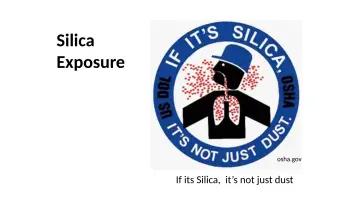
39 slidesSilica Exposure
Short silica exposure deck from the University of Puerto Rico; fits the 30-minute Health Hazards block.
University of Puerto RicoOSHA Harwood grant