1 / 18Use ← → to flip
Respiratory Protection
Respiratory protection instructor deck from the University of Puerto Rico Medical Sciences Campus.
Slide text
· 18 slides · by University of Puerto Rico Medical Sciences Campus
The words on each slide as the author wrote them, read from the file by software so they can be searched. Layout, pictures and tables are not shown here: the slides above and the download are the original.
- Slide 1
Respiratory Protection
- Trainer’s Guide for the Instructor
- Slide 2
Limitation of Liability
- This training material and the training guide for the instructor was prepared with the federal sponsorship of Susan Harwood Grants, with number SH-05034-SH8 of the Occupational Health and Safety Administration of the United States Department of Labor. The contents of this presentation does not necessarily reflect the point of view or policies of the United States Department of Labor, nor does the mention of trademarks, products or commercial organizations imply endorsement by the Government of the United States of America
- Slide 3
DUTIES AND RESPONIBILITIES
- EMPLOYER
- The Occupational Health and Safety Act requires employers to provide a safe and healthy workplace, free of recognized hazards, and to respect the standards set by OSHA. This includes offering
- training
- and medical
- examinations to their employees, and not retaliating when the employee makes use of the protections of the law
- Trainer Guide for Instructor
- EMPLOYEE
- Obey the Health and Safety regulations imposed by the employer and use all the equipment provided while working.
- Observing your employer's workplace safety practices.
- Report any hazardous conditions to a supervisor.
- Report any dangerous conditions to OSHA, if employers do not rectify it.
- Slide 4
Occupational Safety and Health Law
- Slide 5
OBJECTIVES
- Know the minimum requirements for establishing a Respiratory Protection Program based on the 1910.134 standard.
- Discuss the mandatory sections of Appendix C (medical questionnaire)
- Discussing the difference between a qualitative fit test versus a quantitative fit test
- Discuss the different Assigned Protection Factors (AFPs) according to the corresponding respirator
- Perform respirator selection exercise according to the contaminant presented
- Slide 6
Medical Questionnaire - Appendix C
- A medical evaluation is performed to determine the worker's ability to use a respirator.
- The medical questionnaire may be replaced as long as you obtain the same information as provided in Part A in sections 1 and 2.
- Affirmation of any of the questions provided in Section 2 of Part A may involve follow-up of the medical evaluation, including additional medical evidence.
- Refer to the document contained in the folder.
- Slide 7
Quantitative Fit Test and Qualitative Fit Test
- Slide 8
Show fit testing video
- Slide 9
User Seal Check Procedures
- NEGATIVE PRESSURE CHECK
- POSITIVE PRESSURE CHECK
- Photo credit by: hermandadebomberos.ning.com
- Slide 10
Demonstration of Qualitative Fit Test
- Photo credit by: solutions.3m.com
- Photo credit by: www.seton.ca
- Slide 11
Assigned Protection Factor (APF)
- Refer to the document contained in the folder.
- Slide 12
Estimated a Cartridge’s Service Life
- Reference webpage:
- Slide 13
Demonstration of the cleaning process and respirator maintenance
- Slide 14
Summary -Respiratory Protection Program Requirements
- Select and provide a appropriate respirator for exposed respiratory hazards
- Evaluación medica (Apéndice C)
- Fit Test (Qualitative or Quantitative)
- Storage
- Training
- Program Evaluation
- User seal check procedures
- Cleaning and Maintenance
- Slide 15
Exercise: Respirator selection
- Situation #1
- The work area is an outdoor space used to repair boats. The task consists of painting the hull of the boat using a paint sprayer gun driven by compressed air. Two men are working on this task. One is applying the paint on the boat surface, while the other is walking around the boat and under the paint mist while arranging hoses and other tools.
- The paint used was Micron CSC, which has a reduced solvent base. The Safety Data Sheet (SDS) indicates that the material is considered an irritating and flammable material, which can be toxic to aquatic life.
- Slide 16
Exercise: Respirator selection cont.
- Situation #2
- While cleaning an office space, a janitor discovered a stain on the sides of some boxes and on the adjacent wall. After thorough inspection, the concierge suspects that the stain may be mold. He decided to use a respirator to avoid inhaling mold while cleaning the area. What kind of respirator should be used?
- Photo credit by: https://chicago.suntimes.com/working/mold-toxicity-goes-undiagnosed-for-millions/
- Photo credit by: http://www.healthvermont.gov/health-environment/healthy-homes/mold
- Slide 17
Exercise 3: Respirator selection
- Situation #3
- A construction worker is assigned to cut a portion of a cement block. Among the personal protective equipment provided by the employer, the worker wears a full-face respirator with particulate air filter. He used a cement cutter without guards to perform the task. Will the full-face respirator provide the proper protection required for this task?
- Photo credit by: S Caporali, University of Puerto Rico, Medical
- Sciences Campus
- Slide 18
Instructor:
- Date:
- Location:
- Time:
- Trainer’s Guide for the
More on Health Hazards
pptx
83 slidesCarbon Monoxide & Inhalation Hazards
Carbon monoxide and inhalation hazards on construction sites (gas-powered tools, enclosed spaces) from Western Iowa Tech Community College.
Western Iowa Technical Community CollegeOSHA Harwood grant
pptxes
18 slidesProtección respiratoria
Spanish respiratory protection instructor deck.
University of Puerto Rico Medical Sciences CampusOSHA Harwood grant
pptx
39 slidesSilica Exposure
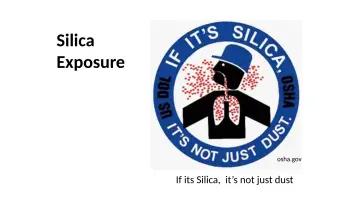
Short silica exposure deck from the University of Puerto Rico; fits the 30-minute Health Hazards block.
University of Puerto RicoOSHA Harwood grant