1 / 32Use ← → to flip
Process Safety Management for Storage Facilities (OSHA 3909)
OSHA booklet, for General Industry classes.
Page text
· 32 pages · by U.S. Department of Labor, OSHA
The words on each page as the author wrote them, read from the file by software so they can be searched. Layout, pictures and tables are not shown here, and long pages are shortened: the pages above and the download are the original.
- Page 1
Process Safety
- Management for Storage Facilities
- OSHA 3909-03 2017
- Page 2
Occupational Safety and Health Act of 1970
- “To assure safe and healthful working conditions for working men and women; by authorizing enforcement of the standards developed under the Act; by assisting and encouraging the States in their efforts to assure safe and healthful working conditions; by providing for research, information, education, and training in the field of occupational safety and health.”
- This guidance document is not a standard or regulation, and it creates no new legal obligations. It contains recommendations as well as descriptions of mandatory safety and health standards. The recommendations are advisory in nature, informational in content, and are intended to assist employers in providing a safe and healthful workplace. The Occupational Safety and Health Act requires employers to comply with safety and health standards and regulations promulgated by OSHA or by a state with an OSHA‑approved state plan. …
- …
- Page 3
Process Safety Management for Storage Facilities
- U.S. Department of Labor
- Occupational Safety and Health Administration
- OSHA 3909-03 2017
- Page 4
Contents
- Purpose … 1
- Applicability … 4
- Employee Participation … 6
- Process Safety Information … 6
- Information on Highly Hazardous Chemicals … 7
- Information on Process Technology … 7
- Information on the Process Equipment … 8
- Process Hazard Analysis (PHA) … 9
- Operating Procedures … 11
- Training … 12
- Mechanical Integrity … 13
- Emergency Planning and Response … 15
- APPENDIX: Misconceptions and
- Frequently Asked Questions … 17
- Workers’ Rights … 21
- OSHA Assistance, Services and Programs … 21
- Establishing a Safety and Health Program … 21
- Compliance Assistance Specialists … 21
- Free On-site Safety and Health Consultation Services for Small Business … 21
- Cooperative Programs … 22
- Occupational Safety and Health Training Courses … 23
- OSHA Educational Materials … 23
- OSHA Regional Offices … 24
- How to Contact OSHA … 27
- Page 5
Purpose
- This document does not cover the entire Process Safety Management (PSM) standard, but only focuses on aspects of the standard particularly relevant to storage facilities. For a full compliance guide to PSM, please refer to OSHA 3132 1 or the full text of the standard at www.osha.gov. 2 Although all elements of the PSM standard apply to a PSM-covered storage facility, the following elements of the standard are most relevant to hazards associated with storage facilities:
- Employee Participation
- Process Safety Information (PSI)
- Process Hazard Analysis
- Operating Procedures
- Training
- Mechanical Integrity (MI)
- Emergency Planning and Response
- PSM is critically important to facilities that store highly hazardous chemicals. Implementing the required safety programs help prevent fires, explosions, large chemical spills, toxic gas releases, runaway chemical reactions, and other major incidents. …
- …
- Page 6
- before the cylinders were cleaned and reused. On the night of the incident, investigators believe, this practice resulted in a cloud of flammable propane gas at the facility, which was ignited by a spark from a forklift operating in the area. The resulting explosions and fires injured several employees—four critically.
- In 2008, a nearly 90-year-old storage tank catastrophically failed and released approximately 2.1 million gallons of liquid fertilizer. The collapsing tank seriously injured two employees, and the chemicals flowed over containment berms. Investigators determined that defective welds likely caused the tank failure, and inspectors condemned another tank at the same facility that presented an “imminent danger” of failure. Major contributing factors were the inadequacy of tank weld inspections and overestimates of the maximum liquid levels that the tank could safely accommodate. …
- …
- Page 7
- years without serious incident. The loading process was equipped with a scrubber, which was designed to control chlorine vapors displaced during trailer filling. On the day of the incident, chlorine vapors overwhelmed the scrubbers’ capacity, and up to 1,920 pounds of chlorine escaped into the air. This incident occurred in a process for which a process hazard analysis had already been conducted. However, investigators found that the process hazard analysis failed to consider the consequences of chlorine gases overloading the scrubbers (CSB, 2007).
- In 1999, a truck driver was killed and an employee injured when a chemical shipment was inadvertently loaded into the wrong tank. Due to this error, incompatible chemicals came into contact, reacted, and released a cloud of toxic gas containing lethal levels of hydrogen sulfide. …
- …
- Page 8
Applicability
- The Process Safety Management standard covers processes which involve a chemical at or above the specified threshold quantity (TQ) listed in Appendix A of the PSM standard 3 , unless another Federal Agency has jurisdiction. 4 The PSM standard is also applicable to processes containing a
- Category 1 flammable gas (as defined in 1910.1200(c)) or a flammable liquid with a flashpoint below 100 °F (37.8 °C) on site in one location, in a quantity of 10,000 pounds (4535.9 kg) or more. A “process” is defined by OSHA in the PSM standard as “any activity involving a highly hazardous chemical including any use, storage, manufacturing, handling, or the on-site movement of such chemicals, or combination of these activities.” 5 The standard also states that any group of vessels which are interconnected and separate vessels that are located such that a highly hazardous chemical could be involved in a potential release, shall…
- …
- Page 9
Oil or gas well drilling or servicing operations 6
- Normally unoccupied remote facilities 7
- All storage facilities that do not fit under one of these exemptions should determine whether they fall under the OSHA PSM standard and comply with the standard if they do.
- Storage facilities typically have considerably less complex process safety issues than facilities with large chemical manufacturing operations, which may make compliance easier and less costly. Some organizations and trade associations provide PSM compliance resources for their members. Those that may address storage activities include, but are not limited to:
- Insurance companies
- Local fire officials
- National Association of Chemical Distributors (NACD)
- Center for Chemical Process Safety (CCPS)
- Agricultural Retailers Association (ARA)
- American Chemistry Council (ACC)
- Society of Chemical Manufacturers and Affiliates (SOCMA)
- American Petroleum Institute (API)
- …
- Page 10
Employee Participation
- Consultants from state agencies or universities work with employers to identify workplace hazards, provide advice on compliance with OSHA standards, and assist in establishing and improving safety and health programs. To locate the OSHA On-site Consultation Program nearest you, call 1-800- 321-6742 (OSHA) or visit www.osha.gov/consultation.
- Although all elements of the PSM standard apply to a PSM‑covered storage facility, the following elements of the PSM standard are particularly relevant to hazards associated with storage facilities:
- Employees with experience in hazard identification and prevention are vital to workplace safety. Workplace safety is taken seriously if employees are committed to following health and safety procedures and have a sincere interest in developing them.
- The PSM standard requires that employers covered under the standard:
- …
- Page 11
Information on Highly Hazardous Chemicals
- involved in their processes. Process safety information must include information on the hazards of the highly hazardous chemicals used or produced by the process, information on the technology of the process, and information on the equipment used in the process. Process safety information for the storage of highly hazardous chemicals will usually be considerably less extensive than that required for the manufacture or use of such chemicals.
- For every highly hazardous chemical, PSM requires that employers compile information on chemical toxicity, permissible exposure limits, physical data, reactivity data, corrosivity data, thermal and chemical stability data, and hazardous effects associated with inadvertent mixing of chemicals that may occur. …
- …
- Page 12
Information on the Process Equipment
- Process technology information must include:
- Diagrams (Block, Process Flow) – an example of which is shown in non-mandatory Appendix B of the PSM standard,
- Maximum inventory levels for all chemicals in the PSMcovered process,
- Safe upper and lower process limits for such items as temperatures, pressures, flows or compositions, and
- An evaluation of the consequences of deviation, including those affecting the safety and health of employees, that could occur if operating beyond the established process limits.
- Many storage facilities may have minimal process equipment. Nevertheless, facilities must collect information on equipment that is part of the PSM-covered process. Typical equipment may include: storage tanks, piping, pumps, containers, pressure relief systems, dikes, ventilation equipment, alarms, controls, process safeguards and monitoring equipment.
- …
- Page 13
- RAGAGEP requirements and identifying potential sources of RAGAGEP. In all cases, the RAGAGEP must be both “recognized and generally accepted” and “good engineering practices”.
- In addition, depending on the classification of the stored contents, storage tanks may bear a marking identifying compliance with the appropriate codes or standards under which the container is constructed, such as the ASME Boiler and Pressure Vessel Code. Other markings may also be required by the National Board of Boiler and Pressure Vessel Inspectors. Typical information on storage tanks may include this information as well as manufacturer name, installation date, materials of construction (to ensure compatibility with the commodity being stored), pressure rating, wall thickness and volume. …
- …
- Page 14
- The team analyzes potential causes and consequences of fires, explosions, releases of toxic or flammable chemicals, and major spills of hazardous chemicals. The team conducting the PHA must make recommendations for additional safeguards to adequately control identified hazards or to mitigate their effects. Safeguards may include inherently safer or passive approaches to hazard control, or suggesting new engineering controls (e.g., improved fire detection and suppression systems at facilities that store heat-sensitive chemicals) or administrative controls (e.g., new operating procedures, inventory control measures, separation of highly hazardous chemicals into different storage areas).
- Employers that operate more than one storage facility with identical equipment and processes may be able to develop just one hazard analysis and then customize it based on the specific hazards present at each facility.
- …
- Page 15
Operating Procedures
- The PSM standard allows PHAs to be conducted by many different methodologies, enabling facilities to address their unique process safety challenges in a manner that is most appropriate and cost-effective for them. Typically, storage facilities should be able to use less sophisticated techniques such as What-if, Checklists, or a combination of accepted methods. Additional guidance can be found on OSHA’s Hazard Identification and Assessment, and Hazard Prevention and Control webpages. 11, 12
- Employers are required to develop and implement written operating procedures that provide clear instructions for safely conducting activities involved in each covered process consistent with the process safety information. Operating procedures must cover not only normal operations, but also other situations such as startup, temporary operations, and emergency shutdown. …
- …
- Page 16
- Although storage facilities typically have relatively few procedures, when highly hazardous chemicals are involved, it is still critically important that these procedures are thorough, clear, and communicated effectively to employees. Operating procedures must be covered in training courses for employees involved in the process and reviewed during mandatory three-year PSM compliance audits. Employers must ensure that employees both understand and routinely follow the procedures.
- Examples of storage facility operating procedures include:
- Container transfer/storage procedures – including proper handling of the container to avoid loss of containment; appropriate locations for stored chemicals; and signs of damaged storage containers
- Storage tank loading/unloading procedures – including proper connection/valve operating sequence, maximum intended inventory, maximum intended pressure, and receiving documentation procedures
- …
- Page 17
- Depending on the facility, training required for employees at storage facilities may include instructions on how employees handle storage containers, including proper operation and correct grounding during storage and transfer. For instance, even though some containers may be small and may appear non-threatening, it is important to inform workers of the dangers of the chemicals they contain. Storage facility training must also focus on any administrative rules followed in the facility, such as designation of hazard areas, temporary access locations, and designated smoking areas. Training must also include loss of containment scenarios. Some chemical releases at storage facilities may appear small and seemingly not highly dangerous, but employees need to be trained to recognize the dangers posed by even small releases and how to appropriately respond to them. …
- …
- Page 18
- A starting point for creating a mechanical integrity program is listing all equipment, instruments, and components that need to be considered. In many cases, the equipment that is part of the MI program will have inspection and testing recommendations from the manufacturer. If the covered equipment does not have any MI related manufacturers recommendations, then employers should look for applicable codes/standards or industry best practices. Inspections and tests must follow Recognized and Generally Accepted Good Engineering Practices (RAGAGEP), and inspection and test frequency must be consistent with manufacturer’s recommendations and good engineering practices, or more frequently if indicated by operating experience. If employers and employees are unfamiliar with these RAGAGEP references, they should consult with others as needed to understand the RAGAGEP. …
- …
- Page 19
Emergency Planning and Response
- limits. The MOC procedure must include a determination of the safety and health impacts of continued operation of the deficient equipment.
- The final element of mechanical integrity programs is quality assurance. PSM-covered facilities must ensure that equipment for newly constructed operations is suitable for the intended application and that equipment in existing processes is properly installed and consistent with design specifications. Quality assurance requirements also apply to maintenance materials and spare parts to ensure compatibility with the equipment and the process.
- The PSM emergency planning and response requirements largely refer to other OSHA standards, particularly the Emergency Action Plan standard 13 which requires an emergency action plan, employee alarm system, employee training on the plan, and provisions for reviewing the plan; employers may also be covered under the…
- …
- Page 20
- Storage tanks must be properly labeled with their contents as required by OSHA’s Hazard Communication standard (29 CFR 1910.1200). This enables first-responders to recognize the hazards of stored commodities and implement appropriate emergency actions. While not required, OSHA recommends that facilities keep track of the location of portable containers of highly hazardous chemicals so that emergency responders can be accurately directed to their location in the event of an incident. In order to facilitate a successful response effort, OSHA encourages facilities to coordinate with their local emergency responders and to perform practice drills whenever possible.
- Storage facilities with PSM-covered processes should also ensure that contractors and visitors who may be present at the storage facility understand how to respond during emergencies. …
- …
- Page 21
APPENDIX: Misconceptions and Frequently Asked Questions
- This appendix documents many PSM-related questions that storage facilities commonly ask of OSHA. These questions are meant to provide storage facility owners with responses that will help with PSM compliance.
- “A major incident will not occur at a facility that only stores hazardous chemicals…” The mere presence of large quantities of highly hazardous chemicals at storage facilities creates a risk of a catastrophic incident. There are many examples of incidents where stored chemicals have leaked, decomposed, polymerized, combusted, or exploded. With a proper PSM program in place, employers at storage facilities can fully evaluate hazards and implement measures that prevent lifethreatening incidents.
- “Aren’t PSM programs extremely expensive for storage facilities?” PSM compliance costs are directly related to the complexity of the covered processes. …
- …
- Page 22
- for most of the case studies referenced in this guidance, the facilities in question had no previous records of major incidents. Employers should be aware of the dangers of operating on a false sense of security based on an incidentfree past. Maintaining a sense of vulnerability is essential to ensuring that process hazards are adequately controlled.
- “My facility already has effective safety programs…” Many facilities that store highly hazardous chemicals may already have safety programs that address specific issues, like confined space entry, hot work, emergency response, and fire protection. Some facilities might also have specialized safety programs recommended by their insurance underwriters. While these programs address certain hazards associated with storing and handling highly hazardous chemicals, they may not provide the comprehensive safety assessment required under PSM. …
- …
- Page 23
- “Can employers use consultants to develop PSM programs?” Yes. Many employers originally implemented and continue to run their PSM programs entirely on their own. Others seek outside assistance, typically by hiring consultants. This is not uncommon for businesses run by managers with limited or no engineering background. Either approach is acceptable, provided the PSM program focuses on and comprehensively addresses the facility-specific hazards, equipment, and operating procedures—and is not based on generic checklists, boilerplate language, or other resources that do not focus on the facility’s hazards. However, keep in mind that ultimately the employer is responsible for PSM compliance!
- “Must employers inform OSHA if the standard applies to them?” No. Unlike various other environmental, health, and safety regulations, the PSM standard does not have notification or reporting requirements. …
- …
- Page 24
- highly hazardous chemicals and isolating stored quantities in distinct facility areas are acceptable risk reduction strategies. Employers at storage facilities may therefore choose to safely alter their storage practices to reduce chemical risks—and fall below PSM applicability criteria—instead of complying with PSM. However, such facilities must still comply with other applicable OSHA standards and section (5)(a)(1) of the OSH Act, the “General Duty Clause” (which requires that employers provide workplaces free from recognized hazards that are likely to cause death or serious physical harm).
- “Who should I contact for any other questions about PSM applicability? “ Employers who have read the requirements of the standard and still have questions about whether the standard applies to their processes should either:
- Contact a local OSHA area office. Refer to OSHA’s website (www.osha.gov/html/RAmap.html) for locations and…
- …
- Page 25
Workers’ Rights
- Under federal law, workers are entitled to working conditions that do not pose a risk of serious harm.
- For more information on how to assure a safe and healthful workplace, see OSHA’s Workers page.
- OSHA Assistance, Services and Programs
- OSHA has a great deal of information to assist employers in complying with their responsibilities under OSHA law. Several OSHA programs and services can help employers identify and correct job hazards, as well as improve their safety and health program.
- Establishing a Safety and Health Program
- Safety and health programs are systems that can substantially reduce the number and severity of workplace injuries and illnesses, while reducing costs to employers.
- Visit www.osha.gov/shpguidelines for more information.
- Compliance Assistance Specialists
- OSHA Compliance assistance specialists can provide information to employers and workers about OSHA standards, short educational programs…
- …
- Page 26
Cooperative Programs
- For more information or to find the local On-site Consultation office in your state, visit www.osha.gov/consultation, or call 1-800-321-OSHA (6742).
- Under the consultation program, certain exemplary employers may request participation in OSHA’s Safety and Health Achievement Recognition Program (SHARP). Worksites that receive SHARP recognition are exempt from programmed inspections during the period that the SHARP certification is valid.
- OSHA offers cooperative programs under which businesses, labor groups and other organizations can work cooperatively with OSHA. To find out more about any of the following programs, visit www.osha.gov/cooperativeprograms.
- Strategic Partnerships and Alliances
- The OSHA Strategic Partnerships (OSP) provide the opportunity for OSHA to partner with employers, workers, professional or trade associations, labor organizations, and/or other interested stakeholders. …
- …
- Page 27
Occupational Safety and Health Training Courses
- The OSHA Training Institute partners with 27 OSHA Training Institute Education Centers at 42 locations throughout the United States to deliver courses on OSHA standards and occupational safety and health topics to thousands of students a year. For more information on training courses, visit www.osha.gov/otiec.
- OSHA Educational Materials
- OSHA has many types of educational materials to assist employers and workers in finding and preventing workplace hazards.
- All OSHA publications are free at www.osha.gov/publications and www.osha.gov/ebooks. You can also call 1-800-321-OSHA (6742) to order publications.
- Employers and safety and health professionals can sign-up for QuickTakes, OSHA’s free, twice-monthly online newsletter with the latest news about OSHA initiatives and products to assist in finding and preventing workplace hazards. To sign up visit www.osha.gov/quicktakes.
- Page 28
OSHA Regional Offices
- Region I
- Boston Regional Office
- (CT*, ME, MA, NH, RI, VT*)
- JFK Federal Building, Room E340 Boston, MA 02203
- (617) 565-9860 (617) 565-9827 Fax
- Region II
- New York Regional Office
- (NJ*, NY*, PR*, VI*)
- 201 Varick Street, Room 670
- New York, NY 10014
- (212) 337-2378 (212) 337-2371 Fax
- Region III
- Philadelphia Regional Office
- (DE, DC, MD*, PA, VA*, WV)
- The Curtis Center
- 170 S. Independence Mall West
- Suite 740 West
- Philadelphia, PA 19106-3309
- (215) 861-4900 (215) 861-4904 Fax
- Region IV
- Atlanta Regional Office
- (AL, FL, GA, KY*, MS, NC*, SC*, TN*) 61 Forsyth Street, SW, Room 6T50
- Atlanta, GA 30303
- (678) 237-0400 (678) 237-0447 Fax
- Region V
- Chicago Regional Office
- (IL*, IN*, MI*, MN*, OH, WI)
- 230 South Dearborn Street
- Room 3244
- Chicago, IL 60604
- (312) 353-2220 (312) 353-7774 Fax
- Page 29
Region VI
- Dallas Regional Office
- (AR, LA, NM*, OK, TX)
- 525 Griffin Street, Room 602
- Dallas, TX 75202
- (972) 850-4145 (972) 850-4149 Fax
- (972) 850-4150 FSO Fax
- Region VII
- Kansas City Regional Office
- (IA*, KS, MO, NE)
- Two Pershing Square Building
- 2300 Main Street, Suite 1010
- Kansas City, MO 64108-2416
- (816) 283-8745 (816) 283-0547 Fax
- Region VIII
- Denver Regional Office
- (CO, MT, ND, SD, UT*, WY*)
- Cesar Chavez Memorial Building
- 1244 Speer Boulevard, Suite 551
- Denver, CO 80204
- (720) 264-6550 (720) 264-6585 Fax
- Region IX
- San Francisco Regional Office
- (AZ*, CA*, HI*, NV*, and American Samoa, Guam and the Northern Mariana Islands) 90 7th Street, Suite 18100
- San Francisco, CA 94103
- (415) 625-2547 (415) 625-2534 Fax
- Region X
- Seattle Regional Office
- (AK*, ID, OR*, WA*)
- 300 Fifth Avenue, Suite 1280
- Seattle, WA 98104
- (206) 757-6700 (206) 757-6705 Fax
- Page 30
- These states and territories operate their own OSHAapproved job safety and health plans and cover state and local government employees as well as private sector employees. The Connecticut, Illinois, New Jersey, New York and Virgin Islands programs cover public employees only. (Private sector workers in these states are covered by Federal OSHA). States with approved programs must have standards that are identical to, or at least as effective as, the Federal OSHA standards.
- Note: To get contact information for OSHA area offices, OSHAapproved state plans and OSHA consultation projects, please visit us online at www.osha.gov or call us at 1-800-321-OSHA (6742).
- Page 31
How to Contact OSHA
- For questions or to get information or advice, to report an emergency, fatality, inpatient hospitalization, amputation, or loss of an eye, or to file a confidential complaint, contact your nearest OSHA office, visit www.osha.gov or call OSHA at 1-800-321-OSHA (6742), TTY 1-877-889-5627.
- For assistance, contact us. We are OSHA. We can help.
- Page 32
U.S. Department of Labor
- For more information:
- Occupational Safety and Health Administration www.osha.gov (800) 321-OSHA (6742)
More on HazMat
pptx
49 slidesHazardous Materials (OSHA 10-Hour General Industry Outreach)
OSHA's own 10-hour General Industry Outreach deck on hazardous materials (v. 03-01-17), editable PowerPoint with trainer notes.
U.S. Department of Labor, OSHA (with the OTIEC Outreach Workgroup)Public domain
pdf
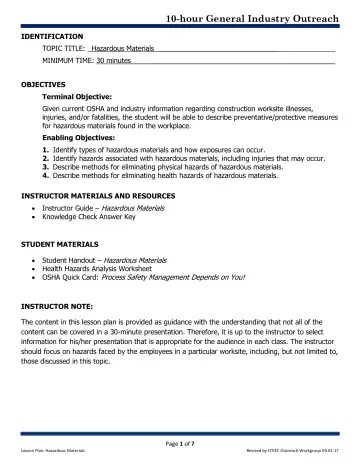
7 slidesHazardous Materials: Lesson Plan (OSHA 10-Hour General Industry Outreach)
Instructor lesson plan (objectives, timing, teaching steps) for the OSHA General Industry hazardous materials outreach deck.
U.S. Department of Labor, OSHA (with the OTIEC Outreach Workgroup)Public domain
pdf
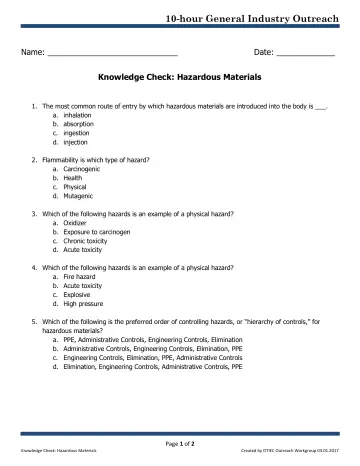
2 slidesHazardous Materials: Knowledge Check (OSHA 10-Hour General Industry Outreach)
Student knowledge-check quiz for the OSHA General Industry hazardous materials outreach deck.
U.S. Department of Labor, OSHA (with the OTIEC Outreach Workgroup)Public domain