Skip to content
Hazardous Materials: Knowledge Check (OSHA 10-Hour General Industry Outreach), page 1: 10-hour General Industry Outreach
1 / 2

Hazardous Materials: Knowledge Check (OSHA 10-Hour General Industry Outreach)

Student knowledge-check quiz for the OSHA General Industry hazardous materials outreach deck.

Page text

· 2 pages · by U.S. Department of Labor, OSHA (with the OTIEC Outreach Workgroup)

The words on each page as the author wrote them, read from the file by software so they can be searched. Layout, pictures and tables are not shown here: the pages above and the download are the original.

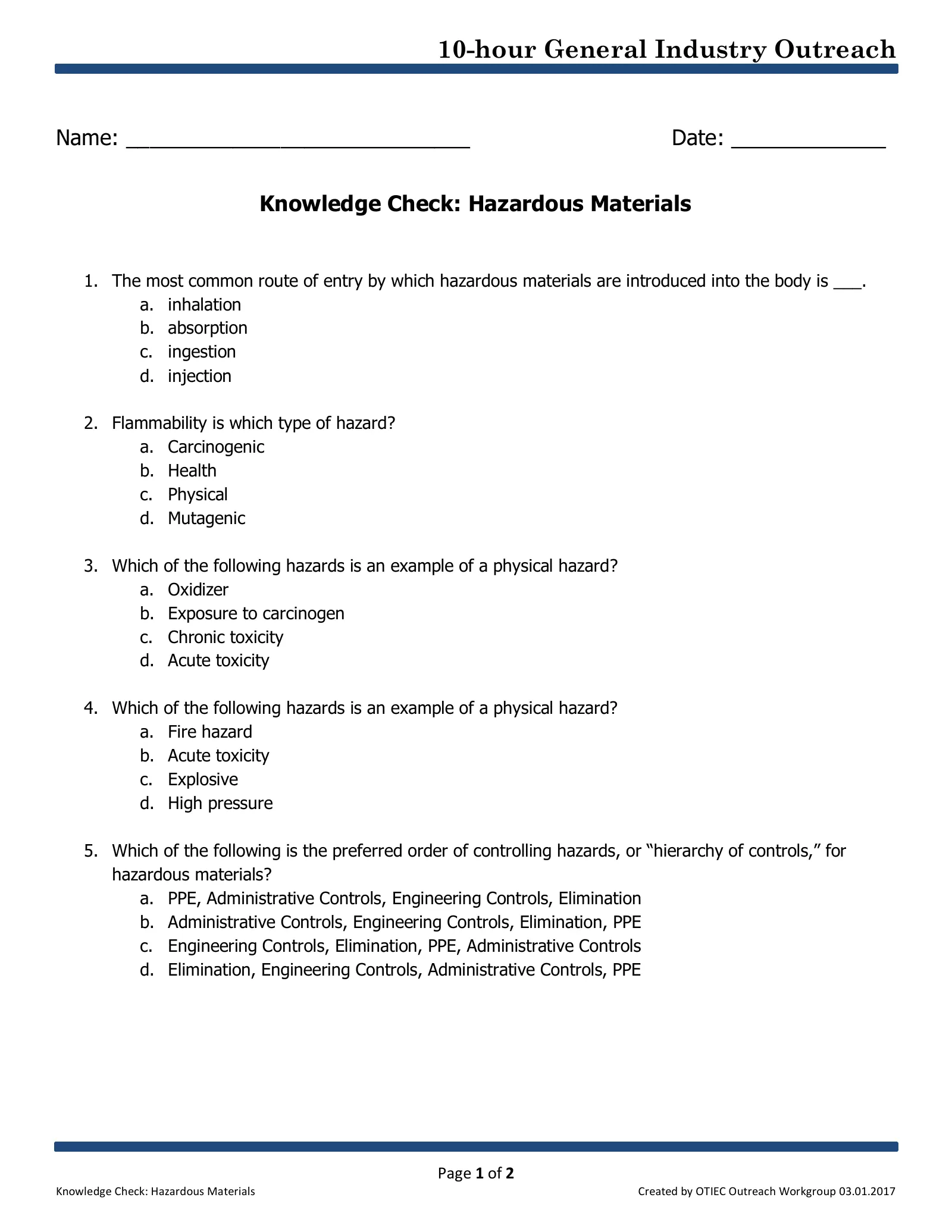
  1. Page 1

    10-hour General Industry Outreach

    • Name: ___
    • Date: ___
    • Knowledge Check: Hazardous Materials
    • 1. The most common route of entry by which hazardous materials are introduced into the body is ___.
    • a. inhalation
    • b. absorption
    • c. ingestion
    • d. injection
    • 2. Flammability is which type of hazard?
    • a. Carcinogenic
    • b. Health
    • c. Physical
    • d. Mutagenic
    • 3. Which of the following hazards is an example of a physical hazard?
    • a. Oxidizer
    • b. Exposure to carcinogen
    • c. Chronic toxicity
    • d. Acute toxicity
    • 4. Which of the following hazards is an example of a physical hazard?
    • a. Fire hazard
    • b. Acute toxicity
    • c. Explosive
    • d. High pressure
    • 5. Which of the following is the preferred order of controlling hazards, or “hierarchy of controls,” for hazardous materials?
    • a. PPE, Administrative Controls, Engineering Controls, Elimination
    • b. Administrative Controls, Engineering Controls, Elimination, PPE
    • c. Engineering Controls, Elimination, PPE, Administrative Controls
    • d. Elimination, Engineering Controls, Administrative Controls, PPE
    • Created by OTIEC Outreach Workgroup 03.01.2017
  2. Page 2

    10-hour General Industry Outreach

    • 6. When transferring a flammable liquid from one container t o another, the containers should be ___ to prevent static electricity from creating a fire hazard.
    • a. ventilated or pressurized
    • b. ventilated and pressurized
    • c. bonded or grounded
    • d. bonded and grounded
    • 7. Which of the following hazard controls is an example of an engineering control?
    • a. Enclosing an operation to prevent contact with the hazardous material
    • b. Training employees on the proper handling and storage of a hazardous material
    • c. Implementing a procedure for the proper use of a hazardous material
    • d. Requiring personal protective equipment to be worn when working with a hazardous material
    • Knowledge Check: Hazardous Materials
    • Created by OTIEC Outreach Workgroup 03.01.2017

More on HazMat

Esc