1 / 49Use ← → to flip
Hazardous Materials (OSHA 10-Hour General Industry Outreach)
OSHA's own 10-hour General Industry Outreach deck on hazardous materials (v. 03-01-17), editable PowerPoint with trainer notes.
Slide text
· 49 slides · by U.S. Department of Labor, OSHA (with the OTIEC Outreach Workgroup)
The words on each slide as the author wrote them, read from the file by software so they can be searched. Layout, pictures and tables are not shown here: the slides above and the download are the original.
- Slide 1
Hazardous Materials
- OSHA 10-hour Outreach Training
- General Industry
- Slide 2
Introduction
- Lesson objectives:
- 1. Identify types of hazardous materials and how exposures can occur.
- 2. Identify hazards associated with hazardous materials, including injuries that may occur.
- 3. Describe methods for eliminating physical hazards of hazardous materials.
- 4. Describe methods for eliminating health hazards of hazardous materials.
- Slide 3
What’s in it for you?
- Source: Construction Safety Council, used with permission.
- Slide 4
Exposure to Hazardous Materials
- What are hazardous materials?
- Group of products for which the storage, handling, and use are regulated under the Hazardous Materials standard
- Primarily associated with physical hazard
- May also pose health hazard
- Slide 5
Exposure to Hazardous Materials
- Examples of worksite exposure:
- Operations involving the storage, handling, and/or use of:
- Compressed gases
- Liquefied gases – anhydrous ammonia, chlorine, propane, nitrous oxide, and carbon dioxide
- Non-liquefied gases – oxygen, nitrogen, helium, and argon
- Dissolved gases - acetylene
- Slide 6
Exposure to Hazardous Materials
- Flammable liquids
- Category 1 – ethyl ether, isopentane, propylene oxide
- Category 2 – acetone, benzene, ethyl alcohol, gasoline isopropyl alcohol, toluene
- Category 3 – naphtha, turpentine, xylene
- Category 4 – ethylene glycol, glycerine
- Cryogenics and refrigerated liquids – oxygen,
- nitrogen, argon, hydrogen, helium LNG, Liquid methane, carbon monoxide
- Liquefied petroleum gases (LPGs) – propane,
- propylene, butane, and butylene
- Explosives and blasting agents
- Slide 7
Exposure to Hazardous Materials
- Spray finishing operations
- Dipping and coating operations
- Processing of highly hazardous chemicals
- Clean-up and management of hazardous waste operations and emergency response
- Source: OSHA; courtesy of U.S. Air Force
- Source: FEMA; S. Shapira
- Slide 8
Exposure to Hazardous Materials
- Additional precautions for hazard exposures:
- Hazardous (classified) locations
- Confined spaces
- Source: OSHA
- Slide 9
Exposure to Hazardous Materials
- Routes of entry:
- Inhalation*
- Ingestion
- Absorption
- Injection
- Most Common
- Source: Construction Safety Council, used with permission.
- Slide 10
Hazards of Hazardous Materials
- Types of physical hazards associated with hazardous materials:
- Oxidizer
- Flammable
- Explosion
- Corrosive to metal
- High-pressure systems
- Source of pictograms: OSHA
- Slide 11
Hazards of Hazardous Materials
- Types of health hazards associated with hazardous materials:
- Acute/chronic toxicity
- Skin corrosion or irritation
- Aspiration hazard
- Serious eye damage or eye irritation
- Respiratory or skin sensitization
- Germ cell mutagenicity
- Carcinogenicity
- Reproductive toxicity
- Specific target organ toxicity
- Source of pictograms: OSHA
- Slide 12
Hazards of Hazardous Materials
- Compressed gases:
- Oxygen displacement
- Fires
- Explosion
- Toxic gas exposures
- Physical hazards associated with high pressure systems
- Source: OSHA
- Slide 13
Hazards of Hazardous Materials
- Cryogenic and refrigerated liquids:
- Extreme cold
- Extreme pressure
- Asphyxiation
- Fire or explosion
- Source: OSHA
- Slide 14
Hazards of Hazardous Materials
- Flammable liquids:
- Fire
- Explosion
- Source: OSHA
- Criteria for Flammable Liquids
- Category
- 29 CFR 1910.1200 Appendix B, B.6.2
- Criteria
- Flashpoint < 73.4°F and initial boiling point ≤
- 95°F
- Flashpoint < 73.4°F and initial boiling point > 95°F
- Flashpoint ≥ 73.4°F and ≤ 140°F
- Flashpoint > 140°F and ≤ 199.4°F
- Slide 15
Hazards of Hazardous Materials
- Spray finishing:
- Flammable/combustible materials
- Health hazards
- Example: Isocyanates
- Powerful irritant to eyes and gastrointestinal and respiratory tracts
- Inflammation to skin
- Source of photos: NIOSH
- Slide 16
Hazards of Hazardous Materials
- Liquefied petroleum gases (LPG):
- Pictograms:
- Signal word: Danger
- Hazard statements:
- Extremely flammable gas.
- Contains gas under pressure; may explode if heated.
- May cause frostbite.
- May form explosive mixtures in air.
- May displace oxygen and cause rapid suffocation.
- Source: OSHA
- Slide 17
Hazards of Hazardous Materials
- Anhydrous ammonia:
- Pictograms:
- Signal word: Danger
- Hazard statements
- Flammable Gas
- Contains gas under pressure
- May explode if heated
- Toxic if inhaled
- Causes severe skin burns and eye damage
- Corrosive to respiratory tract
- Source of photos: OSHA
- Slide 18
Hazards of Hazardous Materials
- Hazardous (classified) locations:
- Class I – flammable gases or vapors
- Class II – combustible dust
- Division 1 Division 2
- Class III – ignitable fibers or flyings
- Slide 19
Hazards of Hazardous Materials
- Confined spaces:
- Limited or restricted means for entry/exit; not designed for continuous occupancy
- PRCS contains or has potential to contain hazardous atmospheres
- Source of photos: OSHA
- Slide 20
Controlling Physical Hazards
- Source: NIOSH
- Slide 21
Controlling Physical Hazards
- Compressed gases:
- Compressed gas cylinders shall be in a safe condition to the extent that this can be determined by visual inspection.
- Source of graphics: OSHA
- Slide 22
Controlling Physical Hazards
- Safety can:
- Not more than
- 5 gallons capacity
- Spring-closing lid
- Designed to relieve internal pressure when subjected to fire.
- Source of photos: OSHA
- Slide 23
Controlling Physical Hazards
- Cabinets:
- Not more than 60 gallons
- of Category 1, 2, or 3 flammable liquids, nor more than 120 gallons of Category 4 flammable liquids.
- Suitable fire control devices shall be available at locations where flammable liquids are stored.
- Source of photos: OSHA
- Slide 24
Controlling Physical Hazards
- Ventilation:
- Category 1 or 2 flammable liquids, or Category 3 flammable liquids with a flashpoint below 100 °F (37.8 °C), shall be ventilated at a rate of not less than 1 cubic foot per minute per square foot of solid floor area.
- Slide 25
Controlling Physical Hazards
- Explosion-proof apparatus:
- Apparatus enclosed in a case that is capable of withstanding an explosion of a specified gas or vapor that may occur within it and of preventing the ignition of a specified gas or vapor surrounding the enclosure by sparks, flashes or explosion of the gas or vapor within, and that operates at such an external temperature that it will not ignite a surrounding flammable atmosphere.
- Slide 26
Controlling Physical Hazards
- Grounding:
- Category 1 or 2 flammable liquids, or Category 3 flammable liquids with a flashpoint below 100 °F (37.8 °C), shall not be dispensed into containers unless the nozzle and container are electrically interconnected.
- Source of graphics: OSHA
- Slide 27
Controlling Physical Hazards
- Intrinsically safe:
- An apparatus/equipment in which all the circuits in which any spark or thermal effect is incapable of causing ignition of a mixture of flammable or combustible material in air.
- Slide 28
Controlling Health Hazards
- Source: NIOSH
- Slide 29
Controlling Health Hazards
- Source: OSHA
- Slide 30
Controlling Health Hazards
- Source: NIOSH
- Slide 31
Controlling Health Hazards
- Source: NIOSH
- Slide 32
Controlling Health Hazards
- Source: NIOSH
- Slide 33
Controlling Health Hazards
- Process Safety Management (PSM) of highly hazardous chemicals:
- Regulations designed to prevent the release of toxic, reactive, flammable and/or explosive chemicals.
- Contains a list and threshold limits for when employers must comply.
- Anhydrous Ammonia - 10,000 lbs
- Chlorine - 1,500 lbs
- Slide 34
Controlling Health Hazards
- Hazardous Waste Operations and Emergency Response (HAZWOPER):
- Applies to employers and their employees who are exposed to hazardous substances and who are engaged in several operations including clean-up, treatment, storage and disposal of hazardous waste.
- Slide 35
Hazardous Materials Worksheet
- Complete the Worksheet
- Slide 36
Hazardous Materials Worksheet
- Hazard Anticipation
- Source: Construction Safety Council, used with permission.
- Slide 37
Hazardous Materials Worksheet
- Hazards Identification
- Source: Construction Safety Council, used with permission.
- Slide 38
Hazardous Materials Worksheet
- Hazards Evaluation
- Source: Construction Safety Council, used with permission.
- Slide 39
Hazardous Materials Worksheet
- Hazards Controls - Engineering
- Source: Construction Safety Council, used with permission.
- Slide 40
Hazardous Materials Worksheet
- Hazards Controls - Administrative
- Source: Construction Safety Council, used with permission.
- Slide 41
Hazardous Materials Worksheet
- Hazards Controls - PPE
- Source: Construction Safety Council, used with permission.
- Slide 42
Summary
- Stop health hazards before they stop you!
- Source: Construction Safety Council, used with permission.
- Slide 43
Knowledge Check
- 1. The most common route of entry by which hazardous materials are introduced into the body is ___.
- a. inhalation
- b. absorption
- c. ingestion
- d. injection
- Answer: a. inhalation
- Slide 44
Knowledge Check
- 2. Flammability is which type of hazard?
- a. Carcinogenic
- b. Health
- c. Physical
- d. Mutagenic
- Answer: c. Physical
- Slide 45
Knowledge Check
- 3. Which of the following hazards is an example of a physical hazard?
- a. Oxidizer
- b. Exposure to carcinogen
- c. Chronic toxicity
- d. Acute toxicity
- Answer: a. Oxidizer
- Slide 46
Knowledge Check
- 4. Which of the following hazards is an example of a health hazard?
- a. Fire hazard
- b. Acute toxicity
- c. Explosive
- d. High pressure
- Answer: b. Acute toxicity
- Slide 47
Knowledge Check
- 5. Which of the following is the preferred order of controlling hazards, or “hierarchy of controls,” for hazardous materials?
- a. PPE, Administrative Controls, Engineering Controls, Elimination
- b. Administrative Controls, Engineering Controls, Elimination, PPE
- c. Engineering Controls, Elimination, PPE, Administrative Controls
- d. Elimination, Engineering Controls, Administrative Controls, PPE
- Answer: d. Elimination, Engineering Controls, Administrative Controls, PPE
- Slide 48
Knowledge Check
- 6. When transferring a flammable liquid from one container to another, the containers should be ___ to prevent static electricity from creating a fire hazard.
- a. ventilated or pressurized
- b. ventilated and pressurized
- c. bonded or grounded
- d. bonded and grounded
- Answer: d. bonded and grounded
- Slide 49
Knowledge Check
- 7. Which of the following hazard controls is an example of an engineering control?
- a. Enclosing an operation to prevent contact with the hazardous material
- b. Training employees on the proper handling and storage of a hazardous material
- c. Implementing a procedure for the proper use of a hazardous material
- d. Requiring personal protective equipment to be worn when working with a hazardous material
- Answer: a. Enclosing an operation to prevent contact with the hazardous material
More on HazMat
pdf
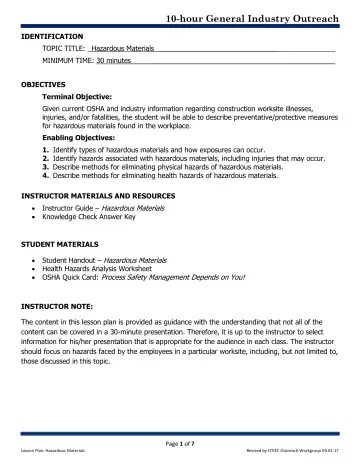
7 slidesHazardous Materials: Lesson Plan (OSHA 10-Hour General Industry Outreach)
Instructor lesson plan (objectives, timing, teaching steps) for the OSHA General Industry hazardous materials outreach deck.
U.S. Department of Labor, OSHA (with the OTIEC Outreach Workgroup)Public domain
pdf
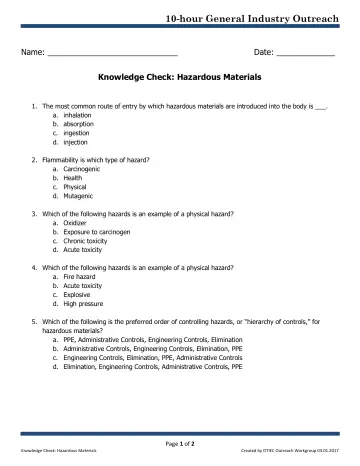
2 slidesHazardous Materials: Knowledge Check (OSHA 10-Hour General Industry Outreach)
Student knowledge-check quiz for the OSHA General Industry hazardous materials outreach deck.
U.S. Department of Labor, OSHA (with the OTIEC Outreach Workgroup)Public domain
pdfes
49 slidesMateriales peligrosos (Capacitación de Extensión de 10 horas de OSHA, Industria General)
Spanish edition of OSHA's 10-hour General Industry Outreach deck on hazardous materials (PDF slides; OSHA does not publish an editable Spanish PowerPoint).
U.S. Department of Labor, OSHA (with the OTIEC Outreach Workgroup)Public domain