1 / 7Use ← → to flip
Hazardous Materials: Lesson Plan (OSHA 10-Hour General Industry Outreach)
Instructor lesson plan (objectives, timing, teaching steps) for the OSHA General Industry hazardous materials outreach deck.
Page text
· 7 pages · by U.S. Department of Labor, OSHA (with the OTIEC Outreach Workgroup)
The words on each page as the author wrote them, read from the file by software so they can be searched. Layout, pictures and tables are not shown here: the pages above and the download are the original.
- Page 1
IDENTIFICATION
- TOPIC TITLE: _Hazardous Materials___
- MINIMUM TIME: 30 mi nutes___
- OBJECTIVES
- Terminal Objective:
- Given current OSHA and industry information regarding construction worksite illnesses, injuries, and/or fatalities, the student will be able to describe preventative/protective measures for hazardous materials found in the workplace.
- Enabling Objectives:
- 1. Identify types of hazardous materials and how exposures can occur.
- 2. Identify hazards associated with hazardous materials, including injuries that may occur.
- 3. Describe methods for eliminating physical hazards of hazardous materials.
- 4. Describe methods for eliminating health hazards of hazardous materials.
- INSTRUCTOR MATERIALS AND RESOURCES
- Instructor Guide – Hazardous Materials
- Knowledge Check Answer Key
- STUDENT MATERIALS
- Student Handout – Hazardous Materials
- Health Hazards Analysis Worksheet
- OSHA Quick Card: Process Safety Management Depends on You!
- INSTRUCTOR NOTE:
- The content in this lesson plan is provided as guidance with the understanding that not all of the content can be covered in a 30-minute presentation. Therefore, it is up to the instructor to select information for his/her presentation that is appropriate for the audience in each class. The instructor should focus on hazards faced by the employees in a particular worksite, including, but not limited to, those discussed in this topic.
- Page 2
TEACHING PROCEDURES ---Preparation, Presentation, Application, Evaluation
- Anticipatory Set (Focus Attention/Gain Interest)
- Estimated Time: 5 minutes
- Key Points
- Methods
- Review lesson objectives.
- Instructor-led discussion
- What’s in it for you?
- PPT slides # 1 - #3
- Workers may potentially be exposed to hazardous material hazards while on the job. The associated health hazards may cause sickness, illness, or even death; physical hazards may result in fire, explosions and the release of other dangerous energies. Also remember, exposure to health hazards may not be limited to just the worker, but to his/her family as well. Unlike safety hazards, some health hazards can be brought home with a worker, thereby exposing the family to the potential for sickness, illness, or death.
- Presentation (Instruction) ___
- Estimated Time: ?? ho urs
- Key Points
- Methods
- I.
- Means of exposure to hazardous materials
- A. Examples of worksite operations where employees might be exposed to hazardous materials
- 1. Use/storage of compressed gases
- PPT slides #4 - #9
- a. Liquefied gases – anhydrous ammonium, chlorine, propane, nitrous oxide, and carbon dioxide
- b. Non-liquefied gases – oxygen, nitrogen, helium, and argon
- c. Dissolved gases - acetylene
- 2. Flammable l iquids
- a. Category 1
- b. Category 2
- c. Category 3
- d. Category 4
- 3. Cryogenics and refrigerated liquids
- 4. Liquefied petroleum gases (LPGs) – propane, propylene, butane, and butylene
- Page 3
5. Explosives and blasting agents
- 6. Spray finishing operations
- 7. Dipping and coating operations
- 8. Process safety management of highly hazardous chemicals
- 9. Hazardous waste operations and emergency response
- (HAZWOPER)
- B. Additional precautions for hazard exposures
- 1. Hazardous (classified) locations
- 2. Confined spaces
- C. Routes of entry
- 1. Inhalation – most common
- 2. Ingestion
- 3. Absorption
- 4. Injection
- II.
- Hazards of hazardous materials
- A. Types of hazards associated with hazardous materials
- 1. Physical hazards – fires, explosions, corrosion, contamination, high pressure systems
- 2. Health hazards – acute/chronic toxicity, radiological, carcinogenic, or other health-related hazard
- B. Specific hazards of hazardous materials
- 1. Compressed gases – oxygen displacement, fires, explosions, toxic gas exposures, high pressure systems
- 2. Cryogenic and refrigerated liquids – extreme cold, extreme pressure, asphyxiation, fire or explosion
- 3. Flammable liquids – fire and explosion
- 4. Liquefied petroleum gases – flammable and potentially explosive
- 5. Anhydrous ammonia – high health hazard due to corrosive effect on skin, eyes, and lungs; fire/explosion hazards
- PPT slides #10 - #19
- C. Hazardous locations
- 1. Class I – flammable gases or vapors
- 2. Class II – combustible dusts
- 3. Class III – ignitable fibers or flyings
- D. Confined space (permit-required confined space) may contain hazardous atmospheres
- Page 4
- III.
- Methods of eliminating/controlling physical hazards
- A. Hierarchy of Controls
- 1. Elimination and substitution
- 2. Engineering controls
- 3. Administrative controls/work practices
- 4. PPE
- B. Terminology
- C. Compressed gases
- 1. Inspection of compressed gas cylinders
- 2. In-plant handling, storage, and utilization of all compressed gases
- 3. Safety relief devices for compressed gas containers
- D. Flammable liquids
- 1. Storage requirements
- i. “Safety Can”
- ii.
- Cabinets
- 2. Ventilation
- 3. Explosion-proof apparatus
- 4. Grounding
- 5. Intrinsically safe
- 6. Engineering controls
- 7. Administrative controls
- 8. Personal Protective equipment
- IV.
- A. Hierarchy of control
- PPT slides #28 - #34
- 1. Elimination/substitution – transitioning to safer chemicals
- a. Change process to minimize contact with hazardous chemicals
- b. Isolate or enclose the process
- c. Use of wet methods to reduce generation of dusts or other particulates
- d. Use ventilation
- 3. Administrative controls
- a. Rotate job assignments
- b. Adjust work schedules so that workers are not overexposed to a hazardous chemical
- Page 5
- c. Establish and enforce safe work practices
- d. Train employees
- B. Process Safety Management of Highly Hazardous Chemicals (PSM)
- C. Hazardous Waste Operations and Emergency Response (HAZWOPER)
- Application (How students apply what they learn) __
- Estimated Time: ?? ho urs
- Hazardous Materials Worksheet
- Purpose of the worksheet is ask detailed questions about a specific hazardous material
- Worksheet
- Key Points
- Instructor chooses a hazardous material, such as:
- Acetylene
- Toluene
- Acetone
- Ammonia, anhydrous
- Liquefied petroleum gas (EPG)
- Instructor leads students through the processes of completing the worksheet using resources such as, safety data sheets, container labels and other pocket reference guides (NIOSH).
- Methods
- PPT slides # 35 - #41
- Evaluation/Summary
- Hazardous materials a re foun d in many work sites. Employers ha ve a responsibility to anticipate, identify, recognize and control these hazards. Employees ha ve the right to understand what these ha zards are a nd be p rovided with the knowledge a nd training to avoid injury, sickness a nd death.
- PPT slides # 42 - #49
- Key Points
- Methods
- Review key points and answer any remaining questions.
- Complete Knowledge Check questions.
- Page 6
References
- OSHA Standard
- 1910 Subpart H - Hazardous Materials
- 1910.101 - Compressed gases (general requirements).
- 1910.102 - Acetylene.
- 1910.103 - Hydrogen.
- 1910.104 - Oxygen.
- 1910.105 - Nitrous oxide.
- 1910.106 - Flammable liquids.
- 1910.107 - Spray finishing using flammable and combustible materials. 1910.108 - [Reserved]
- 1910.109 - Explosives and blasting agents.
- 1910.110 - Storage and handling of liquefied petroleum gases. 1910.111 - Storage and handling of anhydrous ammonia.
- 1910.112 - [Reserved]
- 1910.113 - [Reserved]
- 1910.119 - Process safety management of highly hazardous chemicals.
- 1910.119 App A - List of Highly Hazardous Chemicals, Toxics and Reactives (Mandatory).
- 1910.119 App B - Block Flow Diagram and Simplified Process Flow Diagram (Nonmandatory).
- 1910.119 App C - Compliance Guidelines and Recommendations for Process Safety Management (Nonmandatory).
- 1910.119 App D - Sources of Further Information (Nonmandatory). 1910.120 - Hazardous waste operations and emergency response.
- 1910.120 App A - Personal protective equipment test methods.
- 1910.120 App B - General description and discussion of the levels of protection and protective gear.
- 1910.120 App C - Compliance guidelines.
- 1910.120 App D - References.
- 1910.120 App E - Training Curriculum Guidelines - (Non-mandatory)
- 1910.121 - Reserved
- 1910.122 - Table of contents
- 1910.123 - Dipping and coating operations: Coverage and definitions
- 1910.124 - General requirements for dipping and coating operations
- 1910.125 - Additional requirements for dipping and coating operations that use flammable liquids or liquids with flashpoints greater than 199.4 *F (93 *C).
- 1910.126 - Additional requirements for special dipping and coating operations
- OSHA Publications
- Confined Spaces
- (OSHA 3138 - 2004) (English: HTML PDF*)
- Confined Spaces: Atmospheric Testing in Confined Spaces Fact Sheet (2005) (English: HTML PDF*)
- Page 7
- Confined Spaces: Is 911 your Confined Space Rescue Plan? Fact Sheet NEW (OSHA FS 3849 - 2016) (English: PDF*)
- Confined Spaces: Permit-Required Confined Spaces QuickCard™
- (OSHA 3214 - 2011) (English: HTML PDF*) (OSHA 3214 - 2011) (Spanish: HTML PDF*)
- Hazardous Waste & Emergency Response
- (OSHA 3114 - 2008) (English: PDF*)
- Hazardous Waste Operations and Emergency Response Fact Sheet (English: HTML PDF*)
- Preventing the Uncontrolled Release of Anhydrous Ammonia at Loading Stations (2005, December 5) (English: HTML PDF*)
- Process Safety Management
- (OSHA 3132 - 2000) (English: HTML PDF*)
- Process Safety Management Depends on You! - Poster
- (OSHA 3316 - 2009) (English: PDF*)
- Process Safety Management Depends on You! QuickCard™ (OSHA 3315 - 2009) (English: PDF*)
- Process Safety Management of Highly Hazardous Chemicals Fact Sheet (2002) (English: PDF*) (2002) (Spanish: PDF*)
- Water-Reactive Chemicals, Hazardous Materials Not Covered Under 29 CFR 1910.119 (1996, July 3) (English: HTML)
- OSHA References/Resources
- Chemical Hazards and Toxic Substances (n.d.). Safety and Health Topics, https://www.osha.gov/SLTC/hazardoustoxicsubstances/index.html
- Transporting Hazardous Materials (n.d.). https://www.osha.gov/SLTC/trucking_industry/transportinghazardousmaterials.html
- Working with Hazardous Materials (n.d.). https://www.osha.gov/SLTC/poweredindustrialtrucks/hazmat.html
More on HazMat
pptx
49 slidesHazardous Materials (OSHA 10-Hour General Industry Outreach)
OSHA's own 10-hour General Industry Outreach deck on hazardous materials (v. 03-01-17), editable PowerPoint with trainer notes.
U.S. Department of Labor, OSHA (with the OTIEC Outreach Workgroup)Public domain
pdf
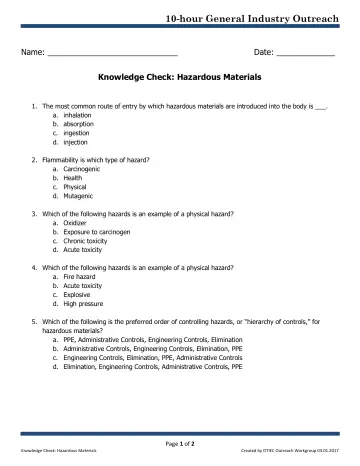
2 slidesHazardous Materials: Knowledge Check (OSHA 10-Hour General Industry Outreach)
Student knowledge-check quiz for the OSHA General Industry hazardous materials outreach deck.
U.S. Department of Labor, OSHA (with the OTIEC Outreach Workgroup)Public domain
pdfes
49 slidesMateriales peligrosos (Capacitación de Extensión de 10 horas de OSHA, Industria General)
Spanish edition of OSHA's 10-hour General Industry Outreach deck on hazardous materials (PDF slides; OSHA does not publish an editable Spanish PowerPoint).
U.S. Department of Labor, OSHA (with the OTIEC Outreach Workgroup)Public domain