1 / 59Use ← → to flip
Process Safety Management (OSHA 3132)
OSHA booklet, for General Industry classes.
Page text
· 59 pages · by U.S. Department of Labor, OSHA
The words on each page as the author wrote them, read from the file by software so they can be searched. Layout, pictures and tables are not shown here, and long pages are shortened: the pages above and the download are the original.
- Page 1
Process Safety Management
- U.S. Department of Labor
- Occupational Safety and Health Administration
- OSHA 3132
- 2000 (Reprinted)
- Page 2
- This informational booklet is intended to provide a generic, non-exhaustive overview of a particular standards-related topic. This publication does not itself alter or determine compliance responsibilities, which are set forth in OSHA standards themselves and the Occupational Safety and Health Act. Moreover, because interpretations and enforcement policy may change over time, for additional guidance on OSHA compliance requirements, the reader should consult current and administrative interpretations and…
- …
- Page 3
Process Safety Management
- U.S. Department of Labor
- Alexis M. Herman, Secretary
- Occupational Safety and Health Administration Charles N. Jeffress, Assistant Secretary
- OSHA 3132
- 2000 (Reprinted)
- Page 4
- Contents
- iii
- The Problem … 1
- How the Standard Works … 5
- Process Safety Information … 7
- Process Hazard Analysis … 9
- Operating Procedures … 12
- Employee Participation … 14
- Training … 15
- Initial Training … 15
- Refresher Training … 15
- Training Documentation … 15
- Contractors … 16
- Application … 16
- Employer Responsibilities … 16
- Contract Employer Responsibilities … 16
- Pre-Startup Safety Review … 18
- Mechanical Integrity … 19
- Hot Work Permit … 21
- Management of Change … 22
- Incident Investigation … 23
- …
- Page 5
The Problem
- Unexpected releases of toxic, reactive, or flammable liquids and gases in processes involving highly hazardous chemicals have been reported for many years. Incidents continue to occur in various industries that use highly hazardous chemicals which may be toxic, reactive, flammable, or explosive, or may exhibit a combination of these properties. …
- …
- Page 6
- 1991, in Houston, TX, enumerating additional issues, and extending the written comment period until January 22, 1991.
- The hearings on the proposed standard were held in Washington, DC, from November 27, 1990, through December 4, 1990, and in Houston, TX, from February 26, 1991, through March 7, 1991. The Administrative Law Judge presiding at the hearings allowed participants to submit post-hearing comments until May 6, 1991, and file post-hearing briefs until June 5, 1991. …
- …
- Page 7
- (1) Develop and maintain written safety information identifying workplace chemical and process hazards, equipment used in the processes, and technology used in the processes;
- (2) Perform a workplace hazard assessment, including, as appropriate, identification of potential sources of accidental releases, identification of any previous release within the facility that had a potential for catastrophic consequences in the workplace, estimation of workplace effects of a range of releases, and estimation of…
- …
- Page 8
- (11) Establish maintenance systems for critical process-related equipment, including written procedures, employee training, appropriate inspections, and testing of such equipment to ensure ongoing mechanical integrity;
- (12) Conduct pre-startup safety reviews of all newly installed or modified equipment;
- (13) Establish and implement written procedures managing change to process chemicals, technology, equipment and facilities; and
- …
- Page 9
How the Standard Works
- This booklet summarizes the OSHA final process safety management (PSM) standard. Employers and employees may prefer to read this booklet and a companion one entitled, “Process Safety Management - Guidelines for Compliance” (OSHA 3133), before studying the rule itself.
- The standard mainly applies to manufacturing industries—particularly, those pertaining to chemicals, transportation equipment, and fabricated metal products. …
- …
- Page 10
- near misses of covered chemicals; emergency, action plans; compliance audits at least every three years; and trade secret protection.
- To understand PSM and its requirements, employers and employees need to understand how OSHA uses the term “process” in PSM. Process means any activity involving a highly hazardous chemical including using, storing, manufacturing, handling, or moving such chemicals at the site, or any combination of these activities. …
- …
- Page 11
Process Safety Information
- Employers must complete a compilation of written process safety information before conducting any process hazard analysis required by the standard. The compilation of written process safety information, completed under the same schedule required for process hazard analyses, will help the employer and the employees involved in operating the process to identify and understand the hazards posed by those processes involving highly hazardous chemicals. …
- …
- Page 12
Information on the equipment in the process must include the following:
- Materials of construction,
- Piping and instrument diagrams (P&IDs),
- Electrical classification,
- Relief system design and design basis,
- Ventilation system design,
- Design codes and standards employed,
- Material and energy balances for processes built after May 26, 1992, and
- Safety systems (e.g., interlocks, detection, or suppression systems).
- The employer shall document that equipment complies with recognized and generally accepted good…
- …
- Page 13
Process Hazard Analysis
- The process hazard analysis is a thorough, orderly, systematic approach for identifying, evaluating, and controlling the hazards of processes involving highly hazardous chemicals. The employer must perform an initial process hazard analysis (hazard evaluation) on all processes covered by this standard. The process hazard analysis methodology selected must be appropriate to the complexity of the process and must identify, evaluate, and control the hazards involved in the process.
- …
- Page 14
- A discussion of these methods of analysis is contained in the companion publication, OSHA 3133, Process Safety Management - Guidelines for Compliance. Whichever method(s) are used, the process hazard analysis must address the following:
- The hazards of the process;
- The identification of any previous incident that had a potential for catastrophic consequences in the workplace;
- Engineering and administrative controls applicable to the hazards and their interrelationships, such as appropriate application of…
- …
- Page 15
- At least every five years after the completion of the initial process hazard analysis, the process hazard analysis must be updated and revalidated by a team meeting the standard’s requirements to ensure that the hazard analysis is consistent with the current process. Employers must keep on file and make available to OSHA, on request, process hazard analyses and updates or revalidation for each process covered by PSM, as well as the documented resolution of recommendations, for the life of the process.
- …
- Page 16
Operating Procedures
- The employer must develop and implement written operating procedures, consistent with the process safety information, that provide clear instructions for safely conducting activities involved in each covered process. OSHA believes that tasks and procedures related to the covered process must be appropriate, clear, consistent, and most importantly, well communicated to employees. The procedures must address at least the following elements:
- Steps for each operating phase:
- …
- Page 17
- To ensure that a ready and up-to-date reference is available, and to form a foundation for needed employee training, operating procedures must be readily accessible to employees who work in or maintain a process. The operating procedures must be reviewed as often as necessary to ensure that they reflect current operating practices, including changes in process chemicals, technology, and equipment, and facilities. …
- …
- Page 18
Employee Participation
- Employers must develop a written plan of action to implement the employee participation required by PSM. Under PSM, employers must consult with employees and their representatives on the conduct and development of process hazard analyses and on the development of the other elements of process management, and they must provide to employees and their representatives access to process hazard analyses and to all other information required to be developed by the standard.
- Page 19
Training
- Initial Training
- OSHA believes that the implementation of an effective training program is one of the most important steps that an employer can take to enhance employee safety. Accordingly, PSM requires that each employee presently involved in operating a process or a newly assigned process must be trained in an overview of the process and in its operating procedures. …
- …
- Page 20
Contractors
- Application
- Many categories of contract labor may be present at a jobsite; such workers may actually operate the facility or do only a particular aspect of a job because they have specialized knowledge or skill. Others work only for short periods when there is need for increased staff quickly, such as in turnaround operations. …
- …
- Page 21
- Ensure that contract employees are instructed in the known potential fire, explosion, or toxic release hazards related to their job and the process, and in the applicable provisions of the emergency action plan;
- Document that each contract employee has received and understood the training required by the standard by preparing a record that contains the identity of the contract employee, the date of training, and the means used to verify that the employee understood the training;
- …
- Page 22
Pre-Startup Safety Review
- It is important that a safety review takes place before any highly hazardous chemical is introduced into a process. PSM, therefore, requires the employer to perform a pre-startup safety review for new facilities and for modified facilities when the modification is significant enough to require a change in the process safety information. Prior to the introduction of a highly hazardous chemical to a process, the pre-startup safety review must confirm that the following:
- …
- Page 23
Mechanical Integrity
- OSHA believes it is important to maintain the mechanical integrity of critical process equipment to ensure it is designed and installed correctly and operates properly. PSM mechanical integrity requirements apply to the following equipment:
- Pressure vessels and storage tanks;
- Piping systems (including piping components such as valves);
- Relief and vent systems and devices;
- Emergency shutdown systems;
- Controls (including monitoring devices and sensors, alarms, and interlocks); and
- …
- Page 24
- inspections must be performed to ensure that equipment is installed properly and is consistent with design specifications and the manufacturer’s instructions.
- The employer also must ensure that maintenance materials, spare parts, and equipment are suitable for the process application for which they will be used.
- Page 25
States with Approved Plans
- Hot Work Permit
- A permit must be issued for hot work operations conducted on or near a covered process. The permit must document that the fire prevention and protection requirements in OSHA regulations (1910.252(a)) have been implemented prior to beginning the hot work operations; it must indicate the date(s) authorized for hot work; and identify the object on which hot work is to be performed. The permit must be kept on file until completion of the hot work.
- Page 26
Management of Change
- OSHA believes that contemplated changes to a process must be thoroughly evaluated to fully assess their impact on employee safety and health and to determine needed changes to operating procedures. To this end, the standard contains a section on procedures for managing changes to processes. Written procedures to manage changes (except for “replacements in kind”) to process chemicals, technology, equipment, and procedures, and change to facilities that affect a covered process, must…
- …
- Page 27
Incident Investigation
- A crucial part of the process safety management program is a thorough investigation of incidents to identify the chain of events and causes so that corrective measures can be developed and implemented. Accordingly, PSM requires the investigation of each incident that resulted in, or could reasonably have resulted in, a catastrophic release of a highly hazardous chemical in the workplace. …
- …
- Page 28
Emergency Planning and Response
- If, despite the best planning, an incident occurs, it is essential that emergency pre-planning and training make employees aware of, and able to execute, proper actions. For this reason, an emergency action plan for the entire plant must be developed and implemented in accordance with the provisions of other OSHA rules (29 CFR 1910.38(a)). In addition, the emergency action plan must include procedures for handling small releases of hazardous chemicals. …
- …
- Page 29
Compliance Audits
- To be certain process safety management is effective, employers must certify that they have evaluated compliance with the provisions of PSM at least every three years This will verify that the procedures and practices developed under the standard are adequate and are being followed. The compliance audit must be conducted by at least one person knowledgeable in the process and a report of the findings of the audit must be developed and documented noting deficiencies that have been…
- …
- Page 30
Trade Secrets
- Employers must make available all information necessary to comply with PSM to those persons responsible for compiling the process safety information, those developing the process hazard analysis, those responsible for developing the operating procedures, and those performing incident investigations, emergency planning and response, and compliance audits, without regard to the possible trade secret status of such information. …
- …
- Page 31
Part 1910-Occupational Safety and Health Standards
- The following sections comprise the process safety management standard, in its entirety, as published in the Federal Register (FR 57(36):6403-6408, February 24, 1992).
- 1. The authority citation for Subpart H of Part 1910 is revised to read as follows:
- Authority Secs. 4, 6, 8, Occupational Safety and Health Act of 1970 (29 U.S.C. 653, 655, 657): Secretary of Labor’s Order No. …
- …
- Page 32
- A new § 1910.119 and appendices A through D* to § 1910.119 are added to read as follows:
- 1910.119 Process Safety Management of Highly Hazardous Chemicals
- Purpose. This section contains requirements for preventing or minimizing the consequences of catastrophic releases of toxic, reactive, flammable, or explosive chemicals. These releases may result in toxic, fire or explosion hazards.
- (a) Application. (1) This section applies to the following:
- …
- Page 33
- Boiling point means the boiling point of a liquid at a pressure of 14.7 pounds per square inch absolute (p.s.i.a.) (760mm). For the purposes of this section, where an accurate boiling point is unavailable for the material in question, or for mixtures which do not have a constant boiling point, the 10 percent point of a distillation performed in accordance with the Standard Method of Test for Distillation of Petroleum Products, ASTM D-86-62, may be used as the boiling point of the liquid.
- …
- Page 34
- employer’s business, and that gives the employer an opportunity to obtain advantage over competitors who do not know or use it. Appendix D contained in § 1910.1200 sets out the criteria to be used in evaluating trade secrets.
- (c) Employee participation. (1) Employers shall develop a written plan of action regarding the implementation of the employee participation required by this paragraph.
- (2) Employers shall consult with employees and their representatives on the conduct and development of process…
- …
- Page 35
- (vii) Hazardous effects of inadvertent mixing of different materials that could foreseeably occur.
- Note: Material Safety Data Sheets meeting the requirements of 29 CFR 1910.1200(g) may be used to comply with this requirement to the extent that they contain the information required by this subparagraph.
- (2) Information pertaining to the technology of the process. (i) Information concerning the technology of the process shall include at least the following:
- …
- Page 36
- (ii) The employer shall document that equipment complies with recognized and generally accepted good engineering practices.
- (iii) For existing equipment designed and constructed in accordance with codes, standards, or practices that are no longer in general use, the employer shall determine and document that the equipment is designed, maintained, inspected, tested, and operating in a safe manner,
- (e) Process hazard analysis. (1) The employer shall perform an initial process hazard analysis (hazard…
- …
- Page 37
- (iv) Hazard and Operability Study (HAZOP);
- (v) Failure Mode and Effects Analysis (FMEA); (vi) Fault Tree Analysis; or
- (vii) An appropriate equivalent methodology.
- (3) The process hazard analysis shall address;
- (i) The hazards of the process;
- (ii) The identification of any previous incident which had a likely potential for catastrophic consequences in the workplace;
- (iii) Engineering and administrative controls applicable to the hazards and their interrelationships such as appropriate application of…
- …
- Page 38
- and revalidated by a team meeting the requirements in paragraph (e)(4) of this section, to assure that the process hazard analysis is consistent with the current process.
- (7) Employers shall retain process hazards analyses and updates or revalidations for each process covered by this section, as well as the documented resolution of recommendations described in paragraph (e)(5) of this section for the life of the process.
- (f) Operating procedures. (1) The employer shall develop and implement written…
- …
- Page 39
- (D) Quality control for raw materials and control of hazardous chemical inventory levels; and,
- (E) Any special or unique hazards.
- (iv) Safety systems and their functions.
- (2) Operating procedures shall be readily accessible to employees who work in or maintain a process.
- (3) The operating procedures shall be reviewed as often as necessary to assure that they reflect current operating practices, including changes that result from changes in process chemicals, technology, and equipment, and changes to…
- …
- Page 40
- (3) Training documentation. The employer shall ascertain that each employee involved in operating a process has received and understood the training required by this paragraph. The employer shall prepare a record which contains the identity of the employee, the date of training, and the means used to verify that the employee understood the training.
- (h) Contractors. (1) Application. This paragraph applies to contractors performing maintenance or repair, turnaround, major renovation, or specialty work on…
- …
- Page 41
- release hazards related to his/her job and the process, and the applicable provisions of the emergency action plan.
- (iii) The contract employer shall document that each contract employee has received and understood the training required by this paragraph. The contract employer shall prepare a record which contains the identity of the contract employee, the date of training, and the means used to verify that the employee understood the training.
- …
- Page 42
- (iii) Relief and vent systems and devices; (iv) Emergency shutdown systems;
- (v) Controls (including monitoring devices and sensors, alarms, and interlocks) and,
- (vi) Pumps.
- (2) Written procedures. The employer shall establish and implement written procedures to maintain the on-going integrity of process equipment.
- (3) Training for process maintenance activities. The employer shall train each employee involved in maintaining the on-going integrity of process equipment in an overview of that process and…
- …
- Page 43
- cated is suitable for the process application for which they will be used.
- (ii) Appropriate checks and inspections shall be performed to assure that equipment is installed properly and consistent with design specifications and the manufacturer’s instructions.
- (iii) The employer shall assure that maintenance materials, spare parts and equipment are suitable for the process application for which they will be used.
- (k) Hot work permit. (1) The employer shall issue a hot work permit for hot work operations…
- …
- Page 44
- (5) If a change covered by this paragraph results in a change in the operating procedures or practices required by paragraph (f) of this section, such procedures or practices shall be updated accordingly.
- (m) Incident investigation. (1) The employer shall investigate each incident which resulted din, or could reasonably have resulted in a catastrophic release of highly hazardous chemical in the workplace.
- (2) An incident investigation shall be initiated as promptly as possible, but not later than 48…
- …
- Page 45
- (o) Compliance audits. (1) Employers shall certify that they have evaluated compliance with the provisions of this section at least every three years to verify that the procedures and practices developed under the standard are adequate and are being followed.
- (2) The compliance audit shall be conducted by at least one person knowledgeable in the process.
- (3) A report of the findings of the audit shall be developed.
- (4) The employer shall promptly determine and document an appropriate response to each of…
- …
- Page 46
Appendix A to § 1910.119
- Appendix A to § 1910.119—List of Highly Hazardous Chemicals, Toxics and Reactives (Mandatory)
- This Appendix contains a listing of toxic and reactive highly hazardous chemicals which present a potential for a catastrophic event at or above the threshold quantity.
- CHEMICAL name
- Acetaldehyde … Acrolein (2-Propenal) … Acrytyl Chloride … Allyl Chloride … Allylamine … Alkylaluminums … Ammonia, Anhydrous … Ammonia solutions
- …
- Page 47
CHEMICAL name
- CAS*
- Chloropicrin and Methyl
- Bromide mixture …
- None
- Chloride mixture …
- None
- Cumene Hydroperoxide …
- 80-15-9
- Cyanogen …
- 460-19-5
- Cyanogen Chloride …
- 506-77-4
- Cyanuric Fluoride …
- 675-14-9
- Diacetyl Peroxide
- (concentration >700%) …
- 110-22-5
- Diazomethane …
- 334-88-3
- Dibenzoyl Peroxide …
- 94-36-0
- Diborane … 19287-45-7
- Dibutyl Peroxide (Tertiary) …
- 110-05-4
- Dichloro Acetylene … 7572-29-4
- Dichlorosilane … 4109-96-0
- Diethylzinc …
- 557-20-0
- Diisopropyl Peroxydicarbonate …
- 105-64-6
- Dilaluroyl Peroxide …
- …
- Page 48
CHEMICAL name
- HydroxIamine … Iron, Pentacarbonyl … Isopropylamine … Ketene … Methacrylaldehyde … Methacryloyl Chloride … Methacryloyloxyethyl Isocyanate … Methyl Acrylonitrile … Methylamine, Anhydrous … Methyl Bromide … Methyl Chloride … Methyl Chloroformate … Methyl Ethyl Ketone Peroxide (concentration >60%) … Methyl Fluoroacetate … Methyl Fluorosulfate … Methyl Hydrazine … Methyl Iodide … Methyl Isocyanate … Methyl Mercaptan … Methyl Vinyl Ketone … Methyltrichlorosilane … Nickel Carbonly (Nickel
- …
- Page 49
CHEMICAL name
- Peracetic Acid (concentration
- >60% Acetic Acid; also called Peroxyacetic Acid) … Perchloric Acid (concentration
- >60% by weight) … Perchloromethyl Mercaptan … Perchloryl Fluoride … Peroxyacetic Acid (concentration
- >60% by Acetic Acid; also called’ Paracetic Acid) … Phosgene (also called
- Carbonyl Chloride) … Phosphine (Hydrogen Phosphide) … Phosphorus Oxychloride (also called Phosphoryl Chloride) … Phosphorus Trichloride … Phosphoryl Chloride (also called Phosphorus Oxychloride … Propargyl…
- …
- Page 50
Appendix B to § 1910.119
- Appendix B to § 1910.119—Block Flow Diagram and Simplified Process Flow Diagram (Nonmandatory)
- Example of a Block Flow Diagram
- Page 51
Example of a Simplified Process Flow Diagram
- Appendix B to § 1910.119
- Page 52
OSHA Consultation Directory
- Consultation programs provide free services to employers who request help in identifying and correcting specific hazards, want to improve their safety and health programs, and/or need further assistance in training and education. Funded by OSHA and delivered by well-trained professional staff of state governments, consultation services are comprehensive, and include an appraisal of all workplace hazards, practices, and job safety and health programs; conferences and agreements…
- …
- Page 53
- Montana … (406) 444-6418 Nebraska … (402) 471-4717 Nevada … (702) 486-9140 New Hampshire … (603) 271-2024 New Jersey … (609) 292-3923 New Mexico … (505) 827-4230 New York … (518) 457-2238 North Carolina … (919) 807-2905 North Dakota … (701) 328-5188 Ohio … (614) 644-2246 Oklahoma … (405) 528-1500 Oregon … (503) 378-3272 Pennsylvania … (742) 357-2396 Puerto Rico … (787) 754-2171 Rhode Island … (401) 222-2438 South Carolina … (803) 734-9614 South Dakota … (605) 688-4101 Tennessee … (615) 741-7036 Texas ……
- …
- Page 54
States with Approved Plans
- States administering their own occupational safety and health programs through plans approved under section 18(b) of the Occupational Safety and Health Act of 1970 must adopt standards and enforce requirements that are at least as effective as federal requirements.
- There are currently 25 state plan states; 23 cover the private and public (state and local government) sections and 2 cover the public sector only (Connecticut and New York)
- Commissioner
- Alaska Department of Labor
- …
- Page 55
Commissioner
- Maryland Division of Labor and Industry
- Department of Labor, Licensing, and Regulation
- 1100 N. Eutaw Street,
- Room 613
- Baltimore, MD 21201-2206
- (410) 767-2215
- Director
- Michigan Department
- of Consumer and Industry
- Services
- P.O. Box 30643
- Lansing, MI 48909-8143
- (517) 322-1814
- Secretary
- New Mexico Environment
- Department
- 1190 St. Francis Drive
- P.O. Box 26110
- Santa Fe, NM 87502
- (505) 827-2850
- New York Department of Labor
- W. Averell Harriman State Office Building - 12, Room 500
- Albany, NY 12240
- …
- Page 56
States with Approved Plans
- Commissioner
- Secretary
- Vermont Department
- Puerto Rico Department
- of Labor and Human Resources of Labor and Industry National Life Building - Prudencio Rivera Martinez
- Drawer 20
- Building
- National Life Drive
- 505 Munoz Rivera Avenue
- Montpelier, VT 05620-3401 Hato Rey, PR 00918
- (802) 828-5098
- (787) 754-2119
- Director
- South Carolina Department of Labor, Licensing, and Regulation
- Koger Office Park, Kingstree Building
- 110 Centerview Drive
- P.O. Box 11329
- Columbia, SC 29210
- …
- Page 57
Administrator
- Worker’s Safety and Compensation Division (WSC) Wyoming Department of Employment
- Herschler Building,
- 2nd Floor East
- 122 West 25th Street
- Cheyenne, WY 82002
- (307) 777-7786
- States with Approved Plans
- Page 58
Related Publications
- Single free copies of the following publications can be obtained from the OSHA Publications Office, Room N3101, Washington, DC 20210, (202) 693-1888.
- All About OSHA - OSHA 2056
- Chemical Hazard Communication - OSHA 3084
- Consultation Services for the Employer - OSHA 3047
- Employee Workplace Rights - OSHA 3021
- How to Prepare for Workplace Emergencies - OSHA 3088 OSHA Inspections - OSHA 2098
- OSHA: Employee Workplace Rights - OSHA 3021
- Personal Protective Equipment - OSHA 3077
- …
- Page 59
U.S. Department of Labor
- Occupational Safety and Health Administration Regional Offices
- Region I
- (CT,* MA, ME, NH, RI, VT*)
- JFK Federal Building
- Room E-340
- Boston, MA 02203
- Telephone: (617) 565-9860
- Region VI
- (AR, LA, MN,* OK, TX) 525 Griffin Street
- Room 602
- Dallas, TX 75202 Telephone: (214) 767-4731
- Region II
- (NJ, NY,* PR,* VI*)
- 201 Varick Street
- Room 670
- New York, NY 10014
- Telephone: (212) 337-2378
- Region VII
- (IA,* KS, MO, NE)
- City Center Square
- …
More on HazMat
pptx
49 slidesHazardous Materials (OSHA 10-Hour General Industry Outreach)
OSHA's own 10-hour General Industry Outreach deck on hazardous materials (v. 03-01-17), editable PowerPoint with trainer notes.
U.S. Department of Labor, OSHA (with the OTIEC Outreach Workgroup)Public domain
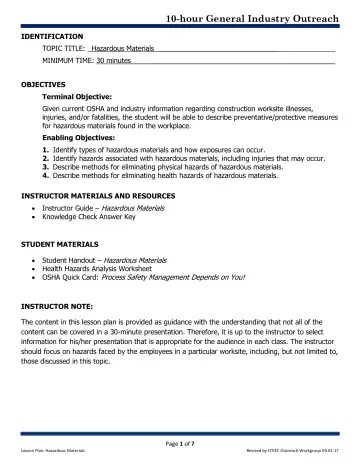
pdf
7 slidesHazardous Materials: Lesson Plan (OSHA 10-Hour General Industry Outreach)
Instructor lesson plan (objectives, timing, teaching steps) for the OSHA General Industry hazardous materials outreach deck.
U.S. Department of Labor, OSHA (with the OTIEC Outreach Workgroup)Public domain
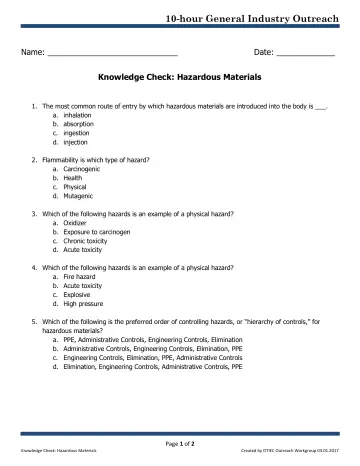
pdf
2 slidesHazardous Materials: Knowledge Check (OSHA 10-Hour General Industry Outreach)
Student knowledge-check quiz for the OSHA General Industry hazardous materials outreach deck.
U.S. Department of Labor, OSHA (with the OTIEC Outreach Workgroup)Public domain