1 / 47Use ← → to flip
Hazardous Waste & Emergency Response (OSHA 3114)
OSHA booklet on the HAZWOPER standard.
Page text
· 45 of 47 pages · by U.S. Department of Labor, OSHA
The words on each page as the author wrote them, read from the file by software so they can be searched. Layout, pictures and tables are not shown here, and long pages are shortened: the pages above and the download are the original.
- Page 1
Hazardous Waste
- Operations and Emergency Response
- OSHA 3114-07R 2008
- Page 2
- Employers are responsible for providing a safe and healthy workplace for their employees. OSHA’s role is to promote the safety and health of America’s working men and women by setting and enforcing standards; providing training, outreach and education; establishing partnerships; and encouraging continual improvement in workplace safety and health.
- This informational booklet provides a general overview of a particular topic related to OSHA standards. It does not alter or determine compliance responsibilities in OSHA standards or the Occupational Safety and Health Act of 1970. …
- …
- Page 3
Hazardous Waste Operations and Emergency Response
- U.S. Department of Labor
- Occupational Safety and Health Administration
- OSHA 3114-07R
- 2008
- Page 4
Contents
- Introduction...5
- Scope and Application...6
- Provisions of HAZWOPER for Cleanup Operations...9
- Safety and Health Program...9
- Organizational Structure...9
- Comprehensive Workplan...10
- Site Characterization and Analysis...10
- Health and Safety Plan (HASP)...11
- Safety and Health Training Program...13
- Medical Surveillance...15
- Engineering Controls, Work Practices, and PPE...17 Exposure Monitoring...19
- Informational Programs...20
- Handling and Labeling Drums and Containers...20 Decontamination Procedures...22
- Hazardous Waste Site Emergency Response...23 Sanitation of Temporary Workplaces...24
- New Technology Programs...24
- …
- Page 5
- This guidance document is not a standard or regulation, and it creates no new legal obligations. The document is advisory in nature, informational in content, and is intended to assist employers in providing a safe and healthy workplace. The Occupational Safety and Health Act requires employers to comply with hazard-specific safety and health standards promulgated by OSHA or by a State with an OSHA-approved State Plan. In addition, pursuant to Section 5(a)(1), the General Duty Clause of the Act, employers must provide their employees with a workplace free from recognized hazards likely to cause death or serious physical harm. …
- …
- Page 6
ACRONYMS
- BBP
- Bloodborne Pathogens
- CERCLA
- Comprehensive Environmental Response, Compensation, and Liability Act of 1980
- CESQGs
- Conditionally Exempt Small Quantity Generators
- CFR
- Code of Federal Regulations
- DHS
- Department of Homeland Security
- DOT
- Department of Transportation
- EPA
- Environmental Protection Agency
- ERP
- Emergency Response Plan
- HASP
- Health and Safety Plan
- HAZMAT
- Hazardous Materials
- HAZWOPER Hazardous Waste Operations and Emergency Response
- HCS
- Hazard Communication Standard
- ICS
- Incident Command System
- IDLH
- Immediately Dangerous to Life or Health
- MSDS
- Material Safety Data Sheet
- NIMS
- National Incident Management System
- NPL
- National Priority List
- OSHA
- …
- Page 7
Introduction
- The dumping of hazardous substances poses a significant threat to the environment. The U.S. Environmental Protection Agency’s (EPA) Toxic Release Inventory (TRI) data show that over 18 million tons of hazardous substances covered by TRI were disposed of or released into the environment from 1998 through 2004. 1 Hazardous substances are a serious safety and health problem that continues to endanger human and animal life and environmental quality. Discarded hazardous substances that are toxic, flammable, or corrosive can cause fires, explosions, and pollution of air, water, and land. …
- …
- Page 8
- Emergency response operations involving hazardous substance releases [paragraph (q)] (e.g., chemical spill at a manufacturing plant).
- An understanding of how each of these sections are different from each other and what they apply to is essential to ensure compliance with the appropriate section of HAZWOPER. The scope and application [paragraphs (a)(1) and (a)(2)] sections of the standard define these work operations and indicate what sections of the standard they fall under.
- State, county, and municipal employees, including hazardous waste treatment, storage and disposal facility employees, and first responders, such as fire and rescue personnel, police…
- …
- Page 9
- been determined. Examples of types of uncontrolled hazardous waste sites that would be covered by HAZWOPER include those:
- Listed or proposed for listing on the National Priority List (NPL),
- Listed or proposed for listing on a State priority list,
- Identified or listed by a governmental agency as an uncontrolled hazardous waste site (Note: this includes voluntary cleanup operations), and
- Regulated as a corrective action covered by the Resource Conservation and Recovery Act (RCRA).
- The second category of work operation is covered by paragraph
- (p) and includes those employees engaged in operations involving hazardous waste TSD facilities regulated under 40 CFR…
- …
- Page 10
Table 1 – Scope and Application of HAZWOPER
- Work Operation
- Cleanup Operations
- Cleanup operations required by a governmental body or other operations involving hazardous substances that are conducted at uncontrolled hazardous waste sites.
- Corrective actions involving cleanup operations at sites covered by RCRA.
- Voluntary cleanup operations at sites recognized by federal, state, local, or other governmental bodies as uncontrolled hazardous waste sites.
- Operations at TSD Facilities
- Operations involving hazardous waste conducted at TSD facilities regulated by 40 CFR 264 and 265 pursuant to RCRA or by agencies under agreement with the EPA to implement RCRA…
- …
- Page 11
Provisions of HAZWOPER for Cleanup Operations
- Safety and Health Program
- An effective and comprehensive safety and health program is essential in reducing work-related injuries and illnesses and in maintaining a safe and healthful work environment. The standard, therefore, requires each employer to develop and implement a written safety and health program that identifies, evaluates, and controls safety and health hazards, and provides emergency response procedures for each hazardous waste site. This written program must include specific and detailed information on the following topics:
- An organizational structure,
- A comprehensive workplan,
- …
- Page 12
- A site safety and health supervisor who develops and implements the HASP and is responsible for ensuring compliance, and
- The roles and responsibilities of all the other site personnel necessary for hazardous waste site operations.
- Comprehensive Workplan
- Planning is the key element in a hazardous waste cleanup program. Proper planning will greatly reduce employee hazards at hazardous waste sites. A workplan should support the overall objectives of the cleanup program and provide procedures for implementation, and incorporate the employer’s standard operating procedures for safety and health.
- …
- Page 13
- A preliminary evaluation of the site’s characteristics must be performed prior to site entry. A secondary more detailed evaluation must be conducted to further identify existing hazards to aid in the selection of appropriate engineering controls and personal protective equipment (PPE) for future site activities. The evaluation must include all suspected conditions that are immediately dangerous to life or health (IDLH) or that may cause serious harm to employees (e.g., confined space entry, potentially explosive or flammable situations, visible vapor clouds, etc.). …
- …
- Page 14
- Exposure monitoring,
- Site control measures,
- Decontamination procedures,
- Emergency response plan,
- Confined space entry procedures, and
- Spill containment.
- Although some of the above elements are a part of the overall safety and health program, several others are additional to these elements and are crucial in developing an effective HASP. For example, the task hazard analysis may be the most critical component of the site HASP and addresses the chemical, physical, and biological hazards associated with each particular task or operation and the control procedures that protect employees when they perform that task. …
- …
- Page 15
- system, two employees must keep in visual contact with each other and only one employee should be in a specific dangerous area at any one time, so that if one gets in trouble the second can call for help. The written HASP must be kept at the site and must always be available for employee, contractor, or subcontractor review. Preentry briefings must be conducted prior to site entry and at other times as necessary to ensure that employees are aware of the HASP and its implementation. The employer also must ensure that periodic safety and health inspections are made of the site and that all known deficiencies are corrected prior to work at the site.
- …
- Page 16
- must be trained to recognize hazards and to prevent them; to select, care for, and use respirators properly, as well as other types of PPE; to understand engineering controls and their use; to use proper decontamination procedures; to understand the emergency response plan, medical surveillance requirements, confined space entry procedures, spill containment program, and any appropriate work practices. Employees also must know the names of personnel and their alternates responsible for site safety and health. …
- …
- Page 17
- Employees at all sites must not perform any hazardous waste operations unless they have been trained to the level required by their job function and responsibility, and have been certified by a qualified trainer as having completed the necessary training. Employees who receive the specified training must receive a written certificate upon successful completion of that training. That training need not be repeated if the employee goes to work at a new site; however, the employee must receive the necessary additional site-specific training needed to work safely at the new site. …
- …
- Page 18
- Employees who wear a respirator for 30 days or more per year on site or as required by 1910.134,
- Employees who are exposed to unexpected or emergency releases of hazardous wastes above exposure limits (without wearing appropriate protective equipment) or who show signs, symptoms, or illness that may have resulted from exposure to hazardous substances, and
- Employees responsible for responding to on-site hazardous materials (HAZMAT) releases (i.e., on-site HAZMAT team).
- All examinations must be performed by or under the supervision of a licensed physician, without cost to the employee, without loss of pay, and at a reasonable time and place. …
- …
- Page 19
- would place the employee at an increased risk from exposure, any recommended limitations on the employee or upon the use of PPE, and a statement that the employee has been informed by the physician of the medical examination. The physician is not to reveal, in the written opinion given to the employer, specific findings or diagnoses unrelated to employment.
- Employers should be aware that there are medical surveillance requirements in other OSHA substance-specific standards that may be applicable for individual sites where these hazardous substances are present (e.g., lead, asbestos, and benzene). …
- …
- Page 20
- PPE typically includes respiratory protection, dermal protection (e.g., gloves and protective clothing), eye protection (e.g., safety glasses, goggles, and face shields), and foot protection (e.g., steeltoed boots and chemical-resistant booties). Employers must select and ensure that employees use PPE in accordance with 29 CFR Part 1910, Subpart I. PPE at hazardous waste sites is often identified as a level of protection and frequently referred to as level A, B, C, or D. Non-mandatory Appendix B to HAZWOPER provides guidelines for selecting PPE and further discusses the levels of protection. The bullets below summarize each level of protection.
- …
- Page 21
- hazard is due to a chemical that poses an inhalation hazard, then a positive pressure SCBA or positive pressure air-line respirator must be used. If a chemical poses a severe skin hazard or is highly toxic and can be readily absorbed through the skin, then appropriate protective clothing (e.g., totally-encapsulating suit) must be worn. In contrast, it is just as important to know when to downgrade the level and type of PPE through exposure monitoring. Wearing too much PPE increases certain hazards such as heat stress, physical and psychological stress, and can impair vision, mobility and communication.
- Exposure Monitoring
- …
- Page 22
- New contaminants are being handled,
- Different type of operation is initiated, and
- Handling leaking drums or working in areas with obvious liquid contamination.
- Informational Programs
- As part of the overall safety and health program in paragraph (b) of the standard, employers must develop and implement a program that informs employees, contractors, and subcontractors of the nature, level, and degree of exposure from performing hazardous waste cleanup operations (Note: this requirement is typically addressed through initial and refresher training under paragraph (e) of the standard). …
- …
- Page 23
- The employer must inform employees of the appropriate hazard warnings for labeled drums, the removal of soil or coverings, and the dangers of handling unlabeled drums or containers without prior identification of their contents,
- To the extent feasible, the moving of drums or containers must be kept to a minimum, and a program must be implemented to contain and isolate hazardous substances being transferred into drums or containers, and
- Ground penetrating systems or other detection devices must be used to estimate the location and depth of buried drums and containers.
- The employer also must ensure that safe work practices are instituted before opening a drum…
- …
- Page 24
- addition, lab packs must be opened only when necessary and only by a qualified person. Prior to shipment to a licensed disposal facility, all drums or containers must be properly labeled and packaged for shipment. Staging areas also must be kept to a minimum and provided with adequate access and exit routes.
- Decontamination Procedures
- Decontamination procedures are a component of the site HASP and, consequently, must be developed, communicated to employees, and implemented before employees enter a hazardous waste site. As necessary, the site safety and health officer must require and monitor decontamination of the employee and decontamination or disposal of…
- …
- Page 25
Hazardous Waste Site Emergency Response
- Proper emergency planning and response are important elements of the site HASP that help minimize employee exposure and injury. The standard requires that the employer develop and implement a written emergency response plan to handle possible emergencies before performing hazardous waste site operations. Employers who will evacuate their employees from the worksite location when an emergency occurs and who do not permit any of their employees to assist in handling the emergency are exempt from developing an emergency response plan. …
- …
- Page 26
- tinguishable and distinct alarm system must be in operation to notify employees of emergencies. The emergency plan also must be made available for inspection and copying by employees, their representatives, OSHA personnel, and other government agencies with relevant responsibilities.
- When deemed necessary, employees must wear a positivepressure self-contained breathing apparatus or a positive pressure air-line respirator equipped with an escape air supply. In addition, backup and first-aid support personnel must be available for assistance or rescue.
- Sanitation of Temporary Workplaces
- …
- Page 27
Provisions of HAZWOPER for TSD Facilities
- Safety and Health Program
- The standard requires the employer at covered TSD facilities to develop and implement a written safety and health program for employees involved in hazardous waste operations at the facility. The program must be designed to identify, evaluate, and control safety and health hazards in the facility for the purpose of employee protection. It must also include emergency response procedures that meet the requirements of paragraph 1910.120(p)(8), discussed below. …
- …
- Page 28
- treat or process hazardous waste would be required to be included in the TSD facility’s hazard communication program.
- Medical Surveillance, Decontamination, New Technology, and Material Handling Programs
- TSD facilities are also required to implement some of the same requirements specified for hazardous waste sites. Paragraph (p) of HAZWOPER references several sections within paragraphs (b)-(o) as follows:
- Medical surveillance program 1910.120(p)(3) references 1910.120(f),
- Decontamination program 1910.120(p)(4) references 1910.120(k),
- New technology program 1910.120(p)(5) references 1910.120(o), and
- …
- Page 29
- Employees must not perform any operations involving exposure to health hazards or hazardous substances at a TSD facility unless they have been trained by a competent trainer to the level required by their job function and responsibility. New employees must also receive a certificate showing that they have completed the necessary training.
- TSD Facility Emergency Response
- The standard requires that a TSD facility develop and implement a written emergency response plan in accordance with paragraph (p)(8) as part of their safety and health program to handle possible emergencies at the facility. …
- …
- Page 30
Provisions of HAZWOPER for Emergency Response Operations
- The employer must periodically review the facility’s emergency response plan and update it as necessary to reflect new or changing site conditions or information.
- Employees of TSD facilities who are expected to perform emergency response must be properly trained prior to responding to emergencies. The training must cover the employer’s emergency response plan, standard operating procedures, appropriate PPE, and procedures for handling an emergency response. The employer must also document the employee’s completion of training or certify the employee’s competency.
- …
- Page 31
Emergency Response Plan
- A written emergency response plan (ERP) must be developed and implemented prior to allowing or permitting an employee response to a hazardous substance release. The plan must cover reasonably anticipated worst-case scenarios. In facilities where the employer has chosen to evacuate employees in the case of an emergency and the employer does not permit any of their employees to assist in handling the emergency, the employer is exempt from paragraph
- (q) and does not need to develop an emergency response plan. These employers must, however, develop an emergency action plan for the safe evacuation of personnel and ensure that the training…
- …
- Page 32
- substances. The ICS is a widely accepted approach to effectively organize, control, and manage operations at an emergency incident. The individual in charge of the ICS is the senior official responding to the incident who oversees the coordination, direction, and actions of the response operations. All site communications are routed through the ICS and the senior official. Ultimately, the implementation of the ICS helps to reduce confusion, improve safety, organize and coordinate actions, and facilitates the effective management of the incident.
- Compliance with the ICS, as defined by the National Incident Management System (NIMS), is consistent with…
- …
- Page 33
- effects of the release, but does not approach the point of release, the employee would be trained to the first responder operations level. If, however, the employee is expected to approach the point of release for the purpose of stopping the release, the employee would minimally need to be trained to the HAZMAT technician level. If an employee is expected to have more direct and specific knowledge of the various hazardous substances and to assist the HAZMAT technician in the response, the employee would minimally need to be trained to the HAZMAT specialist level. …
- …
- Page 34
Hazardous Materials Technician
- (Responds aggressively to stop the release of hazardous substances)
- 24 hours initial training and competencies
- Annual refresher
- Hazardous Materials Specialist
- (Responds with and in support of HAZMAT technicians, but who have specific knowledge of various hazardous substances)
- On Scene Incident Commander (Assumes control of the incident scene beyond the first responder awareness level)
- Other Employees [1910.120(q)(4)-(q)(5)]
- Skilled Support Personnel
- (temporarily perform immediate emergency support work)
- Safety and health briefing at response site
- Specialist Employees
- …
- Page 35
- Medical consultations must also be provided in cases where employees are injured or develop signs or symptoms of overexposure to health hazards. Consultations must be provided as soon as possible following an incident, and also at additional times if the physician determines that it is necessary. Similar to examinations, the content of consultations is determined by the attending physician.
- PPE
- Designated HAZMAT team members and hazardous materials specialists must be provided with the appropriate protective clothing and other necessary equipment. Furthermore, employers must ensure that paragraphs (g)(3)-(g)(5) of HAZWOPER are followed, which cover the…
- …
- Page 36
Related Requirements
- the post-emergency cleanup is to be treated as hazardous waste site cleanup operations as discussed earlier in this publication. The HAZWOPER standard does, however, allow emergency responders, trained in accordance with 1910.120(q)(6), who took part in the initial emergency response to continue working through the cleanup operation without any additional training.
- Recordkeeping
- In 1988, OSHA revised the standard requiring employers to provide employees with information to assist in the management of their own safety and health. The standard, Access to Employee Exposure and Medical Records (29 CFR 1910.1020), permits direct access to…
- …
- Page 37
- Physicians’ written opinions,
- Employee’s medical complaints related to exposure to hazardous substances, and
- Information provided to the treating physician.
- Hazard Communication Standard (HCS)
- Title III of SARA requires employers covered by the Hazard Communication standard (29 CFR 1910.1200) to maintain material safety data sheets (MSDSs) and submit such information to state emergency response commissions, local emergency planning committees, and the local fire department. Under this requirement, employers covered by HCS must provide chemical hazard information to both employees and surrounding communities. …
- …
- Page 38
- Use of engineering and work practice controls and appropriate PPE (e.g., gloves, face and eye protection, gowns, etc.),
- Hepatitis B vaccination provided to exposed employees at no cost,
- Medical follow-up in the event of an “exposure incident,”
- Use of labels or color-coding for items such as sharps disposal containers and containers for regulated waste, contaminated laundry, and certain specimens,
- Employee training, and
- Proper containment of all sharps and regulated waste.
- Other OSHA Standards
- In addition to the related OSHA standards above, there are many other OSHA standards that can interface with HAZWOPER depending on the specific hazards on the site and…
- …
- Page 39
http://www.osha.gov/Publications/complinks/OSHG- HazWaste/4agency.html; and
- OSHA, ICS eTool, http://www.osha.gov/SLTC/etools/ics/index.html.
- Summary
- Hazardous substances, when not handled properly, can pose a significant health and safety risk to employees. OSHA recognizes the need to protect the health and safety of employees who are exposed to these substances and work on hazardous waste sites or at TSD facilities, and who perform emergency response. The HAZWOPER standard provides employers and employees with the information and training criteria necessary to improve workplace health and safety, thereby reducing the number of injuries and illnesses…
- …
- Page 40
OSHA Assistance
- OSHA can provide extensive help through a variety of programs, including technical assistance about effective safety and health programs, state plans, workplace consultations, voluntary protection programs, strategic partnerships, training and education, and more. An overall commitment to workplace safety and health can add value to your business, to your workplace, and to your life.
- Safety and Health Program Management Guidelines
- Effective management of employee safety and health protection is a decisive factor in reducing the extent and severity of work-related injuries and illnesses and their related costs. …
- …
- Page 41
- health plans. OSHA approves and monitors these plans. Twentyfour states, Puerto Rico, and the Virgin Islands currently operate approved state plans: 22 cover both private and public (state and local government) employment; Connecticut, New Jersey, New York, and the Virgin Islands cover the public sector only. States and territories with their own OSHA-approved occupational safety and health plans must adopt standards identical to, or at least as effective as, the Federal OSHA standards.
- Consultation Services
- Consultation assistance is available on request to employers who want help in establishing and maintaining a safe and healthful workplace. …
- …
- Page 42
Voluntary Protection Programs (VPP)
- Voluntary Protection Programs and on-site consultation services, when coupled with an effective enforcement program, expand employee protection to help meet the goals of the OSH Act. The VPPs motivate others to achieve excellent safety and health results in the same outstanding way as they establish a cooperative relationship between employers, employees, and OSHA.
- For additional information on VPP and how to apply, contact the OSHA regional offices listed at the end of this publication.
- Strategic Partnership Program
- OSHA’s Strategic Partnership Program, the newest member of OSHA’s cooperative programs, helps encourage…
- …
- Page 43
- hazards and at-risk audiences, including silica, fall protection, amputations, immigrant workers, youth and small businesses. By meeting the goals of the Alliance Program agreements (training and education, outreach and communication, and promoting the national dialogue on workplace safety and health), OSHA and the Alliance Program participants are developing and disseminating compliance assistance information and resources for employers and employees such as electronic assistance tools, fact sheets, toolbox talks, and training programs.
- OSHA Training and Education
- OSHA area offices offer a variety of information services, such as compliance assistance…
- …
- Page 44
- tools, such as Safety and HealthTopics Pages, eTools, Expert Advisors; regulations, directives, publications and videos; and other information for employers and employees. OSHA’s software programs and compliance assistance tools walk you through challenging safety and health issues and common problems to find the best solutions for your workplace.
- A wide variety of OSHA materials, including standards, interpretations, directives, and more can be purchased on CD-ROM from the U.S. Government Printing Office, Superintendent of Documents, toll-free phone (866) 512-1800.
- OSHA Publications
- …
- Page 45
OSHA Regional Offices
- Region I
- (CT,* ME, MA, NH, RI, VT*)
- JFK Federal Building, Room E340
- Boston, MA 02203
- (617) 565-9860
- Region VI
- (AR, LA, NM,* OK, TX)
- 525 Griffin Street, Room 602
- Dallas, TX 75202
- (972) 850-4145
- Region II
- (NJ,* NY,* PR,* VI*)
- 201 Varick Street, Room 670
- New York, NY 10014
- (212) 337-2378
- Region VII
- (IA,* KS, MO, NE)
- Two Pershing Square
- 2300 Main Street, Suite 1010 Kansas City, MO 64108-2416 (816) 283-8745
- Region III
- (DE, DC, MD,* PA, VA,* WV)
- The Curtis Center
- 170 S. Independence Mall West
- Suite 740 West
- Philadelphia, PA 19106-3309
- (215) 861-4900
- Region IV
- (AL, FL, GA, KY,* MS, NC,* SC,* TN*)
- 61 Forsyth Street, SW, Room 6T50
- …
More on HazMat
pptx
49 slidesHazardous Materials (OSHA 10-Hour General Industry Outreach)
OSHA's own 10-hour General Industry Outreach deck on hazardous materials (v. 03-01-17), editable PowerPoint with trainer notes.
U.S. Department of Labor, OSHA (with the OTIEC Outreach Workgroup)Public domain
pdf
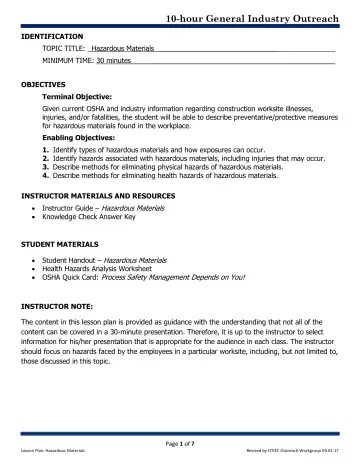
7 slidesHazardous Materials: Lesson Plan (OSHA 10-Hour General Industry Outreach)
Instructor lesson plan (objectives, timing, teaching steps) for the OSHA General Industry hazardous materials outreach deck.
U.S. Department of Labor, OSHA (with the OTIEC Outreach Workgroup)Public domain
pdf
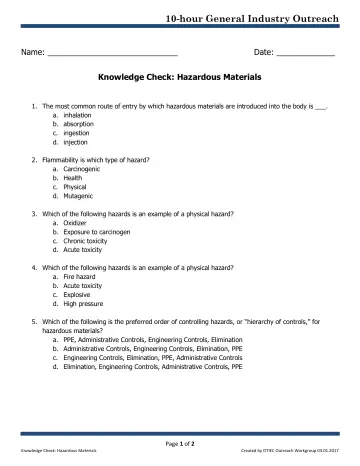
2 slidesHazardous Materials: Knowledge Check (OSHA 10-Hour General Industry Outreach)
Student knowledge-check quiz for the OSHA General Industry hazardous materials outreach deck.
U.S. Department of Labor, OSHA (with the OTIEC Outreach Workgroup)Public domain