1 / 3Use ← → to flip
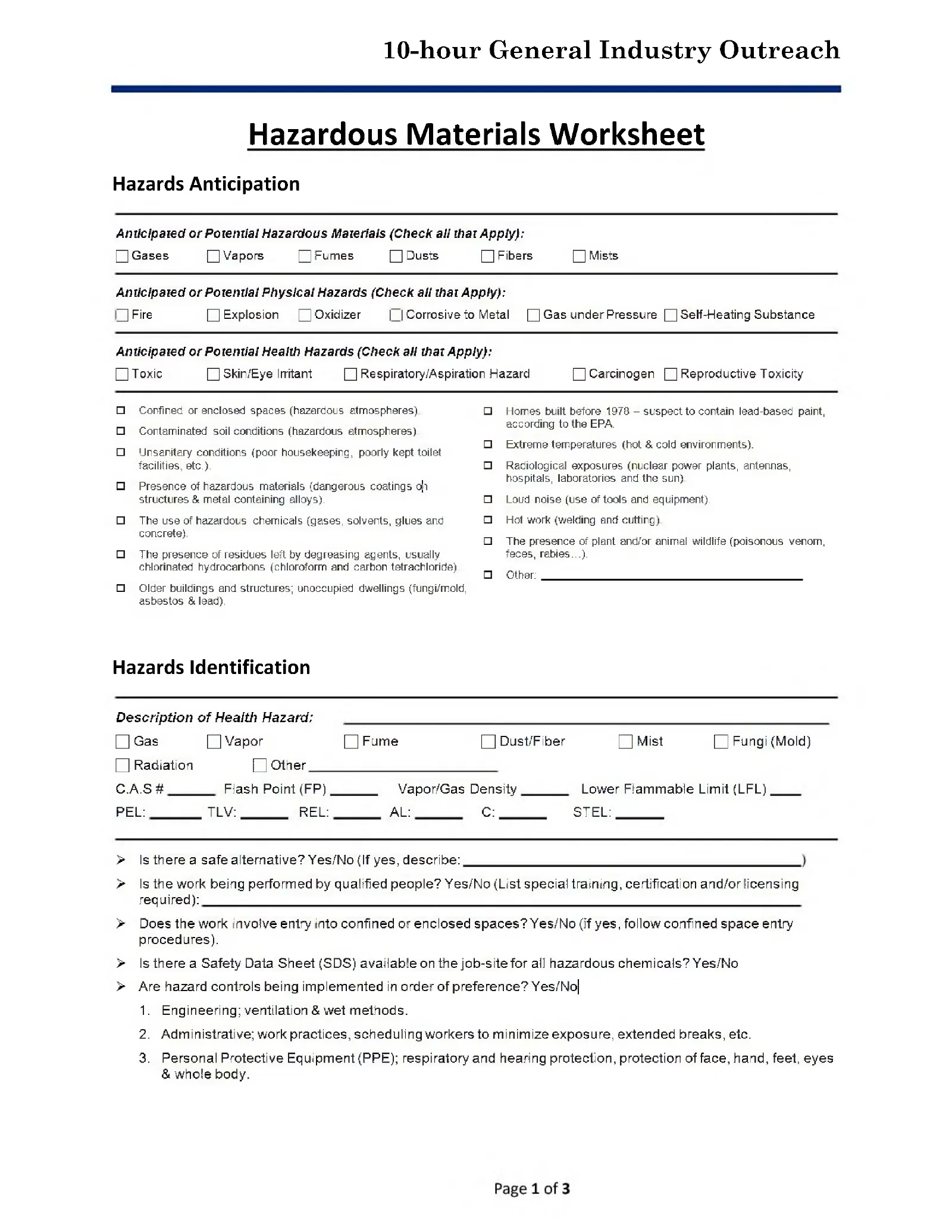
Hazardous Materials: Student Worksheet (OSHA 10-Hour General Industry Outreach)
Student worksheet used with the OSHA General Industry hazardous materials outreach deck.
Page text
· 3 pages · by U.S. Department of Labor, OSHA (with the OTIEC Outreach Workgroup)
The words on each page as the author wrote them, read from the file by software so they can be searched. Layout, pictures and tables are not shown here: the pages above and the download are the original.
- Page 1
Hazardous Materials Worksheet
- 10-hour General Industry Outreach
- Hazards Anticipation
- Anticipated or Potential Hazardous Materials (Check all that Apply):
- Gases
- Vapors
- Fumes
- Dusts
- Fibers
- Mists
- Anticipated or Potential Physical Hazards (Check all that Apply):
- Fire
- Explosion
- Oxidizer
- Corrosive to Metal
- Gas under Pressure □ Self-Heating Substance
- Anticipated or Potential Health Hazards (Check all that Apply):
- Toxic
- Skin/Eye Irritant
- Respiratory/Aspiration Hazard
- Confined or enclosed spaces (hazardous atmospheres)
- Contaminated soil conditions (hazardous atmospheres)
- Unsanitary conditions (poor housekeeping, poorly kept toilet facilities, etc.).
- Presence of hazardous materials (dangerous coatings on structures & metal containing alloys).
- The use of hazardous chemicals (gases, solvents, glues and concrete)
- The presence of residues left by degreasing agents, usually chlorinated hydrocarbons (chloroform and carbon tetrachloride)
- Older buildings and structures; unoccupied dwellings (fungi/mold, asbestos & lead).
- Carcinogen □ Reproductive Toxicity
- Homes built before 1978 - suspect to contain lead-based paint, according to the EPA.
- Extreme temperatures (hot & cold environments).
- Radiological exposures (nuclear power plants, antennas, hospitals, laboratories and the sun)
- Loud noise (use of tools and equipment).
- Hot work (welding and cutting)
- The presence of plant and/or animal wildlife (poisonous venom, feces, rabies...).
- Other:___
- Hazards Identification
- Description of Health Hazard:
- Gas
- PEL:
- Mist
- Dust/Fiber
- Fungi (Mold)
- Other
- Radiation
- C.A.S#
- Fume
- Vapor
- Flash Point (FP)
- TLV:
- REL:
- Vapor/Gas Density
- Lower Flammable Limit (LFL)
- AL:
- STEL:
- C:
- Is there a safe alternative? Yes/No (If yes, describe:
- Is the work being performed by qualified people? Yes/No (List special training, certification and/or licensing required):
- Does the work involve entry into confined or enclosed spaces?Yes/No (if yes, follow confined space entry procedures).
- Is there a Safety Data Sheet (SDS) available on the job-site for all hazardous chemicals? Yes/No
- Are hazard controls being implemented in order of preference? Yes/No
- 1. Engineering; ventilation & wet methods.
- 2. Administrative; work practices, scheduling workers to minimize exposure, extended breaks, etc.
- 3. Personal Protective Equipment (PPE); respiratory and hearing protection, protection of face, hand, feet, eyes & whole body.
- Page 2
10-hour General Industry Outreach
- Hazards Evaluation
- Health Hazard Route of Entry(s) ð Inhalation □ Ingestion
- Absorption □ Injection
- Accessible Pages : 8OCR Pages : 0Fillable Pages : 0 Other
- Environmental & Personal Air Monitoring:
- Air monitoring does not measure you or what you are doing, but rather what you are exposed to on the job,
- Air monitoring must be done by a trained health professional (industrial hygienist or technician).
- Monitoring can be done by measuring the air in a fixed location in the work area (area monitoring) or by placing the monitoring equipment on individual workers and measuring the amount they are exposed to (personal monitoring).
- Hazard Evaluation (Employee Exposure Monitoring and/or Medical Surveillance)
- Exposure Records: TWA:
- C;
- (This information must be maintained by employer for 30 years.)
- STEL:
- Medical Records (List):
- (This information must be maintained by employer for duration of employment, plus 30 years.)
- Hazards Control (Engineering)
- Engineering Controls (Select engineering controls to be implemented):
- Dust suppression (wet methods');
- Dust collection systems (vacuum);
- General (dilution) ventilation; works best when air contaminants are widely disbursed through the area.
- Local (exhaust) ventilation system; works well when air contaminants are generated at a single source.
- Describe mechanical ventilation system used:
- General (Dilution) Ventilation...
- Local (Exhaust) Ventilation...
- Forces fresh air into an area and dilutes contaminants; this allows air to move through a space which ensures a fresh continual supply.
- Removes contaminated air at its source; this prevents harmful dust, fumes & mists from contaminating the breathing air of the worker.
- If no engineering controls are being implemented, person authorizing the non-use of engineering controls:
- Name:
- Date:
- Reason (explain):
- Page 3
10-hour General Industry Outreach
- Hazards Control (Administrative)
- Administrative Controls (used with personal protective equipment):
- Gather all specialty equipment, including, ventilators, warning signs, personal protective equipment, etc. (list all specialty equipment needed for job):
- Operations that involve toxic substances are scheduled at times when other workers are not present? Yes/No (describe):
- Work is isolated to just a few protected employees: signs posted and controlled access zones established? Yes/No (describe):
- Employees are rotated in and out of jobs to minimize exposure? Yes/No (describe):
- Employees removed from working around hazardous substances once they have reached a predetermined level of exposure? Yes/No (describe):
- Are hot and cold work environments considered? Yes/No (describe):
- Employees trained on proper housekeeping & good personal hygiene? Yes/No
- Employees trained on the proper procedures that minimize exposures? Yes/No
- Employees trained on how to inspect and maintain process and equipment on a regular basis? Yes/No
- No eating, drinking, smoking, chewing tobacco or gum, and applying cosmetics in hazardous areas? Yes/No
- Hazards Control (PPE)
- Controlling a hazard at its source is the best way to protect workers. However, when engineering, work practices and administrative controls are not feasible* or do not provide sufficient protection, employers must provide personal protective equipment (PPE) to the employee and ensure its proper use.
- Description of personal protective equipment being used:
- Body Protection
- Gloves
- Eye/Face Protection
- Respirator □ Other
- Foot Protection
- Other
- Is the device approved? Yes/No (describe):
- Is the device appropriate for the type of hazard? Yes/No (explain):
- Is the worker wearing the device properly trained to understand the use, limitations and care instructions of the device? Yes/No (explain):
- Does the material have sufficient strength to withstand the environment? Yes/No (explain):
- Will the material withstand repeated use after contamination and decontamination? Yes/No (explain):
- Is the material flexible or pliable enough to allow end users to perform needed tasks? Yes/No (describe):
- Will the material maintain its protective integrity and flexibility under hot and cold extremes? Yes/No (explain):
More on HazMat
pptx
49 slidesHazardous Materials (OSHA 10-Hour General Industry Outreach)
OSHA's own 10-hour General Industry Outreach deck on hazardous materials (v. 03-01-17), editable PowerPoint with trainer notes.
U.S. Department of Labor, OSHA (with the OTIEC Outreach Workgroup)Public domain
pdf
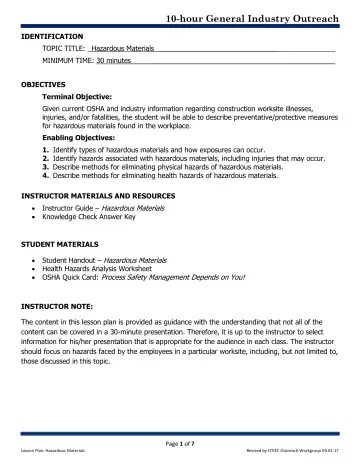
7 slidesHazardous Materials: Lesson Plan (OSHA 10-Hour General Industry Outreach)
Instructor lesson plan (objectives, timing, teaching steps) for the OSHA General Industry hazardous materials outreach deck.
U.S. Department of Labor, OSHA (with the OTIEC Outreach Workgroup)Public domain
pdf
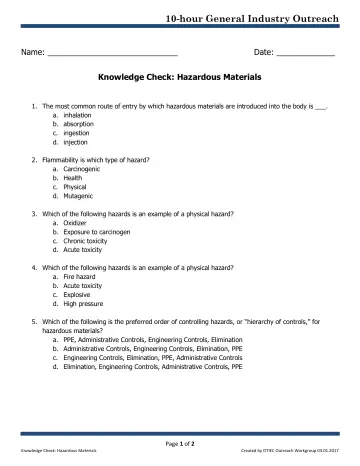
2 slidesHazardous Materials: Knowledge Check (OSHA 10-Hour General Industry Outreach)
Student knowledge-check quiz for the OSHA General Industry hazardous materials outreach deck.
U.S. Department of Labor, OSHA (with the OTIEC Outreach Workgroup)Public domain