OSHA lesson plan that goes with the Flammable Liquids training library deck.
Page text
· 3 pages · by U.S. Department of Labor, OSHA
The words on each page as the author wrote them, read from the file by software so they can be searched. Layout, pictures and tables are not shown here: the pages above and the download are the original.
- Page 1
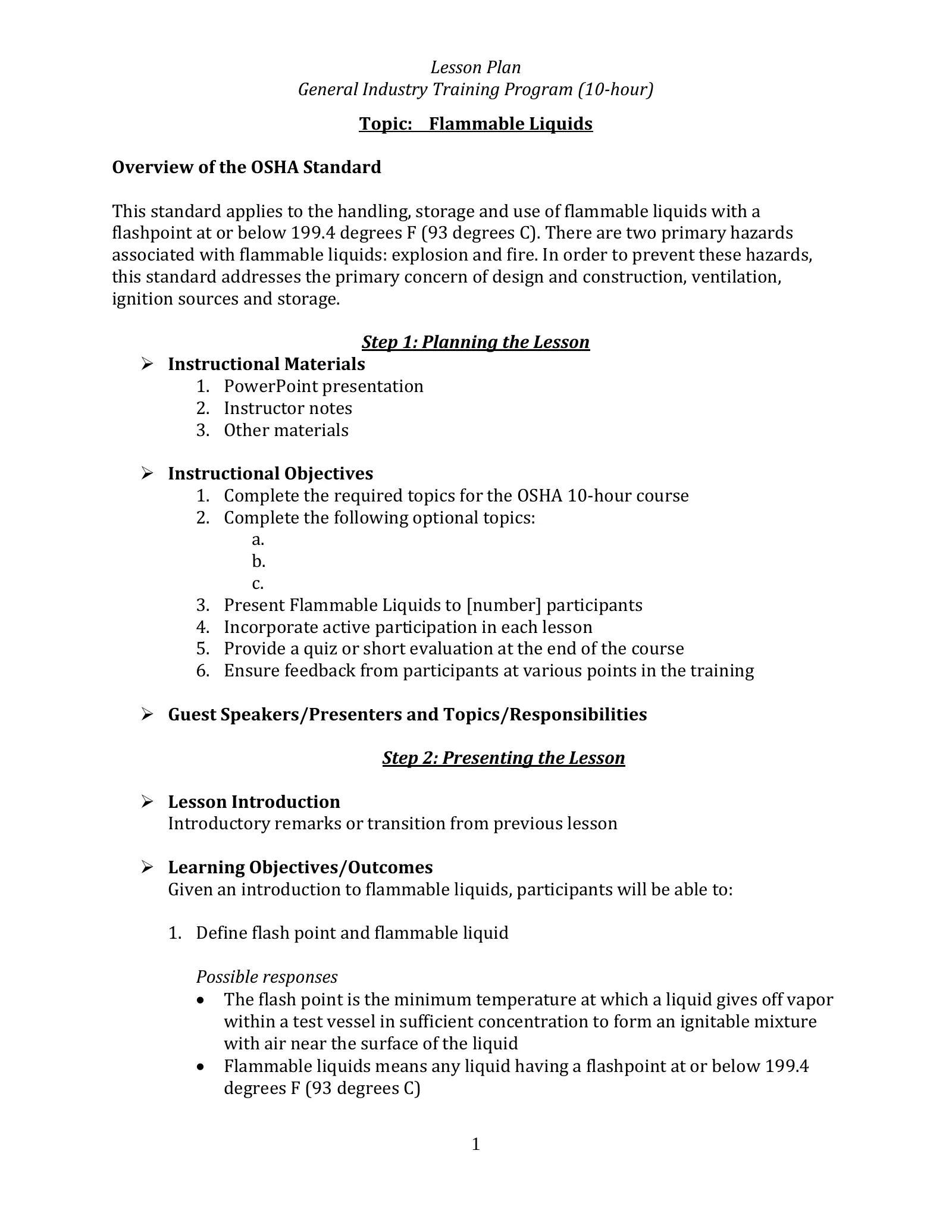
Topic: Flammable Liquids
- Overview of the OSHA Standard
- This standard applies to the handling, storage and use of flammable liquids with a flashpoint at or below 199.4 degrees F (93 degrees C). There are two primary hazards associated with flammable liquids: explosion and fire. In order to prevent these hazards, this standard addresses the primary concern of design and construction, ventilation, ignition sources and storage.
- Step 1: Planning the Lesson
- Instructional Materials
- 1. PowerPoint presentation
- 2. Instructor notes
- 3. Other materials
- Instructional Objectives
- 1. Complete the required topics for the OSHA 10‐hour course
- 2. Complete the following optional topics:
- a.
- b.
- c.
- 3. Present Flammable Liquids to [number] participants
- 4. Incorporate active participation in each lesson
- 5. Provide a quiz or short evaluation at the end of the course
- 6. Ensure feedback from participants at various points in the training
- Guest Speakers/Presenters and Topics/Responsibilities
- Step 2: Presenting the Lesson
- Lesson Introduction
- Introductory remarks or transition from previous lesson
- Learning Objectives/Outcomes
- Given an introduction to flammable liquids, participants will be able to:
- 1. Define flash point and flammable liquid
- Possible responses
- The flash point is the minimum temperature at which a liquid gives off vapor within a test vessel in sufficient concentration to form an ignitable mixture with air near the surface of the liquid
- Flammable liquids means any liquid having a flashpoint at or below 199.4 degrees F (93 degrees C)
- Page 2
- 2. Explain two ways to avoid explosion or fire.
- Possible responses
- Practice safe handling, storage, fire control and ventilation
- Ensure flammables are properly stored
- Always handle and transfer flammable liquids using proper containers; or through proper transfer systems that employ a safety faucet, a safety pump, or a closed piping system
- 3. Explain four potential sources of ignition.
- Open flames
- Smoking
- Static electricity
- Cutting and welding
- Hot surfaces
- Electrical and mechanical sparks
- Lightning
- 4. Identify actions that apply to the good plan for safe use of flammable liquids
- Control of ignition sources
- a. Identify sources of ignition
- b. Always use bonding and grounding when transferring flammable liquids into/from containers
- c. Always provide adequate ventilation to reduce the potential for ignition
- Proper Storage
- a. Identify compatible chemicals
- b. Isolate and separate incompatible materials
- c. Ensure storage doesn’t limit safe egress
- d. Store in proper area, cabinet, or container
- e. Label storage areas/cabinets
- f. Store waste and residue in covered containers and dispose of daily
- Page 3
- Fire Control
- a. Ensure proper hoses, fire extinguishers or other fire control devices are available where flammable liquids are stored
- b. Do not permit flames or smoking in areas where flammable liquids are stored
- c. Store materials that react with water in a room separate from flammable liquids
- Safe Handling
- a. Carefully read the manufacturer’s label on the flammable liquid container before storing or using it
- b. Practice good housekeeping in flammable liquid storage areas
- c. Clean up spills immediately, and then place the cleanup rags in a covered metal container
- d. Only use approved metal safety containers or original manufacturer’s container to store flammable liquids
- e. Keep the containers closed when not in use and store away from exits or passageways
- f. Use flammable liquids only where there is plenty of ventilation
- g. Keep flammable liquids away from ignition sources such as open flames, sparks, smoking, cutting, welding, etc.
- Planned Activities, Discussion or Participant Interaction
- Step 3: Evaluating Student Learning and Instruction
- Lesson Evaluation and Comments
- References
- OSHA Standard
- 29 CFT 1910.106 Subpart H – Flammable Liquids
- https://www.osha.gov/pls/oshaweb/owadisp.show_document?p_table=STANDA
- RDS&p_id=9752
- OSHA Publications
- 3088 How to Prepare for Workplace Emergencies and Evacuations
- https://www.osha.gov/Publications/osha3088.pdf OSHA References/Resources
- OSHA’s Small Business Outreach Training Program, Flammable Liquids
- https://www.osha.gov/dte/outreach/generalindustry/generalindustry_procedures.ht
- ml
- OSHA Technical Links – Ventilation
- https://www.osha.gov/SLTC/ventilation
- Self‐Inspection Checklists
- https://www.osha.gov/Publications/smallbusiness/small-business.html