1 / 75Use ← → to flip
Accident Prevention and Response Manual for Anhydrous Ammonia Refrigeration System Operators (EPA-907-B-1-9001)
EPA manual for operators of ammonia refrigeration systems: hazards, process safety and risk management requirements, and emergency response.
Page text
· 70 of 75 pages · by U.S. Environmental Protection Agency, Region 7
The words on each page as the author wrote them, read from the file by software so they can be searched. Layout, pictures and tables are not shown here, and long pages are shortened: the pages above and the download are the original.
- Page 1
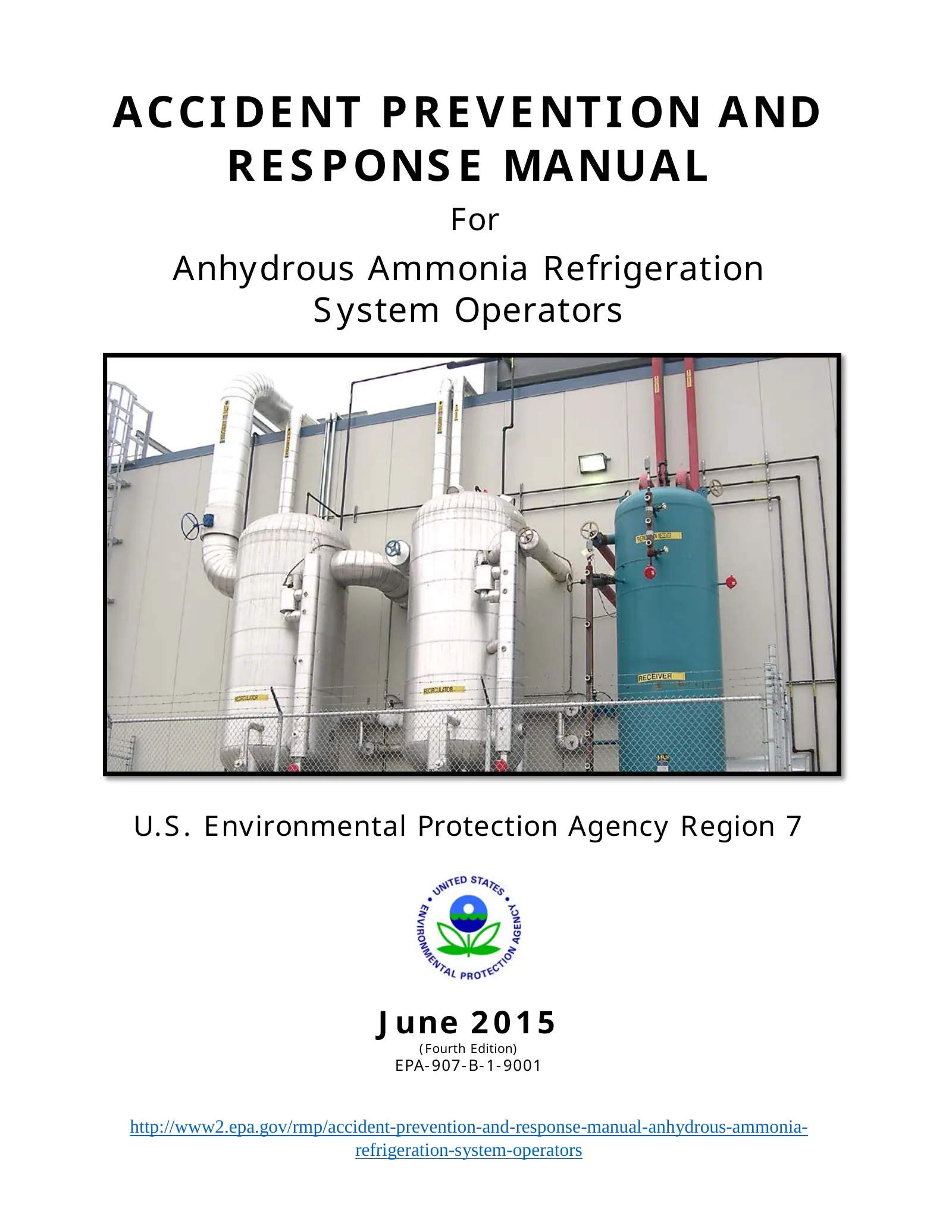
ACCIDENT PREVENTION AND RESPONSE MANUAL
- For
- Anhydrous Ammonia Refrigeration
- System Operators
- U.S. Environmental Protection Agency Region 7
- June 2015
- (Fourth Edition)
- EPA-907-B-1-9001
- http://www2.epa.gov/rmp/accident-prevention-and-response-manual-anhydrous-ammoniarefrigeration-system-operators
- Page 2
What’s this Manual All About?
- There are many laws and regulations in place to protect operators, other employees, and surrounding communities from the potential hazards of working with toxic chemicals like anhydrous ammonia.
- This manual summarizes the requirements of environmental and safety laws for anhydrous ammonia refrigeration system operators. …
- …
- Page 3
Table of Contents
- CHAPTER 1 – WHAT’S THE BIG EMERGENCY? … 1.1
- 1.1 Accidents Happen … 1.1
- 1.2 Why is Anhydrous Ammonia so Dangerous? … 1.2
- CHAPTER 2 – IS MY FACILITY A SAFETY RISK? … 2.1
- 2.1 Determine Your Responsibility … 2.1
- 2.1.1 OSHA Requirements … 2.1
- 2.1.2 EPA Requirements … 2.1
- 2.1.3 DHS Requirements … 2.3
- CHAPTER 3 – PREVENTING ACCIDENTS … 3.1
- 3.1 Work Safely … 3.1
- 3.1.1 Worker and System Protection … 3.2
- …
- Page 4
APPENDIX A – CLEAN AIR ACT (CAA) PREVENTION PROGRAM REQUIREMENTS … A.1
- A.1 Risk Management Program Level … A.1
- A.2 Program 3 Requirements … A.1
- A.2.1 Management System … A.1
- A.2.2 Hazard Assessment … A.2
- A.2.3 Prevention Program … A.2
- A.2.4 Emergency Response … A.3
- A.2.5 Risk Management Plan … A.4
- A.3 Compliance … A.5
- A.4 Deregistration … A.6
- APPENDIX B – EMERGENCY PLANNING … B.1
- B.1 Emergency Response Planning … B.1
- …
- Page 5
CHAPTER 1 – WHAT’S THE BIG EMERGENCY?
- 1.1 Accidents Happen
- Ammonia is used as a refrigerant at a large number of industrial facilities, such as:
- Cold storage warehouses and ice plants,
- Meat, poultry, or fish processing plants,
- Dairy and ice cream plants,
- Wineries and breweries,
- Fruit/vegetable juice and soft drink
- processing facilities, and
- Chemical manufacturing facilities
- …
- Page 6
1.2 Why Is Anhydrous Ammonia So Dangerous?
- Anhydrous ammonia and ammonium hydroxide are two types of ammonia commonly used in industry. This manual will focus on the “anhydrous” type, which means, “without water.” (Ammonium hydroxide is formed when ammonia gas is dissolved in water.)
- Anhydrous ammonia is very corrosive, and exposure to it may result in chemical-type burns to skin, eyes, and lungs. …
- …
- Page 7
- Ammonia is also flammable and explosive at the right concentrations, which is more likely to happen when released in a confined space, such as inside a building. It can be ignited by something as common as the electric flash from a switch.
- The best first aid is to prevent the injury in the first place. Preventing accidents not only keeps employees healthier and more productive, it saves a lot of wasted time and money from…
- …
- Page 9
CHAPTER 2 - IS MY FACILITY A SAFETY RISK?
- 2.1 Determine Your Responsibility
- Keeping employees, emergency workers, and the surrounding community safe is of utmost importance. Therefore, Congress has enacted laws requiring facilities who handle hazardous chemicals to have a plan in place to prevent accidents and a plan on how to respond to emergencies that might occur. The provisions of some of these laws are summarized below.
- …
- Page 10
- Under Section 112(r) of the Clean Air Act (CAA) and Title 40 of the Code of Federal Regulations (CFR), Part 68, owners and operators of stationary sources are required to develop Risk Management Programs for each regulated substance in a process http://www.ecfr.gov/cgi-bin/textidx?tpl=/ecfrbrowse/Title40/40cfr68_main_02.tpl.
- The goal of EPA’s Risk Management Program is to prevent or minimize consequences of accidental…
- …
- Page 11
∗ Security vulnerability assessments, ∗ Develop site security plans, and
- Commission. For additional information on these reporting requirements, please visit http://www2.epa.gov/epcra.
- 2.1.3
- DHS Requirements
- The Department of Homeland Security (DHS) regulates chemical facilities that “present high levels of security risk.” In Section 550 of the Homeland Security Appropriations Act of 2007 (P.L. …
- …
- Page 12
Program thresholds. (See Table 2.1 for more anhydrous ammonia thresholds.)
- Visit http://www.dhs.gov/publication/csat-ts-questions to review the CSAT Top Screen Questions Guide.
- DHS has defined “risk-based performance standards for chemical facilities.”
- A performance standard specifies the outcome required, and allows the company to determine how the outcome is achieved. …
- …
- Page 13
Table 2.1. Threshold/Reportable Quantities for Anhydrous Ammonia
- Agency/Program (Code of Federal Register)
- Threshold Quantity (TQ)
- Reportable Quantity (RQ)
- (pounds)
- OSHA PSM (29 CFR 1910.119)
- TQ 10,000
- EPA Risk Management Program (40 CFR Part 68)
- TQ 10,000
- EPA General Duty Clause [CAA 112(r)(1)]
- EPA EPCRA* 313, Toxic Release Inventory (40 CFR 372)
- Less than TQ of 10,000
- “Otherwise Used” TQ
- 10,000
- …
- Page 15
CHAPTER 3 - PREVENTING ACCIDENTS
- 3.1 Work Safely
- As mentioned in Chapter 1, ninety six (96) percent of accidents are preventable through increased operator training, improved procedures, and better communication of lessons learned.
- A major component of working safely is to develop and implement recognized and generally accepted good engineering practices (RAGAGEP) at your facility. …
- …
- Page 16
- 3.1.1
- Worker and System Protection
- Personnel at ammonia refrigeration facilities should be aware of the hazards associated with anhydrous ammonia releases and the measures that can be taken to prevent such releases.
- The best and most simple rule of thumb is to “Keep the ammonia in the system”.
- Safety practices where EPA inspectors frequently note deficiencies are described, as follows:
- Develop Operating Procedures
- …
- Page 17
Oil Removal
- For proper system maintenance, refrigeration oil should be removed from the refrigeration system as needed. The majority of plants with industrial ammonia refrigeration systems utilize an oil pot which is a vessel equipped with an oil drain valve in series with either a self-closing or manual quick-closing emergency stop valve connected to the oil drain point, a vent line, a vent line isolation valve, and an…
- …
- Page 18
- Operator with plant-required personal protective equipment donned performing an oil drain.
- Note the oil pot is not frosted during the actual oil draining.
- Also note the second operator in the background behind the oil pot serving as a backup.
- For more detailed information on oil management, please refer to “The Cold Front” Newsletter Vol. 14 No. 3, 2014 by the Industrial Refrigeration Consortium, which may be found at…
- …
- Page 19
Example of structural horizontal barriers
- Protect Equipment, Tanks, Piping
- Forklifts, hand trucks, and other maintenance vehicles can and have caused ammonia releases after damaging unprotected components of ammonia refrigeration systems.
- It is good practice to provide barriers or establish safety procedures to protect refrigeration equipment (e.g., pipes, valves, evaporator coils, tanks, vessels, etc.) likely to be damaged.
- …
- Page 20
Example of an ammonia detection device.
- Install, Maintain, and Inspect Ammonia Detector Systems
- IIAR 2 requires at least two (2) ammonia detectors in the machinery room to monitor for leaks. In addition, consider installing detectors in areas where a leak could occur or an area which is not manned 24 hours per day and 7 days a week. …
- …
- Page 21
- There are numerous codes and standards that have requirements related to ammonia detection system design, including IIAR 2 (Addendum B), ASHRAE 15, NFPA-1, UMC, IFC, and IMC. In addition to these, many insurance carriers impose their own requirements to mitigate the risk of loss of life and product in a facility. …
- …
- Page 22
- The following table specifies ammonia alarm system requirements per code.
- IIAR-2B 2012
- ASHRAE 15
- 2013
- NFPA 1 2012
- General
- Machinery Room
- De-energize compressors, pumps, NC valves
- 40,000 PPM or upper limit of detector
- 40,000 PPM
- De-energize all electrical
- IFC 2012
- Comply with IIAR2, ASHRAE
- Comply with IMC - 2012
- 25 PPM
- Manual reset inside machine room
- 25 PPM* “Approved locations”
- IMC 2012
- NFPA 72 2010
- …
- Page 23
- Constant ventilation in a machinery room is an option available in place of ammonia detection devices per the American National Standards Institute/American Society of Heating, Refrigerating and Air-Conditioning Engineers (ANSI/ASHRAE) 15-2014 Safety Standard for Refrigeration Systems. When ammonia is used, the machinery room is required to meet Class I, Division 2, of the National Electric Code (NEC), unless:
- …
- Page 24
Install Check Valves in Ammonia Charging Line
- Facilities should consider installing a manual check valve in the ammonia charging line in a location close to the main control valve. This check valve can be used to isolate any problems associated with the main control valve and prevent release or removal of ammonia through the charging line.
- Configure Remote Operation of Solenoid Valve on King Valve Line
- …
- Page 25
The RAGAGEP for labeling ammonia piping is IIAR B114, as depicted below.
- Color Coding, Labeling, and Signage
- Using a color-coding and/or a labeling system helps to ensure the facility’s engineering drawings or piping and instrumentation diagrams (P&IDs) are up-to-date and reduces the chances of errors in the facility’s operating procedures.
- 1. Use piping abbreviations to properly identify system components.
- …
- Page 26
- Uniquely label all pipes, valves, and instrumentation.
- Some examples include:
- Identify the king valve and all other emergency isolation valves with large, easily identifiable placards to be used in an emergency.
- Clearly and consistently indicate the king valve and all other emergency isolation valves on the P&IDs and any process flow or control logic diagrams.
- …
- Page 27
- Distinguish and label storage cabinets used for emergency response equipment, supplies, and reference materials.
- Consider whether signs should be posted in other languages in addition to English.
- 3.1.2
- System Operations and Maintenance
- In accordance with 40 CFR 68.73, “Mechanical Integrity” procedures must be written and implemented to maintain the ongoing integrity of process equipment. …
- …
- Page 28
- During design of new systems or retrofitting of existing systems, most facilities are using computer controls to monitor, record, and alarm process parameter conditions 24 hours per day. This does not replace essential operator duties of conducting rounds at least daily, which includes walking the system to observe the operation and detect any abnormalities by seeing, hearing, smelling, etc.
- …
- Page 29
Track Ammonia Purchases and Distribution of Ammonia in Your System
- Keep an accurate record of the initial amount of ammonia purchased and any additional replacement charges of ammonia. This data is not only critical for trend and operations analysis, but it also is necessary to determine if system-wide ammonia releases are occurring. …
- …
- Page 30
Piping and Instrumentation Diagrams
- Facilities must maintain complete and accurate piping and instrumentation diagrams (P&IDs) of the ammonia refrigeration system and the equipment manufacturer’s documentation. A P&ID is a set of drawings or detailed schematics that illustrate all components (e.g., vessels, valves, pumps, and piping) of the refrigeration system. …
- …
- Page 31
Conduct a Periodic Process Hazard Analysis
- A Process Hazard Analysis (PHA) is used to identify, evaluate, and control hazards that exist within the facility. These hazards have the potential to lead to the release of ammonia with the further prospect of causing on-site injury, infrastructure damage, or offsite consequences. …
- …
- Page 32
System Inspections
- 3.1.3
- Conducting inspections is one of the system operator’s most valuable tools for preventing unnecessary accidents due to equipment failure.
- Conduct Visual Testing
- Visual inspections are relatively inexpensive and provide a great deal of valuable information to the system operator. To monitor the condition of the ammonia refrigeration system, the person inspecting the system should note any corrosion of…
- …
- Page 33
Conduct Vibration Testing
- Depending on the nature of equipment at the site, some facility operators may elect to perform vibration testing on rotating equipment (i.e., compressors and pumps). These usually are performed to supplement the maintenance practices to indicate when equipment overhauls should be performed. …
- …
- Page 34
Property Security
- Facilities should also provide awareness training to other facility personnel who work within ammonia refrigerated areas. Awareness training of the hazards associated with ammonia accidents should be conducted in a manner that encourages immediate reporting of ammonia system damage and releases. …
- …
- Page 35
- Consider setting up a valve protection program for critical valves that would cause a significant release if opened by mistake. For example, install a check valve in the ammonia charging line close to the main control valve. In addition, evaluate the benefits of installing lockable, quarter-turn ball or globe valves, or spring-loaded ball or globe valves in series with a manual valve in critical areas (e.g., ammonia supply…
- …
- Page 36
Other RAGAGEP
- The Center for Chemical Process Safety (www.aiche.org/ccps) develops engineering and management practices to prevent and mitigate consequences of catastrophic events involving chemical releases.
- The National Safety Council (www.nsc.org) provides general safety information on chemical and environmental issues.
- The Energy Security Council (www.energysecuritycouncil.org) is a national industry association that…
- …
- Page 37
American Society of Heating Refrigerating and Air-Conditioning Engineers (ASHRAE)
- ASHRAE Standard 15-2013 “Safety Standard for Refrigeration Systems” clarifies location requirements for machinery room mechanical ventilation, harmonizes Standard 15 with the 2012
- International Mechanical Code (IMC) section
- 1101.10.
- ASHRAE Standard 34-2013 “Designation and
- …
- Page 38
Factory Mutual Global Property Loss Prevention Data Sheet 12-61; Pressure Vessels, Mechanical
- Refrigeration (May 2002)
- This data sheet applies to mechanical (compression type) refrigeration systems found in food processing and storage, chemical processes, biomedical applications and office buildings.
- This data sheet provides loss prevention recommendations, support for those recommendations and inspection guidelines.
- …
- Page 39
- ANSI/IIAR Standard 4-2015 “Installation of Closed-Circuit Ammonia Refrigeration Systems” serves as a standard for the installation of closedcircuit ammonia mechanical refrigeration systems and overpressure protection relief piping systems.
- ANSI/IIAR Standard 5-2013 “Start-up and Commissioning of Closed-Circuit
- Ammonia Refrigeration Systems” specifies criteria and procedures of the startup and commissioning of closed-circuit…
- …
- Page 40
IIAR Bulletins
- IIAR Bulletins may be found at http://www.iiar.org/iiar/WCM/Store/Bulletins/WCM/IIAR_Publications/Bulletins.aspx?hkey=edfd130e-9f58-43c9-979a-1f18dc8c8a9a.
- IIAR B108 “Water Contamination in Ammonia Refrigeration Systems”
- IIAR B109 “Minimum Safety Criteria for a Safe Ammonia Refrigeration System”
- IIAR B110 “Start-up, Inspection and Maintenance of Ammonia Mechanical Refrigerating Systems”
- …
- Page 41
CHAPTER 4 - WHAT TO DO WHEN THERE IS AN ACCIDENT
- 4.1
- Be Prepared
- Not knowing how to respond in an emergency often makes the situation worse. It is important to develop a suitable plan for emergency response, meet the local emergency responders, and to practice your plan.
- Facilities whose
- employees do not
- respond to chemical
- emergencies, would
- merely take steps to safely shut down the process and evacuate personnel. …
- …
- Page 42
The risk management emergency response program requires the following elements:
- An emergency response plan. Your emergency response plan must be specific to the operations and layout of your facility and must be maintained and kept at your facility. Each emergency response plan is to include:
- Procedures for informing the public and local emergency response agencies about accidental releases.
- …
- Page 43
- Notification, reporting, and response requirements are summarized in the following table. The first notification should be made to the local responders, since they are needed immediately*. The next notification should be made to the state, followed by the National Response Center.
- Subject
- Law and Regulation
- Who to Notify
- When
- EPCRA Release Notification
- (≥ 100 pounds of anhydrous ammonia)
- EPCRA
- 40 CFR 355
- …
- Page 44
Immediate Accident Reporting
- In accordance with 40 CFR 355.40, a facility is to immediately report ammonia releases producing potential offsite exposure exceeding 100 pounds to all Local Emergency Planning Committee (LEPCs) and State Emergency Response Commission (SERCs) of the area likely to be affected. The release report is to include:
- Chemical name or identity of all substances involved in the accident;
- …
- Page 45
Investigations
- The facility owner or operator also is required to provide a written Follow-up
- Emergency Notice as soon as possible
- (and within 30 calendar days) to their
- LEPC and SERC after a release that requires notification.
- The written follow-up notice should include the following:
- An update of all previously provided information;
- Actions taken to respond to the release;
- …
- Page 46
- The goal of an accident investigation is to determine the root causes or management system failures that ultimately caused the ammonia release. Efforts to determine the facts, conditions, circumstances, and probable causes of ammonia releases can help to reduce the likelihood of their recurrence. …
- …
- Page 47
APPENDIX A - CLEAN AIR ACT (CAA) PREVENTION PROGRAM REQUIREMENTS
- This appendix highlights the basic CAA 112(r) Risk Management Program requirements. For a detailed description of all requirements under this program, please visit: http://www2.epa.gov/rmp/guidance-facilities-risk-management-programs-rmp
- A.1
- Risk Management Program Level
- Most ammonia refrigeration processes are Program 3, because they are covered by OSHA Process…
- …
- Page 48
A.2.2 HAZARD ASSESSMENT
- Document names of people or positions and define lines of authority through an organizational chart or other similar document.
- A Hazard Assessment must include an offsite consequence analysis (OCA) for each covered process as follows:
- For worst-case and alternative release scenarios, potential exposures to human populations must be quantified and potential environmental damage must be identified;
- …
- Page 49
- Ammonia refrigeration facilities are also subject to OSHA’s PSM standards. Many of OSHA’s PSM requirements are very similar to the EPA Risk Management Program requirements as demonstrated in the following table:
- Risk Management Plan (EPA)
- Process safety information
- Process Hazard Analysis
- Operating Procedures
- Employee participation
- Training
- Contractors
- Pre-Startup Safety Review
- Mechanical Integrity
- Hot Work permit
- …
- Page 50
A.2.5 RISK MANAGEMENT PLAN
- A Risk Management Plan (RMP) is a document which reflects the status of a facility’s Risk Management Program. In addition to including a summary of general facility information, the hazard assessment, the prevention program, and the emergency response program, the RMP includes an executive summary. Guidance on preparing and electronically submitting an RMP may be found at http://www2.epa.gov/rmp.
- …
- Page 51
RMPs must be revised and resubmitted at least once every five years.
- RMP Corrections and Updates
- In accordance with 40 CFR 68.190, a facility is required to electronically update their RMP:
- At least every five (5) years from the date of the initial submission;
- No later than the date a regulated substance is present at or above the threshold quantity;
- …
- Page 52
A.4 Deregistration
- Identify and correct corrosion on ammonia vessels, piping, and structural supports;
- Retest, calibrate, and replace ammonia sensors found inoperable;
- Stock spill booms (specific for ammonia) to limit flow of released ammonia;
- Perform vibration testing and trend analysis on all motor/compressors every six (6) months;
- Replace pressure safety valves after they have been activated or every 5 years, whichever…
- …
- Page 53
APPENDIX B - EMERGENCY PLANNING
- B.1
- Emergency Response Planning
- Effective emergency response planning is proactive and ongoing. EPA interprets “response” to be consistent with OSHA’s Hazardous Waste Operations and Emergency Response (HAZWOPER) Standard (29 CFR 1910.120). OSHA defines emergency response as, “a response effort by employees from outside the immediate release area or by other designated responders...to an…
- …
- Page 54
B.2 Emergency Response Program
- Any spill of anhydrous ammonia, regardless of quantity, will require a “response” effort due to immediate ammonia volatilization, the hazardous nature of ammonia gas dispersing into the environment, and human health risks to on-site and off-site people.
- Any facility whose employees will respond to an accidental release is required to develop and implement an EPA Emergency Response Program in…
- …
- Page 55
National Response Center 800-424-8802
- Emergency Response Procedures
- The ERP must contain procedures and measures for emergency response after an accidental release of a regulated substance. Some of these procedures and measures may include:
- Emergency Contact Information
- Prepare an easily accessible list of Emergency contact information including, at a minimum:
- The National Response Center State Emergency Response Commission
- …
- Page 56
Mitigation Procedures
- Procedures included in an ERP should involve mitigation activities to protect workers and the public from further exposure to hazards. In general, public health officials, EMS personnel, and criminal investigators should work together to identify and mitigate hazards following an event. …
- …
- Page 57
B.2.2 EMERGENCY RESPONSE EQUIPMENT
- The Emergency Response Program must include procedures for inspecting, testing, and maintaining emergency response equipment. Emergency equipment should be inspected and tested regularly to ensure respirators and other equipment are maintained, available, and accessible. Air-purifying respirators must have appropriate and unexpired cartridges. …
- …
- Page 58
- A facility must conduct training, evaluate its program, maintain emergency equipment, and regularly coordinate with local agencies in order for an EAP/ERP to be useful in an emergency.
- Include Local Emergency Medical Service (EMS) Personnel in your Planning and Practice
- In an emergency, an integrated EMS response is critical. People seriously injured by a hazardous material have a greater chance of recovery when:
- …
- Page 59
- The absence of EMS personnel in emergency response planning has resulted in the following types of problems:
- Poorly managed incidents by facility personnel and first responders;
- Ineffective and/or redundant communication channels between private and public sectors;
- Medical facilities inadequately prepared to treat or manage incoming patients involved in hazardous materials incidents; and
- …
- Page 60
B.4 Emergency Planning and Response Guidance
- Assistance in developing an emergency response program may be found at the US National Response Team (NRT) home page:
- http://www.nrt.org/production/nrt/nrtweb.nsf/PagesByLevelCat/Level3GeneralNRT Publications?Opendocument
- The NRT home page provides links to several guidance documents, including:
- Update of Hazardous Materials Emergency
- …
- Page 61
- NIOSH Pocket Guide to Chemical Hazards,
- United States Centers for Disease Control and Prevention. Provides ten relevant databases, including recommendations for chemical protective clothing, toxicologic chemical reviews, and the Emergency
- Response Guidebook. For the most up to date information, view the pocket guide electronically at: http://www.cdc.gov/niosh/npg/
- …
- Page 63
APPENDIX C – GOVERNMENT REQUIREMENTS
- C.1
- Federal Requirements
- When it comes to managing your facility in accordance to environmental laws, the Environmental Protection Agency’s laws and regulations are not the only ones to consider. Federal statutes and regulations relevant to anhydrous ammonia process safety, accident prevention, emergency planning, and release reporting are summarized in the table below. …
- …
- Page 64
Statute and Regulation
- CAA
- 40 CFR 608
- Clean Water Act
- (CWA)
- 40 CFR 112
- CWA
- 40 CFR 117.21
- Description
- Source(s)
- Regulates the use, recycling, and disposal of certain ozone-depleting substances (ODS) in applications including industrial processes and commercial refrigeration systems. The rules apply to systems that contain chlorofluorocarbon (CFC) or hydrochloroflurocarbon (HCFC) refrigerants or refrigerant mixtures containing…
- …
- Page 65
Statute and Regulation Description Source(s)
- Community Emergency Planning
- EPCRA
- 40 CFR 355.10
- Facilities that have ammonia equal to or greater than the threshold planning quantity (TPQ) of 500 pounds must report to their Local Emergency Planning Committee (LEPC) and State Emergency Response Commission (SERC), and comply with EPCRA Section 302 requirements. …
- …
- Page 66
Statute and Regulation Description Source(s)
- Toxic Chemicals Release Inventory
- Manufacturing businesses with certain NAIC codes and ten or more employees that manufacture, process, or otherwise use ammonia above an applicable threshold quantity of 10,000 pounds must file annually a Toxic Chemical Release form with EPA and the state by July 1 st .
- EPCRA
- 40 CFR 372
- …
- Page 67
Statute and Regulation Description Source(s)
- Process Safety Management (PSM) Standard
- Facilities that have ammonia equal to or greater than the threshold quantity of 10,000 pounds are subject to a number of requirements for management of hazards, including process hazards analysis and maintaining mechanical integrity of equipment. Note that external threats must be considered when conducting a process hazard analysis. …
- …
- Page 68
Statute and Regulation Description Source(s)
- Spill Prevention, Control, and Countermeasure (SPCC)
- Oil Pollution Act
- (OPA) of 1990
- 40 CFR 112,
- 33 CFR 154,
- 49 CFR 194,
- 30 CFR 254
- Facilities storing oil above 1,320 aggregate gallons in containers larger than 50 gallons must prepare and implement SPCC plans.
- These plans need to address security elements such as locks, guards, access, lighting, and vandalism.
- …
- Page 69
C.2 State and Local Requirements
- The federal statutes and regulations discussed above are the primary requirements. However, state and local governmental agencies may have their own (possibly more strict) requirements that are based on the federal laws. Therefore, be sure to check applicable state and local government industrial, agricultural, chemical, and environmental requirements, including, but not limited to the…
- …
- Page 71
APPENDIX D - EDUCATION AND INFORMATION RESOURCES
- For further training about anhydrous ammonia refrigeration, visit the following websites. (Please note: The listings in this Appendix are not all-inclusive and do not constitute EPA endorsement.)
- Refrigerating Engineers & Technicians Association (RETA) provides online training which meets OSHA documenting requirements. Visit www.reta.com for additional information.
- …
- Page 73
APPENDIX E - ANHYDROUS AMMONIA HANDLING QUIZ
- The following ten (10) questions can help an individual begin to realize the range of information and knowledge required to safely handle anhydrous ammonia systems and releases. Answers follow the quiz.
- At what concentration is a person able to smell the presence of anhydrous ammonia?
- a) 0-4ppm
- b) 5-50ppm
- c) 51-100ppm
- d) 101-150ppm
- …
- Page 74
- 6. Which of the following information is the owner or operator of a Program 3 facility required to provide when verifying the completion of the operator’s training?
- a) the operator’s identity
- b) the method used to verify the operator understood the training
- c) the date of training
- d) a) thru c) are all correct
- 7. Your facility is required to notify the appropriate emergency response authorities ___ pounds of anhydrous…
- …
- Page 75
ANSWERS TO QUIZ
- 1. At what concentration is a person able to smell the presence of anhydrous ammonia?
- b) 5-50ppm (Page 1.2)
- 2. In accordance with 40 CFR 68, what is the threshold quantity for anhydrous ammonia?
- d) 10,000 pounds (Page 2.2)
- 3. Refrigeration facilities are subject to the General Duty Clause if they:
- d) All of the above are correct. (Page 3.1)
- …
More on HazMat
pptx
49 slidesHazardous Materials (OSHA 10-Hour General Industry Outreach)
OSHA's own 10-hour General Industry Outreach deck on hazardous materials (v. 03-01-17), editable PowerPoint with trainer notes.
U.S. Department of Labor, OSHA (with the OTIEC Outreach Workgroup)Public domain
pdf
7 slidesHazardous Materials: Lesson Plan (OSHA 10-Hour General Industry Outreach)
Instructor lesson plan (objectives, timing, teaching steps) for the OSHA General Industry hazardous materials outreach deck.
U.S. Department of Labor, OSHA (with the OTIEC Outreach Workgroup)Public domain
pdf
2 slidesHazardous Materials: Knowledge Check (OSHA 10-Hour General Industry Outreach)
Student knowledge-check quiz for the OSHA General Industry hazardous materials outreach deck.
U.S. Department of Labor, OSHA (with the OTIEC Outreach Workgroup)Public domain