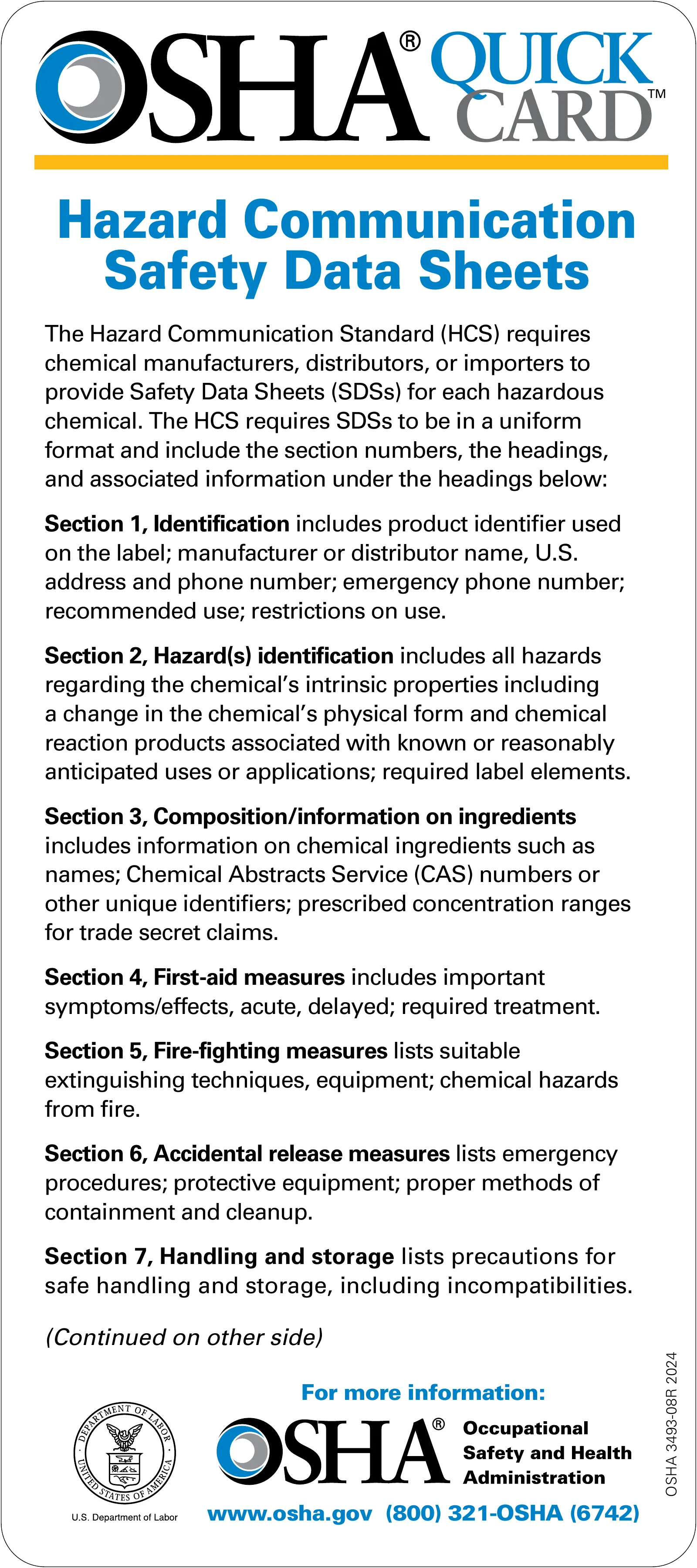
Pocket card on the 16 sections of a safety data sheet.
Page text
· 2 pages · by U.S. Department of Labor, OSHA
The words on each page as the author wrote them, read from the file by software so they can be searched. Layout, pictures and tables are not shown here: the pages above and the download are the original.
- Page 1
QUICK CARD
- TM
- Hazard Communication
- Safety Data Sheets
- The Hazard Communication Standard (HCS) requires chemical manufacturers, distributors, or importers to provide Safety Data Sheets (SDSs) for each hazardous chemical. The HCS requires SDSs to be in a uniform format and include the section numbers, the headings, and associated information under the headings below:
- Section 1, Identification includes product identifier used on the label; manufacturer or distributor name, U.S. address and phone number; emergency phone number; recommended use; restrictions on use.
- Section 2, Hazard(s) identification includes all hazards regarding the chemical’s intrinsic properties including a change in the chemical’s physical form and chemical reaction products associated with known or reasonably anticipated uses or applications; required label elements.
- Section 3, Composition/information on ingredients includes information on chemical ingredients such as names; Chemical Abstracts Service (CAS) numbers or other unique identifiers; prescribed concentration ranges for trade secret claims.
- Section 4, First-aid measures includes important symptoms/effects, acute, delayed; required treatment.
- Section 5, Fire-fighting measures lists suitable extinguishing techniques, equipment; chemical hazards from fire.
- Section 6, Accidental release measures lists emergency procedures; protective equipment; proper methods of containment and cleanup.
- Section 7, Handling and storage lists precautions for safe handling and storage, including incompatibilities.
- For more information:
- www.osha.gov (800) 321-OSHA (6742)
- OSHA 3493-08R 2024
- (Continued on other side)
- Page 2
QUICK CARD
- TM
- Hazard Communication
- Safety Data Sheets
- Section 8, Exposure controls/personal protection for chemicals listed in Section 3, lists OSHA’s Permissible Exposure Limits (PELs); ACGIH Threshold Limit Values (TLVs); and any other exposure limit or range used or recommended by the chemical manufacturer, importer, or employer preparing the SDS, where available; appropriate engineering controls; personal protective equipment (PPE).
- Section 9, Physical and chemical properties lists the chemical’s characteristics, including particle size.
- Section 10, Stability and reactivity lists chemical stability and possibility of hazardous reactions, including associated with any foreseeable emergencies.
- Section 11, Toxicological information includes routes of exposure; related symptoms, acute and chronic effects; numerical measures of toxicity; interactive effects.
- Section 12, Ecological information* Section 13, Disposal considerations* Section 14, Transport information* Section 15, Regulatory information*
- Section 16, Other information, includes the date of preparation or last revision.
- *Note: Since other Agencies regulate this information, OSHA will not be enforcing Sections 12 through 15 (29 CFR 1910.1200(g)(2)).
- Employers must ensure that SDSs are readily accessible to employees.
- See Appendix D of 29 CFR 1910.1200 for a detailed description of SDS contents.
- For more information:
- www.osha.gov (800) 321-OSHA (6742)