1 / 82Use ← → to flip
Hazard Communication and the GHS
Hazard Communication / GHS labels, pictograms and safety data sheets from Central Georgia Technical College.
Slide text
· 82 slides · by Central Georgia Technical College
The words on each slide as the author wrote them, read from the file by software so they can be searched. Layout, pictures and tables are not shown here: the slides above and the download are the original.
- Slide 1
Globally Harmonized System of Classification and Labeling of Chemicals
- (GHS)
- Slide 2
Sponsorship
- Department of Labor
- Occupational Health and Safety Administration (OSHA)
- Susan Harwood Training Grant
- This material was produced under Susan Harwood grant number SH-22315-SH1 Occupational Safety and Health Administration, U.S. Department of Labor. The contents in this presentation do not necessarily reflect the views or policies of the U.S. Department of Labor, nor does the mention of trade names, commercial products, or organizations imply endorsement by the U.S. Government.
- Revisions were made to this material under grant number SH-05059-SH8 from the Occupational Safety and Health Administration, U.S. Department of Labor.
- Slide 3
Global Harmonization System (GHS)
- Slide 4
What is GHS?
- acronym for:
- Globally
- Harmonized
- System of Classification and Labeling of Chemicals
- Slide 5
GHS
- GHS is a harmonized system for the classification and labeling of chemicals covering health, physical and environmental hazards.
- It provides a basis for the harmonization of regulations related to the handling of chemical materials at a global level.
- Elements of this system have been adopted by OSHA to classify and communicate hazards of chemicals based on a common set of criteria
- Slide 6
Three Parts of GHS
- GHS establishes
- Harmonized definitions of hazards
- Physical , health, environmental
- Specific criteria for labels
- Pictograms, signal words, hazard and precautionary statements
- Harmonized format for safety data sheets
- 16 sections (ANSI format)
- Slide 7
GHS main elements
- Classification criteria
- Standardized for health, physical and environmental hazards
- Hazard communication elements
- Labels
- Standardized elements and format
- Safety Data Sheets
- Standardized sections and format
- Slide 8
How was GHS developed?
- United Nations Organization (UN) initiative since 1992 to provide a system for the standard handling of chemicals
- The system used as reference several existing system from various countries. It is now available for adoption by competent authorities around the world.
- Revision 3 of the GHS was used by OSHA as the reference for the proposed Hazard Communication rule
- Slide 9
Principles of Harmonization
- Harmonization should not reduce the level of protection.
- Requires changes in all existing systems.
- The scope includes both hazard classification criteria and hazard communication tools (labels, SDS’s).
- Slide 10
Principles of Harmonization (cont.)
- Target audiences include consumers, workers, transport workers and emergency responders.
- Information should be presented in a comprehensive manner to all audiences
- Confidential Business Information (CBI) should be protected without compromising worker safety.
- Slide 11
Guiding Principles
- All hazardous chemicals are covered including mixtures
- The GHS does not include requirements for additional testing for health hazards nor establishes uniform test methods
- The system takes into account existing data from testing for hazard determination.
- Slide 12
Why is the GHS needed?
- The correct handling of chemicals requires that all necessary information be provided by means of labels, symbols and data sheets.
- Differences in countries regulations have resulted in non standardized information for the same material leading to mishandling and /or unsafe situations
- Slide 13
GHS Impact
- These differences impact both protection and trade.
- Protection: inconsistent information
- for the same chemical can lead to mishandling.
- Trade: compliance with multiple regulations regarding hazard classification and labelling is costly
- and time-consuming.
- Slide 14
Application of GHS
- The system is created as a “building-block” (modular) approach:
- This means that each authority / agency/ adopts the “blocks” that are applicable to existing or new regulations under their scope
- Slide 15
Building Block Approach
- Hazard classes
- Health
- Skin
- Physical
- Acute Toxicity
- Category 1-4
- Explosives
- Category 1-6
- The building blocks are the hazard classes and categories and each competent authority adopts the building blocks that are applicable to their specific sector.
- Slide 16
GHS versus OSHA’S HCS
- Slide 17
Target Sectors
- Slide 18
GHS impact 1 of 2
- Based on those sectors GHS impacts several US agencies:
- Environmental Protection Agency (EPA) Pesticides Program
- Consumer Product Safety Commission (CPSC) User end of products or materials
- Department of Transportation (DOT) Hazardous Materials Regulations
- Slide 19
GHS impact
- Occupational Safety and Health Administration (OSHA)
- Under HAZCOM, OSHA has more requirements affected
- by the GHS than any other US agency
- hazards,
- labels,
- material safety data sheets,
- training
- Main impact is on the Hazard Communication Standard which covers 945,000 hazardous chemical products and 7 million workplaces.
- Slide 20
HCS History
- First publication on Nov.1983. Only covered manufacturing sector. Final Rule was published on Aug 1987 covering all employers except for the construction industry (temporary)
- Supreme Court decision to enforce all provisions in all industrial segments was on Feb 1990.
- Publication of final rule on Feb. 1994 including technical amendments and minor changes
- Slide 21
HCS Framework
- Purpose - to ensure that the hazards of all chemicals produced or imported are evaluated, and that information concerning their hazards is transmitted to employers and employees.
- Scope – worksites where employees could be exposed to hazardous chemicals
- Slide 22
HCS Framework (cont.)
- How – transmitting information by means of a complete hazard communication program that includes:
- list of hazardous chemicals present
- container labeling and other forms of warning
- safety data sheets
- employee training
- Slide 23
Responsibilities under HCS
- OSHA requires manufacturers and importers to evaluate the hazards related to chemicals they produce or import.
- This evaluation will be changed to a hazard classification
- Employers are required to inform their employees about the hazards related to chemicals they might be exposed to and corresponding protective measures.
- Labels and safety data sheets change
- Training needs to include GHS adopted elements
- Slide 24
GHS – Hazard Classification
- Health, Physical, Environmental
- Slide 25
GHS: Environmental Hazards
- Hazardous to the Aquatic
- Environment
- Acute – injury after short
- term exposure
- Chronic – injury during the organism life cycle
- Includes fish, crustaceans, and algae or other aquatic plants
- The environmental hazards are not covered by OSHA. The competent authority for those would be EPA.
- Slide 26
GHS – Health Hazards
- Slide 27
GHS Health Hazards (10)
- Acute Toxicity
- Skin corrosion/Irritation
- Serious eye damage/eye irritation
- Respiratory or skin sensitization
- Germ cell mutagenicity
- Carcinogenicity
- Reproductive toxicity
- Target organ system toxicity – Single exposure
- Target organ system toxicity – repeated exposure
- Aspiration hazard
- Slide 28
Definitions: Health Hazards
- Acute toxicity refers to those adverse effects occurring following oral or dermal administration of a single dose of a substance, or multiple doses given within 24 hours or an inhalation exposure of 4 hours.
- Substances are assigned to one of five categories based on oral, dermal, and inhalation toxicity.
- OSHA did not adopt category 5
- Slide 29
Definitions: Health Hazards (cont.)
- Skin corrosion is defined as the production of irreversible damage to the skin; namely, visible necrosis through the epidermis and into the dermis, which was followed by the application of a test substance for up to 4 hours.
- Corrosive reactions are typified by ulcers, bleeding, bloody scabs.
- Visible damage to skin after contact with substance
- Slide 30
Definitions: Health Hazards -Skin
- Skin irritation is defined as the production of reversible damage to the skin following the application of a test substance for up to 4 hours.
- Before contact
- There are two categories for the Skin Corrosion/irritation hazard class
- After contact
- Slide 31
Definitions: Health Hazards - Respiratory
- Skin sensitizer means a chemical that induces an allergic response following skin contact.
- Respiratory sensitizer means a chemical that will lead to hypersensitivity of the airways following inhalation of the chemical.
- There are two categories for the Respiratory or Skin Sensitization
- hazard class
- Slide 32
Definitions: Health Hazards - Eyes
- Serious eye damage is defined as the production of tissue damage in the eye, or serious physical decay of vision, following application of a test substance to the anterior surface of the eye, which is not fully reversible within 21 days of application.
- Slide 33
Definitions: Health Hazards – Eyes (cont.)
- Eye irritation is defined as the production of changes in the eye following the application of test substance to the anterior surface of the eye which are full reversible within 21 days of application.
- There are two categories for eye hazards
- Slide 34
Definitions: Health Hazards - Mutagenicity
- Germ Cell Mutagenicity
- A mutation is defined as a permanent change in the amount or structure of the genetic material in a cell.
- The terms mutagenic and mutagen will be used for agents giving rise to an increased occurrence of mutations in populations of cells and/or organisms.
- Two categories in this hazard class.
- Slide 35
Definitions: Carcinogen
- Carcinogen means a substance or a mixture of substances which induce cancer or increase its incidence.
- Substances and mixtures which have induced benign and malignant tumors in well-performed experimental studies
- on animals are considered also to be presumed or suspected human carcinogens.
- Two categories in this hazard class
- Slide 36
Definitions: Reproductive Toxicity
- Reproductive toxicity means adverse effects on sexual function and fertility in adult males and females, as well as adverse effects on development of the offspring.
- Adverse effects on development
- of the offspring means any effect of chemicals which interferes with normal development of the conceptus either before or after birth.
- Two categories in this hazard
- Slide 37
Definitions: STOT
- Specific Target Organ Toxicity
- (STOT)
- Single exposure means specific, non-lethal target organ toxicity arising from a single exposure to a chemical.
- Repeated exposure
- requires more than one instance of exposure.
- Slide 38
Definitions: STOT (cont.)
- STOT is caused by chemicals that are specific target organ toxicants and, as such, present a potential for adverse health effects in people who are exposed to it.
- STOT – single
- exposure has three
- hazard categories
- STOT – repeated exposure has two
- hazard categories.
- Slide 39
Definitions: Aspiration
- Aspiration means the entry of a liquid or solid chemical directly through the oral or nasal cavity, or indirectly from vomiting, into the trachea and lower respiratory system.
- Includes severe acute effects such
- as chemical pneumonia, varying degrees of pulmonary injury or death following aspiration.
- Only one category adopted
- Slide 40
GHS – Physical Hazards
- Slide 41
GHS Physical Hazards (16)
- Explosives
- Flammable gases
- Flammable aerosols
- Oxidizing gases
- Gases under pressure
- Flammable liquids
- Flammable solids
- Self-reactive substances and mixtures
- Pyrophoric liquids
- Pyrophoric solids
- Self-heating substances and mixtures
- Substances which on contact with water emit flammable gases Oxidizing liquids
- Oxidizing solids
- Organic peroxides
- Corrosive to metals
- Slide 42
Physical Hazards - Explosives
- Explosive Substances and Mixtures
- Solid or liquid substances capable of producing gas at such a high temperature and pressure that it can cause damage to surroundings.
- Divided in 6 categories based on type of damage produced.
- Slide 43
Physical Hazards - Flammables
- Flammables include
- Flammable Gases
- Flammable Aerosols
- Flammable Liquids
- Flammable Solids
- Slide 44
Physical Hazards (cont.)
- Flammable gas means a gas having any flammable range with air at 20°C (68 F) and a standard pressure of 101.3 kPa (14.7 psi).
- Two categories
- Slide 45
Physical Hazards...
- Flammable Liquids
- Any liquid with a flash point of 93 degrees C (199.4 F) or less.
- Four categories
- Flammable Solids means a solid, usually in a powder or granular form, that is easily combustible through friction
- Two categories
- Slide 46
Aerosol
- Aerosol means any non-refillable receptacle containing a gas compressed, liquefied or dissolved under pressure, and fitted with a release device allowing the contents to be ejected as particles in suspension in a gas, or as a foam, paste, powder, liquid or gas.
- Flammable Aerosols
- Contain Flammable components
- Two categories
- Slide 47
Oxidizing
- Oxidizing gas means any gas which may, generally by providing oxygen, cause or contribute to the combustion of other material more than air does.
- One category.
- Oxidizing Liquids and Solids though not necessarily combustible on their own by yielding oxygen cause or contribute combustion of other material.
- Three categories
- Slide 48
Gases
- Gases Under Pressure
- Gases contained in a receptacle at a pressure of 200 kPa (29 psi) or more, which are liquefied or liquefied and refrigerated
- Includes 4 groups: compressed gases, liquefied gases, dissolved gases and refrigerated liquefied gases
- Slide 49
Self-Reactive Chemicals
- Self-reactive chemicals are thermally unstable liquid or solid chemicals liable to undergo a strongly exothermic decomposition even without participation of oxygen or air.
- Divided into 7 categories similar to those in the transport sector
- Excludes oxidizers, organic peroxides and explosives.
- Slide 50
Pyrophoric
- Pyrophoric Solids/ Liquids means a solid or liquid which, even in small quantities, is liable to ignite within five minutes after coming into contact with air.
- One category for each
- Slide 51
Self-Heating
- Self-Heating Chemicals
- Solids or liquids, other than pyrophoric, which by reaction with air and without energy supply is liable to self heat. Two categories
- They require large amounts of material and long periods of time to ignite.
- Slide 52
Physical Hazards Contact with Water
- Substances which on Contact with Water Emit Flammable Gas are solid or liquid chemicals which, by interaction with water, are liable to become spontaneously flammable or to give off flammable gases in dangerous quantities
- Three categories
- Slide 53
Corrosive Metals
- Corrosive to Metals means a chemical which by chemical action will materially damage, or even destroy, metals.
- One category
- Organic Peroxides means organic liquids or solids that can decompose explosively, burn rapidly, be sensitive to friction and react dangerously with other chemicals.
- 7 categories similar to those in transport sector
- Slide 54
GHS – Labels - Hazard Communication Tools
- Slide 55
Label Components
- Product identifier
- Supplier identifier
- Chemical identity
- Hazard pictograms*
- Signal words*
- Hazard statements*
- Precautionary information
- *Standardized Based on Appendixes
- Slide 56
Product Identifier
- States the identity of the chemical including all the ingredients that contribute to the hazard of the mixture.
- Unique means by which the chemical can be identified.
- Slide 57
Supplier Identification
- Supplier Information
- Name, address and telephone number of the manufacturer or supplier of the hazardous chemical.
- Slide 58
Chemical Identity
- A name that will uniquely identify a chemical. Name as determined by IUPAC or CAS, or technical name as determined by ISO.
- Slide 59
Chemical Identity – cont.
- For Mixtures
- Identities of all ingredients contributing to health hazards All ingredients that contribute to the hazard of the mixture.
- Slide 60
GHS - Pictograms
- Slide 61
Pictograms
- Display health, physical and environmental hazard information.
- New health hazard symbol.
- Slide 62
Pictogram Features
- Pictograms feature a white background with a red border instead of a solid orange background.
- Slide 63
GHS Pictograms
- Exploding bomb
- Skull and Crossbones
- Flame
- Explosives; Self Reactive; Organic
- Peroxides
- Acute toxicity (severe)
- Flammables; Pyrophorics; Self-Heating; Emits Flammable Gas; Self Reactive;
- Organic Peroxides
- Gas Cylinder
- Health Hazard
- Flame over circle
- Gases under pressure
- Carcinogen; Mutagenicity; Reproductive Toxicity; Respiratory Sensitizer; Target Organ Toxicity; Aspiration Toxicity
- Oxidizers
- Corrosion
- Exclamation mark
- Environmental
- Corrosives
- Irritant; Skin Sensitizer; Acute Toxicity (harmful); Narcotic effects; Respiratory Tract Irritant; Hazardous to Ozone Layer
- Aquatic Toxicity (OSHA did not propose this pictogram)
- Slide 64
Pictogram Shape & Color
- For transport pictograms will not change
- For other sectors pictograms will have a black symbol on a white background with a red diamond frame.
- For the same hazard where a transport pictogram appears the GHS pictogram should not appear.
- Slide 65
Transport Pictograms
- Slide 66
Signal Words
- These words are used to alert the reader of health, physical, and environmental hazards, and the hazard’s level of severity
- “Danger” and “Warning” are the only two signal words used.
- Slide 67
Pause
- Slide 68
Hazard Statements
- GHS label should include appropriate hazard and precautionary information.
- A hazard statement is a phrase assigned to a hazard class that describes the nature of the hazard, and its level of severity.
- “Highly Flammable,” “Unstable Explosive,” “Toxic if Inhaled”.
- There are three types: Physical, Health and Environmental
- Slide 69
Precautionary Information
- Phrases indicate measures recommended to help minimize or prevent the effects resulting from exposure, improper storage or handling of hazardous products
- Precautionary statements include provisions for storage, handling, response and disposal
- Appendix C contains, among other information, statements recommended for each level of hazard within each hazard class.
- Slide 70
Appendix C
- Slide 71
Precedence
- Where a chemical is classified for a number of hazards, and the precautionary statements are similar, the most stringent shall be included on the label (this will be applicable mainly as preventive measures).
- An order of precedence may be imposed by the manufacturer, importer or responsible party in situations where phrases concern “Response.”
- Slide 72
GHS: Safety Data Sheets
- Slide 73
Role of the SDS in the GHS
- Primary Use of SDS: The Workplace Employers and workers use them as an information source about hazards of a chemical substance or mixture and to obtain advice on safety precautions.
- SDS information can be used by those involved in the transport of dangerous goods and emergency responders.
- Slide 74
When is an SDS required?
- Slide 75
Safety Data Sheet content
- 1. Identification
- 2. Hazard (s) identification
- 3. Composition/ information on ingredients
- 4. First-aid measures
- OSHA requires sections 1-11 and
- 5. Fire-fighting measures
- 16 be mandatory
- 6. Accidental release measures
- 7. Handling and storage
- 8. Exposure control/ personal protection
- 9. Physical and chemical properties
- 10. Stability and reactivity
- 11. Toxicological information
- 12. Ecological information
- 13. Disposal considerations Not under OSHA jurisdiction
- 14. Transport information
- 15. Regulatory information
- 16. Other information
- Slide 76
Global Harmonization System(GHS)
- Exercises
- Slide 77
Exercise on Pictograms
- Determine the type of hazard based on the pictograms below
- Slide 78
Exercise on Pictograms – cont.
- Determine what pictogram would use the following chemical using the information provided
- 1. Material is extremely toxic to humans
- 2. Keep away from flames and sparks.
- 3. Corrosive to metals
- Slide 79
Exercise on Hazards
- Determine the type of precautionary statement (prevention, response, storage, disposal) of these materials given the following information
- 1. Wear cold insulating gloves
- 2. Dispose of contents in accordance with local regulations
- 3. If exposed: call poison center or doctor/ physician
- 4. Stored in a well ventilated place
- Slide 80
Data Sheets Exercise
- Using the data sheet provided, identify in which section of the data sheet you can find the following
- 1. Health effects
- 2. Flammability of material
- 3. Storage precautions
- 4. Toxicity of material
- 5. Material identity
- Slide 81
Labels Exercise
- With the information provided for each chemical, identify the following elements of the label. Please reference Appendix C
- 1. Pictogram
- 2. Signal words
- 3. Hazard statements
- 4. Precautionary statement
- Slide 82
HAZCOM- GHS
More on HazCom
pptx
33 slidesHazard Communication
Hazard communication training for employers and workers from Citizen Action of Wisconsin Education Fund.
Citizen Action of Wisconsin Education FundOSHA Harwood grant

pptxes
33 slidesComunicación de Riesgos Para Empleadores & Empleados En la Industria General
Spanish edition of the Citizen Action of Wisconsin hazard communication deck.
Citizen Action of Wisconsin Education FundOSHA Harwood grant
pdf
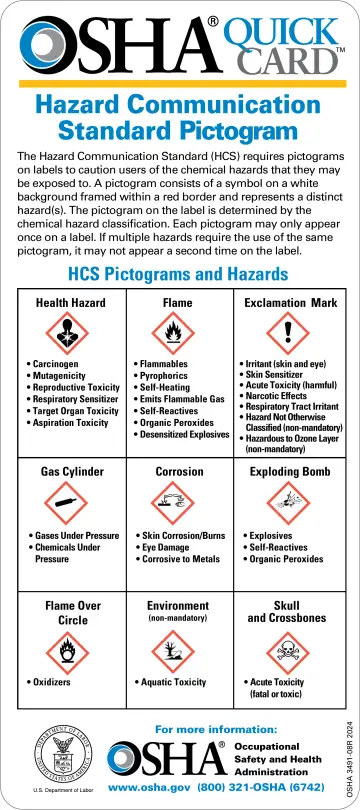
2 slidesHazard Communication Standard Pictogram QuickCard (OSHA 3491)
Pocket card showing the nine GHS hazard pictograms (English and Spanish in one file).
U.S. Department of Labor, OSHAPublic domain