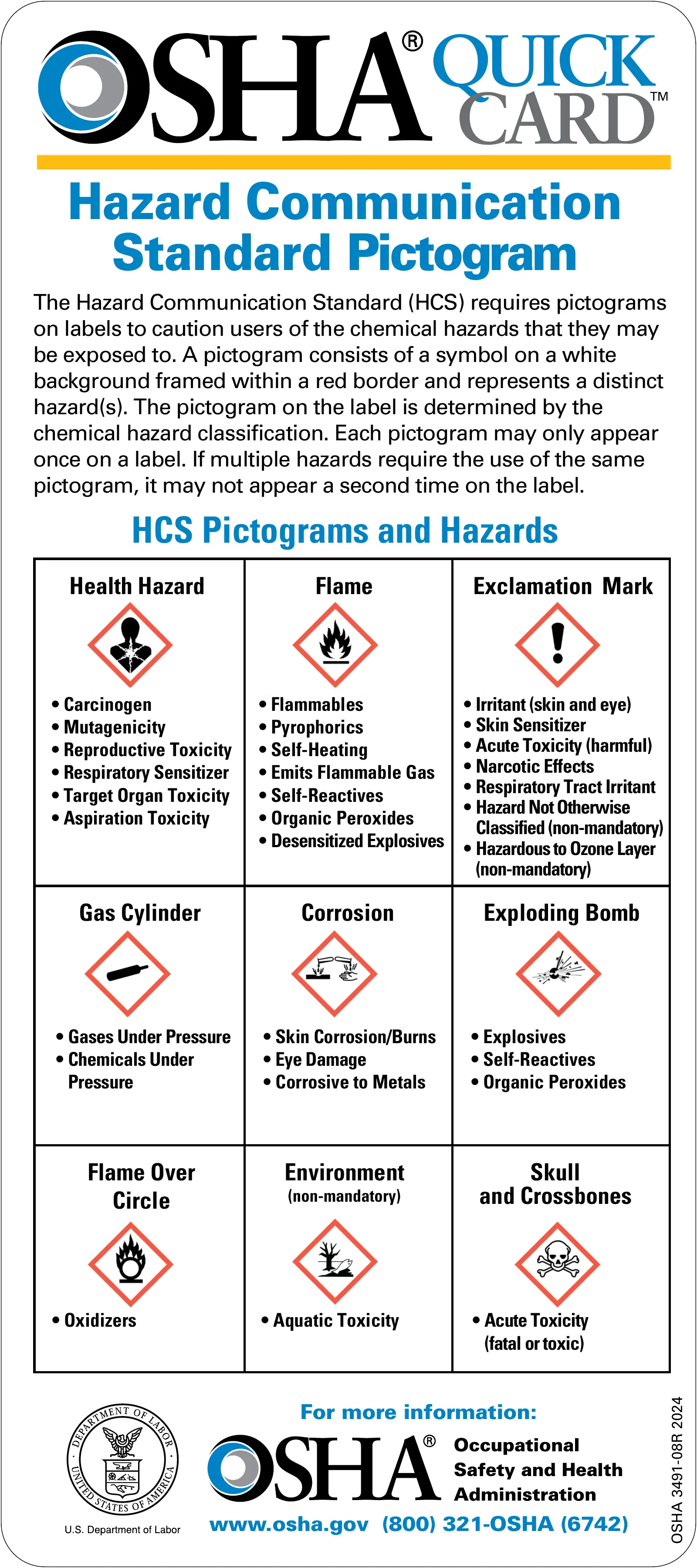
Pocket card showing the nine GHS hazard pictograms (English and Spanish in one file).
Page text
· 2 pages · by U.S. Department of Labor, OSHA
The words on each page as the author wrote them, read from the file by software so they can be searched. Layout, pictures and tables are not shown here: the pages above and the download are the original.
- Page 1
QUICK CARD
- TM
- Hazard Communication
- Standard Pictogram
- The Hazard Communication Standard (HCS) requires pictograms on labels to caution users of the chemical hazards that they may be exposed to. A pictogram consists of a symbol on a white background framed within a red border and represents a distinct hazard(s). The pictogram on the label is determined by the chemical hazard classification. Each pictogram may only appear once on a label. If multiple hazards require the use of the same pictogram, it may not appear a second time on the label.
- HCS Pictograms and Hazards
- Health Hazard
- Flame
- Exclamation Mark
- Carcinogen
- Mutagenicity
- Reproductive Toxicity
- Respiratory Sensitizer
- Target Organ Toxicity
- Aspiration Toxicity
- Flammables
- Pyrophorics
- Self-Heating
- Emits Flammable Gas
- Self-Reactives
- Organic Peroxides
- Desensitized Explosives
- Irritant (skin and eye)
- Skin Sensitizer
- Acute Toxicity (harmful)
- Narcotic Effects
- Respiratory Tract Irritant
- Hazard Not Otherwise Classified (non-mandatory)
- Hazardous to Ozone Layer (non-mandatory)
- Gas Cylinder
- Corrosion
- Exploding Bomb
- Gases Under Pressure
- Chemicals Under
- Pressure
- Skin Corrosion/Burns
- Eye Damage
- Corrosive to Metals
- Explosives
- Flame Over
- Circle
- Environment
- Skull
- and Crossbones
- Aquatic Toxicity
- Acute Toxicity (fatal or toxic)
- For more information:
- www.osha.gov (800) 321-OSHA (6742)
- OSHA 3491-08R 2024
- Oxidizers
- (non-mandatory)
- Page 2
DATOS RÁPIDOS
- Pictograma para la norma sobre la comunicación de peligros
- La norma de comunicación de peligros (HCS, por sus siglas en inglés) exige pictogramas en las etiquetas para advertir a los usuarios de los peligros químicos a los que puedan estar expuestos. Un pictograma representa un peligro definido y consiste en un símbolo sobre un fondo blanco enmarcado con un borde rojo. La clasificación del peligro químico determina el pictograma que muestra la etiqueta. Cada pictograma sólo puede aparecer una vez en la etiqueta. Si varios peligros requieren el uso del mismo pictograma, no podrá aparecer una segunda vez en la etiqueta.
- Pictogramas y peligros según la HCS
- Peligro para la salud
- Llama
- Signo de exclamación
- Carcinógeno
- Mutagenicidad
- Toxicidad para la reproducción
- Sensibilización respiratoria
- Toxicidad especifica de órganos diana
- Peligro por aspiración
- Inflamables
- Pirofóricos
- Calentamiento espontáneo
- Desprenden gases inflamables
- Reaccionan espontáneamente
- (autorreactivas)
- Peróxidos orgánicos
- Explosivos desensibilizados
- Irritante (piel y ojos)
- Sensibilizador cutáneo
- Toxicidad aguda (dañino)
- Efecto narcótico
- Irritante de vías respiratorias
- Peligro no clasificado de otro modo
- (no obligatorio)
- Peligros para la capa de ozono (no obligatorio)
- Botella de gas
- Corrosión
- Bomba explotando
- Gases a presión
- Productos químicos a presión
- Corrosión cutánea/ quemaduras
- Lesion ocular
- Corrosivo para los metales
- Explosivos
- Llama sobre círculo
- Comburentes
- Medio ambiente
- Toxicidad acuática
- Calavera y tibias cruzadas
- Toxicidad aguda (mortal o tóxica)
- Para más información:
- Administración de Seguridad y Salud Ocupacional
- Departamento de Trabajo
- de los EE. UU.
- Hilda L. Solis, Secretaria de Trabajo
- www.osha.gov (800) 321-OSHA (6742)