1 / 33Use ← → to flip
Hazard Communication
Hazard communication training for employers and workers from Citizen Action of Wisconsin Education Fund.
Slide text
· 33 slides · by Citizen Action of Wisconsin Education Fund
The words on each slide as the author wrote them, read from the file by software so they can be searched. Layout, pictures and tables are not shown here: the slides above and the download are the original.
- Slide 1
Training
- OSHA’s
- Hazard Communication (2012)
- For
- Employers & Workers
- In
- General Industry
- Slide 2
Disclaimer
- This material was produced under grant number SH-31210- SH7 from the Occupational Safety and Health Administration (OSHA), U.S. Department of Labor. It does not necessarily reflect the views or policies of the U.S. Dept. of Labor, nor does the mention of trade names, commercial products, or organizations imply endorsement by the U.S. Government.
- Disclaimer
- Slide 3
Overview of Class
- Brief History of Workplace Safety in America Introduction to OSHA
- OHS Rights & Responsibilities
- Brief History of Hazardous Materials
- OSHA Hazard Communication Standard (2012)
- 1. Container Labeling
- 2. Safety Data Sheets (SDS)
- 3. Worker Training
- Slide 4
Glossary of Acronyms Used
- Glossary of Acronyms Used
- DOL – Department of Labor
- OSHA – Occupational Safety and Health Administration OHS – Occupational Health and Safety
- HazCom – Hazard Communication
- CDC – Centers for Disease Control and Prevention NIOSH – National Institute for Occupational Safety and Health
- NIH – National Institutes of Health
- COSH – Committee/Coalition on Occupational Safety and Health
- PEL – Permissible Exposure Limit
- PPE – Personal Protective Equipment
- Slide 5
Introduction to OSHA
- With the Occupational Safety and Health Act of 1970, Congress created the Occupational Safety and Health Administration (OSHA) to assure safe and healthful working conditions for men and women by setting and enforcing standards and by providing training, outreach, education and assistance. Public Law 91-596 Introduction
- The OSH Act covers most private sector employers /workers, as well as some public sector employers/workers in 50 states and certain territories/jurisdictions.
- Slide 6
Introduction to OSHA
- The Occupational Safety and Health Act of 1970 sets out the rights and responsibilities of employers and workers
- 5(a) Each employer
- (1) shall furnish to each of his employees work and a place of employment which are free from recognized hazards that are causing or are likely to cause death or serious physical harm to his employees;
- (2) shall comply with occupational safety and health standards set forth under this Act.
- Together these are known as the General Duty Clause.
- Slide 7
Introduction to OSHA
- Some Worker rights under OSHA include:
- Right to medical exam(s) or test(s) performed for work related purposes
- Right to refuse work that could kill or seriously injure them (known as imminent danger)
- Right to know about workplace injuries and illnesses
- Right to hazard monitoring results
- Right to know what kinds of chemicals are used in their workplace
- Slide 8
Introduction to OSHA
- Some Worker rights under OSHA include:
- Right to file a complaint with OSHA
- Right to get information
- Right to have an OSHA inspection
- Right to know about hazards
- Right to health and safety training
- Right not to be discriminated against for health and safety activities
- Slide 9
A Brief History of Hazardous Materials
- The use of hazardous materials in the workplace is nothing new. Many of the hazards associated with a number of materials have been known for a long time.
- A Brief
- History
- of
- Asbestos
- Hazardous Materials
- Lead
- Slide 10
A Brief History of Hazardous Materials
- The use of hazardous materials in the workplace is nothing new. Other hazardous materials were not created or used until more “modern” times such as the 18 th , 19 th , or 20 th century.
- Benzene
- A c et
- on e
- ium
- Ca
- Vinyl chloride
- Acrylonitrile
- Diacetyl
- ne
- Me
- de i
- 4,4-
- Chrom
- Biphen
- ium (IV
- ) ol
- 1,2-dibromo-3-chloropropane
- Tolue ne
- Slide 11
Introduction to Hazard Communication
- In order to help employers and workers OSHA created Subpart Z, otherwise known as the Hazard Communication Standard. It’s stated purpose being:
- “ to ensure that the hazards of all chemicals produced or imported are classified, and that information concerning the classified hazards is transmitted to employers and employees.”
- Introduction to Hazard
- Communication
- 29 CFR 1910.1200(a)(1)
- Slide 12
OSHA’s Hazard Communication Standard
- The Hazard Communication Standard has requirements of employers to train their workers concerning hazardous chemicals and materials in the workplace.
- These requirements are the same in General Industry, Construction and Maritime Industries.
- OSHA’s Hazard
- Communication Standard
- Slide 13
OSHA’s Hazard Communication Standard
- …is intended to address comprehensively the issue of classifying the potential hazards of chemicals, and communicating information concerning hazards and appropriate protective measures to employees
- 29 CFR 1910.1200(a)(2)
- Slide 14
OSHA’s Hazard Communication Standard
- Under it’s Hazard Communication Standard OSHA requires that employers provide effective information and training to employees
- at the time of initial assignment
- when new chemical hazards arise the worker has not previously been trained about is introduced into their work area
- 29 CFR 1910.1200(h)(1)
- Slide 15
OSHA’s Hazard Communication Standard
- While information and training may cover categories of hazards or specific chemicals used by the worker the employer must ensure that chemical specific information is made available through labels and Safety Data Sheets (SDS).
- Safety Data Sheets
- Slide 16
OSHA’s Hazard Communication Standard
- Labels and other forms of warning
- The chemical manufacturer, importer, or distributor shall ensure that each container of hazardous chemicals leaving the workplace is labeled, tagged, or marked.
- 29 CFR 1910.1200(f)(1)
- Slide 17
OSHA’s Hazard Communication Standard
- Where the chemical manufacturer or importer is required to label, tag or mark the following information shall be provided: Product identifier
- Signal word
- Hazard statement(s)
- Pictogram(s)
- Precautionary statement(s)
- Name, address, and telephone number of the chemical manufacturer, importer, or other responsible party
- Slide 18
OSHA’s Hazard Communication Standard
- Labels and other forms of warning Pictograms
- 29 CFR 1910.1200 App C.2.3
- Slide 19
OSHA’s Hazard Communication Standard
- Labels and other forms of warning Workplace labeling.
- The employer may use signs, placards, process sheets, or other such written materials in lieu of affixing labels to containers, as long as the alternative method identifies the containers to which it is applicable and conveys the information required to be on a label.
- Slide 20
OSHA’s Hazard Communication Standard
- Labels and other forms of warning Workplace labeling.
- The employer is not required to label portable containers into which hazardous chemicals are transferred from labeled containers, and which are intended only for the immediate use of the employee who performs the transfer.
- (1910.1200(f)(8))
- Slide 21
OSHA’s Hazard Communication Standard
- Labels and other forms of warning Workplace labeling.
- The employer shall not remove or deface existing labels on incoming containers of hazardous chemicals, unless the container is immediately marked with the required information
- (1910.1200(f)(9))
- Slide 22
OSHA’s Hazard Communication Standard
- Labels and other forms of warning Workplace labeling.
- The employer shall ensure that workplace labels or other forms of warning are legible, in English, and prominently displayed on the container, or readily available in the work area throughout each work shift.
- Employers having employees who speak other languages may add the information in their language to the material presented, as long as the information is presented in English as well
- (1910.1200(f)(10))
- Slide 23
OSHA’s Hazard Communication Standard
- Labels and other forms of warning Workplace labeling.
- Chemical manufacturers, importers, distributors, or employers who become newly aware of any significant information regarding the hazards of a chemical shall revise the labels for the chemical within six months and shall ensure that labels on containers of hazardous chemicals shipped after that time contain the new information.
- (1910.1200(f)(11))
- Slide 24
OSHA’s Hazard Communication Standard
- Safety Data Sheets
- Chemical manufacturers and importers shall obtain or develop a safety data sheet for each hazardous chemical they produce or import.
- Employers shall have a safety data sheet in the workplace for each hazardous chemical which they use.
- (1910.1200(g)(1))
- Slide 25
OSHA’s Hazard Communication Standard
- Safety Data Sheets
- The chemical manufacturer or importer preparing the safety data sheet shall ensure that it is in English (although the employer may maintain copies in other languages as well), and includes at the required section numbers and headings, and associated information
- (1910.1200(g)(2))
- Slide 26
OSHA’s Hazard Communication Standard
- Safety Data Sheets
- Retail (and Wholesale) distributors selling hazardous chemicals…shall provide a safety data sheet to employers upon request, and shall …inform them that a safety data sheet is available
- The retail distributor shall provide the employer, upon request, with the name, address, and telephone number of the chemical manufacturer, importer, or distributor from which a safety data sheet can be obtained
- (1910.1200(g)(7)(iv))
- Slide 27
OSHA’s Hazard Communication Standard
- Safety Data Sheets
- The employer shall maintain in the workplace copies of the required safety data sheets for each hazardous chemical, and shall ensure that they are readily accessible during each work shift to employees when they are in their work area(s)
- Electronic access to the safety data sheets are permitted as long as no barriers to immediate employee access in each workplace are created by such options.
- 29 CFR 1910.1200(g)(8)
- Slide 28
OSHA’s Hazard Communication Standard
- OSHA mandates that employees be informed of:
- The requirements of this section
- Any operations in their work area where hazardous chemicals are present
- The location and availability of the written hazard communication program
- Including the required list(s) of hazardous chemicals
- Safety Data Sheets required by this section
- (1910.1200(h)(2)(iii))
- Slide 29
OSHA’s Hazard Communication Standard
- Worker training must include at least:
- Methods and observations that may be used to detect the presence or release of hazardous chemicals in the work area e.g. monitoring conducted by the employer, continuous monitoring devices, visual appearance or odor of hazardous chemicals when being released
- 29 CFR 1910.1200(h)(3)(i)
- Slide 30
OSHA’s Hazard Communication Standard
- Worker training must include at least:
- The physical, health, simple asphyxiation, combustible dust, and pyrophoric gas hazards, as well as hazards not otherwise classified, of the chemicals in the work area
- 29 CFR 1910.1200(h)(3)(ii)
- Slide 31
OSHA’s Hazard Communication Standard
- Worker training must include at least:
- The measures workers can take to protect themselves from these hazards, including specific procedures the employer has implemented to protect employees from exposure to hazardous chemicals, such as:
- appropriate work practices,
- emergency procedures, and
- personal protective equipment to be used
- 29 CFR 1910.1200(h)(3)(iii)
- Slide 32
OSHA’s Hazard Communication Standard
- Worker training must include at least:
- The details of the hazard communication program developed by the employer, including
- explanation of the labels received on shipped containers and the workplace labeling system used by their employer;
- the safety data sheet, including the order of information and how employees can obtain and use the appropriate hazard information
- 29 CFR 1910.1200(h)(3)(iv)
- Slide 33
Thank You!
- Questions?
- Please don’t hesitate to ask!
- Need further help? You can reach your nearest OSHA office at (800) 321-6742
- Thank You!
More on HazCom

pptx
82 slidesHazard Communication and the GHS
Hazard Communication / GHS labels, pictograms and safety data sheets from Central Georgia Technical College.
Central Georgia Technical CollegeOSHA Harwood grant
pptxes
33 slidesComunicación de Riesgos Para Empleadores & Empleados En la Industria General
Spanish edition of the Citizen Action of Wisconsin hazard communication deck.
Citizen Action of Wisconsin Education FundOSHA Harwood grant
pdf
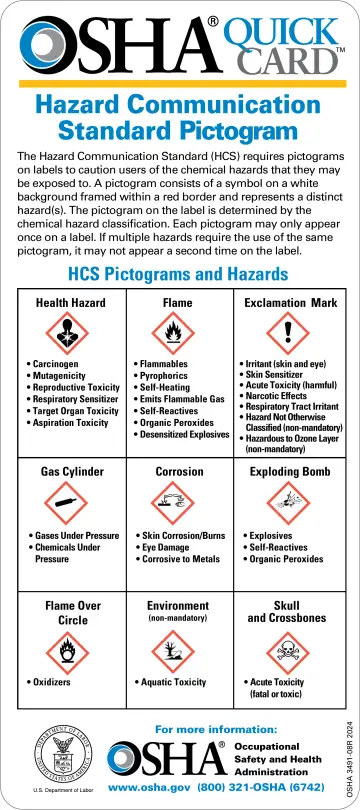
2 slidesHazard Communication Standard Pictogram QuickCard (OSHA 3491)
Pocket card showing the nine GHS hazard pictograms (English and Spanish in one file).
U.S. Department of Labor, OSHAPublic domain