Emergencies and Fire Protection
Emergency response and fire protection module from the WVU oil and gas site course.
Slide text
· 41 of 43 slides · by West Virginia University
The words on each slide as the author wrote them, read from the file by software so they can be searched. Layout, pictures and tables are not shown here: the slides above and the download are the original.
- Slide 1
Module 8
- Emergencies
- Slide 2
Objectives
- After this module you should be able to
- identify the most common emergency situations
- discuss the elements of a company’s emergency plans
- Slide 3
- your company must have an emergency action plan and should have BOP drills and fire drills
- the emergency action plan must be available for workers to review
- Slide 4
Emergency Action Plan Elements
- Procedures for reporting a fire or other emergency
- Procedures for emergency evacuation, including type of evacuation and exit route assignments
- Procedures to be followed by workers who remain to operate critical rig operations before they evacuate
- Slide 5
Emergency Action Plan Elements
- Procedures to account for all workers after evacuation
- Procedures to be followed by workers performing rescue or medical duties
- The name or job title of every employee who may be contacted by workers who need more information about the plan or an explanation of their duties under the plan
- Slide 6
- 911
- 911 will be used on all sites unless the service does not exist in that area
- Your company will determine availability
- Satellite phones or 2-way radios may be used when cell phone reception cannot be achieved
- 911
- Slide 7
Geronimo Line
- Setting up the geronimo line
- periodically checked, adjusted if necessary
- 6-12 feet of sag in the middle
- anchor point on ground should be at least 2 times the distance from the derrick as its starting point is high
- anchor point should be able withstand a 3000 pound force
- You should be trained on its use
- Never ride unless in an emergency
- Slide 8
this geronimo line has been tied off to the ladder, an insufficient anchor point
- Corrective Action: contact your supervisor and arrange for the anchor point to be moved to the derrick
- Slide 9
Medical Emergencies
- Oil and gas operations are often in remote areas far from emergency medical care
- establish a site-wide communication system and a reliable way of contacting EMS on the work site; identify areas of cell phone reception or the phone(s) to be used in the event of an emergency
- review the emergency plan and procedures for emergency contact with the employees at all work sites
- discuss what to do if a serious injury occurs
- Slide 10
First Aid Kits
- First aid kits should be
- kept clean
- well stocked
- inspected often
- available when needed
- kept in a visible location
- located throughout the site
- marked clearly with signage
- Slide 11
first aid kits must be checked regularly and restocked when necessary
- Slide 12
Eye Wash Stations and Showers
- Many corrosive materials are used in the oil and gas industry
- The eyes and body may be harmfully exposed to these materials
- Suitable facilities for quick drenching or flushing of the eyes and body shall be provided on the site for emergency use
- Slide 13
this is an example of an emergency shower
- Slide 14
this is an example of an emergency eye wash station
- Slide 15
eye wash stations should be located throughout the site
- Slide 16
this first aid station is blocked
- Corrective Action: the space in front of emergency equipment should remain accessible at all times
- Slide 17
this fire extinguisher is visible, free of obstructions, and ready for use
- Slide 18
Fire
- Slide 19
Fire Protection Elements
- Portable fire extinguishers
- Fire and employee alarm systems
- Controlling sources of ignition
- Storage of flammable materials
- Disposal of flammable materials
- Slide 20
Preventing Fires
- Never store flammables in open or unapproved containers
- Store flammables in a special storage cabinet that is well marked with warning signs for everyone to see
- Control all ignition sources around flammable liquids
- Smoke in designated areas only
- Slide 23
Keep Away Sources of Ignition
- Open flames
- Smoking
- Cutting or welding
- Static electricity
- Hot surfaces
- Electrical and mechanical sparks
- Sparking tools or devices
- Lightning
- Slide 24
Disposing of Oil-Soaked Rags
- Dispose of oil-soaked rags in a metal container with a tight-fitting lid
- keeps oxygen away and reduces chance of fire
- when exposed to air, some rags can produce enough heat to spontaneously ignite
- Mark these special containers as “Oil- Soaked Rags ONLY”
- Slide 25
Extinguisher Maintenance
- Must maintain in a fully charged and operable condition
- Must keep in their designated places at all times except during use
- Visually inspect portable extinguishers and hoses monthly
- Must conduct an annual maintenance check
- Slide 26
Employee Training
- Your company must familiarize workers with the general principles of fire extinguisher use
- This training must be given at the beginning of employment and annually thereafter
- Slide 27
PASS
- PULL
- SQEEZE
- AIM
- SWEEP
- Slide 28
Extinguisher Classification
- Class A
- ordinary combustibles (wood, cloth, paper)
- Class B
- flammable liquids, gases, greases
- Class C
- energized electrical equipment
- Class D
- combustible metals
- Class K
- kitchen grease
- Slide 29
Pressure Release
- A pressure release occurs when a high-pressure line or hose fails at either one of the connection points or at some point along its length
- This can cause injury to a worker in several ways including
- the actual fluid or gas in the line or hose
- the line or hose whipping uncontrollably
- Slide 30
existing wellheads on site should be barricaded and caged
- Slide 31
- hoses can become damaged with nicks, cuts, or gouges and could burst
- inspect cables and hoses frequently for damage
- Slide 32
- high-pressure lines can disconnect from their fittings and whip around uncontrolled
- properly install whip checks on all high-pressure lines; ensure that fitting connections are secure
- Slide 33
- a coupling connection for a flow line during the air drilling phase
- use a chain with a ratcheting system to keep connection tight and to keep lines from whipping in case of a failure/disconnect
- Slide 34
- depending on the pressure involved, this line could kick up and strike you
- use some type of device to secure the line to the ground or to keep workers out of the area
- Slide 35
a worker working around this line could get struck by it when it kicks
- Corrective Action: ensure that lines are properly secured to prevent line from kicking up or barricade area around line to prevent entry
- Slide 36
Applicable Standards
- 1910.38 Emergency Action Plans
- 1910 Subpart L Fire Protection
- 1926.35 Employee Emergency Action Plans
- 1926 Subpart F Fire Protection and Prevention
- Slide 37
Your Employer Is Responsible For
- Informing workers of the fire and pressure release hazards to which they are exposed
- Preparing, implementing, and training on emergency action plans for all types of foreseeable emergencies
- Responding to and correcting hazards pointed out by you, the worker
- Slide 38
You Are Responsible For
- Being familiar with and following your company’s emergency action plan
- Knowing what to do in the event of a medical emergency
- Doing your part to prevent fires and pressure release
- Correcting the hazards you are able to correct
- Reporting to your supervisor the hazards you are unable to correct
- Slide 39
Case Study
- A rig hand discovered a co-worker lying motionless. He responded by checking for vital signs and found none. He went to the nearest first aid kit to obtain a clear mouth barrier to begin CPR. The barrier was missing. The county coroner stated that the additional time needed to find a barrier may contributed to loss of life.
- Slide 40
Always Remember
- Review the emergency action plans and the fire prevention plans
- You can prevent fires and pressure releases by taking appropriate actions
- Before beginning a job in a new area, locate the nearest
- fire extinguisher
- eyewash station
- emergency shower
- emergency exit route
- Slide 41
Memory Check
- 1. How much should a properly tensioned geronimo escape line sag in the middle?
- a. 1-2 feet
- b. 3-5 feet
- c. 6-12 feet
- d. it should not sag at all
- Slide 42
Memory Check
- 2. First aid kits should be
- a. located in a visible location
- b. fully stocked
- c. available for use
- d. all of the above
- Slide 43
Memory Check
- 3. According to OSHA, how often must portable fire extinguishers be visually inspected?
- a. daily
- b. weekly
- c. monthly
- d. annually
More on Exit Routes & Fire
Exit Routes, Emergency Action Plans, Fire Prevention Plans, and Fire Protection (OSHA 10-Hour General Industry Outreach)
OSHA's general industry outreach deck on exits, emergency plans, fire prevention and extinguishers (2017); adapt for construction sites.
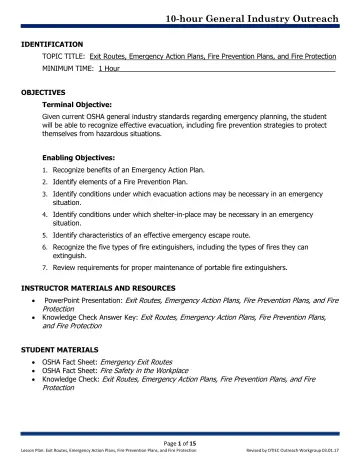
Exit Routes, Emergency Action Plans, Fire Prevention Plans, and Fire Protection: Lesson Plan (OSHA 10-Hour General Industry Outreach)
Instructor lesson plan (objectives, timing, teaching steps) for the OSHA General Industry exit routes, emergency action plans, fire prevention plans, and fire protection outreach deck.
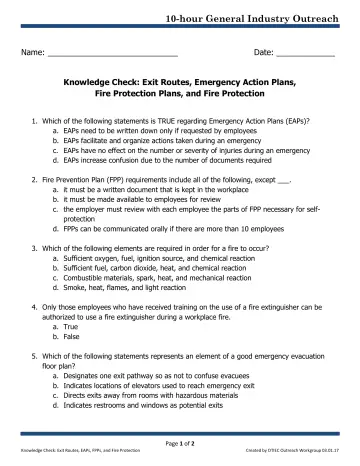
Exit Routes, Emergency Action Plans, Fire Prevention Plans, and Fire Protection: Knowledge Check (OSHA 10-Hour General Industry Outreach)
Student knowledge-check quiz for the OSHA General Industry exit routes, emergency action plans, fire prevention plans, and fire protection outreach deck.