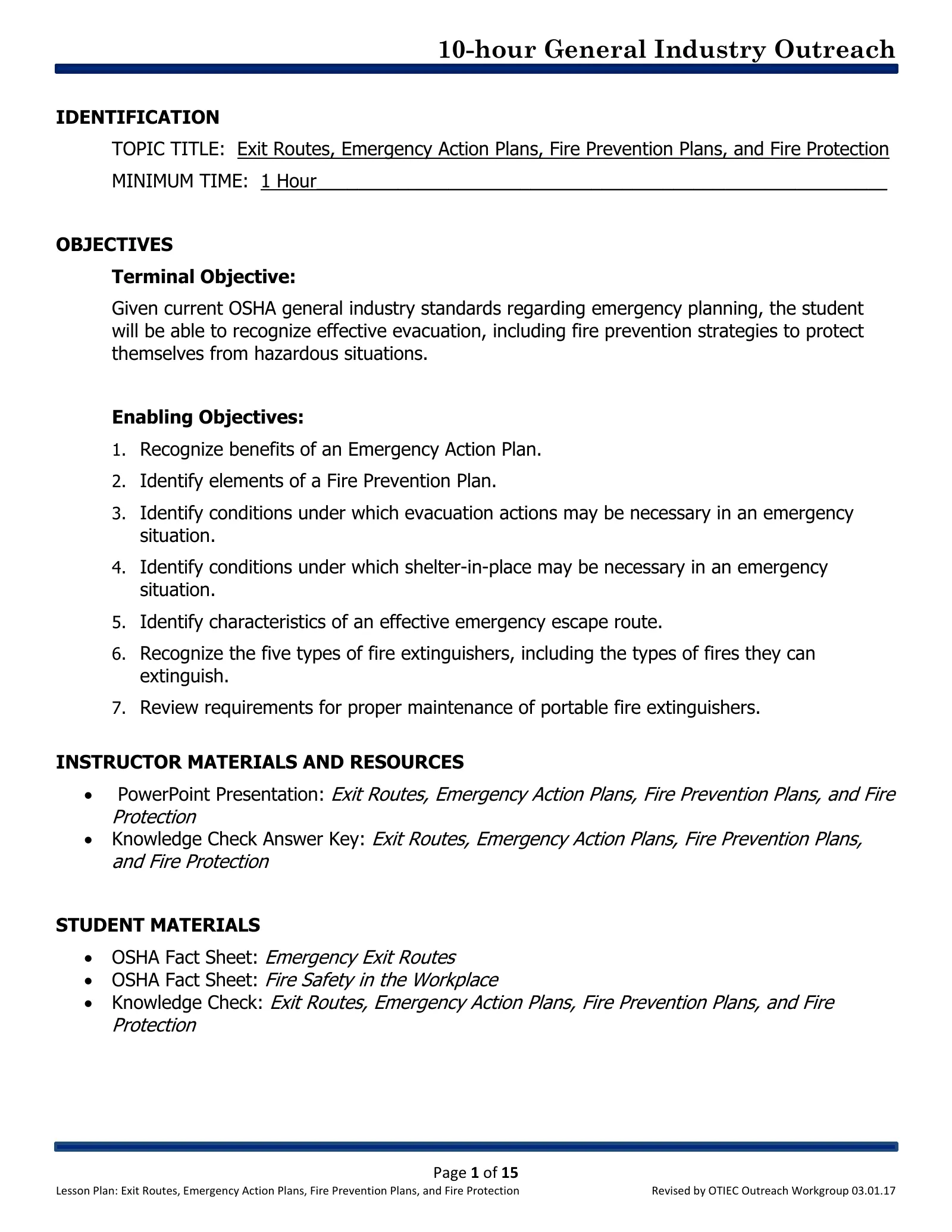
Exit Routes, Emergency Action Plans, Fire Prevention Plans, and Fire Protection: Lesson Plan (OSHA 10-Hour General Industry Outreach)
Instructor lesson plan (objectives, timing, teaching steps) for the OSHA General Industry exit routes, emergency action plans, fire prevention plans, and fire protection outreach deck.
Page text
· 15 pages · by U.S. Department of Labor, OSHA (with the OTIEC Outreach Workgroup)
The words on each page as the author wrote them, read from the file by software so they can be searched. Layout, pictures and tables are not shown here: the pages above and the download are the original.
- Page 1
IDENTIFICATION
- TOPIC TITLE: Exit Routes, Emergency Action Plans, Fire Prevention Plans, and Fire Protection
- MINIMUM TIME: 1 Hour___
- OBJECTIVES
- Terminal Objective:
- Given current OSHA general industry standards regarding emergency planning, the student will be able to recognize effective evacuation, including fire prevention strategies to protect themselves from hazardous situations.
- Enabling Objectives:
- 1. Recognize benefits of an Emergency Action Plan.
- 2. Identify elements of a Fire Prevention Plan.
- 3. Identify conditions under which evacuation actions may be necessary in an emergency situation.
- 4. Identify conditions under which shelter-in-place may be necessary in an emergency situation.
- 5. Identify characteristics of an effective emergency escape route.
- 6. Recognize the five types of fire extinguishers, including the types of fires they can extinguish.
- 7. Review requirements for proper maintenance of portable fire extinguishers.
- INSTRUCTOR MATERIALS AND RESOURCES
- PowerPoint Presentation: Exit Routes, Emergency Action Plans, Fire Prevention Plans, and Fire
- Protection
- Knowledge Check Answer Key: Exit Routes, Emergency Action Plans, Fire Prevention Plans, and Fire Protection
- STUDENT MATERIALS
- OSHA Fact Sheet: Emergency Exit Routes
- OSHA Fact Sheet: Fire Safety in the Workplace
- Knowledge Check: Exit Routes, Emergency Action Plans, Fire Prevention Plans, and Fire
- Protection
- Page 2
TEACHING PROCEDURES ---Preparation, Presentation, Application, Evaluation
- Anticipatory Set (Focus Attention/ Gain I nterest)
- Estim ated Tim e: ?? hours
- Key Points
- Methods
- Approximately 145 fatalities per year are the result of fires and explosions (3% of total fatalities). There has been a long and tragic history of workplace fatalities related to fires and explosions. In addition to fires and explosions, other incidents in the workplace may require emergency actions to protect employees.
- http://www.bls.gov/iif/oshwc/cfoi/cfch0013.pdf
- PPT slides #1 - #4
- OSHA requires employers to inform and train employees on what to do in an emergency, what the employees responsibilities are in regards to fire prevention and the defined employee scope and approved employee methods of dealing with fires in the workplace.
- Presentation (I nstruction)___
- Key Points
- Methods
- I. Emergency Action Plan (EAP)
- PPT slides #5 - #10
- A. Benefits of an EAP
- 1. Written documentation to facilitate/organize actions during an emergency
- 2. Can result in fewer/less severe injuries, less structural damage, and reduced confusion
- B. Elements of Plan
- 1. Purpose of EAP
- a. Describes actions to be taken to ensure safety
- b. Uses floor plans/maps to show emergency evacuation routes
- c. Tells employees what actions to take
- d. Covers reasonably expected emergencies
- 2. Required elements of plan
- a. Means of reporting
- b. Evacuation procedures and emergency escape routes https://www.osha.gov/SLTC/etools/evacuation/min_requirements.html
- c. Procedures for critical operations
- Page 3
- d. Accounting of employees
- e. Rescue and medical duties
- f. Contact persons
- g. Recommended elements
- i. Description of alarm system
- ii. Site of alternative communications center
- iii. Secure on- or off-site storage of documents
- 3. Training employees on EAP
- a. Review plan with each employee when:
- i. Plan is initially developed
- ii. Initial assignment of employee to job
- iii. Changes are made to plan or employee actions or responsibilities
- b. Annual retraining with drills
- c. Education and training should cover:
- i. Types of emergencies and courses of action
- ii. Functions and elements of EAP
- iii. Special hazards in the workplace
- iv. Fire hazards and fire prevention plan
- d. General training should also address:
- i. Individual roles and responsibilities
- ii. Threats, hazards, and protective actions
- iii. Notification, warning, and communications procedures
- iv. Means for locating family members in emergency
- v. Emergency response procedures
- vi. Evacuation, shelter, and accounting procedures
- vii. Location and use of common emergency equipment
- viii. Emergency shutdown procedures
- C. Examples of procedures for elements of EAP
- 1. Method of reporting an emergency
- a. 911
- b. Onsite resources
- Page 4
- 2. Instructions for exit
- a. Pull alarm
- b. Use nearest staircase; do not use elevator
- c. Designate rally points
- d. Accounting of employees
- 3. Instructions for limited mobility
- a. Proceed to nearest stairwell or area of refuge
- b. Designate a buddy
- PPT slides #11 - #17
- II. Fire Prevention Plan (FPP)
- A. Fire Prevention Plan requirements
- 1. Must be in writing, kept in the workplace, and available to employees for review https://www.osha.gov/SLTC/etools/evacuation/fire.html
- 2. Employer must inform employees of fire hazards to which they are exposed upon initial job assignment and review with each employee applicable parts of the FPP necessary for self-protection
- 3. Minimum requirements for FPP
- a. List of major fire hazards, proper handling and storage of hazardous materials, ignition sources and their control, and type of fire protection equipment needed for control of major hazards
- b. Procedure to control flammable and combustible waste materials
- c. Procedures for maintenance of safeguards on heat-producing equipment
- d. Name or job title of persons responsible for
- i. Maintaining equipment to prevent or control ignition sources or fires
- ii. Control of fuel source hazards
- B. Preventing fire hazards
- 1. Understanding fires
- a. Very rapid chemical reaction between oxygen and a combustible material
- b. Results in release of heat, light, flames, and smoke
- Page 5
- c. Four elements required for fire to exist
- i. Enough oxygen to sustain combustion
- ii. Enough heat to raise the material to its ignition temperature
- iii. Some sort of fuel or combustible material
- iv. The chemical reaction that is fire
- d. Ignition sources – open flames, smoking, static electricity, hotwork, hot surfaces, electrical and mechanical sparks, lightning
- C. Tasks that require fire protection and examples of hazards
- 1. Hotwork – welding, cutting, brazing; 30-minute fire watch
- 2. Dispensing flammables and combustibles: gasoline, diesel, or natural gas
- 3. Flammable wastes: solvent waste, oily rags, and flammable liquids
- D. Handling of flammable hazards
- 1. Only use approved metal safety containers or the original manufacturer’s containers for storage
- 2. Practice good housekeeping – clean up spills immediately and dispose of cleanup rags properly
- 3. Keep containers closed when not in use
- 4. Store away from exits or passageways
- 5. Keep away from ignition sources
- E. Fire protection equipment https://www.osha.gov/SLTC/etools/evacuation/high_haza rd.html#special
- 1. PPE needed for evacuation
- a. Eye and face protection
- b. Head protection
- c. Foot protection
- d. Respiratory protection
- e. Body protection
- f. Special body protection for abnormal environmental conditions such as extreme heat
- g. Special equipment or warning devices for hazards associated with the workplace
- Page 6
- III. Conditions under which evacuation actions may be necessary in an emergency situation
- A. Type of Emergency
- PPT slides #18 - #23
- https://www.osha.gov/SLTC/etools/evacuation/evac.html
- 1. Man-made: fires, explosions, toxic material releases, radiological/biological incidents, civil disturbances, workplace violence
- 2. Natural: floods, earthquakes, hurricanes, tornadoes
- B. Factors affecting decision to evacuate/shelter-in-place
- 1. Type/extent of emergency
- 2. Location of emergency within or outside the workplace
- 3. Type of building in which the workplace is located
- 4. Shutting down critical operations
- 5. Fire emergencies – fight or flee?
- a. Options for evacuation
- i. Option 1: Total evacuation
- ii. Option 2: Designated employees are authorized to fight fire; all other evacuate
- iii. Option 3: All employees are authorized to fight fire
- iv. Option 4: Extinguishers are provided, but are not intended for employee use
- b. Performing a risk assessment
- i. Is the fire too big?
- ii. Is the air safe to breathe?
- iii. Is the environment too hot or smoky?
- iv. Is there a safe evacuation path?
- C. Evacuation maps
- 1. Floor diagrams that designate exit route assignments
- 2. Should include locations of:
- a. Exits
- i. To, thru, and away
- ii. Minimum of two – primary and secondary exits
- b. Assembly/refuge areas
- Page 7
- c. Current location on map; “You are here”
- d. Equipment needed in an emergency – fire extinguishers, first aid kits, spill kits
- D. Planning evacuation actions
- 1. Alerting employees to evacuate
- 2. Accounting for who has exited
- 3. Informing employees regarding actions after emergency – all clear, safe to re-enter, remain at assembly point, clear to leave workplace
- IV. Conditions under which shelter-in-place may be necessary in an emergency situation
- A. Incidents that may require shelter-in-place
- 1. Release of chemical, biological, or radiological contaminants
- PPT slides #24 - #26
- https://www.osha.gov/SLTC/etools/evacuation/shelterinplace.html
- 2. Severe weather, such as tornadoes
- a. Watch – high possibility that weather emergency will occur; pay attention for updates/changes and be ready to take action
- b. Warning – a weather emergency is already happening, or will happen soon; take immediate action
- 3. Other situations occurring outside the workplace (building lockdowns)
- a. Civil disturbances
- b. Criminal suspect in area
- B. Shelter-in-place
- 1. Means taking refuge in interior room(s) with no/few windows
- 2. Local authorities often issue shelter-in-place advice via television or radio
- 3. Procedures are specific to worksite, such as:
- a. Close business
- b. Provide for safety of customers, clients, or visitors in the building; authorities want everyone to act; do not drive or walk outdoors
- Page 8
- c. Call emergency contacts (except with imminent threat); turn on answering systems
- d. Explosion dangers: close window shades, blinds, or curtains
- e. Gather essential disaster supplies
- f. Select rooms with hard-wired telephones
- g. Tape plastic sheeting to prevent contamination
- h. Document/report who is in room
- i. Get further instructions until safe or ordered to evacuate (radio, tv, internet)
- C. Planning shelter-in-place actions
- 1. Alerting employees to take shelter
- 2. Accounting for everyone in refuge
- 3. Keeping employees informed
- V. Characteristics of an effective emergency escape route
- A. Exit routes
- 1. Continuous and unobstructed path of exit travel from any place in workplace t safety
- 2. Consists of three parts
- PPT slides #27 - #30
- https://www.osha.gov/SLTC/etools/evacuation/egress_construction.html
- a. Exit access
- b. Exit
- c. Exit discharge
- 3. Should be:
- a. Clearly marked
- b. Well-lit
- c. Wide enough to accommodate the number of personnel evacuating
- d. Unobstructed and clear of debris at all times
- e. Unlikely to expose any additional hazards
- B. Basic exit route requirements
- 1. Permanent
- 2. Separated by fire-resistant materials
- Page 9
3. Limited openings to an exit; protected by self-closing fire door
- 4. Adequate number of exit routes
- 5. Discharge leading directly to outside or to a place with access to outside
- 6. Exit door must be unlocked from inside and side-hinged
- 7. Exit route capacity must be adequate
- 8. Meet minimum height (7’ 6”) and width (28”)
- 9. Outdoor exit routes permitted; guardrails if fall hazard exists
- C. Clear communication of 3 elements of escape route
- 1. Exit access pathway
- 2. Nearest exits from all points of building
- 3. Pathway away from building structure to rally point/area of refuge
- D. Review elements of a good evacuation floor plan
- 1. Designated primary and secondary exits
- 2. No emergency exits in restrooms https://www.osha.gov/SLTC/etools/evacuation/floorplan _ demo.html
- 3. Exit away from rooms with hazardous materials
- 4. No emergency exits into narrow passages
- 5. Exit signs indicating the nearest emergency exit
- 6. Designated assembly area
- 7. No use of elevators to reach emergency exit
- 8. Exits with wheelchair access
- 9. Employee’s current location (“You are here”)
- VI. Extinguishing fires
- PPT slides #31 - #42
- A. Methods of fire protection
- 1. Fixed extinguishing systems
- 2. Fire brigade
- 3. Fire extinguishers
- Page 10
B. Portable fire extinguisher training and education
- 1. Required for employees authorized to use fire extinguishers
- 2. General principles of fire extinguisher use
- 3. Hazards of incipient stage fire fighting
- 29 CFR 1910.157(g)
- https://www.osha.gov/pls/oshaweb/owadisp.show_docum ent?p_table=STANDARDS&p _id=9811
- 4. Operation of equipment – instruction and practice
- 5. Required upon initial employment/assignment and at least annually thereafter
- C. Classes of fire – based on substances fueling fire
- 1. Class A – ordinary combustibles
- 2. Class B – flammable liquids and gases
- 3. Class C – energized electrical equipment
- 4. Class D – combustible metals
- 5. Class K – cooking oils and greases (kitchen)
- D. Fire extinguishers
- 1. How they work – recall fire triangle (requirements for a fire to exist)
- a. Remove heat
- b. Displace/remove oxygen
- c. Stop chemical reaction
- 2. Parts and label
- a. Safety pin
- b. Handle
- c. Nozzle
- d. Canister
- e. Pressure gauge (depending on type)
- f. Label
- i. Letters – represent type of fire for which extinguisher has been approved
- ii. Rating – water equivalent and/or area it can extinguish
- Page 11
- 3. Extinguisher types
- a. Water or air-pressurized water (APW)
- i. Designed for Class A fires only
- ii. Large, silver container, 2-3 ft. tall, weighing about 25 lbs. when full https://www.osha.gov/SLTC/etools/evacuation/portable_a bout.html#water
- iii. Filled 2/3 with ordinary water, then pressurized with air; detergents may be added to produce foam
- iv. Works by cooling the surface of the fuel – removes heat
- v. Never use on flammable fires or electrical fires
- b. Carbon dioxide (CO 2 )
- i. Designed for Class B and Class C fires only
- ii. Red cylinders, ranging from 5 – 100 lbs. or larger, with a hard horn (located at the end of the flexible hose) and no pressure gauge
- iii. Filled with CO 2 under ex treme pressure
- iv. Displaces oxygen; dry ice pieces also have a cooling effect
- v. Never use in a confined space without proper respiratory protection; not recommended for Class A fires
- c. Dry chemical (Multi-purpose)
- i. May be used on Class A, Class B, and/or Class C fires (check label)
- ii. Red cylinders, ranging in size from 5 – 20 lbs.
- iii. Fire-retardant powder is the extinguishing agent and is propelled by a compressed, non-flammable gas
- iv. Separates fuel from oxygen; powder also interrupts the chemical reaction
- d. Class K – dry and wet chemical extinguishers
- i. Designed for kitchen fires
- ii. Only intended to be used after activation of built-in hood suppression system
- Page 12
- iii. Filled with electrically conductive extinguishing agents; use only after electrical power to appliance has been shut off
- iv. Potassium bicarbonate may be used in dry types; wet chemical extinguishers spray a fine mist
- 4. Using a fire extinguisher
- a. Steps to follow:
- i. Sound alarm; call fire department
- ii. Identify safe evacuation path
- iii. Select appropriate fire extinguisher
- iv. Discharge extinguisher using P.A.S.S technique
- v. Back away once fire is extinguished in case of flame-up
- vi. Evacuate immediately if:
- Extinguisher is empty and fire is not out Fire progresses beyond incipient stage
- b. P.A.S.S technique
- i. Pull the pin
- ii. Aim nozzle (horn or hose) at base of fire
- iii. Squeeze the handle to release extinguishing agent
- iv. Sweep from side to side at base of fire until it is out
- v. Watch area for re-ignition; repeat steps 2 – 4 if necessary; when in doubt, evacuate immediately
- VII. Maintenance of portable fire extinguishers
- PPT slide #43
- A. Elements of inspection
- 1. Inspect bottle, handle, hose and gauge to make sure they are in proper working order
- 2. Inspect inspection tag and bottle for
- a. Month and Year put in service current (annual)
- b. Monthly visual inspections completed (monthly)
- c. Extinguisher product still free flowing inside bottle (turn upside down and / or shake)
- Page 13
Application (How students apply w hat they learn) __
- Estim ated Tim e: ?? hours
- Key Points
- Methods
- Have participants describe the issues with the numbered elements shown in the exit route illustrations on slides.
- PPT slides #44 - #45
- Follow elements of a typical evacuation plan or have them make their own. Demonstrate the monthly inspection of a fire extinguisher. Match up the proper class of fire extinguisher to the type of fire that it is most effective on
- Evaluation/ Sum m ary
- Key Points
- Methods
- Knowledge Check: Exit Routes, Emergency Action Plans, Fire
- PPT slides #46 - #54
- Prevention Plans, and Fire Protection
- Page 14
References
- OSHA Standard
- General Industry (29 CFR 1910)
- 1910 Subpart E, Means of egress o
- 1910.35, Compliance with alternate exit-route codes o
- 1910.36, Design and construction requirements for exit routes o
- 1910.37, Maintenance, safeguards, and operational features for exit routes o
- 1910.38, Emergency action plans o
- 1910.39, Fire prevention plans
- 1910 Subpart L, Fire protection o
- 1910.155, Scope, application and definitions applicable to this subpart o
- 1910.156, Fire brigades
- 1910.157, Portable fire extinguishers o
- 1910.158, Standpipe and hose systems o
- 1910.159, Automatic sprinkler systems o
- 1910.160, Fixed extinguishing systems, general o
- 1910.161, Fixed extinguishing systems, dry chemical o
- 1910.162, Fixed extinguishing systems, gaseous agent o
- 1910.163, Fixed extinguishing systems, water spray and foam o
- 1910.164, Fire detection systems o
- 1910.165, Employee alarm systems o
- Appendix A, Fire Protection o
- Appendix B, National consensus standards o
- Appendix C, Fire Protection references for further information o
- Appendix D, Availability of publications incorporated by reference in section 1910.156 fire brigades o
- Appendix E, Test methods for protective clothing https://www.osha.gov/pls/oshaweb/owasrch.search_form?p_doc_type=STANDARDS&p_toc_level =1&p_keyvalue=1910
- Page 15
Directives
- Compliance Policy for Emergency Action Plans and Fire Prevention Plans. CPL 02-01-037 [CPL 2-1.037], (2002, July 9). Provides a consolidated compliance policy for the application of emergency action plans (EAPs) and fire prevention plans (FPPs), General Industry Standard for 29 CFR 1910.38.
- 1910.156(e)(3)(ii) Fire - Resistive Coat Requirements for Fire Brigades. STD 01-09-003 [STD 1-9.3], (1981, December 12). Recognizes a variation to the washing cycle requirements referenced in 29 CFR 1910.156(e)(3)(ii).
- 29 CFR 1910.157(f)(2),(f)(2)(i) and (f)(4) Hydrostatic Testing of Dry Chemical Cartridge Portable Fire Extinguishers. STD 01-09-002 [STD 1-9.2], (1981, August 5). Provides exceptions for hydrostatic testing and repairs.
- Search all available directives.
- OSHA Publications
- OSHA #3088 Booklet Emergency Action Plans: How to Plan for Workplace Emergencies and Evacuation (2001)
- OSHA #3335 Fact Sheet Emergency Management: Planning & responding to Workplace Emergencies (2004)
- OSHA Fact Sheet Emergency Exit Routes (2003)
- OSHA # 3183 QuickCard TM Emergency Exit Routes
- OSHA #3256 Booklet Fire Service Features and Fire Protection Systems (2015)
- OSHA Fact Sheet Fire Safety (2002)
- OSHA References/Resources
- Safety and Health Topics, Emergency Preparedness , no date https://www.osha.gov/SLTC/emergencypreparedness/index.html Safety and Health Topics, Fire Safety , no date https://www.osha.gov/SLTC/etools/evacuation/sitemap.html Evacuation Plans and procedures eTool, no date https://www.osha.gov/SLTC/etools/evacuation/eap.html
- Evacuation Plans and procedures eTool, no date https://www.osha.gov/SLTC/etools/evacuation/floorplan_demo.html
More on Exit Routes & Fire
Exit Routes, Emergency Action Plans, Fire Prevention Plans, and Fire Protection (OSHA 10-Hour General Industry Outreach)
OSHA's general industry outreach deck on exits, emergency plans, fire prevention and extinguishers (2017); adapt for construction sites.
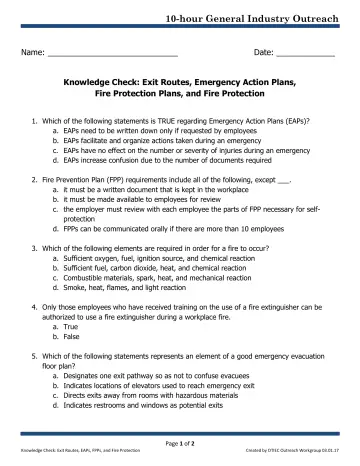
Exit Routes, Emergency Action Plans, Fire Prevention Plans, and Fire Protection: Knowledge Check (OSHA 10-Hour General Industry Outreach)
Student knowledge-check quiz for the OSHA General Industry exit routes, emergency action plans, fire prevention plans, and fire protection outreach deck.
Rutas de salida, planes de acción de emergencia, planes de prevención de incendios y protección contra incendios (Capacitación de Extensión de 10 horas de OSHA, Industria General)
Spanish edition of OSHA's 10-hour General Industry Outreach deck on exit routes, emergency action plans, fire prevention plans, and fire protection (PDF slides; OSHA does not publish an editable Spanish PowerPoint).