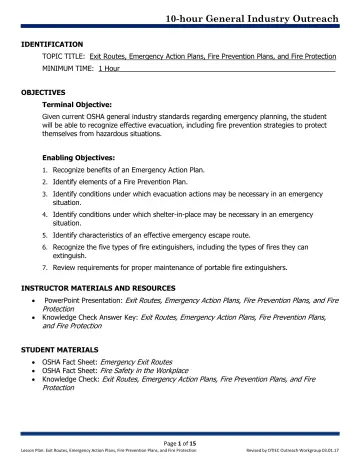
Student knowledge-check quiz for the OSHA General Industry exit routes, emergency action plans, fire prevention plans, and fire protection outreach deck.
Page text
· 2 pages · by U.S. Department of Labor, OSHA (with the OTIEC Outreach Workgroup)
The words on each page as the author wrote them, read from the file by software so they can be searched. Layout, pictures and tables are not shown here: the pages above and the download are the original.
- Page 1
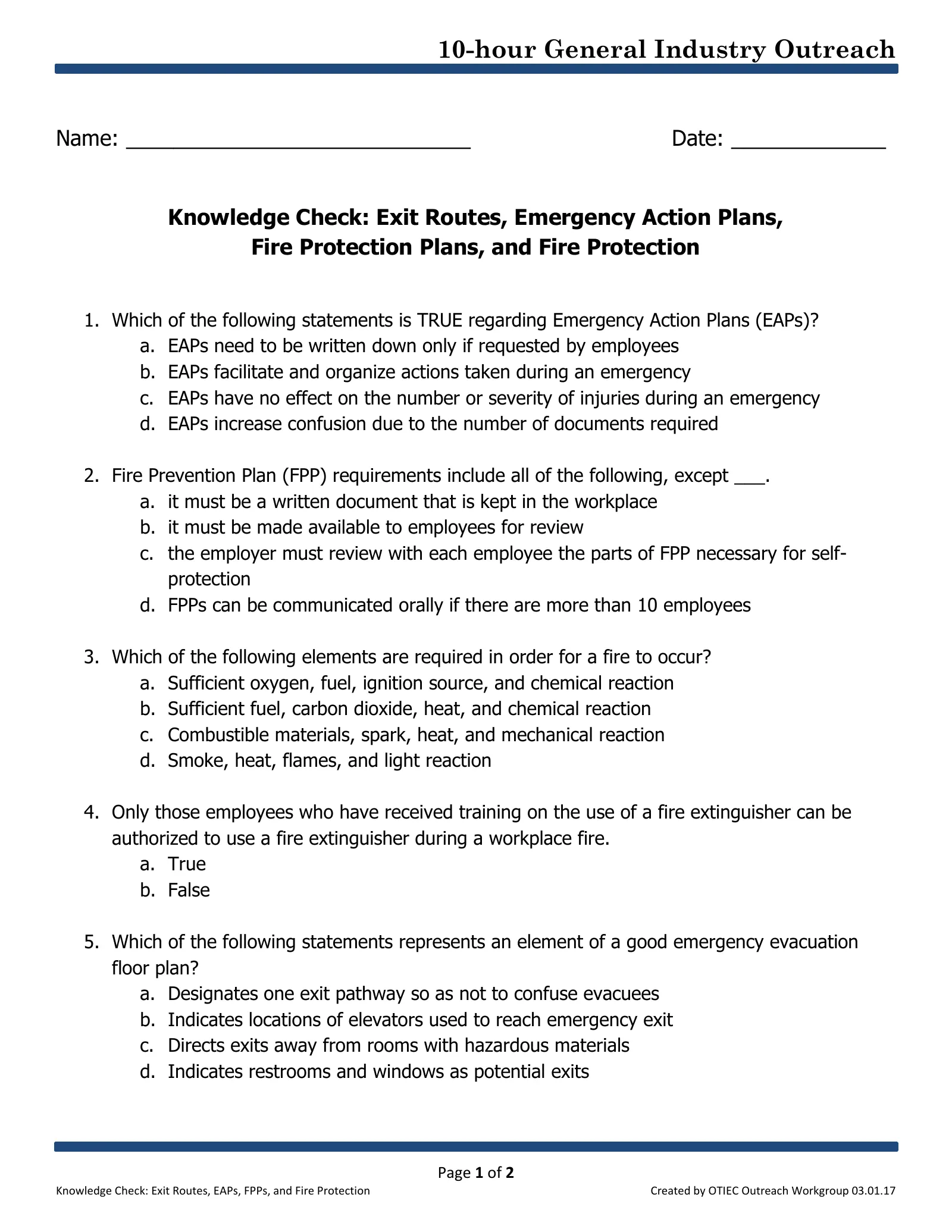
10-hour General Industry Outreach
- Name: ___
- Date: ___
- Knowledge Check: Exit Routes, Emergency Action Plans, Fire Protection Plans, and Fire Protection
- 1. Which of the following statements is TRUE regarding Emergency Action Plans (EAPs)?
- a. EAPs need to be written down only if requested by employees
- b. EAPs facilitate and organize actions taken during an emergency
- c. EAPs have no effect on the number or severity of injuries during an emergency
- d. EAPs increase confusion due to the number of documents required
- 2. Fire Prevention Plan (FPP) requirements include all of the following, except ___.
- a. it must be a written document that is kept in the workplace
- b. it must be made available to employees for review
- c. the employer must review with each employee the parts of FPP necessary for self-protection
- d. FPPs can be communicated orally if there are more than 10 employees
- 3. Which of the following elements are required in order for a fire to occur?
- a. Sufficient oxygen, fuel, ignition source, and chemical reaction
- b. Sufficient fuel, carbon dioxide, heat, and chemical reaction
- c. Combustible materials, spark, heat, and mechanical reaction
- d. Smoke, heat, flames, and light reaction
- 4. Only those employees who have received training on the use of a fire extinguisher can be authorized to use a fire extinguisher during a workplace fire.
- a. True
- b. False
- 5. Which of the following statements represents an element of a good emergency evacuation floor plan?
- a. Designates one exit pathway so as not to confuse evacuees
- b. Indicates locations of elevators used to reach emergency exit
- c. Directs exits away from rooms with hazardous materials
- d. Indicates restrooms and windows as potential exits
- Knowledge Check: Exit Routes, EAPs, FPPs, and Fire Protection
- Created by OTIEC Outreach Workgroup 03.01.17
- Page 2
10-hour General Industry Outreach
- 6. Trash fires involving paper and wood products are ___ fires.
- a. Class A
- b. Class B
- c. Class C
- d. Class D
- 7. Which fire extinguisher is appropriate for use on a fire involving gasoline in a confined space when no respiratory protection is available?
- a. Water (APW) extinguisher
- b. Carbon dioxide extinguisher
- c. Dry chemical extinguisher
- d. Class K dry-type extinguisher
- 8. The P.A.S.S technique for using a fire extinguisher means ___.
- a. Position, aim, sweep, slowly
- b. Pull, aim, squeeze, sweep
- c. Point, away, side-to-side
- d. Pin, approach, start, stop
- 9. At minimum, how often must maintenance checks be performed on portable fire extinguishers?
- a. Once a month
- b. Once a year
- c. Once every two years
- d. Once every five years
- Knowledge Check: Exit Routes, EAPs, FPPs, and Fire Protection
- Created by OTIEC Outreach Workgroup 03.01.17