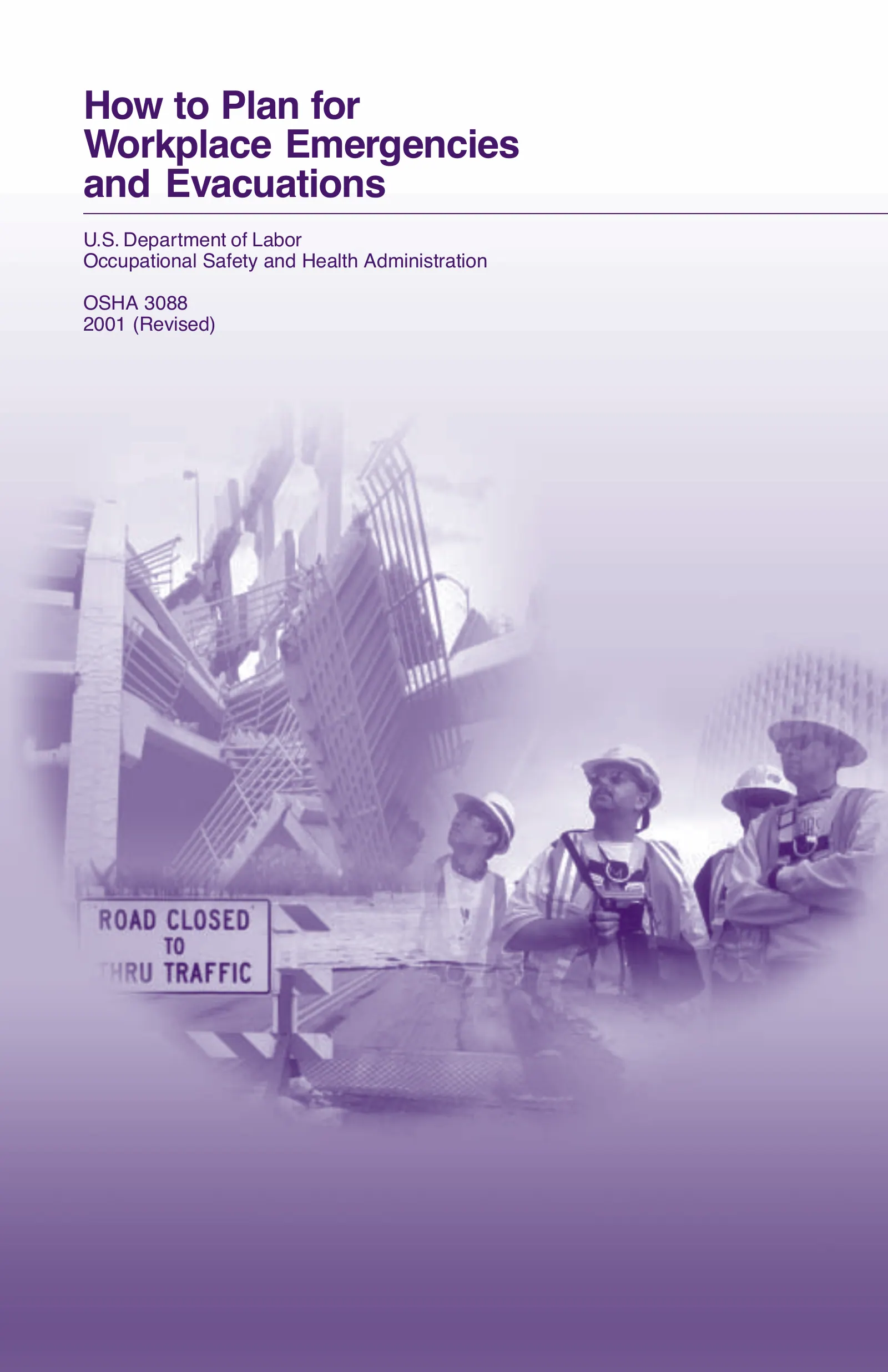
Emergency Action Plans: How to Plan for Workplace Emergencies and Evacuations (OSHA 3088)
OSHA booklet on writing an emergency action plan and planning evacuations.
Page text
· 30 pages · by U.S. Department of Labor, OSHA
The words on each page as the author wrote them, read from the file by software so they can be searched. Layout, pictures and tables are not shown here, and long pages are shortened: the pages above and the download are the original.
- Page 1
- How to Plan for
- How
- to Plan Emergencies
- for
- Workplace
- Workplace
- Emergencies
- and Evacuations
- U.S. Department of Labor
- Occupational
- Safety
- and Health Administration
- U.S. Department
- of Labor
- Occupational Safety and Health Administration
- OSHA 3088
- 2001 (Revised)
- OSHA
- 3088
- Page 2
How to Plan for Workplace Emergencies and Evacuations
- OSHA 3088
- 2001 (Revised)
- This booklet provides a generic overview of a standards-related topic. This publication does not alter or determine compliance responsibilities, which are described in the OSHA standards and the Occupational Safety and Health Act. Because interpretations and enforcement policy may change over time, the best sources for additional guidance on OSHA compliance requirements are current administrative interpretations and decisions by the Occupational Safety and Health Review Commission and the courts. This publication is in the public domain and may be reproduced fully or partially without permission. Source credit is requested but not required.
- OSHA will make this information available to sensory impaired individuals upon request. Call (202) 693-1999.
- Page 3
Table of Contents
- Introduction … 4 What is a workplace emergency? … 4 How do you protect yourself, your employees, and your business? … 4 What is an emergency action plan? … 5 What should your emergency action plan include? … 5 How do you alert employees to an emergency? … 7 How do you develop an evacuation policy and procedures? … 7 Under what conditions should you call for an evacuation? … 8 What is the role of coordinators and evacuation wardens during an emergency? … 9 How do you establish evacuation routes and exits? … 10 How do you account for employees after an evacuation? … 10 How should you plan for rescue operations? … 10 What medical assistance should you provide during an emergency? . . 11 What role should employees play in your emergency action plan? … 11 What employee information should your plan include? … 12 What type of training do your employees need? … 12 How often do you need to train your employees? …
- …
- Page 4
Introduction
- Nobody expects an emergency or disaster -- especially one that affects them, their employees, and their business personally. Yet the simple truth is that emergencies and disasters can strike anyone, anytime, and anywhere. You and your employees could be forced to evacuate your company when you least expect it.
- This booklet is designed to help you, the employer, plan for that possibility. The best way to protect yourself, your workers, and your business is to expect the unexpected and develop a well-thought-out emergency action plan to guide you when immediate action is necessary.
- What is a workplace emergency?
- A workplace emergency is an unforeseen situation that threatens your employees, customers, or the public; disrupts or shuts down your operations; or causes physical or environmental damage. Emergencies may be natural or manmade and include the following:
- Floods, Hurricanes, Tornadoes,
- Fires,
- Toxic gas releases, Chemical spills,
- Radiological accidents, Explosions,
- …
- Page 5
What is an emergency action plan?
- An emergency action plan covers designated actions employers and employees must take to ensure employee safety from fire and other emergencies. Not all employers are required to establish an emergency action plan. See the flowchart on page 17 to determine if you are. Even if you are not specifically required to do so, compiling an emergency action plan is a good way to protect yourself, your employees, and your business during an emergency.
- Putting together a comprehensive emergency action plan that deals with all types of issues specific to your worksite is not difficult.
- You may find it beneficial to include your management team and employees in the process. Explain your goal of protecting lives and property in the event of an emergency, and ask for their help in establishing and implementing your emergency action plan. Their commitment and support are critical to the plan’s success.
- What should your emergency action plan include?
- …
- Page 6
- Names, titles, departments, and telephone numbers of individuals both within and outside your company to contact for additional information or explanation of duties and responsibilities under the emergency plan;
- Procedures for employees who remain to perform or shut down critical plant operations, operate fire extinguishers, or perform other essential services that cannot be shut down for every emergency alarm before evacuating; and
- Rescue and medical duties for any workers designated to perform them.
- You also may want to consider designating an assembly location and procedures to account for all employees after an evacuation.
- In addition, although they are not specifically required by OSHA, you may find it helpful to include in your plan the following:
- The site of an alternative communications center to be used in the event of a fire or explosion; and
- A secure on- or offsite location to store originals or duplicate copies of accounting records, legal documents, your employees’…
- …
- Page 7
How do you alert employees to an emergency?
- Your plan must include a way to alert employees, including disabled workers, to evacuate or take other action, and how to report emergencies, as required. Among the steps you must take are the following:
- Make sure alarms are distinctive and recognized by all employees as a signal to evacuate the work area or perform actions identified in your plan;
- Make available an emergency communications system such as a public address system, portable radio unit, or other means to notify employees of the emergency and to contact local law enforcement, the fire department, and others; and
- Stipulate that alarms must be able to be heard, seen, or otherwise perceived by everyone in the workplace. You might want to consider providing an auxiliary power supply in the event that electricity is shut off. (29 CFR 1910.165(b)(2) offers more information on alarms.)
- Although it is not specifically required by OSHA, you also may want to consider the following:
- …
- Page 8
Under what conditions should you call for an evacuation?
- Procedures for assisting people with disabilities or who do not speak English;
- Designation of what, if any, employees will continue or shut down critical operations during an evacuation. These people must be capable of recognizing when to abandon the operation and evacuate themselves; and
- A system for accounting for personnel following an evacuation. Consider employees’ transportation needs for community-wide evacuations.
- In the event of an emergency, local emergency officials may order you to evacuate your premises. In some cases, they may instruct you to shut off the water, gas, and electricity. If you have access to radio or television, listen to newscasts to keep informed and follow whatever official orders you receive.
- In other cases, a designated person within your business should be responsible for making the decision to evacuate or shut down operations. …
- …
- Page 9
What is the role of coordinators and evacuation wardens during an emergency?
- When drafting your emergency action plan, you may wish to select a responsible individual to lead and coordinate your emergency plan and evacuation. It is critical that employees know who the coordinator is and understand that person has the authority to make decisions during emergencies.
- The coordinator should be responsible for the following:
- Assessing the situation to determine whether an emergency exists requiring activation of your emergency procedures;
- Supervising all efforts in the area, including evacuating personnel; Coordinating outside emergency services, such as medical aid and local fire departments, and ensuring that they are available and notified when necessary; and
- Directing the shutdown of plant operations when required.
- You also may find it beneficial to coordinate the action plan with other employers when several employers share the worksite, although OSHA standards do not specifically…
- …
- Page 10
How do you establish evacuation routes and exits?
- When preparing your emergency action plan, designate primary and secondary evacuation routes and exits. To the extent possible under the conditions, ensure that evacuation routes and emergency exits meet the following conditions:
- Clearly marked and well lit;
- Wide enough to accommodate the number of evacuating personnel; Unobstructed and clear of debris at all times; and
- Unlikely to expose evacuating personnel to additional hazards.
- If you prepare drawings that show evacuation routes and exits, post them prominently for all employees to see.
- How do you account for employees after an evacuation?
- Accounting for all employees following an evacuation is critical. Confusion in the assembly areas can lead to delays in rescuing anyone trapped in the building, or unnecessary and dangerous search-and-rescue operations. …
- …
- Page 11
What medical assistance should you provide during an emergency?
- If you have operations that take place in permit-required confined spaces, you may want your emergency action plan to include rescue procedures that specifically address entry into each confined space. (See also OSHA Publication 3138, Permit-Required Confined Spaces, and the National Institute for Occupational Safety and Health (NIOSH) Publication 80-106, Criteria for a Recommended Standard... Working in Confined Spaces.)
- If your company does not have a formal medical program, you may want to investigate ways to provide medical and first-aid services. If medical facilities are available near your worksite, you can make arrangements for them to handle emergency cases. Provide your employees with a written emergency medical procedure to minimize confusion during an emergency.
- If an infirmary, clinic, or hospital is not close to your workplace, ensure that onsite person(s) have adequate training in first aid. …
- …
- Page 12
What employee information should your plan include?
- Keep a copy of your emergency action plan in a convenient location where employees can get to it, or provide all employees a copy. If you have 10 or fewer employees, you may communicate your plan orally.
- In the event of an emergency, it could be important to have ready access to important personal information about your employees. This includes their home telephone numbers, the names and telephone numbers of their next of kin, and medical information.
- What type of training do your employees need?
- Educate your employees about the types of emergencies that may occur and train them in the proper course of action. The size of your workplace and workforce, processes used, materials handled, and the availability of onsite or outside resources will determine your training requirements. …
- …
- Page 13
How often do you need to train your employees?
- Once you have reviewed your emergency action plan with your employees and everyone has had the proper training, it is a good idea to hold practice drills as often as necessary to keep employees prepared. Include outside resources such as fire and police departments when possible. After each drill, gather management and employees to evaluate the effectiveness of the drill. Identify the strengths and weaknesses of your plan and work to improve it.
- Review your plan with all your employees and consider requiring annual training in the plan. Also offer training when you do the following:
- Develop your initial plan;
- Hire new employees;
- Introduce new equipment, materials, or processes into the workplace that affect evacuation routes;
- Change the layout or design of the facility; and
- Revise or update your emergency procedures.
- What does your plan need to include about hazardous substances?
- …
- Page 14
What special equipment should you provide for emergencies?
- ways to protect themselves against those hazards. A good way to start is to determine from your hazardous chemical inventory what hazardous chemicals you use and to gather the MSDSs for the chemicals. MSDSs describe the hazards that a chemical may present, list the precautions to take when handling, storing, or using the substance, and outline emergency and first-aid procedures.
- For specific information on how to respond to emergencies involving hazardous materials and hazardous waste operations, refer to 29 CFR, Part 1910.120(q) and OSHA Publication 3114, Hazardous Waste and Emergency Response Operations. Both are available online at www.osha.gov.
- Your employees may need personal protective equipment to evacuate during an emergency. Personal protective equipment must be based on the potential hazards in the workplace. …
- …
- Page 15
Who should you coordinate with when drafting your emergency action plan?
- Respiratory protection may be necessary if your employees must pass through toxic atmospheres of dust, mists, gases, or vapors, or through oxygen-deficient areas while evacuating. There are four basic categories of respirators for use in different conditions. All respirators must be NIOSH-certified under the current 29 CFR 1910.134. See also OSHA’s Small Entity Compliance Guide for Respiratory Protection, 1999, online at www.osha.gov.
- Although there is no specific OSHA requirement to do so, you may find it useful to coordinate your efforts with any other companies or employee groups in your building to ensure the effectiveness of your plan. In addition, if you rely on assistance from local emergency responders such as the fire department, local HAZMAT teams, or other outside responders, you may find it useful to coordinate your emergency plans with these organizations. …
- …
- Page 16
What other OSHA standards address emergency planning requirements?
- Subpart J -- General Environmental Controls 1910.146 Permit-required confined spaces 1910.147 Control of hazardous energy sources
- Subpart K -- Medical and First Aid 1910.151 Medical services and first aid
- Subpart L -- Fire Protection
- 1910.155-156 Fire protection and fire brigades 1910.157-163 Fire suppression equipment 1910.164 Fire detection systems
- 1910.165 Employee alarm systems Appendices A-E of Subpart L
- Subpart R -- Special Industries, Electrical Power Generation, Transmission, and Distribution
- Subpart Z -- Toxic and Hazardous Substances 1910.1030 Bloodborne pathogens
- 1910.1200 Hazard communication
- In addition to 29 CFR 1910.38(a), several other OSHA standards address emergency planning requirements. These include the 29 CFR 1910.120(q), Hazardous Waste Operations and Emergency Response; 29 CFR 1910.156, Fire Brigades; and 29 CFR 1910.146(k), Permit-Required Confined Spaces. …
- …
- Page 17
What assistance does OSHA provide?
- OSHA provides a wide range of references and services to help employers and employees improve workplace health and safety and comply with regulatory requirements. These include the following:
- Education and training opportunities,
- Publications,
- Electronic services,
- Free onsite consultation services, and Participation in the Voluntary Protection Programs.
- To file a complaint, report an emergency, or seek OSHA advice, assistance, or products, call 1-800-321 OSHA or your nearest regional office, listed in Appendix 1. The teletypewriter (TTY) number is 1-877-889-5627.
- Information on these and other OSHA programs and services is posted on the agency website at www.osha.gov.
- Page 18
What education and training does OSHA offer?
- OSHA area offices offer a variety of information services including publications, audiovisual aids, technical advice, and speakers for special engagements.
- In addition, OSHA’s Training Institute in Des Plaines, IL, provides basic and advanced courses in safety and health for federal and state compliance officers, state consultants, federal agency employees, and private-sector employers, employees, and their representatives.
- Due to the high demand for OSHA Training Institute courses, OSHA Training Institute Education Centers also offer them at sites throughout the United States. These centers are nonprofit colleges, universities, and other organizations selected through a competitive process.
- OSHA also provides grants to nonprofit organizations to conduct specialized workplace training and education not available from other sources. Grants are awarded annually. Recipients contribute 20 percent of the total grant cost.
- …
- Page 19
What electronic services does OSHA provide?
- Job Hazard Analysis -- OSHA 3071
- OSHA Handbook for Small Business -- OSHA 2209 Personal Protective Equipment -- OSHA 3077 Respirator Protection -- OSHA 3079
- OSHA standards, interpretations, directives, and additional information are posted on the agency’s website at www.osha.gov.Visits to the site continue to increase, with nearly 1.4 million visitors using the site each month for a total of 23 million hits.
- Among the popular Internet offerings are electronic tools to help small businesses understand and comply with OSHA regulations and promote safety and health in their workplaces. These e-Tools include the Expert Advisors, interactive software programs that help businesses identify workplace hazards. By answering a few simple questions on their computer screens, employers get reliable answers on how OSHA regulations apply to their unique work sites.
- Another popular Internet product is eCATS, OSHA’s electronic Compliance Assistance Tools…
- …
- Page 20
What are the Voluntary Protection Programs?
- of all mechanical systems, physical work practices, environmental workplace hazards, and all aspects of the employer’s job safety and health program.
- The onsite consultation program is separate from OSHA’s inspection efforts. No penalties are proposed or citations issued for safety or health problems identified by an OSHA consultant. The service is confidential. The employer’s and firm’s name, and any information about the workplace, including any unsafe or unhealthful working conditions the consultant identifies, are not reported routinely to the OSHA inspection staff. The employer, however, is obligated to correct any serious job safety and health hazards identified in a timely manner, and commits to do so when requesting the service.
- For more information, see Appendix 3 for a list of contact telephone numbers.
- The Voluntary Protection Programs, or VPPs, recognize and promote effective safety and health program management. …
- …
- Page 21
What partnership opportunities does OSHA provide?
- OSHA has initiated partnerships with employers, employees, and employee representatives in a wide range of industries to encourage, assist, and recognize efforts to eliminate workplace hazards. Participants work together to identify a common goal, develop plans to achieve it, and implement those plans in a cooperative way. Partnerships can transform relationships between OSHA and an employer or entire industry. Former adversaries recognize that working together to solve workplace safety and health problems is to everyone’s advantage.
- For more information, contact your OSHA regional office. See Appendix 1 for a list of telephone numbers.
- What is the value of a good safety and health program?
- A good, effectively managed worker safety and health program can be a big factor in reducing work-related injuries and illnesses and their related costs. …
- …
- Page 22
What other groups or associations can help me?
- only public employees. For more information, visit OSHA’s website and see Appendix 2 for a listing of states and territories with approved plans.
- Various organizations can provide you with safety and health information that may help you in formulating your emergency action plan. A few are listed here.
- Safety Data Sheets, Guides and Manuals
- AIHA Hygienic Guide Series. American Industrial Hygiene Association, 2700 Prosperity Avenue, Fairfax, VA 22031.
- ANSI Standards, Z37 Series, Acceptable Concentrations of Toxic Dusts and Gases. American National Standards Institute, 11 West 42 nd Street, New York, NY 10036.
- ASTM Standards and Related Material. American Society for Testing and Materials, 1916 Race Street, Philadelphia, PA 19103. Safety Standards and Specifications Groups
- American National Standards Institute, 11 West 42 nd Street,
- New York, NY 10036. Coordinates and administers the federal voluntary standardization system in the United…
- …
- Page 23
Appendices
- Appendix 1 OSHA Regional and Area Office Directory
- OSHA Regional Offices
- Region I
- Boston Regional Office
- (CT*, ME, MA, NH, RI, VT*)
- JFK Federal Building, Room E340 Boston, MA 02203
- (617) 565-9860 (617) 565-9827 Fax
- Region II
- New York Regional Office
- (NJ*, NY*, PR*, VI*)
- 201 Varick Street, Room 670
- New York, NY 10014
- (212) 337-2378 (212) 337-2371 Fax
- Region III
- Philadelphia Regional Office
- (DE, DC, MD*, PA, VA*, WV)
- The Curtis Center
- 170 S. Independence Mall West
- Suite 740 West
- Philadelphia, PA 19106-3309
- (215) 861-4900 (215) 861-4904 Fax
- Region IV
- Atlanta Regional Office
- (AL, FL, GA, KY*, MS, NC*, SC*, TN*)
- 61 Forsyth Street, SW, Room 6T50
- Atlanta, GA 30303
- (678) 237-0400 (678) 237-0447 Fax
- Region V
- Chicago Regional Office
- (IL*, IN*, MI*, MN*, OH, WI)
- 230 South Dearborn Street
- Room 3244
- Chicago, IL 60604
- (312) 353-2220 (312) 353-7774 Fax
- Page 24
Region VI
- Dallas Regional Office
- (AR, LA, NM*, OK, TX)
- 525 Griffin Street, Room 602
- Dallas, TX 75202
- (972) 850-4145 (972) 850-4149 Fax
- (972) 850-4150 FSO Fax
- Region VII
- Kansas City Regional Office
- (IA*, KS, MO, NE)
- Two Pershing Square Building
- 2300 Main Street, Suite 1010
- Kansas City, MO 64108-2416
- (816) 283-8745 (816) 283-0547 Fax
- Region VIII
- Denver Regional Office
- (CO, MT, ND, SD, UT*, WY*) Cesar Chavez Memorial Building 1244 Speer Boulevard, Suite 551 Denver, Colorado 80204
- (720) 264-6550 (720) 264-6585 Fax
- Region IX
- San Francisco Regional Office
- (AZ*, CA*, HI*, NV*, and American
- Samoa, Guam and the Northern Mariana Islands) 90 7th Street, Suite 18100
- San Francisco, CA 94103
- (415) 625-2547 (415) 625-2534 Fax
- Region X
- Seattle Regional Office
- (AK*, ID, OR*, WA*)
- 300 Fifth Avenue, Suite 1280
- Seattle, WA 98104
- (206) 757-6700 (206) 757-6705 Fax
- These states and territories operate their own OSHA-approved job safety and health plans and cover state and local government employees as well as…
- …
- Page 25
OSHA Area Offices
- Birmingham, AL
- (205) 731-1534
- Mobile, AL
- (334) 441-6131
- Anchorage, AK
- (907) 271-5152
- Phoenix, AZ
- (602) 640-2348
- Little Rock, AR
- (501) 324-6291(5818)
- San Diego, CA
- (619) 557-5909
- Sacramento, CA
- (916) 566-7471
- Denver, CO
- (303) 844-5285
- Englewood, CO
- (303) 843-4500
- Bridgeport, CT
- (203) 579-5581
- Hartford, CT
- (860) 240-3152
- Wilmington, DE
- (302) 573-6518
- Fort Lauderdale, FL
- (954) 424-0242
- Jacksonville, FL
- (904) 232-2895
- Tampa, FL
- (813) 626-1177
- Savannah, GA
- (912) 652-4393
- Smyrna, GA
- (770) 984-8700
- Tucker, GA
- (770) 493-6644/6742
- Boise, ID
- (208) 321-2960
- Calumet City, IL
- (708) 891-3800
- Des Plaines, IL
- (847) 803-4800
- Fairview Heights, IL
- (618) 632-8612
- North Aurora, IL
- (630) 896-8700
- Peoria, IL
- (309) 671-7033
- Indianapolis, IN
- (317) 226-7290
- Des Moines, IA
- (515) 284-4794
- Wichita, KS
- (316) 269-6644
- Frankfort, KY
- (502) 227-7024
- Baton Rouge, LA
- (225) 389-0474/0431
- Bangor, ME
- (207) 941-8177
- Portland, ME
- (207) 780-3178
- August, ME
- (207) 622-8417
- Linthicum, MD
- (410) 865-2055/2056
- Page 26
Braintree, MA
- (617) 565-6924
- Methuen, MA
- (617) 565-8110
- Springfield, MA
- (413) 785-0123
- Lansing, MI
- (517) 327-0904
- Minneapolis, MN
- (612) 664-5460
- Jackson, MS
- (601) 965-4606
- Kansas City, MO
- (816) 483-9531
- St. Louis, MO
- (314) 425-4289
- Billings, MT
- (406) 247-7494
- Raleigh, NC
- (919) 856-4770
- Omaha, NE
- (402) 221-3182
- Carson City, NV
- (775) 885-6963
- Concord, NH
- (603) 225-1629
- Avenel, NJ
- (732) 750-3270
- Hasbrouck Heights, NJ
- (201) 288-1700
- Marlton, NJ
- (609) 757-5181
- Parsippany, NJ
- (973) 263-1003
- Albuquerque, NM
- (505) 248-5302
- Albany, NY
- (518) 464-4338
- Bayside, NY
- (718) 279-9060
- Bowmansville, NY
- (716) 684-3891
- North Syracuse, NY
- (315) 451-0808
- Tarrytown, NY
- (914) 524-7510
- Westbury, NY
- (516) 334-3344
- Bismark, ND
- (701) 250-4521
- Cincinnati, OH
- (513) 841-4132
- Cleveland, OH
- (216) 522-3818
- Columbus, OH
- (614) 469-5582
- Toledo, OH
- (419) 259-7542
- Oklahoma City, OK
- (405) 231-5351/5389
- Portland, OR
- (503) 326-2251
- Allentown, PA
- (610) 776-0592
- Erie, PA
- (814) 833-5758
- Harrisburg, PA
- (717) 782-3902
- Page 27
Philadelphia, PA
- (215) 597-4955
- Pittsburgh, PA
- (412) 395-4903
- Wilkes-Barre, PA
- (570) 826-6538
- Guaynabo, PR
- (787) 277-1560
- Providence, RI
- (401) 528-4669
- Columbia, SC
- (803) 765-5904
- Nashville, TN
- (615) 781-5423
- Austin, TX
- (512) 916-5783/5788
- Corpus Christi, TX
- (512) 888-3420
- Dallas, TX
- (214) 320-2400/2558
- El Paso, TX
- (915) 534-6251
- Fort Worth, TX
- (817) 428-2470
- (485-7647)
- Houston, TX
- (281) 591-2438/2787
- Houston, TX
- (281) 286-0583/0584
- Lubbock, TX
- (806) 472-7681/7685
- Salt Lake City, UT
- (801) 530-6901
- Norfolk, VA
- (757) 441-3820
- Bellevue, WA
- (206) 553-7520
- Charleston, WV
- (304) 347-5937
- Appleton, WI
- (920) 734-4521
- Eau Claire, WI
- (715) 832-9019
- Madison, WI
- (608) 264-5388
- Milwaukee, WI
- (414) 297-3315
- Appendix 2
- OSHA-Approved Safety and Health Plans
- Juneau, AK
- (907) 465-2700
- Phoenix, AZ
- (602) 542-5795
- San Francisco, CA
- (415) 703-5050
- Wethersfield, CT
- (860) 566-5123
- Honolulu, HI
- (808) 586-8844
- Indianapolis, ID
- (317) 232-2378
- Des Moines, IA
- (515) 281-3447
- Page 28
Indianapolis, IN
- (317) 232-3325
- Frankfort, KY
- (502) 564-3070
- Baltimore, MD
- (410) 767-2215
- Lansing, MI
- (517) 373-7230
- St. Paul, MN
- (651) 296-2342
- Raleigh, NC
- (919) 807-2900
- Trenton, NJ
- (609) 292-2975
- Santa Fe, NM
- (505) 827-2850
- Carson City, NV
- (775) 687-3032
- Albany, NY
- (518) 457-2741
- Salem, OR
- (503) 378-3272
- Hato Rey, PR
- (787) 754-2119
- Columbia, SC
- (803) 896-4300
- Nashville, TN
- (615) 741-2582
- Salt Lake City, UT
- (801) 530-6901
- Richmond, VA
- (804) 786-2377
- Christiansted, St. Croix, VI
- (340) 773-1990
- Montpelier VT
- (802) 828-2288
- Olympia, WA
- (360) 902-4200 (360) 902-5430
- Cheyenne, WY
- (307) 777-7786
- Appendix 3
- OSHA Consultation Offices
- Anchorage, AK
- (907) 269-4957
- Tuscaloosa, AL
- (205) 348-3033
- Little Rock, AR
- (501) 682-4522
- Phoenix, AZ
- (602) 542-1695
- Sacramento, CA
- (916) 574-2555
- Fort Collins, CO
- (970) 491-6151
- Wethersfield, CT
- (860) 566-4550
- Washington, DC
- (202) 541-3727
- Wilmington, DE
- (302) 761-8219
- Tampa, FL
- (813) 974-9962
- Page 29
Atlanta, GA
- (404) 894-2643
- Tiyam, GU
- 9-1-(671) 475-1101
- Honolulu, HI
- (808) 586-9100
- Des Moines, IA
- (515) 281-7629
- Boise, ID
- (208) 426-3283
- Chicago, IL
- (312) 814-2337
- Indianapolis, IN
- (317) 232-2688
- Topeka, KS
- (785) 296-7476
- Frankfort, KY
- (502) 564-6895
- Baton Rouge, LA
- (225) 342-9601
- West Newton, MA
- (617) 727-3982
- Laurel, MD
- (410) 880-4970
- Augusta, ME
- (207) 624-6460
- Lansing, MI
- (517) 322-1809
- Saint Paul, MN
- (651) 297-2393
- Jefferson City, MO
- (573) 751-3403
- Jackson, MS
- (601) 987-3981
- Helena, MT
- (406) 444-6418
- Raleigh, NC
- (919) 807-2905
- Bismarck, ND
- (701) 328-5188
- Lincoln, NE
- (402) 471-4717
- Concord, NH
- (603) 271-2024
- Trenton, NJ
- (609) 292-3923
- Santa Fe, NM
- (505) 827-4230
- Albany, NY
- (518) 457-2238
- Henderson, NV
- (702) 486-9140
- Columbus, OH
- (614) 644-2631
- Oklahoma City, OK
- (405) 528-1500
- Salem, OR
- (503) 378-3272
- Indiana, PA
- (724) 357-2396
- Hato Rey, PR
- (787) 754-2171
- Providence, RI
- (401) 222-2438
- Columbia, SC
- (803) 734-9614
- Brookings, SD
- (605) 688-4101
- Page 30
Nashville, TN
- (615) 741-7036
- Austin, TX
- (512) 804-4640
- Salt Lake City, UT
- (801) 530-6901
- Montepilier, VT
- (802) 828-2765
- Richmond, VA
- (804) 786-6359
- Christiansted St. Croix, VI
- (809) 772-1315
- Olympia, WA
- (360) 902-5638
- Madison, WI
- (608) 266-9383
- Waukesha, WI
- (262) 523-3044
- Charleston, WV
- (304) 558-7890
- Cheyenne, WY
- (307) 777-7786
More on Exit Routes & Fire
Exit Routes, Emergency Action Plans, Fire Prevention Plans, and Fire Protection (OSHA 10-Hour General Industry Outreach)
OSHA's general industry outreach deck on exits, emergency plans, fire prevention and extinguishers (2017); adapt for construction sites.
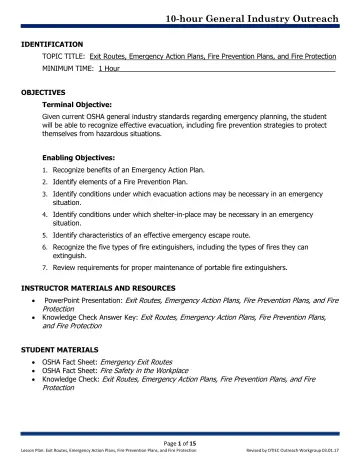
Exit Routes, Emergency Action Plans, Fire Prevention Plans, and Fire Protection: Lesson Plan (OSHA 10-Hour General Industry Outreach)
Instructor lesson plan (objectives, timing, teaching steps) for the OSHA General Industry exit routes, emergency action plans, fire prevention plans, and fire protection outreach deck.
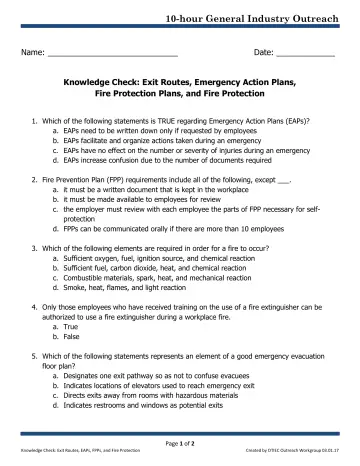
Exit Routes, Emergency Action Plans, Fire Prevention Plans, and Fire Protection: Knowledge Check (OSHA 10-Hour General Industry Outreach)
Student knowledge-check quiz for the OSHA General Industry exit routes, emergency action plans, fire prevention plans, and fire protection outreach deck.