From a small-business course on emergency planning. An archived deck: check it against the current standard before teaching from it.
Slide text
· 14 slides · by National Safety Council
The words on each slide as the author wrote them, read from the file by software so they can be searched. Layout, pictures and tables are not shown here: the slides above and the download are the original.
- Slide 1
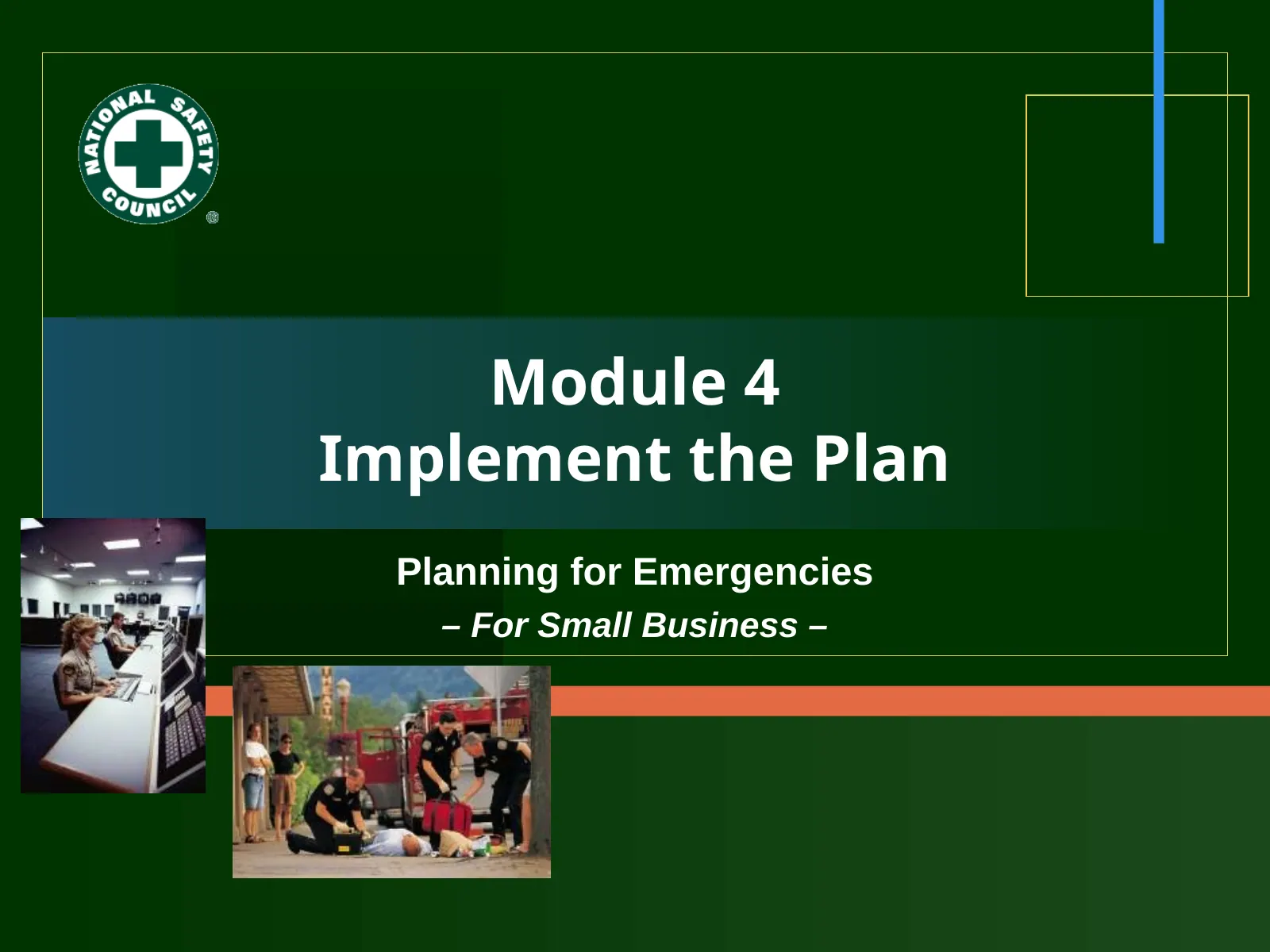
Module 4
- Implement the Plan
- Planning for Emergencies
- For Small Business –
- Slide 2
Module 4 Objectives
- Describe ways to integrate the plan into business operations.
- Recognize basic considerations for developing a training plan and conducting effective training.
- Recognize issues when conducting a formal audit of the plan.
- Identify resources to help in completing sections of a plan.
- Demonstrate an understanding of Step 4 by responding to questions posed at critical decision points in a case study.
- Identify 2 actions related to Step 4 to implement at your workplace, as well as potential barriers.
- Slide 3
Step 4: The Emergency Planning Process
- Step 4
- Implement the Plan
- Step 3
- Develop the Plan
- Step 1
- Get Started –
- Establish a Planning Team
- Step 2
- Analyze
- Capabilities, Risks, &
- Vulnerabilities
- Slide 4
Basic Components of the Emergency Plan
- Is the corporate culture of your business supportive of emergency planning? How supportive?
- Emergency planning must become part of the corporate culture. Look for opportunities to:
- Build awareness.
- Educate and train personnel.
- Test procedures.
- Involve all levels of management, departments, and community.
- Make emergency management part of what personnel do on a daily basis.
- Slide 5
Activity: Integrating the Plan in Business Operations
- 1. In pairs, discuss/identify behaviors that show evidence that each aspect of emergency planning was accomplished in business operations.
- 2. Take notes in the space provided.
- 3. Be prepared to share your responses in a large group.
- Slide 6
Conduct Training
- Everyone who works at or visits the facility requires some form of emergency training, such as:
- Periodic employee discussion sessions to review procedures.
- Technical training in equipment use for emergency responders.
- Evacuation drills.
- Full-scale exercises.
- Slide 7
Planning Considerations
- Determine for a 12 month period:
- Who will be trained?
- Who will do the training?
- What training activities will be used?
- When/where will each session take place?
- How will sessions be evaluated and documented?
- Slide 8
Planning Considerations (continued)
- Use a training drills/exercises chart to schedule training.
- Consider how to involve community responders in training.
- Conduct reviews after each training activity.
- Slide 9
Training Activities
- Orientation & Education
- Session
- Tabletop Exercise
- Walk-Through Drill
- Functional Drills
- Evacuation Drills
- Full-Scale Exercise
- How have you used types of training activities in your emergency planning efforts? What worked well? What did not work well?
- Slide 10
Employee Training
- Roles and responsibilities
- Threats, hazards, protective actions
- Notification, warning, communications procedures
- Means for locating family members
- Response procedures
- Evacuation, shelter, accountability procedures
- Location/use of common emergency equipment
- Emergency shutdown procedures
- Slide 11
Evaluate & Modify the Plan
- Conduct a formal audit of entire plan at least once a year.
- In addition to a yearly audit, evaluate, and modify the plan:
- After each training drill or exercise.
- After each emergency.
- When personnel or their responsibilities change.
- When the layout or design of the facility changes.
- When policies or procedures change.
- Remember to brief personnel on changes to the plan.
- Slide 12
Emergency Plan Templates & Resources
- 1. Review a section(s) of an emergency plan template related to information in this module.
- 2. Identify additional internal and external resources that may help you complete section(s) of your plan upon return to your business.
- Slide 13
Case Study: Emergency Planning
- 1. Break into small work groups with guidance from your facilitator.
- 2. In groups, discuss and answer questions that follow the case study. Take notes.
- 3. Share responses with the large group.
- Slide 14
Activity: Priority Actions for Your Business
- 1. Identify 2 actions to take upon return to your business. Select from actions listed or come up with your own.
- 2. Identify potential barriers you might encounter in taking the actions.
- 3. List ideas for overcoming barriers you identified.