From a small-business course on emergency planning. An archived deck: check it against the current standard before teaching from it.
Slide text
· 17 slides · by National Safety Council
The words on each slide as the author wrote them, read from the file by software so they can be searched. Layout, pictures and tables are not shown here: the slides above and the download are the original.
- Slide 1
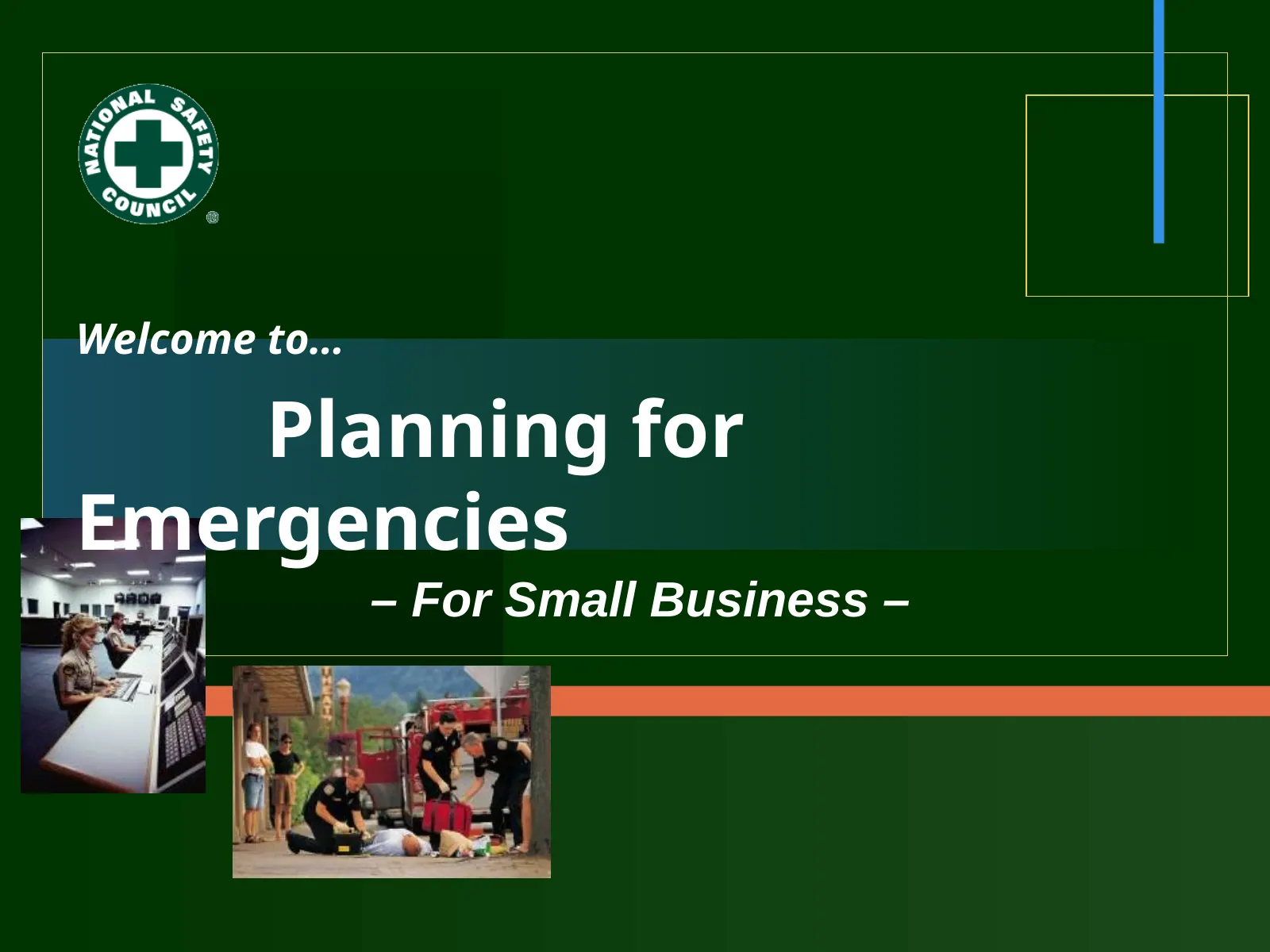
Planning for Emergencies
- Welcome to…
- For Small Business –
- Slide 2
National Safety Council
- Mission
- The mission of the National Safety Council is to educate and influence people to prevent accidental injury and death.
- Slide 3
Safety & Logistics
- Emergency procedures and exits
- Starting and ending times
- Breaks and lunch
- Tobacco policy
- Rest and break rooms – telephones
- Electronic devices
- Medical concerns
- Participation, attendance, certificates
- Slide 4
Module (Introduction) Objectives
- Identify a learning goal/expectation.
- Recognize course goals, learning path, and structure and purpose of the PG (including the Tools and Resources)
- Rate your [basic] business readiness in case of an emergency.
- Recognize the potential impact of an effective emergency plan.
- Assess your facility’s experience with emergencies.
- Recognize:
- Emergency management considerations
- Key terms
- Cost to develop a plan
- Goals for emergency planning
- OSHA requirements
- 4 steps in the emergency planning process
- Slide 5
Activity: Readiness Assessment
- 1. Using the Readiness Assessment, answer questions (Yes, No, or Unsure) pertaining to your business readiness (level of preparedness) in case of an emergency/disaster.
- 2. Calculate your results and check the corresponding rating.
- 3. Share your Readiness Assessment results during introductions.
- Slide 6
Activity: Introductions
- 1. Prepare to introduce yourself – name, industry/business, size of your business, and job/type of work.
- 2. Identify reason(s) for attending this training program (learning goal).
- 3. Introduce yourself briefly, highlighting points above and results of your Readiness Assessment.
- Slide 7
Program Goals
- You will be able to implement an effective emergency action planning process and create a plan for your business.
- Based on best practices and OSHA requirements for emergency action planning, focus on a 4-step process and elements for handling emergencies in the workplace.
- 1. Get Started – Establish a Planning Team
- 2. Analyze Capabilities, Risks, and Vulnerabilities
- 3. Develop the Plan
- 4. Implement the Plan
- Address types of emergencies, planning guidelines, and planning priorities.
- Slide 8
Agenda
- Planning for Emergencies Agenda
- Program Introduction
- Module 1: Get Started – Establish a Planning Team
- Module 2: Analyze Capabilities, Risks, and Vulnerabilities
- Module 3: Develop the Plan
- Module 4: Implement the Plan
- Conclusion
- Slide 9
Video: Why Are We Here?
- What would you do if an emergency – earthquake, fire, building/bridge collapsed, or pandemic – happened where you were at 9 AM tomorrow?
- Watch a short video on emergencies as you take a few minutes to consider the answer to this question.
- Slide 10
Activity: Preparing Your Business for Any Emergency
- 1. Consider the perspective of your business in regard to ANY emergency as you read the questions.
- 2. Answer/discuss each question. Take notes in the space provided.
- 3. Prepare to share your responses with other participants.
- Slide 11
Scope of Workplace Emergencies
- Threat
- Fire
- Criminal Act
- Natural (Weather-Related) Disasters
- Emergency
- Crisis
- Disaster
- Hazard
- Risk
- Vulnerability
- RVA
- Medical Emergencies
- Hazardous Material
- Emergencies
- Workplace Violence/
- Intruders
- Intentional Emergencies or Disasters
- Capability
- Capability Analysis
- Slide 12
Goals of Emergency Planning
- Protect employees/your facility and develop a plan to resume operations if a facility is damaged or destroyed.
- Lessen potential for loss of life and property by anticipating emergencies.
- Protect employees, customers, and business.
- Assist employees in understanding their responsibilities and those of co-workers.
- Slide 13
Intro to the 4-Step Emergency Planning Process
- Step 4
- Implement the Plan
- Step 1
- Get Started –
- Establish a Planning Team
- Step 3
- Develop the Plan
- Step 2
- Analyze
- Capabilities, Risks, &
- Vulnerabilities
- Slide 14
Emergency Management
- Need authority to create a plan and CEO commitment to make emergency management part of corporate culture.
- If you already have a plan, use this program as a resource to assess and update your plan.
- Emergency management is a dynamic process.
- Planning, training, conducting drills, testing equipment and coordinating activities with the community are important.
- Requires upper management support. CEO sets tone.
- Slide 15
The Case for Emergency Management
- Helps companies fulfill moral AND social responsibility.
- Facilitates compliance with regulatory requirements.
- Enhances ability to recover from financial losses, regulatory fines, market share loss, equipment damages, or products or business interruption.
- Reduces exposure to civil or criminal liability.
- Enhances a company’s image and credibility.
- May reduce your insurance premiums.
- Slide 16
Costs to Develop an Emergency Plan
- Determine what recommendations will cost
- No Cost
- More than $250
- More than $1,000
- Slide 17
OSHA Requirements Related to Emergencies
- Exit routes, emergency action plans, and fire prevention plans
- (29 CFR 1910.33-1910.39)
- Fire brigades (29 CFR 1910.156)
- Hazardous waste operations and emergency response (29 CFR 1910.120)
- Respiratory protection (29 CFR 1910.134)
- Permit-required confined spaces
- (29 CFR 1910.146)
- Bloodborne pathogens (29 CFR 1910.1030)