1 / 42Use ← → to flip
Excavations (OSHA 10-Hour Construction Outreach)
OSHA's own 10-hour Construction Outreach deck on trenching and excavation hazards and protective systems (2015 edition).
Slide text
· 42 slides · by U.S. Department of Labor, OSHA (with the OTIEC Outreach Workgroup)
The words on each slide as the author wrote them, read from the file by software so they can be searched. Layout, pictures and tables are not shown here: the slides above and the download are the original.
- Slide 1
Excavations
- 10-Hour Construction Outreach
- Slide 2
Excavations
- Source of photos: NIOSH /John Rekus
- Slide 3
Excavations
- Lesson Overview
- Role of Competent Person
- Excavation Hazards
- Protection from Cave-ins
- Protection from other Excavation Hazards
- Employer Requirements
- Slide 4
Role of Competent Person
- Required training and knowledge
- Soil classification
- Use of protective systems
- OSHA’s requirements for excavation
- Able to identify hazards and have the authority to eliminate hazards
- Slide 5
- This competent person is inspecting the excavation, surroundings and protective system. If a hazard is identified, they will remove the worker and take prompt corrective action.
- Source of photo: OTIEC Chabot Las Positas
- Slide 6
Excavation Hazards
- This is a very dangerous situation!
- Cave-ins
- Falls
- Falling Loads
- Hazardous Environment Mobile Equipment
- Underground Utilities
- Source of photo: OSHA
- Slide 7
Cave-Ins
- Greatest hazard
- It is natural for a trench to try to fill itself
- One cubic foot of soil weighs between 90-130 lbs.
- It will entrap, bury, or otherwise injure you
- Slide 8
They Both Died
- A crew was installing conduit in an 8’ deep by 2’ wide trench.
- The trench collapsed.
- Two workers were buried.
- They both died!
- Source of photo: CDC/NIOSH/FACE
- Slide 9
Protection is Required
- Never enter an unprotected trench that is 5 or more in depth
- The competent person must first choose and implement a protective system
- Even excavations less than 5 feet deep need to be deemed safe by the competent person
- Cave-ins can happen without warning
- This 6 foot deep vertical-sided, unprotected trench is dangerous!
- Source of photo: OTIEC NRC WVU
- Slide 10
Protective Systems
- Support/shoring systems
- Sloping and benching
- Shielding systems (trench boxes)
- Shoring
- Sloping
- Shielding
- Slide 11
Support/shoring Systems
- Source of photos: NIOSH /John Rekus
- Slide 12
The Theory of Shoring
- Shoring prevents cave-ins
- Shoring, if designed and installed correctly, prevents movement of the excavated wall.
- In order for the shoring to do its job, you must stay within the protection of the shoring even when entering and exiting
- Slide 13
Improper Shoring
- Click to add Text
- Make-shift, improperly designed shoring does little other then provide a false sense of security!
- Source of photos: OSHA
- Slide 14
Sloping and Benching
- This slope is safe for any soil classification!
- Is this a 1 ½ to 1 slope?
- Slide 15
The Theory of Sloping
- Sloping prevents cave-ins
- Sloping, if done correctly, removes the risk of cave-ins by sloping the soil of the trench back from the trench bottom
- Source of photo: OTIEC NRC WVU
- Slide 16
Shield System
- How many hazards can you find ?
- Source of photo: OSHA
- Slide 17
The Theory of Shielding
- Trench shields and boxes, if installed correctly, are designed to protect workers from the forces of a cave-in
- In order for the shield to do its job, you must stay within the protection of the shield even when entering and exiting
- Slide 18
Falls
- Safe Alternative
- Source of photos: OSHA
- Slide 19
Adjacent Structures
- Structures become unstable when earth next to them is removed
- For your safety, they must be supported
- A competent person must ensure precautions are implemented.
- Slide 20
Underground Utilities
- As required, this worker’s employer used their state’s one call system to locate under ground utilities before breaking ground. Now he is hand digging to find the exact location.
- Source of photo: OSHA
- Slide 21
Spoil Pile
- Minimum
- Source of photo: OSHA
- Slide 22
Mobile Equipment
- Safe Alternative
- Source of photos: OSHA
- Slide 23
Vehicular or Traffic Hazards
- Source of photos: OSHA
- Slide 24
Falling Loads
- Do you see any other hazards?
- Source of photo: OSHA
- Slide 25
Hazardous Atmospheres
- Source of photo: OSHA
- Slide 26
Water Accumulation
- Source of photos: OSHA
- Slide 27
Access/Egress
- Source of photo: OSHA
- Slide 28
Ladders
- Slide 29
Hard Hats
- Working below grade, overhead hazards exist
- Hard hats must be worn in excavations because of overhead hazards
- Source of photo: OSHA
- Slide 30
Responsibilities: Employer
- Employers must:
- preplan the work and use the one-call system to identify underground utilities
- protect you from cave-ins and other excavation-related hazards
- inspect the excavation at least daily and throughout the shift as needed
- take prompt corrective action when a hazard is identified
- respond to and correct hazards pointed out by you, the worker
- Slide 31
Responsibilities: Employer
- Employers must:
- make sure a ladder is within 25’ of your work area when deeper than 4’
- keep excavated dirt, rocks and other materials back 2’ from the excavation’s edge
- Test and monitor the air within the trench in areas suspect to atmospheric hazards
- Slide 32
Responsibilities: You
- You must:
- work defensively
- Follow you company’s excavation and trenching safety rules
- correct the hazards you are able to correct
- report to your supervisor the hazards you are unable to correct
- Slide 33
Case Study
- Slide 34
Hazard Recognition
- Identify hazards and what should be done
- Source of photos: OSHA
- Slide 35
Hazard Recognition
- Identify hazards and what should be done
- Source of photos: OSHA
- Slide 36
Hazard Recognition
- Identify hazards and what should be done
- Source of photo: OSHA
- Slide 37
Always Remember
- Never enter a trench 5’ or greater in depth unless a protective system is in place.
- Trenches less than 5’ deep still require the competent person’s “OK”
- If a trench box or shoring is used, never leave its protection while in the trench
- Slide 38
Knowledge Check
- What is the minimum distance that excavated materials, tools, and other supplies be kept back from the excavation’s edge?
- a. 1 foot
- b. 2 feet
- c. 7.5 feet
- d. 25 feet
- b. 2 feet
- Slide 39
Knowledge Check
- At what depth must a ladder, ramp, steps, or runway be present for quick worker exit:
- a. 4 feet
- b. 5 feet
- c. 10 feet
- d. It is never required
- a. 4 feet
- Slide 40
Knowledge Check
- What is the greatest hazard facing a worker while working in a trench:
- a. Hazardous atmospheres
- b. Falls
- c. Cave-ins
- d. Falling Objects
- c. Cave-ins
- Slide 41
Knowledge Check
- Unless made in entirely stable rock, at what depth is a protective system required for a trench:
- a. Any depth if the competent person says so.
- b. 5 feet deep and greater
- c. Both a and b
- d. A protective system is never required in trenches
- Slide 42
Excavations in Construction
- Questions?
More on Excavations
pdf
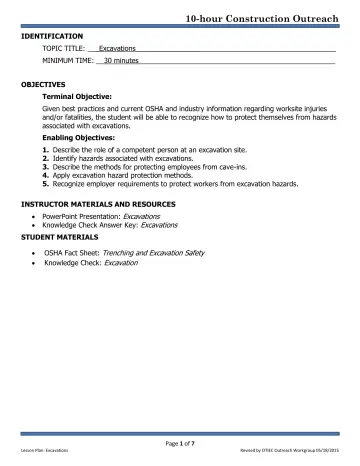
7 slidesExcavations: Lesson Plan (OSHA 10-Hour Construction Outreach)
Instructor lesson plan with objectives, timing and teaching procedures for the OSHA excavations outreach deck.
U.S. Department of Labor, OSHA (with the OTIEC Outreach Workgroup)ArchivedPublic domain
pdf
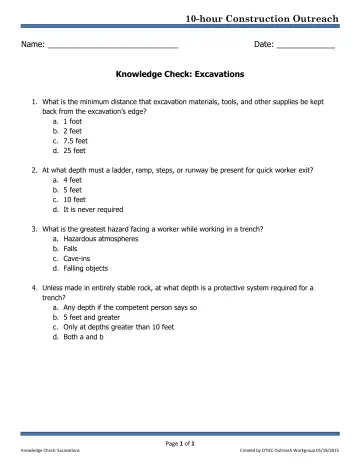
1 slidesExcavations: Knowledge Check (OSHA 10-Hour Construction Outreach)
Student knowledge-check quiz that accompanies the OSHA excavations outreach deck.
U.S. Department of Labor, OSHA (with the OTIEC Outreach Workgroup)ArchivedPublic domain
pptx
62 slidesExcavation and Trenching Safety Training
Excavation and trenching safety training from Wayne State University.
Wayne State UniversityOSHA Harwood grant