1 / 7Use ← → to flip
Excavations: Lesson Plan (OSHA 10-Hour Construction Outreach)
Instructor lesson plan with objectives, timing and teaching procedures for the OSHA excavations outreach deck.
Page text
· 7 pages · by U.S. Department of Labor, OSHA (with the OTIEC Outreach Workgroup)
The words on each page as the author wrote them, read from the file by software so they can be searched. Layout, pictures and tables are not shown here: the pages above and the download are the original.
- Page 1
IDENTIFICATION
- TOPIC TITLE: ___Excavations___
- MINIMUM TIME: __30 minutes___
- OBJECTIVES
- Terminal Objective:
- Given best practices and current OSHA and industry information regarding worksite injuries and/or fatalities, the student will be able to recognize how to protect themselves from hazards associated with excavations.
- Enabling Objectives:
- 1. Describe the role of a competent person at an excavation site.
- 2. Identify hazards associated with excavations.
- 3. Describe the methods for protecting employees from cave-ins.
- 4. Apply excavation hazard protection methods.
- 5. Recognize employer requirements to protect workers from excavation hazards.
- INSTRUCTOR MATERIALS AND RESOURCES
- PowerPoint Presentation: Excavations
- Knowledge Check Answer Key: Excavations
- STUDENT MATERIALS
- OSHA Fact Sheet: Trenching and Excavation Safety
- Knowledge Check: Excavation
- Page 2
TEACHING PROCEDURES ---Preparation, Presentation, Application, Evaluation
- Anticipatory Set (Focus Attention/Gain Interest)
- Estimated Time: ?? hours
- Key Points
- Methods
- Excavations and trenching activities are some of the most dangerous construction operations. Most accidents tend to happen in trenches between 5-15 feet deep and there’s usually little or no warning before a cave-in occurs.
- PPT slide #1 – #3
- According to OSHA, two workers are killed every month in trench collapses. The crushing weight of soil can break bones, impair circulation and breathing, and cause serious internal injuries.
- Presentation (Instruction)___
- Key Points
- Methods
- I.
- PPT slide #4 - #5
- Role of Competent Person
- A. Required training and knowledge
- 1. Soil classification
- 2. Use of protective systems
- 3. Requirements of OSHA’s standard on excavation and trenching
- B. Capable of identifying hazards and have authority to eliminate hazards
- C. Make daily inspections of excavations, areas around them, and protective systems
- 1. Before work starts and as needed
- 2. After rainstorms, high winds, or other occurrences that may increase hazards
- 3. When it can be reasonably anticipated that an employee will be exposed to hazard(s).
- 4. Remove employees exposed to hazards
- Page 3
II. Excavation Hazards
- A. Cave-ins
- 1. Greatest risk
- 2. Open excavation is unnatural and soil wants to flow back together to fill void
- B. Other potential hazards
- 1. Falls
- 2. Falling loads
- 3. Hazardous environment – considered a confined space; can pose potential risks of oxygen deficiency, toxic fumes, and water accumulation
- 4. Mobile equipment
- a. Can contribute to cave-in potential
- b. Struck-by hazard
- c. Caught-in/-between hazard
- 5. Vehicular or traffic hazards
- a. High-visibility garments needed
- b. Manual on Uniform Traffic Control Devices (MUTCD)
- III. Protection from Cave-ins
- A. Protection from collapse must be provided for all excavations 5 feet or deeper. Workers should never enter an unprotected trench.
- PPT slide #9 - #17
- B. Types of protective systems
- 1. Support/shoring systems
- 2. Sloping and benching
- 3. Shield system
- IV. Protection from Excavation Hazards
- A. Instability of adjacent structures
- 1. Structures become unstable when soil next to them is removed
- 2. Use support system to ensure stability of structure
- PPT slide #18 - #29
- B. Underground structures
- 1. Pipe lines, water or wastewater lines, other utility lines
- Page 4
2. Before digging, contact utility or owner
- 3. Support, protect, or appropriately remove underground installations in open excavations
- C. Spoil pile
- 1. Keep at least 2 feet from edge of excavation
- 2. Place pile so that rainwater runs away from excavation and not into it
- D. Mobile equipment
- 1. Danger of falling into excavation
- 2. Use warning system
- a. Barricades
- b. Hand or mechanical signals
- c. Stop logs
- 3. Grade soil with angle away from excavation, if possible
- E. Falling loads
- 1. Items such as tools, equipment, or construction materials falling into trench
- 2. Keep items at least 2 feet from edge or use retaining device
- 3. Do not allow workers to stand or work below loads being handled by lifting or digging equipment
- F. Hazardous atmospheres
- 1. Test for hazardous environments before employees enter excavations that are more than 4 feet deep
- 2. Proper respiratory protection or ventilation must be provided when working in hazardous atmospheres
- 3. Regularly test all controls used
- 4. Emergency rescue equipment must be available
- a. Breathing apparatus
- b. Safety harness and line
- c. Basket stretcher
- G. Water accumulation
- 1. Risk of cave-in is increased, risk of drowning, increased difficulty of exiting excavation
- 2. Use water removal equipment
- 3. Divert surface water away from excavation and provide adequate drainage of adjacent area
- 4. Competent person should inspect excavations after rains
- Page 5
H. Access/Egress
- 1. Entry/exit can present fall hazards if safe means of access/egress is not in place
- 2. Survival may depend on quick exit
- 3. Stairways, ladders, ramps, or other safe means provided in all trenches 4+ feet deep; means of egress within 25 lateral feet of workers
- I. Hard hats
- 1. Danger of head injury from impact
- 2. Hard hats must be worn in excavations 5+ feet deep or when competent person determines hazard exists at lesser depth
- V.
- Employer Requirements
- PPT slide #30 – #32
- A. Comply with all applicable OSHA standards related to excavations, including:
- 1. Training requirements
- 2. Inspection requirements
- B. Designate a competent person, who has the appropriate experience and training, to:
- 1. Identify existing and potential hazards and immediately eliminate those hazards.
- 2. Make daily inspections of excavations, areas around excavations, and protective systems as required by OSHA.
- 3. Remove exposed employees from hazardous area and not allow employees to return until all necessary precautions have been taken to protect them.
- Page 6
Application (How students apply what they learn) __
- Estimated Time: ?? hours
- Key Points
- Methods
- Show pictures of excavation sites. Have students identify any unsafe actions or conditions and discuss related best practices.
- PPT slide #33 – #36
- Evaluation/Summary
- Key Points
- Methods
- Knowledge Check: Excavations
- PPT slide #37 – #41
- References
- OSHA Standard: https://www.osha.gov/pls/oshaweb/owasrch.search_form?p_doc_type=STANDARDS&p_toc_level=1 &p_keyvalue=Construction
- 1926 Subpart P – Excavations
- 1926.650 – Scope, application, and definitions applicable to this subpart
- 1926.651 – Specific Excavation Requirements
- 1926.652 – Requirements for protective systems
- 1926 Subpart P App A – Soil Classification
- 1926 Subpart P App B – Sloping and Benching
- 1926 Subpart P App C – Timber Shoring for Trenches
- 1926 Subpart P App D – Aluminum Hydraulic Shoring for Trenches
- 1926 Subpart P App E – Alternatives to Timber Shoring
- 1926 Subpart P App F – Selection of Protective Systems
- Page 7
- OSHA Publications
- https://www.osha.gov/pls/publications/publication.arthruz?pType=Industry&pID=213
- OSHA #2226 Booklet Excavations (2002)
- OSHA FS-3476 (English) and OSHA FS-3480 (Spanish) Fact Sheet Trenching and Excavation Safety (2011)
- OSHA #3255 Poster Trenching (2011)
- OSHA #3243 QuickCard TM Working Safely in Trenches (2011)
- OSHA References/Resources
- Construction Safety and Health Outreach Program, Excavations , 1996 https://www.osha.gov/doc/outreachtraining/htmlfiles/excavate.html
- Safety and Health Topics, Trenching and Excavations , no date https://www.osha.gov/SLTC/trenchingexcavation/index.html
- OSHA Construction eTool, Trenching and Excavation , 2009 https://www.osha.gov/SLTC/etools/construction/trenching/mainpage.html Prevention Video (v-Tool), Excavations in Construction , no date https://www.osha.gov/dts/vtools/construction/trench_fnl_eng_web.html Prevention Video (v-Tool), Soil Classification , no date https://www.osha.gov/dts/vtools/construction/soil_testing_fnl_eng_web.html
More on Excavations
pptx
42 slidesExcavations (OSHA 10-Hour Construction Outreach)
OSHA's own 10-hour Construction Outreach deck on trenching and excavation hazards and protective systems (2015 edition).
U.S. Department of Labor, OSHA (with the OTIEC Outreach Workgroup)ArchivedPublic domain
pdf
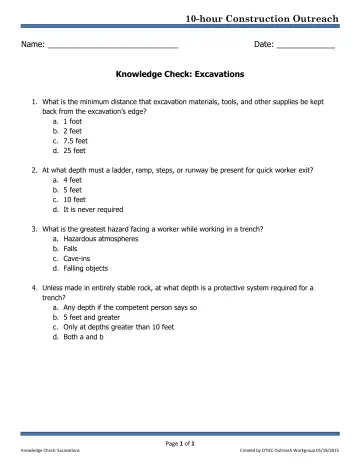
1 slidesExcavations: Knowledge Check (OSHA 10-Hour Construction Outreach)
Student knowledge-check quiz that accompanies the OSHA excavations outreach deck.
U.S. Department of Labor, OSHA (with the OTIEC Outreach Workgroup)ArchivedPublic domain
pptx
62 slidesExcavation and Trenching Safety Training
Excavation and trenching safety training from Wayne State University.
Wayne State UniversityOSHA Harwood grant