1 / 92Use ← → to flip
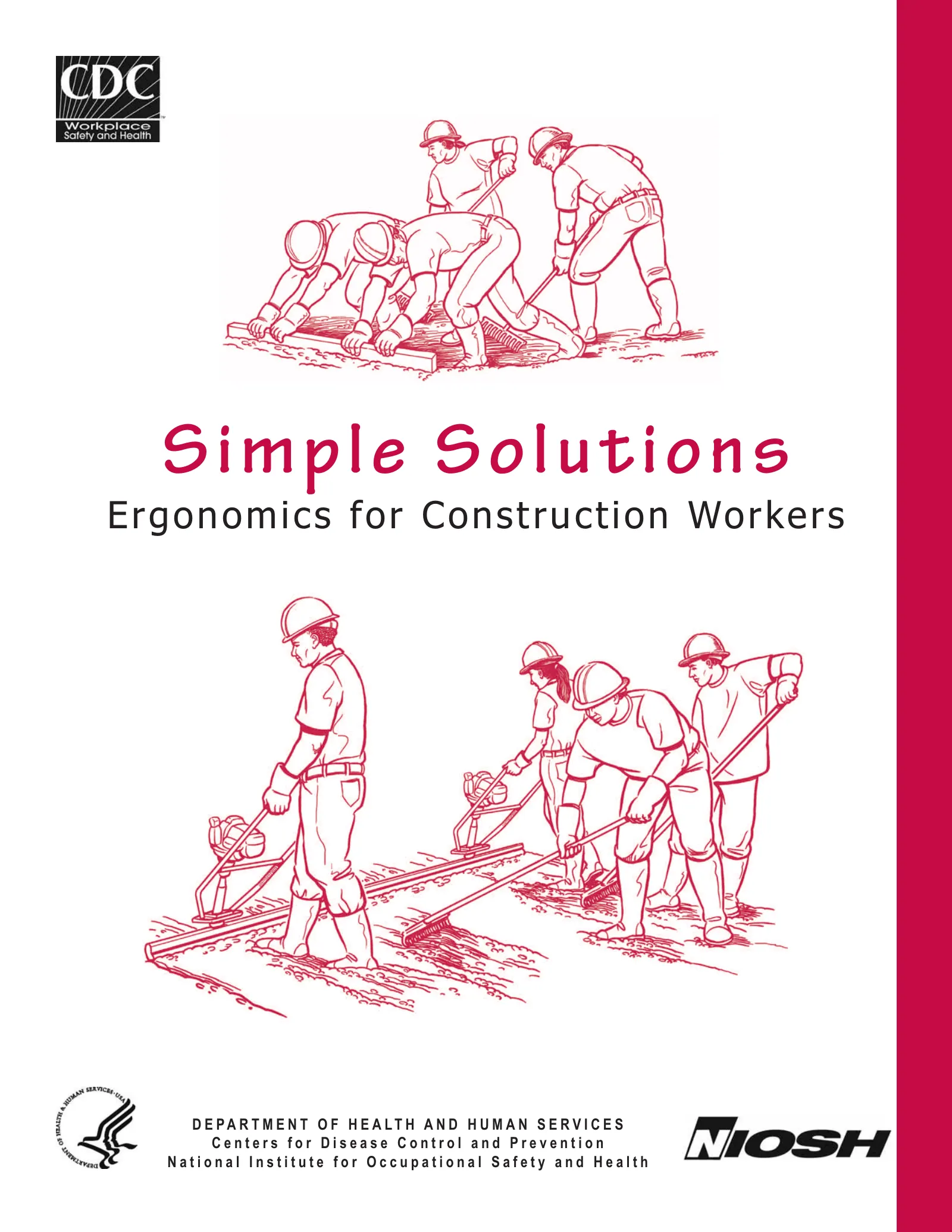
Simple Solutions: Ergonomics for Construction Workers (NIOSH 2007-122)
NIOSH guide with practical, low-cost fixes for lifting, overhead work, kneeling and hand-intensive construction tasks. Great for picking examples to discuss.
Page text
· 80 of 92 pages · by National Institute for Occupational Safety and Health (NIOSH)
The words on each page as the author wrote them, read from the file by software so they can be searched. Layout, pictures and tables are not shown here, and long pages are shortened: the pages above and the download are the original.
- Page 1
Simple Solutions
- Ergonomics for Construction Workers
- Centers for Disease Control and Prevention
- National Institute for Occupational Safety and Health
- Page 3
Simple Solutions
- Ergonomics for Construction Workers
- James T. Albers
- NIOSH Division of Applied Research and Technology
- Cheryl F. Estill
- NIOSH Division of Surveillance, Hazard Evaluations, and Field Studies
- U.S. DEPARTMENT OF HEALTH AND HUMAN SERVICES
- Public Health Service
- Centers for Disease Control and Prevention
- National Institute for Occupational Safety and Health
- 2007
- Page 4
Disclaimers and Ordering Information
- This document is in the public domain and may be freely copied or reprinted.
- Disclaimers
- Mention of any company or product does not constitute endorsement by the National Institute for Occupational Safety and Health (NIOSH). In addition, citations to Web sites external to NIOSH do not constitute NIOSH endorsement of the sponsoring…
- …
- Page 5
Acknowledgments
- Writing and Research
- James T. Albers, NIOSH Division of Applied Research and Technology
- Cheryl F. Estill, NIOSH Division of Surveillance, Hazard Evaluations, and Field Studies
- Editing and Design
- Eugene Darling, Labor Occupational Health Program (LOHP), University of California, Berkeley Kate Oliver, LOHP
- Laura Stock, LOHP
- Anne Votaw, NIOSH
- Illustrations
- …
- Page 6
- Tip Sheet #7. Charles P. Austin, MS, CIH, Sheet Metal Occupational Health Institute Trust (SMOHIT), Alexandria, VA.
- Tip Sheet #8. Greg Shaw, Midstate Education and Service Foundation, Ithaca, NY.
- Tip Sheet #9. Greg Shaw, Midstate Education and Service Foundation, Ithaca, NY.
- Tip Sheet #10. Dan Anton, PhD, PT, ATC, University of Iowa, College of Public Health, Department of…
- …
- Page 7
Reviewers
- Page 9
Table of Contents
- SIMPLE SOLUTIONS
- Foreword … 9 Why This Booklet? … 11 Oh, My Aching Body! … 13 What Is Ergonomics? … 15
- Simple Solutions for Floor and Ground-Level Work Introduction … 19 TIP SHEET #1
- Fastening Tools that Reduce Stooping … 23 TIP SHEET #2
- Motorized Concrete Screeds … 25 TIP SHEET #3
- Rebar-Tying Tools … 27 TIP SHEET #4
- Kneeling Creepers … 29 TIP SHEET #5
- …
- Page 11
Foreword
- SIMPLE SOLUTIONS
- C onstruction is a physically demanding occupation, but a vital part of our nation and the U.S.
- economy. In 2006, the total annual average number of workers employed in construction rose to an all-time high of nearly 7.7 million, according to U.S. Bureau of Labor Statistics data. …
- …
- Page 13
Why This Booklet?
- SIMPLE SOLUTIONS
- T his booklet is intended for construction workers, unions, supervisors, contractors, safety
- specialists, human resources managers—anyone with an interest in safe construction sites. Some of the most common injuries in construction are the result of job demands that push the human body beyond its natural limits. …
- …
- Page 15
Oh, My Aching Body!
- SIMPLE SOLUTIONS
- C onstruction work is hard work, and construction workers feel the results. In one survey, seven out
- ten construction workers from 13 trades reported back pain, and nearly a third went to the doctor for it (Cook et al, 1996).
- You have an increased risk of these injuries if you often:
- Carry heavy loads
- Work on your knees
- …
- Page 16
- NIOSH believes that better work practices and tools can reduce the frequency and seriousness of sprains and strains among construction workers.
- These suggestions can be adapted for your own jobsite.
- SAFER • HEALTHIER • PEOPLE TM
- Page 17
What Is Ergonomics?
- SIMPLE SOLUTIONS
- Ergon omics looks at how:
- Physical abilities of the human body
- and —
- Limitations of the human body
- Work tasks
- The job environment
- Work-Related Musculoskeletal Disorders
- Gripping
- Kneeling
- Lifting
- Working in awkward positions
- Applying force
- Repeating movements
- Bending
- Working overhead
- Twisting
- 6TXDWWLQJ
- Over-reaching.
- Page 18
Do You Need an Ergonomics Program?
- There may be a particularly urgent need for an ergonomics program at your site if:
- Injury records or workers’ compensation claims show excessive hand, arm, and shoulder problems; low back pain; or carpal tunnel syndrome.
- Workers often say that some tasks are causing aches, pains, or soreness, especially if these symptoms do not go away…
- …
- Page 19
Maintaining good injury records
- Regular evaluation of the program’s effectiveness.
- For additional information on developing an ergonomics program, see Elements of Ergonomics Programs (NIOSH Pub. No. 97-117) at www.cdc.gov/niosh/docs/97-117.
- Page 21
Simple Solutions for Floor and Ground-Level Work
- INTRODUCTION
- The Problem
- These positions can also make it harder to do your job. When stooping or kneeling, you can’t lift, push, or pull as much weight without putting stress on your body.
- Injuries & Disorders
- Below are some of the injuries you may develop
- …
- Page 22
Some Solutions
- Knee. The muscles in your knee are connected to your leg by tendons. Between
- Floor-level work cannot be eliminated from c but it is possible to change how you do it so on your body. Solutions are available that can level of stress on your back, knee, and other body. They may also reduce how often and h body is subjected to this stress. …
- …
- Page 23
- Change tools and/or equipment. For example, use tools with extension handles that let you stand up
- Example: Gurney converted to work table
- Page 25
Simple Solutions
- Fastening Tools that Reduce Stooping
- Problem: Stooping to use screw gun
- TIP SHEET #1
- The Problem
- Your lower back and knees are the areas at greatest risk of a muscle or joint injury
- Solution: Autofeed stand-up screw gun
- One Solution
- How It Works
- A screw gun with an extension can be XVHGWRVHFXUHVXEÀRRULQJIDOVHÀRRUVDQG decking; to construct concrete forms…
- …
- Page 26
Approximate Cost
- Stand-up screw guns are $200–400. PAT fastening tools with stand-up handles are $500–700. The PAT handles can also be purchased separately
- For More Information
- Ɣ Products related to this solution are described at www.cpwr.com/simple.html. Products also may be found on the internet using the following search terms:
- Stand-Up Screw Guns: “screw gun extension”
- …
- Page 27
Simple Solutions
- Motorized
- Concrete Screeds
- TIP SHEET #2
- The Problem
- Problem: Hand screeding
- When you hand screed concrete, you work bent over, and you have to use a strong grip to pull the board over the wet concrete. Your arms and shoulders exert a lot of force over and over.
- Doing this work often or for a long period of time increases your chance of fatigue and pain. …
- …
- Page 28
- Vibration can also be a problem. It is important to protect workers from hand-arm vibration syndrome (HAVS), a nerve disorder that can become disabling. NIOSH measured vibration levels on three types of motorized screeds. Two had the gasoline engine placed at the bottom of the frame and above the plow. …
- …
- Page 29
Simple Solutions
- Rebar-Tying Tools
- The Problem
- TIP SHEET #3
- Problem: Tying rebar by hand
- One Solution
- Solution: Rebar-tying tool with extension handle
- How It Works
- Both manual and battery-powered rebartying tools are currently available.
- Battery-powered rebar tiers automatically fasten the bars together with tie wire. They can be used whenever a simple “wrap and twist” tie…
- …
- Page 30
- Several companies offer power rebar tiers. With one tool design, you press the trigger and the tool feeds wire around the bars and then twists and cuts the wire. These models are not stand-up tools, but an adjustable extension handle is available.
- Workers should experience fewer injuries. Studies conducted by NIOSH and the Construction Safety Association of Ontario…
- …
- Page 31
Simple Solutions
- Kneeling Creepers
- The Problem
- TIP SHEET #4
- Problem: Kneeling to work near floor
- If you work in a stooped position, there is stress on your lower back as well as your knees, possibly leading to back pain and even a serious back injury.
- One Solution
- Solution: Laying tile with kneeling creeper
- How It Works
- …
- Page 32
- Kneeling creepers provide support when work must be done in awkward and stressful positions. They reduce stress on the knees and lower back, and can help prevent serious muscle and joint problems. Since work can be done with less discomfort and pain, productivity often also increases.
- These devices can be used to assist injured workers retuning to the job, since they can…
- …
- Page 33
Simple Solutions
- Adjustable Scaffolding for Masonry Work
- The Problem
- TIP SHEET #5
- Problem: Conventional unguarded frame scaffolding
- You have to bend deeper and twist your body more often if you keep materials below hip height, or lay brick or block on a section of wall below hip height.
- One Solution
- Solution: Masons finish top course on split-level adjustable scaffolding
- Page 34
How It Works
- Adjustable scaffolding has separate platforms for the worker and the materials. Since the worker platform can be raised or lowered, the materials and the work surface can both be positioned around the height of the worker’s waist. Small scaffolds can be raised manually using hand jacks or a hand winch. Taller scaffolds can be raised using a powered winch.
- …
- Page 35
Simple Solutions for Overhead Work
- INTRODUCTION
- The Problem
- Working overhead also may reduce your ability to do the job safely and productively. For example, you are at risk of many types of injury if your vision is obstructed, if you have an unstable footing, or if you have trouble holding or positioning a tool.
- Injuries & Disorders
- …
- Page 36
- Neck. The neck is a complicated structure composed of seven bones called cervical vertebrae, one below
- Another common condition is tension neck syndrome. This is muscle strain that results from long periods of looking up. It can cause neck stiffness, muscle spasms, and pain in the neck or radiating from the neck.
- …
- Page 37
General solutions for doing overhead work with less risk of injury include:
- Change materials or work processes. One of the most effective solutions may be to use materials, building components, or work methods that are less labor-intensive, so the task takes less time and you reach overhead for a shorter period. …
- …
- Page 39
Simple Solutions
- Bit Extension Shafts
- for Drills and Screw Guns
- The Problem
- TIP SHEET #6
- Problem: Drilling overhead
- This work can put stress on your arms, neck, shoulders, and back. It can lead to fatigue and serious muscle or joint injuries.
- One Solution
- Use a bit extension shaft for the drill or screw gun, so you can hold the tool below your shoulder and closer to your…
- …
- Page 40
- inserted into the socket. PVC pipe is used as a sleeve over the extension. Part of the PVC pipe slides over the bit. The sleeve protects your hands from the spinning shaft and gives you better control of the tool. You hold the tool with one hand and the sleeve with the other.
- Extensions are available from several manufacturers in many different lengths and diameters. …
- …
- Page 41
Simple Solutions
- Extension Poles for Powder-Actuated Tools
- The Problem
- TIP SHEET #7
- Problem: Using PAT overhead
- Using powder-actuated fastening tools
- (PATs) for overhead work may lead to serious shoulder, arm, and hand injuries.
- The recoil shock transmitted from the tool to your hand, arm, and shoulder put you at even greater risk of injury. …
- …
- Page 42
- body and below your shoulders. This cuts down on the risk of injury to your shoulders, arms, and hands. There is also less recoil shock directed to your shoulders and neck. In addition, you can work on the ground rather than using a ladder, scaffold, or lift.
- How It Works
- Workers have less chance of developing a shoulder, arm, and hand injury. …
- …
- Page 43
Simple Solutions
- Spring-Assisted
- Drywall Finishing Tools
- The Problem
- Eventually this work can lead to serious wrist, arm, shoulder, and back injuries.
- TIP SHEET #8
- Problem: Hand drywall finishing with mudbox
- One Solution
- Solution: Spring-assisted mudbox
- O verhead Work .
- Page 44
How It Works
- A spring-assisted mudbox should reduce a worker’s chance of developing a muscle or joint injury. More than 80% of the workers involved in one study liked using the new tools much better than the older ones. After using both new tools, all workers in the study said they were not as tired as when using the regular tools. Most said they had less pain.
- …
- Page 45
Simple Solutions
- Pneumatic Drywall Finishing Systems
- The Problem
- TIP SHEET #9
- Problem: Hand drywall finishing with mudbox
- The combination of pushing and working in an awkward position causes fatigue as well as tired and sore muscles. Eventually it can increase your chance of developing a muscle or joint injury.
- Solution: Pneumatic finishing system
- One Solution
- …
- Page 46
- and back movements. It also takes less effort to use than the automatic tools. You do not need to push with the same strong force used with boxes. You only have to guide the powered tool down the corner.
- How It Works
- These systems should reduce a worker’s chance of developing muscle and joint injuries. In one study, most workers who tried the pneumatic system liked it…
- …
- Page 47
Simple Solutions for Lifting, Holding, and Handling Materials
- INTRODUCTION
- The Problem
- On many construction sites, workers spend time lifting, carrying, holding, pushing, or pulling loads of material. Although it is common today to use mechanical devices for some of this work, a lot of materials are still handled manually. …
- …
- Page 48
- When you lift, bend forward, stretch upward, or stretch outward, your back muscles work harder
- Twisting your body while bending puts even more pressure on the discs, especially when you are exerting force to lift, push, or pull objects.
- Shoulder and neck. Carrying even light loads above
- Trapezius muscle
- …
- Page 49
General solutions for doing material handling with less risk of injury include:
- Change tools and/or equipment. You can buy or rent material handling devices for all aspects of construction. Devices include special round handles and cushioned grips for carrying heavy objects; powered and non-powered carts and dollies for indoor or outdoor use; rolling carts to move sheet…
- …
- Page 50
- Provide training and related programs. A policy of providing ergonomics training may help workers
- Workplace exercise programs are popular in the construction industry. Although they may be a part of any effort to prevent muscle and joint disorders, exercise programs are not a substitute for other solutions. No studies have shown that they prevent injuries by themselves. …
- …
- Page 51
Simple Solutions
- Lightweight
- Concrete Block
- The Problem
- A regular concrete block (also called a concrete masonry unit, or CMU) can weigh up to 50 pounds, depending on size. For masons and mason tenders, lifting and placing CMUs can cause fatigue and put strain on the low back, hands, and arms. …
- …
- Page 52
- Laying lightweight CMUs reduces a worker’s fatigue and lowers stress on the back and arm muscles. One study looked at how concrete block of different weights affects muscle stress. Masons built two walls. One used lightweight CMUs and the other regular CMUs. When workers built the lightweight CMU wall, they had less back and arm muscle stress. …
- …
- Page 53
Simple Solutions
- Pre-Blended Mortar and Grout Bulk Delivery Systems
- The Problem
- When laborers mix mortar or grout in the traditional way, they have to lift heavy cement bags and shovel sand into the mixer. They usually repeat these motions over and over. Full cement bags weigh around 100 pounds, and workers may handle more than 100 bags a day.
- TIP SHEET #11
- …
- Page 54
How It Works
- Pre-blended dry ingredients (including sand, pigments, and admixtures) are delivered to the site in
- 2,000 – 3,000 pound bulk bags. These are moved by forklift or boom truck over a funnel-shaped silo that straddles a conventional mortar mixer. The mix is released into the silo by pulling a hitch pin on the bag. …
- …
- Page 55
Simple Solutions
- Skid Plates to Move
- Concrete-Filled Hoses
- The Problem
- Problem: Pulling concrete hose without skid plate
- TIP SHEET #12
- Charged concrete hoses are heavy and pulling them takes a lot of strength. The latches on a hose may snag on rebar. Workers must sometimes bend down and lift the hose to free it.
- …
- Page 56
- Skid plates slide more easily across the rebar matting, reducing the friction. Pulling is easier. Also, hose couplings do not catch on the rebar matting. This decreases the need for laborers to jerk the hose or bend over to free it.
- From four to six skid plates should be used near the pour end of the hose. They are most effective when the hose is secured to each plate. …
- …
- Page 57
Simple Solutions
- Vacuum Lifters for
- Windows and Sheet Materials
- The Problem
- Problem: Installing window using manual suction cups still requires lifting
- TIP SHEET #13
- This work puts stress on your back and shoulders, which can lead to serious muscle and joint injuries. Injuries can be even more serious when you have to work in awkward positions or hold materials for a long…
- …
- Page 58
Approximate Cost
- style vacuum cups attached to a specially-designed frame. Some of these frames permit loads to be rotated and tilted. In some cases, the cups can be removed from the frame so they can be used individually for lifting and carrying.
- Although some contractors use manual systems, a more typical system is a powered lifter using cups with a cord-free 12-volt…
- …
- Page 59
Simple Solutions for Hand-Intensive Work
- INTRODUCTION
- The Problem
- Construction workers usually spend a lot of time gripping tools or materials with one or both hands. This work can put stress on your hand, wrist, and/or elbow, causing discomfort and pain. Eventually you may develop a serious muscle or joint injury. …
- …
- Page 60
If left untreated, carpal tunnel syndrome can
- Epicondylitis. Forceful twisting motions may cause strain on your elbow tendons, causing discomfort or pain. This condition is called epicondylitis, also known as tennis elbow.
- Hand-arm vibration syndrome (HAVS). Operating vibrating tools like needle guns, chipping hammers,
- Page 61
Some Solutions
- Hand-intensive work cannot be eliminated from construction, but it is possible to change how you do it so the work is easier on your body. Solutions are available that can reduce the level of stress on your hands, wrists, and arms. They may also reduce how often and how long your body is subjected to this stress. …
- …
- Page 63
Simple Solutions
- Ergonomic Hand Tools
- The Problem
- Using a conventional hand tool over and over can lead to muscle strain or even a serious injury like carpal tunnel syndrome or tendinitis. Using the wrong tool, or using a tool the wrong way, can strain your hand, wrist, forearm, shoulder, and neck.
- TIP SHEET #14
- Avoid tools with finger grooves
- One Solution
- …
- Page 64
- Wrist position. Pick a tool that keeps your wrist straight when you use it. A tool with a bent handle may work best if you are applying a horizontal force (in the same direction as your straight forearm and wrist). A tool with a straight handle may work best if you are applying an upward or downward force.
- …
- Page 65
Easy-Hold Glove for Mud Pans
- The Problem
- Problem: Holding mud pan without glove
- TIP SHEET #15
- A mud pan full of drywall compound can weigh more than five pounds. Continuously gripping the pan can put a lot of stress on your hand, wrist, and forearm. If the mud pan is too wide for your hand, you have to squeeze its sides to hold it, putting more strain on your forearm…
- …
- Page 66
- Finishers who used the easy-hold glove liked it and said it was great for long periods of coating drywall. They said that it cut down on their long-term fatigue and pain. Researchers found that wearing the glove led to a 25% reduction in grip force needed to hold the pan.
- There are some drawbacks. Finishers said that it takes time to put the glove on and take it off. …
- …
- Page 67
Simple Solutions
- Power Caulking Guns
- The Problem
- of time, you are at risk of stressing the soft tissues in your hand, wrist, and forearm. This can lead to serious muscle or joint injuries.
- TIP SHEET #16
- Problem: Manually squeezing caulking gun
- Your chance of developing an injury increases if the gun you use has sharp edges or grooves on the trigger, or has a wide span…
- …
- Page 68
Approximate Cost
- Cordless guns are available for tube, sausage, and bulk caulks. A 12-volt or higher cordless gun will produce 600+ lbs. of thrust force. Pneumatic guns will handle sausage and bulk caulks.
- Another device available is a caulk-dispensing adapter that can be used with a cordless drill or variable speed AC drill. These adapters are available for 10 oz. …
- …
- Page 69
Simple Solutions
- Reduced Vibration
- Power Tools
- The Problem
- From chainsaws to impact drills to soil compactors, some hand-held power tools can produce a lot of vibration. Certain tools generate vibration levels so high that they can damage the blood vessels and nerves in your hands.
- TIP SHEET #17
- Problem: Some soil compactors can produce high vibration levels
- …
- Page 70
How It Works
- Many manufacturers now offer reduced vibration tools. Although there are no regulations limiting vibration exposure in the U.S., there are limits in Europe and companies produce tools for both markets. The European limits have been adopted by the American National Standards Institute (ANSI) as recommended exposure limits (S2.70-2006).
- …
- Page 71
Simple Solutions
- Power Cleaning and Reaming with a Brush
- The Problem
- TIP SHEET #18
- Problem: Brushing copper tube by hand
- One Solution
- Place the wire brush in the chuck of a battery-powered or corded screw gun or screwdriver. The power tool will eliminate the repeated hand, wrist, and forearm motions and may improve your grip.
- Solution: Using wire brush with power driver
- …
- Page 72
- There will be less localized pressure on your hand because the handle won’t dig into your skin. There also will be fewer rapid movements of your hand, wrist, and forearm. The rotation of the power tool replaces the motions necessary with the manual wire brush.
- Many power tools can help keep your wrist straight. Some have handles that change from in-line to pistol-grip…
- …
- Page 73
Simple Solutions
- Snips for Cutting
- Sheet Metal
- The Problem
- Cutting sheet metal with snips takes a lot of hand force. You often need to work with your wrist in an awkward position. If you do this work often or for long periods of time, you may experience hand or wrist pain. Eventually you may develop a serious injury.
- TIP SHEET #19
- …
- Page 74
How It Works
- Choosing the correct snips should make the job easier. Your hand and wrist should be less tired, and less likely to be injured. You also should be able to get the job done faster.
- Approximate Cost
- The best snip for the job should not cost much more than other snips. Newer snips are often between $10–40.
- For More Information
- …
- Page 75
Simple Solutions
- Quick-Threading
- Lock Nuts
- The Problem
- TIP SHEET #20
- Problem: Tightening conventional nut on all-thread
- When you tighten a standard lock nut around the thread on a long rod, you have to twist your hand, wrist, and forearm over and over. Making these twisting movements can strain the muscles and tendons in your hand, wrist, and elbow. …
- …
- Page 76
- When using the two piece lock nut, you twist the two sections of the nut apart until the slot is open, then place the nut on the all-thread rod where you need it. Then twist the two sections together again until the slot is closed and the sections are snug against each other. …
- …
- Page 77
Glossary
- SIMPLE SOLUTIONS
- ANSI
- Arthritis
- Awkward position
- See Awkward posture.
- Awkward posture
- Body mechanics education
- Education that emphasizes how best to align the musculoskeletal system during work and other activities to reduce abnormal joint stress, muscle strain, and fatigue.
- Bursa
- Bursitis
- Carpal tunnel
- …
- Page 78
Contact stress
- Cumulative trauma disorder (CTD)
- Discs
- See Intervertebral discs.
- Disorder
- A medical condition in which some body function does not work as it should.
- Epicondylitis
- Ergonomics
- Ergonomics program
- A systematic process, often spelled out in writing, for identifying, analyzing, and controlling ergonomic hazards at a particular workplace.
- Fatigue
- …
- Page 79
In-line grip
- A hand tool handle which is straight.
- ,QÀDPPDWLRQ
- A protective response of the body to infection and injury. Symptoms may include tissue swelling, redness, pain, and a feeling of warmth.
- Intervertebral discs
- Discs that sit between the bones of the spinal column (vertebrae) in the back and neck. The discs act as cushions or “shock absorbers” between the bones. …
- …
- Page 80
Neutral position
- See Neutral body posture.
- NIOSH
- National Institute for Occupational Safety and Health. NIOSH, part of the Centers for Disease Control and Prevention (CDC) under the Department of Health and Human Services, is the federal government agency with a mandate to conduct and fund occupational safety and health research and training.
- OSHA
- …
- Page 81
Strain
- An injury caused by a muscle, tendon, or ligament stretching.
- Stress
- Demand (or “burden”) on the human body caused by something outside of the body, such as a work task, the physical environment, work-rest schedules, and social relationships.
- Tendinitis
- Tendon
- Tough rope-like material that connects the muscles to the bones. Tendons transfer forces and movements from…
- …
- Page 83
References
- SIMPLE SOLUTIONS
- Why This Booklet?
- Center to Protect Workers’ Rights [2002]. Construction Chart Book, 2nd edition. Silver Spring, MD: CPWR. [www.cdc.gov/ elcosh/docs/d0100/d000038/sect41.html]. Date accessed: July 2006.
- Cook TM, Rosecrance JC, Zimmerman CL [1996]. The University of Iowa construction survey. Washington, DC: Center to Protect Workers’ Rights…
- …
- Page 84
- Seidler A, Bolm-Audorff U, Heiskel H, Henkel N, Roth-Küver B, Kaiser U, Bickeböller R, Willingstorfer WJ, Beck W, Elsner G [2001]. The role of cumulative physical work load in lumbar spine disease: risk factors for lumbar osteochondrosis and spondylosis associated with chronic complaints. Occupational and Environmental Medicine 58:735-746.
- …
- Page 85
Tip Sheet #5. Adjustable Scaffolding for Masonry Work
- Breithaupt J [2005]. A scaffold by any other name. Masonry 44(4).
- Breithaupt J [2005]. Saving the day … Each and every day. Masonry 43(3).
- de Jong AM, Vink P, De Kroon JC [2003]. Reasons for adopting technological innovations reducing physical workload in bricklaying. Ergonomics 46(11):1091-1108.
- …
- Page 86
Tip Sheet #7. Extension Poles for Powder-Actuated Tools
- Wos H, Lindberg J, Jakus R, Norlander S [1992]. Evaluation of impact loading in overhead work using a bolt pistol support. Ergonomics 35(9):1069-1079.
- Tip Sheet #8. Spring-Assisted Drywall Finishing Tools
- Pan CS, Chiou SS, Hsiao H, Becker P, Akladios M [2000]. Assessment of perceived traumatic injury hazards during…
- …
- Page 87
Tip Sheet #10. Lightweight Concrete Block
- Anton D, Rosecrance JC, Gerr F, Merlino LA, Cook TM [2005]. Effect of concrete block weight and wall height on electromyographic activity and heart rate of masons. Ergonomics 48(10):1314-1330.
- Brouwer J, Bulthuis BM, Begemann-Meijer M [1991]. The workload of gypsum bricklayers: the effect of lowering the mass and reducing the size…
- …
- Page 88
- Keyserling WM [2000]. Workplace risk factors and occupational musculoskeletal disorders. Part 2: A review of biomechanical and psychophysical research on risk factors associated with upper extremity disorders. American Industrial Hygiene Association Journal 61(2):231-243.
- Marras WS, Schoenmarklin RW [1993]. Wrist motions in industry. Ergonomics 36(4):342-351.
- …
- Page 89
Tip Sheet #16. Power Caulking Guns
- Dababneh A, Lowe B, Krieg E, Kong YK, Waters T [2004]. A checklist for the ergonomic evaluation of nonpowered hand tools. Journal of Occupational and Environmental Hygiene 1(12):D135-D145.
- Tichauer ER, Gage H [1977]. Ergonomic principles basic to hand tool design. American Industrial Hygiene Association Journal 38(11):622-634.
- …
- Page 92
Delivering on the Nation’s promise:
- Safety and health at work for all people through research and prevention.
- To receive documents or other information about occupational safety and health topics, contact the National Institute for Occupational Safety and Health
- (NIOSH) at:
- Telephone:
- 1–800–CDC-INFO (1–800–232-4636)
- TTY:
- 1-888-232-6348
- E-mail:
- [email protected]
- …
More on Ergonomics
pptx
53 slidesPreventing Sprains, Strains, and Repetitive Motion Injuries
Construction ergonomics deck from the State Building and Construction Trades Council of California (2011).
State Building and Construction Trades Council of CaliforniaArchivedOSHA Harwood grant
pptxes
53 slidesPrevención de Torceduras, Distensiones y Lesiones por Movimiento Repetitivo
Spanish edition of the SBCTC construction ergonomics deck.
State Building and Construction Trades Council of CaliforniaArchivedOSHA Harwood grant
pdf
150 slidesPreventing Sprains, Strains, and Repetitive Motion Injuries: Instructor Guide
Full instructor guide (219 pages) with activities for the SBCTC construction ergonomics course.
State Building and Construction Trades Council of CaliforniaArchivedOSHA Harwood grant