1 / 150Use ← → to flip
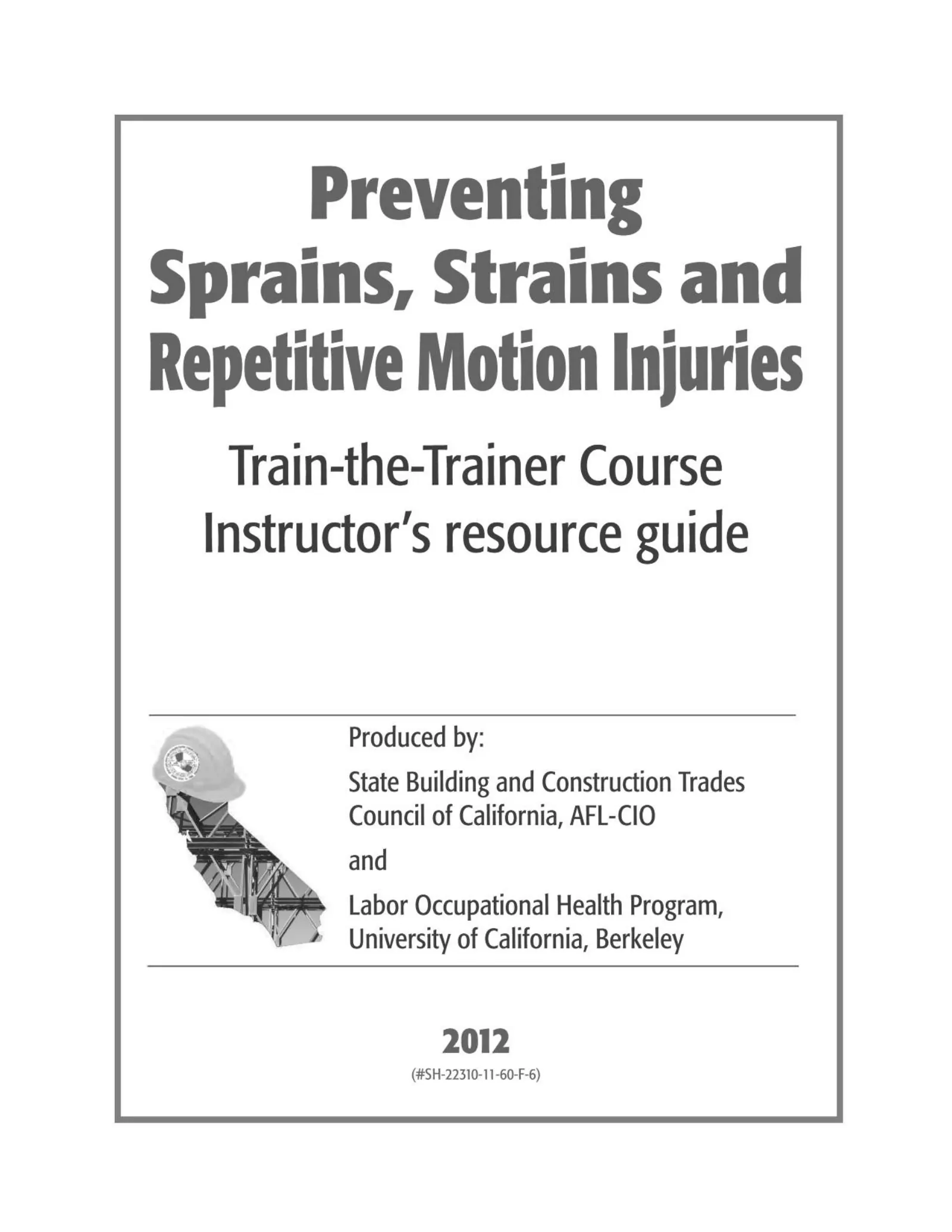
Preventing Sprains, Strains, and Repetitive Motion Injuries: Instructor Guide
Full instructor guide (219 pages) with activities for the SBCTC construction ergonomics course.
Page text
· 114 of 150 pages · by State Building and Construction Trades Council of California
The words on each page as the author wrote them, read from the file by software so they can be searched. Layout, pictures and tables are not shown here, and long pages are shortened: the pages above and the download are the original.
- Page 3
Acknowledgements
- The State Building and Construction Trades Council of California (SBCTC) acknowledges the following organizations that provided information and/or photos for this course:
- Cal/OSHA
- Worker Occupational Safety and Health Training Program, The Commission on Health and Safety and Workers'…
- …
- Page 5
Preventing Sprains, Strains, and Repetitive Motion Injuries
- State Building & Construction Trades Council of California
- Course Objectives
- After this course, participants will be able to:
- Define and explain the terms Musculoskeletal Disorders (MSDs) and ergonomics.
- …
- Page 7
Preventing Sprains, Strains, and Repetitive Motion Injuries
- State Building & Construction Trades Council of California
- Table of Contents
- Title Page
- Acknowledgements Page
- Course Objectives
- How The Binder Is Organized
- Section 1:
- Agenda/Evaluation
- Pretest
- What Do You Know About Cal/OSHA (Quiz)
- Post Test
- …
- Page 9
Preventing Sprains, Strains, and Repetitive Motion Injuries
- State Building & Construction Trades Council of California
- Table of Contents (cont’d)
- Section 5:
- Factsheets/Worksheets (cont’d)
- Drywall Installers: Prevent Back, Wrist, Neck and Shoulder Injuries, California
- …
- Page 11
Preventing Sprains, Strains, and Repetitive Motion Injuries
- State Building & Construction Trades Council of California
- How The Binder Is Organized
- This training program consists of this course binder, a PowerPoint (PPT) CD, five plastic laminated trigger photos, and a body chart template. …
- …
- Page 13
Section 1: Agenda/Evaluation
- Page 15
Preventing Sprains, Strains, and Repetitive Motion Injuries
- State Building & Construction Trades Council of California
- Train the Trainer
- Agenda ― Day One
- 8:00-9:00am
- Introductions and Overview
- Course Overview
- SBCTC Ergonomics Study
- Pretest Quiz
- 9:00-9:30
- …
- Page 16
Preventing Sprains, Strains, and Repetitive Motion Injuries
- State Building & Construction Trades Council of California
- Train the Trainer
- Agenda ― Day Two
- 8:00-8:15am
- Welcome Back
- Questions from Day One
- Overview of Day Two
- Post Test
- 8:15-9:30
- How To Address Costs of MSDs
- …
- Page 17
Preventing Sprains, Strains, and Repetitive Motion Injuries
- State Building & Construction Trades Council of California
- Pre Test
- 1. In 2010 how many injuries in construction resulted from Musculoskeletal
- Disorders (MSDs)?
- a. 10%
- b. 15%
- c. 25%
- d. 35%
- …
- Page 18
Pre Test (cont’d)
- Preventing Sprains, Strains, and Repetitive
- Motion Injuries
- State Building & Construction Trades Council of California
- 6. List 4 risk factors that can cause MSDs:
- a. ___
- b. ___
- c. ___
- d. ___
- 7. List 4 ways to prevent strains, sprains, and Musculoskeletal Disorders
- (MSDs):
- a. ___
- …
- Page 19
What Do You Know About Cal/OSHA?
- Quiz
- True
- False
- The employer, the workers, and the union are all legally responsible for providing a safe and healthful workplace.
- Only a worker directly affected by a hazardous situation may file a complaint with Cal/OSHA.
- …
- Page 21
Preventing Sprains, Strains, and Repetitive Motion Injuries
- State Building & Construction Trades Council of California
- Post Test
- 1. In 2010 how many injuries in construction resulted from Musculoskeletal
- Disorders (MSDs)?
- a. 10%
- b. 15%
- c. 25%
- d. 35%
- …
- Page 22
Post Test (cont’d)
- Preventing Sprains, Strains, and Repetitive
- Motion Injuries
- State Building & Construction Trades Council of California
- 6. List 4 risk factors that can cause MSDs:
- a. ___
- b. ___
- c. ___
- d. ___
- 7. List 4 ways to prevent strains, sprains, and Musculoskeletal Disorders
- (MSDs):
- a. ___
- …
- Page 23
Preventing Sprains, Strains, and Repetitive Motion Injuries
- State Building & Construction Trades Council of California
- Train the Trainer Course Evaluation
- Thank you for taking the time to complete this evaluation. Your feedback is important and will be used to improve the program.
- …
- Page 24
Preventing Sprains, Strains, and Repetitive Motion Injuries
- State Building & Construction Trades Council of California
- Train the Trainer Course Evaluation
- Please evaluate each training topic below. Circle the best answer.
- Not Useful
- Useful
- Very
- Useful
- Overview/Definition of MSDs
- Body Mapping
- …
- Page 25
Preventing Sprains, Strains, and Repetitive Motion Injuries
- State Building & Construction Trades Council of California
- Train the Trainer Course Evaluation (cont’d)
- What did you like most about the training today?
- How could the training be improved?
- …
- Page 27
Section 2: Instructor’s Guide
- Page 29
Instructor’s Guide
- Preventing Sprains, Strains, and Repetitive Motion Injuries
- State Building & Construction Trades
- Council of California
- State Building and Construction Trades Council of California and the
- Labor Occupational Health Program
- University of California, Berkeley
- 2012
- Page 30
Overview and Course Outline
- The goal of this course is to give workers in the construction trades the information they need to help reduce Musculoskeletal Disorders (MSDs). The information in this course focuses on risk factors, prevention strategies and solutions. …
- …
- Page 31
Preparation and Materials Needed
- Specific instructions for conducting the activities in this course appear in the Notes section of the PowerPoint presentation (accompanying each slide). Questions for the class are in a bold blue font. …
- …
- Page 32
Conducting Class Activities
- There are three interactive activities used in this class. Two activities are conducted with the entire class (Body Mapping and the Ouch Activity) and one is a small group activity (Trigger Photos). …
- …
- Page 33
Small Group Activity: Trigger Photos
- Specific instructions for conducting the small group activity appear in the Notes section of the PowerPoint presentation (accompanying each slide).
- Description
- Five small groups are each assigned a different job task, these include: screeding, handling drywall…
- …
- Page 34
Factsheets
- Optional Small Group Activity: OSHA v-Tools
- Federal OSHA developed 12 videos to show how quickly workers can be injured or killed on the job. These videos are intended to assist those in the construction industry to identify, reduce, and eliminate construction-related hazards. …
- …
- Page 35
Section 3: PowerPoint Slides
- Page 38
- Tell the class: This is a training on job site health and safety for construction workers, unions, and employers. It was produced by the Labor Occupational Health Program at UC Berkeley for the State Building and Construction Trades Council of California, AFL‐CIO. …
- …
- Page 39
Tell the class: Information from the sources listed on the slide were used to develop this program.
- Page 40
Ask the class: Do you have any questions about the course and its purpose?
- Page 41
- Tell the class: According to the Bureau of Labor Statistics (BLS), in 2010 Musculoskeletal Disorders (MSDs) accounted for 25% of all workplace injuries in construction. This is a big source of injury and disability for construction workers which is why the State Building & Construction Trades…
- …
- Page 42
- Ask the class: What are examples of MSDs? (Instructor writes what students say on the flipchart).
- Tell the class:
- Carpal tunnel syndrome (CTS) ‐ Carpal tunnel syndrome is pressure on the median nerve ‐ ‐ the nerve in the wrist that supplies feeling and movement to parts of the hand. …
- …
- Page 43
Tell the class:
- 1. The sprains/strains category in this slide includes other MSDs: carpal tunnel syndrome, tendinitis, and back pain.
- 2. The "All Other" category includes chemical burns, amputations, general soreness/pain (except when it's back pain only), crushing injuries, suffocation, eye…
- …
- Page 44
- Tell the class: In this slide you see the rate of MSDs. The rate of injury is calculated based on 10,000 workers. For example, looking at the graph, 45.2 laborers out of 10,000 suffered a lost time injury from an MSD. …
- …
- Page 45
- Tell the class: MSDs continue to be the biggest cause of non‐fatal injuries for construction workers.
- Source: U.S. Bureau of Labor Statistics, 2003‐2009 Survey of Occupational Injuries and Illnesses, CPWR.
- Page 46
- Review the information on the slide. Note that back injuries are the most common MSD.
- Source: U.S. Bureau of Labor Statistics, 2003‐2009 Survey of Occupational Injuries and Illnesses, CPWR.
- Page 47
- Tell the class: As you can see from this slide, overexertion by excessive lifting, pushing, pulling, is a major cause of MSDs and accounts for 25% of all workers’ compensation costs.
- Our task is to find out what the problem is and how to fix it. The first step is to identify symptoms which are often…
- …
- Page 48
- Ask the class: What does the term “ergonomics” mean? Is it a hazard, injury or solution?
- Tell the class: The word is used to describe the science of fitting the job to the worker, not the worker to the job. MSDs are the problem and ergonomics is the solution.
- …
- Page 49
- Tell the class: These terms do not refer to different conditions. Many of these types of i njuries can b e d escribed i n all f our ways. We will mainly use the term musculoskeletal disorders or MSDs in this training. "Ergonomics" is a general term that has different meanings to different audiences. …
- …
- Page 50
- Tell the class: There are many ways to illustrate the types of physical problems people have on the job. One way is to create “body maps” that show where workers are experiencing discomfort or pain. …
- …
- Page 51
- Create a new flipchart page, and label it Job Tasks That May Cause Pain.
- Ask the class: What construction jobs can cause pain? What specific tasks put workers at risk? List what people say on the flipchart. Save this flipchart page for use in the next activity.
- …
- Page 52
- Post the flipchart from the last activity and pick one activity (task) to be demonstrated. Ask for a volunteer to demonstrate the job task. Give everyone in the class some ouch stickers.
- Ask the class: Will someone demonstrate this job task in front of the class?
- …
- Page 53
- Tell the class: A risk factor is anything that can increase your risk of injury. The more risk factors you have, the more likely you will be injured.
- We are going to look at examples of each of these risk factors in the next slides.
- …
- Page 54
Ask the class: What awkward postures do you work in?
- Awkward postures can include:
- Bending
- Working overhead
- Kneeling
- Twisting
- Reaching far in front of you to pick up something
- Working with a bent wrist.
- Tell the class: The term awkward postures refers to any posture where the body parts are away from…
- …
- Page 55
- Ask the class: What jobs require you to repeat the same movement over and over? What physical symptoms do you have from doing this kind of work (e.g., waking up at night with pain in arm, numbness in fingers, swelling in hands or arms, etc.)?
- …
- Page 56
- Ask the class: What jobs require you to use a lot of force? How do you know when it’s too much force?
- Tell the class: Some common jobs that require a lot of force include:
- Lifting something heavy and carrying it
- Pushing or pulling heavy objects
- …
- Page 57
Ask the class: What jobs require work in a static or stationary position?
- Tell the class: Stationary/static postures, or positions that a worker must hold for long periods of time, can restrict blood flow and damage muscles. Long periods of standing can also cause foot pain.
- Page 58
Ask the class: What jobs expose you to vibration?
- Tell the class: The two main types of vibration that can lead to musculoskeletal injuries are:
- 1) hand/arm vibration: and, 2) whole body vibration.
- Background information:
- Hand/arm vibration
- …
- Page 59
Ask the class: What is the problem with these tools?
- Do you use tools that are poorly designed? If so, what are they?
- Tell the class: If you use a tool that does not fit your hand or use the tool in a way it was not intended, you might develop an injury, such as carpal tunnel syndrome, tendinitis, or…
- …
- Page 60
- Ask the class: Do you work in cold or hot conditions for extended periods of time?
- Tell the class: Working in cold temperatures for extended periods of time can reduce the blood flow to your hands and fingers creating numbness. This can cause loss of grip and may damage your hands and wrists.
- …
- Page 62
Ask the class: What are some other ways to identify risk factors on your job?
- Tell the class:
- 1. Employer Records
- Most employers are required to keep a record, called the Cal/OSHA Log 300, of reported work‐ related injuries or illnesses. …
- …
- Page 63
- Tell the class: Ergonomic solutions are used to help fit the workplace to the worker. They help eliminate or reduce risk factors. We are going to briefly discuss each of these solutions in the next slides.
- As you discuss the solutions on the next slides ask if anyone has implemented any of these…
- …
- Page 64
- Tell the class: Contractors can make changes with architects and designers in selecting the material they use for the job. For example, using lighter ladders made out of fiberglass or ordering 3‐foot wide drywall.
- Ask the class: Why are the bricks in the photo a better design?
- …
- Page 65
- Ask the class: Do you use poorly designed tools on your job? If so, please describe them.
- What would you look for in a hand tool?
- The best tool is one that:
- Fits the job you are doing.
- Fits the work space available.
- Reduces the force you need to apply. It should be balanced and not tip backwards or…
- …
- Page 66
- Tell the class: Use a power tool when you can. A power tool can reduce repetition and damage to your hand.
- Page 67
- Ask the class: How can work be done differently to reduce risk factors at your job?
- Refer to examples on the slide.
- Page 68
- Ask the class: How can risk factors be reduced by better planning and organization?
- Refer to examples on the slide.
- Page 69
Ask the class: What training have you received about MSDs or ergonomics at work?
- Tell the class: Training on MSDs should occur before a person starts their job. It should include:
- Understanding how risk factors can increase their chance of injury
- Learning about solutions
- …
- Page 70
- Ask the class: How many of you have participated in a worksite stretch and flex program? What are the pros and cons?
- Pros may include:
- Team building‐people interact with each other
- Open communication with crew members
- Easy to implement
- Low cost solution .
- Cons may include:
- Not taken seriously
- …
- Page 71
- Tell the class: Back belts have been studied extensively and experts have concluded that they are not effective in preventing back injuries. The National Institute for Occupational Safety and Health (NIOSH) recommends that employers not rely on back belts to protect worker from repeated lifting…
- …
- Page 72
Ask the class: How do we address these challenges?
- Points to raise in the discussion:
- 1. MSDs are the leading cause of workers’ compensation claims. Most MSDs can be prevented. Implementing changes can reduce costs in the long run.
- …
- Page 73
Instructions for this activity:
- 1. Break the class into 5 small groups with 4‐5 people in each group.
- 2. Ask everyone to take out the Construction Solutions Worksheet.
- 3. Give each small group a different construction task trigger photo to discuss:
- Group #1: Screeding
- Group #2: Handling Drywall
- …
- Page 74
- After small groups have met for 15 minutes, bring them back together to report on their task. Start with screeding.
- Ask the class: Will the recorder for group #1 please report back their answers for screed operations?
- After the screeding small group has reported, show the next slide to make sure the…
- …
- Page 75
Risks factors might include:
- working in an awkward posture bent over
- using a forceful motion to grip and pull the board over the wet concrete
- using excessive force with arms and shoulders
- Repetition.
- These motions put major stress on your back, knees, hands, arms, and shoulders, which may lead to…
- …
- Page 76
- After small groups have met for 15 minutes, bring them back together to report on their task. Continue with handling drywall.
- Ask the class: Will the recorder for group #2 please report back their answers for handling drywall?
- …
- Page 77
Risks factors might include:
- Pressure put on hands to grip and carry the drywall
- Carrying heavy material in an awkward position.
- Solutions might include:
- Using a strap or handles to carry drywall
- Using a cart to carry drywall
- Using a stand to lift and position the drywall in place
- …
- Page 78
- After small groups have met for 15 minutes, bring them back together to report on their task. Continue with rebar tying.
- Ask the class: Will the recorder for group #3 please report back their answers for rebar tying?
- After the rebar tying small group has reported, show the next slide to make sure…
- …
- Page 79
Risks factors might include:
- Working in a static, stooped and prolonged position
- Bending the wrist in an awkward position to twist and tie the wire
- Using excessive force to grip the pliers
- Repeating the same motion over and over.
- Solutions might include:
- …
- Page 80
- After small groups have met for 15 minutes, bring them back together to report on their task. Continue with overhead drilling.
- Ask the class: Will the recorder for group #4 please report back their answers for overhead drilling?
- …
- Page 81
Risks factors might include:
- Working overhead with arms and neck in a fixed, awkward hard‐to‐hold position This creates stress on the arms, neck, shoulders, and back
- Using a heavy tool that creates vibration in the hands and arms
- Gripping with hands to hold the tool and forcing it upwards
- Repetition.
- …
- Page 82
- After small groups have met for 15 minutes, bring them back together to report on their task. Continue with caulking.
- Ask the class: Will the recorder for group #5 please report back their answers for caulking?
- After the caulking small group has reported, show the next slide to make sure the group…
- …
- Page 83
Risks factors might include:
- Using force to pull the trigger. The more pressure your gun requires to pull the trigger the greater your chance of injury. You may have to exert even more force when you apply a thicker sealant material.
- …
- Page 84
- Ask the class the questions on the slide and lead a discussion on each one. Record what is said for each question on the flipchart. Then proceed with the slide show.
- Examples of changes the worker can make:
- Report problems early
- Ask for help when needed
- Suggest solutions to your employer
- …
- Page 85
- Tell the class: Cal/OSHA has an ergonomics standard. Note that the standard is in the General Industry Safety Orders (GISO) but it applies to construction. The standard has limitations. It does not take effect unless the two conditions stated in the slide are met. …
- …
- Page 86
- Tell the class: Federal OSHA does not have an ergonomics standard. Federal OSHA issued an ergonomics standard in 2000 but it was repealed in 2001 before it took effect. The following components of a comprehensive ergonomics program are suggestions adapted from the proposed federal OSHA Ergonomics…
- …
- Page 87
- Tell the class: An expert approach to ergonomics makes specialists, such as safety managers or industrial engineers, the primary directors of workplace changes. In contrast, participatory ergonomics is based on the belief that workers are the experts in identifying problems and finding solutions. …
- …
- Page 88
Let participants respond, then review the points on the slide.
- Page 89
- Tell the class: Thank you for attending this training. Please take a few moments to complete the evaluation.
- Collect the evaluation forms and return them to Laura Boatman at the State Building & Construction Trades Council of California.
- Page 91
Section 4: Trigger Photos and OSHA V-Tools
- Page 93
- Photo Credit: Cement Masons/Washington State Department of Labor and Industries, elcoshimages.com.
- Small Group #1: Screeding
- Page 95
- Photo Source: Ergonomic Interventions in Construction: Evaluation, Diffusion, and Adoption, Steve Hecker.
- Small Group #2: Handling Drywall
- Page 97
- Photo Source: Construction Solutions: Solution: Rebar-Tying Tools, CPWR.
- Small Group #3: Rebar Tying
- Page 99
Photo Credit: NIOSH/John Rekus, elcoshimages.org
- Small Group #4: Overhead Drilling
- Page 101
- Photo Source: Construction Solutions: Solution: Power Caulking Guns, CPWR.
- Small Group #5: Caulking
- Page 103
OSHA v-Tool: Sprains and Strains in Construction/Pulling Cables
- Each year in the U.S., 31,000 construction workers seek medical attention due to sprains and strains suffered on the job. These injuries happen when the human body is forced to work beyond its limits. …
- …
- Page 105
OSHA v-Tool: Sprains and Strains in Construction/Laying Stone
- Each year in the U.S., 31,000 construction workers seek medical attention due to sprains and strains suffered on the job. These injuries happen when the human body is forced to work beyond its limits. …
- …
- Page 107
Section 5: Factsheets/Worksheets
- Page 109
What Is Cal/OSHA?
- FAC TS HEET
- Cal/OSHA is the California state program that is responsible for protecting the health and safety of workers.
- Cal/OSHA, housed in the Department of Industrial Relations, has several parts:
- Division of Occupational Safety and Health (DOSH) is the agency that enforces
- The
- …
- Page 110
hazards
- FACTSHEET
- WHAT IS CAL/OS HA?
- What Are Employer Responsibilities Under Cal/OSHA?
- Employers must:
- Provide their employees with work and workplaces that are safe and healthful.
- Cal/OSHA’s Safety and Health Protection on the Job poster so that workers are aware of
- Display
- …
- Page 111
How Does Cal/OSHA Help Employers? (CONTINUED FROM PREVIOUS PAGE)
- FAC TS HEET
- All communications between the employer and the Consultation Service are confi dential and are not shared with enforcement staff. In exchange for this free consultation, however, employers must agree to correct in a timely…
- …
- Page 112
What Is a Cal/OSHA Complaint? (CONTINUED FROM PREVIOUS PAGE)
- FACTSHEET
- WHAT IS CAL/OS HA?
- immediately. Complaints from named employees (formal complaints) about serious hazards are given the next priority. Complaints from anonymous sources (non-formal complaints) about non-serious hazards are given…
- …
- Page 113
FAC TS HEET
- WALKAROUND
- The Cal/OSHA inspector informs the employer of “walkaround” procedures. He or she explains that the inspection may include taking photographs, conducting air monitoring, and examining written programs, training records, and Form 300 records.
- CLOSING CONFERENCE
- …
- Page 114
Can Employers Appeal Cal/OSHA Citations?
- FACTSHEET
- WHAT IS CAL/OS HA?
- POSTING CITATIONS
- The citation must be posted by the employer at or near each place where a serious violation occurred. For other violations, the citation must be posted in a place readily seen by all employees. …
- …
- Page 115
Cal/OSHA District Offices
- FAC TS HEET
- Concord
- 1450 Enea Circle, Suite 525,
- Concord 94520
- (925) 602-6517
- Fax (925) 676-0227
- Modesto
- 1209 Woodrow, Suite C-4,
- Modesto 95350
- (209) 576-6260
- Fax (209) 576-6191
- San Bernardino
- 464 W. 4th St.,
- Suite 332,
- San Bernardino 92401
- (909) 383-4321
- Fax (909) 383-6789
- …
- Page 117
What Are Musculoskeletal Disorders?
- FAC TS HEET
- Our bodies normally recover from the wear and tear of work after a period of rest. But if the stresses continue day after day without time to recover, the damage can lead to ergonomic injuries.
- …
- Page 118
If and/or
- WHAT ARE MUS CULOS KELETAL DIS ORDERS ?
- If your work exposes you to any of the ergonomic risk factors described in Factsheet B, these symptoms may be signs that you have an MSD.
- It is important to seek medical care if these symptoms:
- Last for more than a week
- …
- Page 119
Risk Factors for Ergonomic Injuries
- FAC TS HEET
- The field of ergonomics examines the fit between workers and their jobs. It looks at:
- What body movements and positions people use when they work.
- What tools and equipment they use.
- The physical environment (temperature, noise, lighting, etc.).
- …
- Page 120
Ergonomic Risk Factors
- RIS K FAC TORS FOR ERGONOM IC INJ URIES
- RISK FACTORS
- DEFINITION
- POSSIBLE SOLUTIONS
- Repetition
- Making the same motion over and over.
- Redesign task to reduce repetitions; increase rest time between repetitions; rotate among tasks with different motions.
- Awkward Posture
- …
- Page 121
Identifying Risk Factors
- FAC TS HEET
- Below are some ways to identify ergonomic risk factors.
- Talk to Workers: Surveys or Interviews
- Workers are often the best source of information on the potential problems posed by their jobs. You can conduct a written survey or talk to people individually. …
- …
- Page 123
Worker Health Survey
- FAC TS HEET
- Return this survey to:
- Name:
- Male
- Phone:
- Female
- Right handed
- Employer/department:
- Date:
- Left handed
- Job title:
- Main job activities:
- 1. Have you had any pain or discomfort during the past year which you feel might have been caused or made worse by your work?
- Yes
- No
- …
- Page 124
WORK ER HEALTH SURVEY
- 2. What part of your job do you think causes your pain or discomfort?
- 3. What time does your discomfort usually occur? (Check all that apply.)
- Morning
- Afternoon
- Evening
- Night
- 4. Do any of these symptoms wake you up at night?
- Yes
- No
- Yes
- No
- …
- Page 125
Inspection Checklist
- FAC TS HEET
- Date:
- Time:
- Job title:
- Worker observed:
- Task:
- Task description:
- RISK FACTORS
- Found In Not
- This Task Found
- Don’t Know
- Notes: At what point in task, how often, etc.
- Repetition
- Repeated forceful or awkward motions
- Little or no rest
- Using same body part repeatedly
- …
- Page 126
Inspection Checklist (CONTINUED FROM PREVIOUS PAGE)
- INS PEC TION CHEC K LIS T
- RISK FACTORS
- Found In Not
- This Task Found
- Don’t Know
- Notes: At what point in task, how often, etc.
- Forceful Motion, CONT’D.
- Forceful gripping of material or tools
- Handling tools or material in pinch grip
- Stationary Position
- …
- Page 127
Construction Ergonomics Checklist
- The Center to Protect Workers’ Rights
- To be filled out and updated jointly by contractors and union reps — every 2 weeks or as a site changes. This document is intended to help develop an “eye” for ergonomic problems and prevent injuries.
- …
- Page 128
Tools
- On what jobs do workers have to lift overhead?
- How can this lifting be avoided?
- Are materials stored at floor or ground level?
- Yes___ No___
- If yes, do workers have to bend down to lift materials?
- Can the materials be stored at waist height?
- …
- Page 129
Repetitive work
- Which tasks or jobs use the same motion dozens of times an hour for more than 1 hour per day?
- What are the motions?
- Can the number of repetitions be reduced by job rotation or rest breaks?
- Yes___ No___
- Awkward postures
- …
- Page 130
Standing
- What jobs require workers to stand all day, especially on concrete floors?
- Can anti-fatigue matting be used?
- Yes___ No___
- Is it possible to use adjustable stools to allow workers to rest periodically?
- Surfaces for walking and working
- Are working and walking surfaces clean and dry?
- …
- Page 131
Production pressures
- Do any workers work piece rate?
- Yes___ No___
- Have supervisors or workers been under production pressures that could lead to shortcuts and injuries?
- How could this problem be reduced?
- More rest breaks?___
- More safety meetings?___
- A special safety rep on site?___
- Other___
- Training
- …
- Page 132
Solutions
- What jobs on site are the most hazardous for musculoskeletal injuries?
- Most hazardous jobs for musculoskeletal injuries
- What has been done to get worker ideas to help reduce musculoskeletal injuries on the job?
- What can be done working together to reduce these injuries?
- …
- Page 133
Checklist for Hand Tool Selection
- CHECKLIST
- Use BOTH sides of the checklist to compare similar tools. For example, if you have two pliers and want to select the best of the two, compare each tool against the features on the checklist.
- The more “Yes” answers the tool has, the better the tool.
- …
- Page 134
CHECKLIST
- Can the tool be used while keeping your wrist straight?
- Can the tool be used with your dominant hand or with either hand?
- For high- force tasks: Is the handle longer than the widest part of your hand (usually 4 inches to 6 inches)?
- Does the tool handle have a non-slip surface?
- …
- Page 135
Task: ___
- Construction Solutions Worksheet
- Better
- Materials
- Better tools
- Improved Work
- Methods
- Ergonomics
- Better Work Organization
- Solutions
- Training
- PPE
- Other
- Risk Factors
- Check all that apply
- ___ Awkward
- postures
- ___ Repetition
- ___ Forceful
- Motion
- ___ Stationary Position
- ___ Vibration
- …
- Page 137
Task: ___
- Construction Solutions Worksheet
- 1. What changes can workers make on their own?
- 2. What changes can a contractor make?
- 3. What can the union do?
- Page 139
Solution: Motorized Concrete Screeds
- Use a motorized screed (also called a vibratory screed). You can work
- Description: standing upright, and operating the screed takes much less effort than hand screeding.
- This type of screed eliminates both screeding in a stooped position and the need for repeated…
- …
- Page 140
- Risks Addressed: When you hand screed concrete, you work bent over, and you have to use a strong grip to pull the board over the wet concrete. Your arms and shoulders exert a lot of force over and over.
- Doing this work often or for a long period of time increases your chance of fatigue and pain. …
- …
- Page 141
- Return on To calculate the return on investment (ROI) for your specific application,
- Investment: please visit our Return on Investment Calculator. While a specific ROI example has not been developed for this particular solution, the ROI
- …
- Page 142
Hazards
- Masonry, Tile, Cement & Plaster
- Addressed:
- Chip, scrape and grind surfaces, or joints
- Install forms, pour or apply refractory materials
- Kneeling & Squatting
- Spread, level, and smooth concrete, mortar, or terrazzo mixtures
- Sources:
- Stooped postures
- Stressful hand & wrist activity
- …
More on Ergonomics
pptx
53 slidesPreventing Sprains, Strains, and Repetitive Motion Injuries
Construction ergonomics deck from the State Building and Construction Trades Council of California (2011).
State Building and Construction Trades Council of CaliforniaArchivedOSHA Harwood grant
pptxes
53 slidesPrevención de Torceduras, Distensiones y Lesiones por Movimiento Repetitivo
Spanish edition of the SBCTC construction ergonomics deck.
State Building and Construction Trades Council of CaliforniaArchivedOSHA Harwood grant
pptx
42 slidesErgonomics: Making the Work Fit the Worker
Ergonomics for utility and construction workers from the Alaska Native Tribal Health Consortium.
The Alaska Native Tribal Health ConsortiumOSHA Harwood grant