1 / 92Use ← → to flip
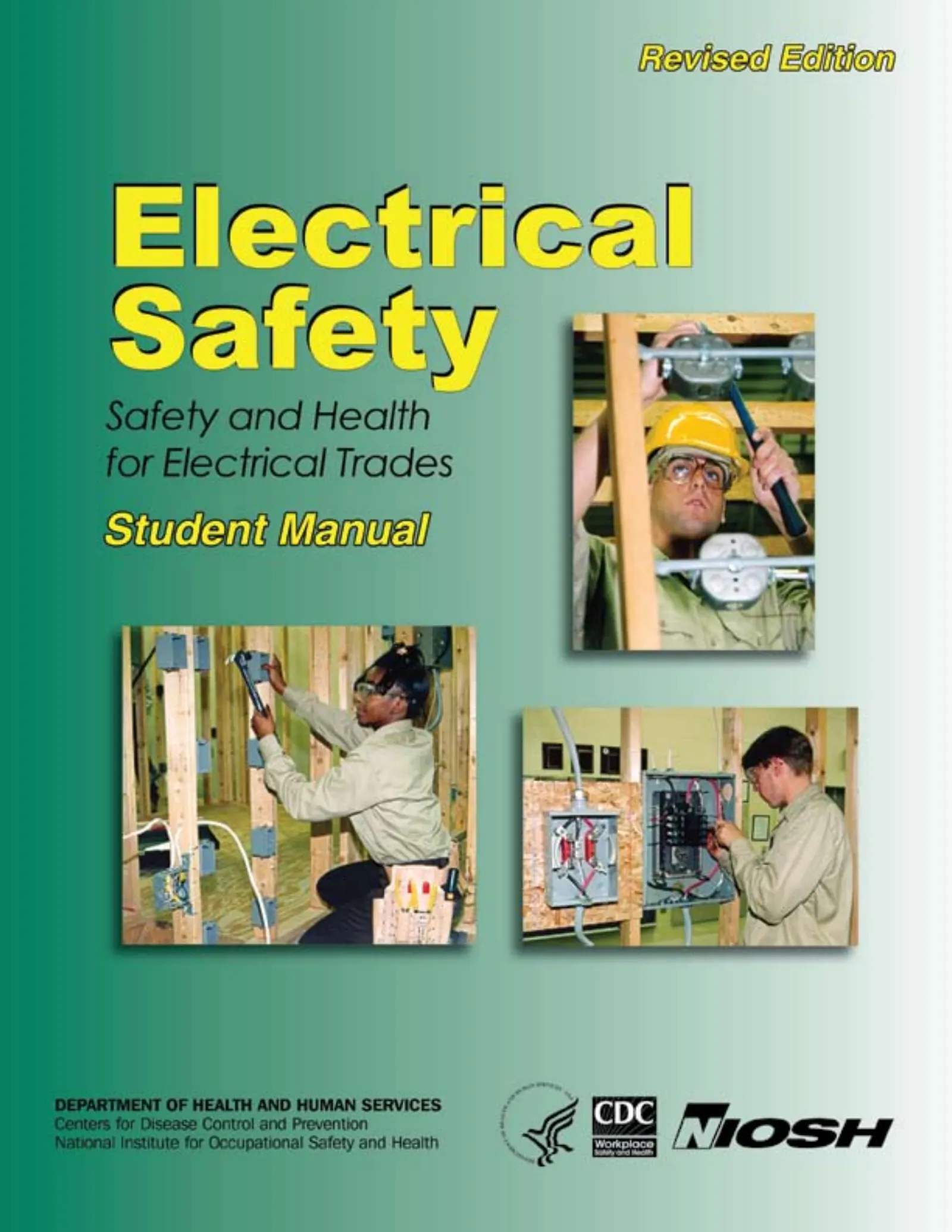
Electrical Safety: Safety and Health for Electrical Trades, Student Manual (NIOSH 2009-113)
NIOSH student manual on electrical hazards, case studies and safe work practices for apprentices and other construction workers.
Page text
· 87 of 92 pages · by National Institute for Occupational Safety and Health (NIOSH)
The words on each page as the author wrote them, read from the file by software so they can be searched. Layout, pictures and tables are not shown here, and long pages are shortened: the pages above and the download are the original.
- Page 3
DEPARTMENT OF HEALTH AND HUMAN SERVICES
- Centers for Disease Control and Prevention
- National Institute for Occupational Safety and Health
- Page 4
This document is in the public domain and may be freely copied or -reprinted.
- DISCLAIMER
- Mention of any company or product does not constitute endorsement by the National Institute for Occupational Safety and Health (NIOSH). In addition, citations to Web sites external to NIOSH do not constitute NIOSH endorsement of the sponsoring…
- …
- Page 5
Foreword
- The National Institute for Occupational Safety and Health (NIOSH) estimates that 230,000 young workers under the age of 18 suffer work-related injuries in the United States each year. Young and new workers have a high risk for work-related injury compared with more experienced workers. …
- …
- Page 6
Acknowledgments
- This document was prepared by Thaddeus W. Fowler, Ed.D. and Karen
- K. Miles, Ph.D., Education and Information Division (EID) of the National Institute for Occupational Safety and Health (NIOSH). Editorial services were provided by John W. Diether and Rodger L. Tatken. …
- …
- Page 7
Contents
- Page
- Section 1 …
- Electricity Is Dangerous …
- How is an electrical shock received? …
- Summary of Section 1 …
- 1 1 2 5
- Section 2 …
- Dangers of Electrical Shock …
- Summary of Section 2 …
- 6 6 11
- Section 3 …
- Burns Caused by Electricity …
- Arc Blasts …
- Electrical Fires …
- Summary of Section 3 …
- First Aid Fact Sheet …
- 12 12 12 14 15 16
- Section 4 …
- …
- Page 8
Page
- vi
- Use the right extension cord …
- Control hazards of exposed live electrical parts: isolate energized components …
- Control hazards of exposure to live electrical wires:
- use proper insulation …
- Control hazards of shocking currents …
- Ground circuits and equipment …
- Use GFCIs …
- Bond components to assure grounding path …
- …
- Page 9
Electrical Safety
- Section 1
- Electricity Is Dangerous
- Whenever you work with power tools or on electrical circuits, there is a risk of electrical hazards, especially electrical shock. Anyone can be exposed to these hazards at home or at work. …
- …
- Page 10
How is an electrical shock received?
- This manual will present many topics. There are four main types of electrical injuries: electrocution (death due to electrical shock), electrical shock, burns, and falls. The dangers of electricity, electrical shock, and the resulting injuries will be discussed. …
- …
- Page 11
- energized black wire—and you are also in contact with the neutral white wire—current will pass through your body. You will receive an electrical shock.
- conductor—material in which an electrical current moves easily
- neutral—at ground potential (0 volts) because of a connection to ground
- …
- Page 12
- You can even receive a shock when you are not in contact with an electrical ground. Contact with both live wires of a 240-volt cable will deliver a shock. (This type of shock can occur because one live wire may be at +120 volts while the other is at -120 volts during an alternating current cycle—a difference of 240 volts.). …
- …
- Page 13
pletes an electrical circuit by • • •
- Always test a circuit to make sure it is de-energized before working on it.
- Summary of Section 1
- You will receive an electrical shock if a part of your body com-
- touching a live wire and an electrical ground, or touching a live wire and another wire at a different voltage.
- Page 14
Section 2 Dangers of Electrical Shock
- ampere (amp)—the unit used to measure current
- milliampere (milliamp or mA)—
- 1/1,000 of an ampere
- shocking current—electrical current that passes through a part of the body
- You will be hurt more if you can’t let go of a tool giving a shock.
- The longer the shock, the greater the injury.
- …
- Page 15
Effects of Electrical Current in the Human Body 3,4
- Current Reaction
- Below 1 milliampere
- Generally not perceptible.
- 1 milliampere
- Faint tingle.
- 5 milliamperes
- Slight shock felt; not painful but disturbing. Average individual can let go. Strong involuntary reactions can lead to other injuries.
- 6–25 milliamperes
- (women)
- 9–30 milliamperes (men)
- …
- Page 16
- shock (lasting a few seconds) could be fatal if the level of current is high enough to cause the heart to go into ventricular fibrillation. This is not much current when you realize that a small power drill uses 30 times as much current as what will kill. At relatively high currents, death is certain if the shock is long enough. …
- …
- Page 17
- male service technician arrived at a customer’s house to perform pre-winter maintenance on an oil furnace. The customer then left the house and returned 90 minutes later. She noticed the service truck was still in the driveway. …
- …
- Page 18
- There have been cases where an arm or leg is severely burned by high-voltage electrical current to the point of coming off, and the victim is not electrocuted. In these cases, the current passes through only a part of the limb before it goes out of the body and into another conductor. …
- …
- Page 19
Summary of Section 2
- The danger from electrical shock depends on • • •
- the amount of the shocking current through the body, the duration of the shocking current through the body, and the path of the shocking current through the body.
- Page 20
Section 3 Burns Caused by Electricity
- Electrical shocks cause burns.
- arc-blast—explosive release of molten material from equipment caused by high-amperage arcs
- arcing—the luminous electrical discharge (bright, electrical sparking) through the air that occurs when high voltages exist across a gap between conductors
- …
- Page 21
- concussion. Sometimes the pressure wave throws the victim away from the arc-blast. While this may reduce further exposure to the thermal energy, serious physical injury may result. The pressure wave can propel large objects over great distances. …
- …
- Page 22
Electrical Fires
- Electricity is one of the most common causes of fires and thermal burns in homes and workplaces. Defective or misused electrical equipment is a major cause of electrical fires. If there is a small electrical fire, be sure to use only a Class C or multipurpose (ABC) fire extinguisher, or you might make the problem worse. …
- …
- Page 23
The three types of burns are • • •
- Summary of Section 3
- Burns are the most common injury caused by electricity.
- electrical burns,
- arc burns, and
- thermal contact burns.
- All fire extinguishers are marked with a letter(s), which identifies the kinds of fires they put out. Sometimes the label is marked with both a letter and symbol. …
- …
- Page 24
Shut off
- First Aid Fact Sheet
- What Should I Do if a Co-worker is Shocked or Burned by Electricity?
- the electrical current if the victim is still in contact with the energized circuit. While you do this, have someone else call for help. If you cannot get to the switchgear quickly, pry the victim from the circuit with something that does not…
- …
- Page 25
- Once you know that electrical current is no longer flowing through the victim, call out to the victim to see if he or she is conscious (awake). If the victim is conscious, tell the victim not to move. It is possible for a shock victim to be seriously injured but not realize it. Quickly examine the victim for signs of major bleeding. …
- …
- Page 26
Section 4: Overview of the Safety Model
- What must be done to be safe?
- Use the safety model to recognize, evaluate, and control hazards.
- Use the three-stage safety model: recognize, evaluate, and control hazards. To be safe, you must think about your job and plan for hazards. To avoid injury or death, you must understand and recognize hazards. …
- …
- Page 27
- OSHA regulations, the NEC, NFPA 70E Standard for Electrical Safety in the Workplace, and the National Electrical Safety Code (NESC) provide a wide range of safety information. Although these sources may be difficult to read and understand at first, with practice they can become very useful tools to help you recognize unsafe conditions and…
- …
- Page 28
JHA: Changing a Wall Ground Fault Circuit Interrupter (GFCI)
- One way to implement this safety model is to conduct a job hazard analysis (JHA). This involves development of a chart: 1) Column 1, breaking down the job into its separate task or steps; 2) Column 2, evaluating the hazard(s) of each task, and 3) Column 3, developing a control for…
- …
- Page 29
1— Recognize hazards
- Summary of Section 4
- The three stages of the safety model are • • •
- Stage
- Stage
- 2— Evaluate hazards
- Stage
- 3— Control hazards
- Page 30
Section 5 Safety Model Stage 1— Recognizing Hazards
- How do you recognize hazards?
- The first step toward protecting yourself is recognizing the many hazards you face on the job. To do this, you must know which situations can place you in danger. Knowing where to look helps you to recognize hazards.
- Inadequate wiring is dangerous.
- …
- Page 31
- Worker was electrocuted while removing energized fish tape.
- electrician was removing a metal fish tape from a hole at the base of a metal light pole. (A fish tape is used to pull wire through a conduit run.) The fish tape became energized, electrocuting him. …
- …
- Page 32
Inadequate wiring hazards
- wire gauge—wire size or diameter
- (technically, the cross-sectional area)
- ampacity—the maximum amount of current a wire can carry safely without overheating
- Overloaded wires get hot!
- An electrical hazard exists when the wire is too small a gauge for the current it will carry. …
- …
- Page 33
Approach boundaries
- terminals in motors, appliances, and electronic equipment may be exposed. Older equipment may have exposed electrical parts. If you contact exposed live electrical parts, you will be shocked. You need to recognize that an exposed electrical component is a hazard.
- …
- Page 34
APPROACH BOUNDARIES
- To protect against burns, there’s one more boundary: The flash protection boundary is where you need PPE to prevent incurable burns, if there’s an arc flash.
- Flash Protection Boundary For Live Parts For 300–600 Volts
- Flash Protection Boundary
- 4 ft.
- Power source ➔
- Overhead powerlines kill many workers!
- …
- Page 35
Overhead powerline hazards
- Most people do not realize that overhead powerlines are usually not insulated. More than half of all electrocutions are caused by direct worker contact with energized powerlines. Powerline workers must be especially aware of the dangers of overhead lines. …
- …
- Page 36
- Operating a crane near overhead wires is very hazardous.
- Shocks and electrocutions occur where physical barriers are not in place to prevent contact with the wires. When dump trucks, cranes, work platforms, or other conductive materials (such as pipes and ladders) contact overhead wires, the equipment operator or other workers can be killed. …
- …
- Page 37
- Extension cords may have damaged insulation. Sometimes the insulation inside an electrical tool or appliance is damaged. When insulation is damaged, exposed metal parts may become energized if a live wire inside touches them. Electric hand tools that are old, damaged, or misused may have damaged insulation inside. …
- …
- Page 38
- If you touch a defective live component that is not grounded, you will be shocked.
- device that is not grounded (or grounded improperly), you will be shocked. You need to recognize that an improperly grounded electrical system is a hazard.
- Electrical systems are often grounded to metal water pipes that serve as a continuous path to ground. …
- …
- Page 39
- The temperature of the wires can be high enough to cause a fire. If their insulation melts, arcing may occur. Arcing can cause a fire in the area where the overload exists, even inside a wall.
- In order to prevent too much current in a circuit, a circuit breaker or fuse is placed in the circuit. …
- …
- Page 40
Additional hazards
- or tools can expose you to live electrical parts. A damaged tool may not be grounded properly, so the housing of the tool may be energized, causing you to receive a shock. Improperly grounded metal switch plates and ceiling lights are especially hazardous in wet conditions. …
- …
- Page 41
- Intensive use of hand tools that involve force or twisting can cause tendinitis of the hands, wrists, or elbows. Use of hand tools can also cause carpal tunnel syndrome, which results when nerves in the wrist are damaged by swelling tendons or contracting muscles.
- …
- Page 42
- Low back pain can result from lifting objects the wrong way or carrying heavy loads of wire or other material. Back pain can also occur as a result of injury from poor working surfaces such as wet or slippery floors. Back pain is common, but it can be disabling and can affect young individuals.
- …
- Page 43
Summary of Section 5
- You need to be able to recognize that electrical shocks, fires, or falls result from these hazards:
- Inadequate wiring
- Exposed electrical parts
- Overhead powerlines
- Defective insulation
- Improper grounding
- Overloaded circuits
- Wet conditions
- Damaged tools and equipment
- Improper PPE
- Page 44
Section 6 Safety Model Stage 2— Evaluating Hazards
- How do you evaluate your risk?
- risk—the chance that injury or death will occur
- Make the right decisions.
- After you recognize a hazard, your next step is to evaluate your risk from the hazard. Obviously, exposed wires should be recognized as a hazard. …
- …
- Page 45
- A cable, fuse box, or junction box that feels warm may indicate too much current in the circuits.
- A burning odor may indicate overheated insulation.
- Worn, frayed, or damaged insulation around any wire or other conductor is an electrical hazard because the conductors could be exposed. Contact with an exposed wire could cause a shock. …
- …
- Page 46
Section 7 Safety Model Stage 3— Controlling Hazards: Safe Work Environment
- SAF ET Y M O DEL STAG E 3—C O N TROLLING HAZARDS: SAFE WORK ENVIRON MEN T
- How do you control hazards?
- In order to control hazards, you must first create a safe work environment, then work in a safe manner. …
- …
- Page 47
Lock out and tag out circuits and equipment
- t about 1:45 a.m., two journeyman electricians began replacing bulbs and making repairs on light fixtures in a spray paint booth at an automobile assembly plant. The job required the two electricians to climb on top of the booth and work from above. …
- …
- Page 48
Lock-Out/Tag-Out Checklist
- SAF ET Y M O DEL STAG E 3—C O N TROLLING HAZARDS: SAFE WORK ENVIRON MEN T
- Lock-out/tag-out is an essential safety procedure that protects workers from injury while working on or near electrical circuits and equipment. Lock-out involves applying a physical lock to the power source(s) of circuits and equipment after…
- …
- Page 49
Control inadequate wiring hazards
- Electrical hazards result from using the wrong size or type of wire. You must control such hazards to create a safe work environment. You must choose the right size wire for the amount of current expected in a circuit. The wire must be able to handle the current safely. …
- …
- Page 50
SAF ET Y M O DEL STAG E 3—C O N TROLLING HAZARDS: SAFE WORK ENVIRON MEN T
- Control hazards of fixed wiring
- The wiring methods and size of conductors used in a system depend on several factors:
- intended use of the circuit system
- building materials
- size and distribution of electrical load
- location of equipment (such as underground burial)
- …
- Page 51
- Flexible wiring can be used for extension cords or power supply cords. Power supply cords can be removable or permanently attached to the appliance.
- flexible wiring—cables with insulated and stranded wire that bends easily
- 29-year-old male welder was assigned to work on an outdoor concrete platform attached to the main factory building. …
- …
- Page 52
SAF ET Y M O DEL STAG E 3—C O N TROLLING HAZARDS: SAFE WORK ENVIRON MEN T
- Use the right extension cord
- power—the amount of energy used in a second, measured in watts
- 1 horsepower = 746 watts.
- The gauge of wire in an extension cord must be compatible with the amount of current the cord will be expected to carry. …
- …
- Page 53
Control hazards of exposed live electrical parts: isolate energized components
- The grounding path for extension cords must be kept intact to keep you safe. A typical extension cord grounding system has four components:
- Make sure the path to ground is continuous.
- a third wire in the cord, called a ground wire;
- …
- Page 54
SAF ET Y M O DEL STAG E 3—C O N TROLLING HAZARDS: SAFE WORK ENVIRON MEN T
- 20-year-old male laborer was carrying a 20-foot piece of iron from a welding shop to an outside storage rack. As he was turning a corner near a bank of electrical transformers, the top end of the piece of iron struck an uninsulated supply wire at the top of a…
- …
- Page 55
- conductors from coming in contact with each other or any other conductor. If conductors are allowed to make contact, a short circuit is created. In a short circuit, current passes through the shorting material without passing through a load in the circuit, and the wire becomes overheated. …
- …
- Page 56
SAF ET Y M O DEL STAG E 3—C O N TROLLING HAZARDS: SAFE WORK ENVIRON MEN T
- 5 times the diameter of the cable so that insulation at a bend is not damaged. Extension cords come with insulation in a variety of types and colors. The insulation of extension cords is especially important. …
- …
- Page 57
- Grounding is connecting an electrical system to the earth with a wire. Excess or stray current travels through this wire to a grounding device (commonly called a “ground”) deep in the earth. Grounding prevents unwanted voltage on electrical components. Metal plumbing is often used as a ground. …
- …
- Page 58
SAF ET Y M O DEL STAG E 3—C O N TROLLING HAZARDS: SAFE WORK ENVIRON MEN T
- Equipment needs to be grounded under any of these circumstances:
- The equipment is within 8 feet vertically and 5 feet horizontally of the floor or walking surface.
- The equipment is within 8 feet vertically and 5 feet horizontally of grounded metal objects you could…
- …
- Page 59
- female assistant manager of a swim club was instructed to add a certain chemical to the pool. She went down into the pump room, barefoot. The room was below ground level, and the floor was covered with water. She filled a plastic drum with 35-40 gallons of water, then plugged a mixing motor into a 120-volt wall outlet and turned on the motor. …
- …
- Page 60
Control overload current hazards
- SAF ET Y M O DEL STAG E 3—C O N TROLLING HAZARDS: SAFE WORK ENVIRON MEN T
- bonding jumper—the conductor used to connect parts to be bonded box, might not make a good electrical connection because of paint or possible corrosion. To make a good electrical connection, a bonding jumper needs to be installed.
- …
- Page 61
- Overcurrent protection devices are designed to protect equipment and structures from fire. They do not protect you from electrical shock! Overcurrent protection devices stop the flow of current in a circuit when the amperage is too high for the circuit. …
- …
- Page 62
SAF ET Y M O DEL STAG E 3—C O N TROLLING HAZARDS: SAFE WORK ENVIRON MEN T
- When You Must Work on or Near Live Circuits
- Working on live circuits means actually touching energized parts. Working near live circuits means working close enough to energized parts to put you at risk even though you may be working on de--energized parts. …
- …
- Page 63
- Energized-work approval signatures (authorizing or approving management, safety officer, owner, etc.).
- To work on or near live parts, you must do the following:
- Have a written live-work permit for the work to be done.
- Wear the right PPE to protect against electric shock and arc flash. Never wear clothing made from synthetic materials, such as…
- …
- Page 64
SAF ET Y M O DEL STAG E 3—C O N TROLLING HAZARDS: SAFE WORK ENVIRON MEN T
- Summary of Section 7
- Control contact with electrical voltages and control electrical currents to create a safe work environment.
- Lock out and tag out circuits and machines.
- Prevent overloaded wiring by using the right size and type of wire.
- …
- Page 66
Section 8 Safety Model Stage 3— Controlling Hazards: Safe Work Practices
- How do you work safely?
- A safe work environment is not enough to control all electrical hazards. You must also work safely. Safe work practices help you control your risk of injury or death from workplace hazards. …
- …
- Page 67
Plan your work and plan for safety
- Take time to plan your work, by yourself and with others. Safety planning is an important part of any task. It takes effort to recognize, evaluate, and control hazards. If you are thinking about your work tasks or about what others think of you, it is hard to take the time to plan for safety. …
- …
- Page 68
- Plan to lock out and tag out circuits and equipment—Make certain all energy sources are locked out and tagged out before performing any work on an electrical circuit or electrical device. Working on energized (“hot”) circuits is one of the most dangerous things any worker could do. …
- …
- Page 69
- worker was attempting to correct an electrical problem involving two non-operational lamps. He examined the circuit in the area where he thought the problem was located. He had not shut off the power at the circuit breaker panel and did not test the wires to see if they were live. …
- …
- Page 70
Ladder Safety Fact Sheet
- To prevent injury when climbing, follow these procedures:
- 1. Position the ladder at a safe angle to prevent slipping. The horizontal distance from the base of the ladder to the structure should be one-quarter the length of the ladder to its resting position.
- …
- Page 71
- 5. When using a stepladder, make sure it is level and fully open. Always lock the hinges. Do not stand on the top step.
- 6. When using scaffolding, use a ladder to access the tiers. Never climb the cross braces.
- 7. Do not use metal ladders. Instead, use ladders made of fiberglass. (Although wooden ladders are permitted, wood can soak up water…
- …
- Page 72
- S A F E T Y M O D E L STAG E 3 — C O N T R O L L I N G H A Z A R D S : S A F E W O R K P RAC T I C E S crew of 7 workers was painting a 33-foot sign at a shopping mall. The crew used tubular welded frame scaffolding that was 31 feet tall and made up of several tiers. …
- …
- Page 73
Avoid wet working conditions and other dangers
- Remember that any hazard becomes much more dangerous in damp or wet conditions. To be on the safe side, assume there is dampness in any work location, even if you do not see water. Even sweat can create a damp condition!
- …
- Page 74
- S A F E T Y M O D E L STAG E 3 — C O N T R O L L I N G H A Z A R D S : S A F E W O R K P RAC T I C E S worker from an electrical service company was changing bulbs in pole-mounted light fixtures in a shopping center parking lot. The procedure for installing the bulbs was as follows: The worker would park the truck near the first light pole. …
- …
- Page 75
- service) rather than cords marked “SJ” (junior hard service). Make sure the grounding prong is intact. In damp locations, make sure wires and connectors are waterproof and approved for such locations. Do not create a tripping hazard.
- Check power cords and extensions—Electrical cords should be inspected regularly using the following procedure:
- …
- Page 76
Use and maintain tools properly
- Use locking connectors—Use locking-type attachment plugs, receptacles, and other connectors to prevent them from becoming unplugged.
- Locking-type attachment plug.
- Maintain tools and equipment.
- Inspect your equipment before you use it.
- …
- Page 77
- employee was climbing a metal ladder to hand an electric drill to the journeyman installer on a scaffold about 5 feet above him. When the victim reached the third rung of the ladder, he received an electrical shock that killed him. An investigation showed that the grounding prong was missing from the extension cord attached to the drill. …
- …
- Page 78
- 22-year-old male carpenter was building the wooden framework of a laundry building. He was using portable power tools. Electricity was supplied to the tools by a temporary service pole 50 feet away. The service pole had not been inspected and was not in compliance. It was also not grounded. …
- …
- Page 79
- Wear safety glasses—Wear safety glasses with side shields or goggles to avoid eye injury. They should have a Z87 stamped on them to show they are certified by the American National Standards Institute Z87 Standard for eye and face protection.
- Wear safety glasses to avoid eye injury.
- …
- Page 80
PPE Fact Sheet—The Right Equipment—Head to Toe
- PPE is the last line of defense against workplace hazards. OSHA defines PPE as "equipment for the eyes, face, head, and extremities, protective clothing, respiratory devices, protective shields and barriers." Many OSHA regulations state that PPE must meet criteria set by the American National…
- …
- Page 81
- Do not "store" anything (gloves, wallet, etc.) in the top of your hard hat while you are wearing it. The space between the inside harness and the top of the hard hat must remain open to protect you. Do not put stickers on your hat (the glue can weaken the
- Never “store” anything in the top of your hard hat while you are wearing it.
- …
- Page 82
PPE Fact Sheet (continued)
- Foot Protection
- approval stamp alone does not necessarily mean the footwear offers protection from electrical hazards.) Note that footwear made of leather must be kept dry to protect you from electrical hazards, even if it is marked "EH."
- …
- Page 83
Summary of Section 8
- Control hazards through safe work practices.
- Plan your work and plan for safety.
- Avoid wet working conditions and other dangers.
- Avoid overhead powerlines.
- Use proper wiring and connectors.
- Use and maintain tools properly.
- Wear correct PPE.
- Page 84
Glossary of Terms
- ampacity
- maximum amount of current a wire can carry safely without overheating amperage strength of an electrical current, measured in amperes ampere (amp) unit used to measure current arc-blast explosive release of molten material from equipment caused by high-amperage arcs arcing luminous electrical discharge (bright…
- …
- Page 85
Glossary of Terms (continued)
- fixed wiring
- permanent wiring installed in homes and other buildings flexible wiring cables with insulated and stranded wire that bends easily fuse overcurrent protection device that has an internal part that melts and shuts off the current in a circuit if there is an overload
- GFCI
- …
- Page 86
Glossary of Terms (continued)
- OSHA
- Occupational Safety and Health Administration—Federal agency in the U.S. Department of Labor that establishes and enforces workplace safety and health regulations overcurrent protection device device that shuts off the current in a circuit when it reaches a certain level overload too much current in a circuit…
- …
- Page 87
Appendix
- References
- 1. NIOSH [2003]. NIOSH alert: preventing deaths, injuries, and illnesses of young workers. Cincinnati, OH: U.S. Department of Health and Human Services, Public Health Service, Centers for Disease Control and Prevention, National Institute for Occupational Safety and Health, DHHS (NIOSH) Publication
- No. 2003–128.
- …
- Page 88
- INDEX
- aluminum wire hazard 24 amp 6 ampacity 24 ampere 6 arc-blast 12 arc-fault circuit breaker 46 arcing 12, 29
- AWG 39
- de-energizing circuits 55
- GFCI
- (see ground fault circuit interrupter) ground 2 ground connection 47 ground fault 28 ground fault circuit interrupter
- 28, 34, 48, 61
- ground potential 27
- grounding 27, 28, 46
- grounding path 47
- …
- Page 89
mA 6 milliamp 6 milliampere 6 personal protective equipment
- 31, 66, 68, 80
- perspiration 30
- plugs, three-prong 62
- power 42
- power rating 42
- PPE
- (see personal protective equipment)
- National Electrical Code 15 National Electrical Safety Code 19 NEC (see National Electrical Code) NEMA 63
- …
- Page 92
Delivering on the Nation’s promise: Safety and health at work for all people through research and prevention
- To receive NIOSH documents or more information about occupational safety and health topics, call NIOSH at
- 1–800–CDC–INFO (1–800–232–4636)
- TTY: 1–888–232–6348
- E-mail: [email protected]
- or visit the NIOSH Web site at www.cdc.gov/niosh.
- …
More on Electrocution
ppt
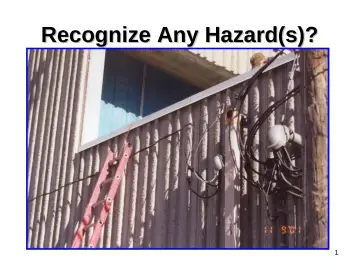
20 slidesFocus Four: Electrocution Hazard Recognition
OSHA's official Construction Focus Four slide deck on electrocution hazards: overhead lines, contact with energized sources, improper use of cords and tools.
U.S. Department of Labor, OSHAPublic domain
pdf
83 slidesFocus Four: Electrocution Hazards Instructor Guide
OSHA instructor guide/lesson plan for the Focus Four electrocution module.
U.S. Department of Labor, OSHAPublic domain
pdf
9 slidesFocus Four: Electrocution Student Handouts
Student handouts including the Focus Four electrocution safety tips, toolbox talks and the Electrical Safety QuickCard.
U.S. Department of Labor, OSHAPublic domain