1 / 104Use ← → to flip
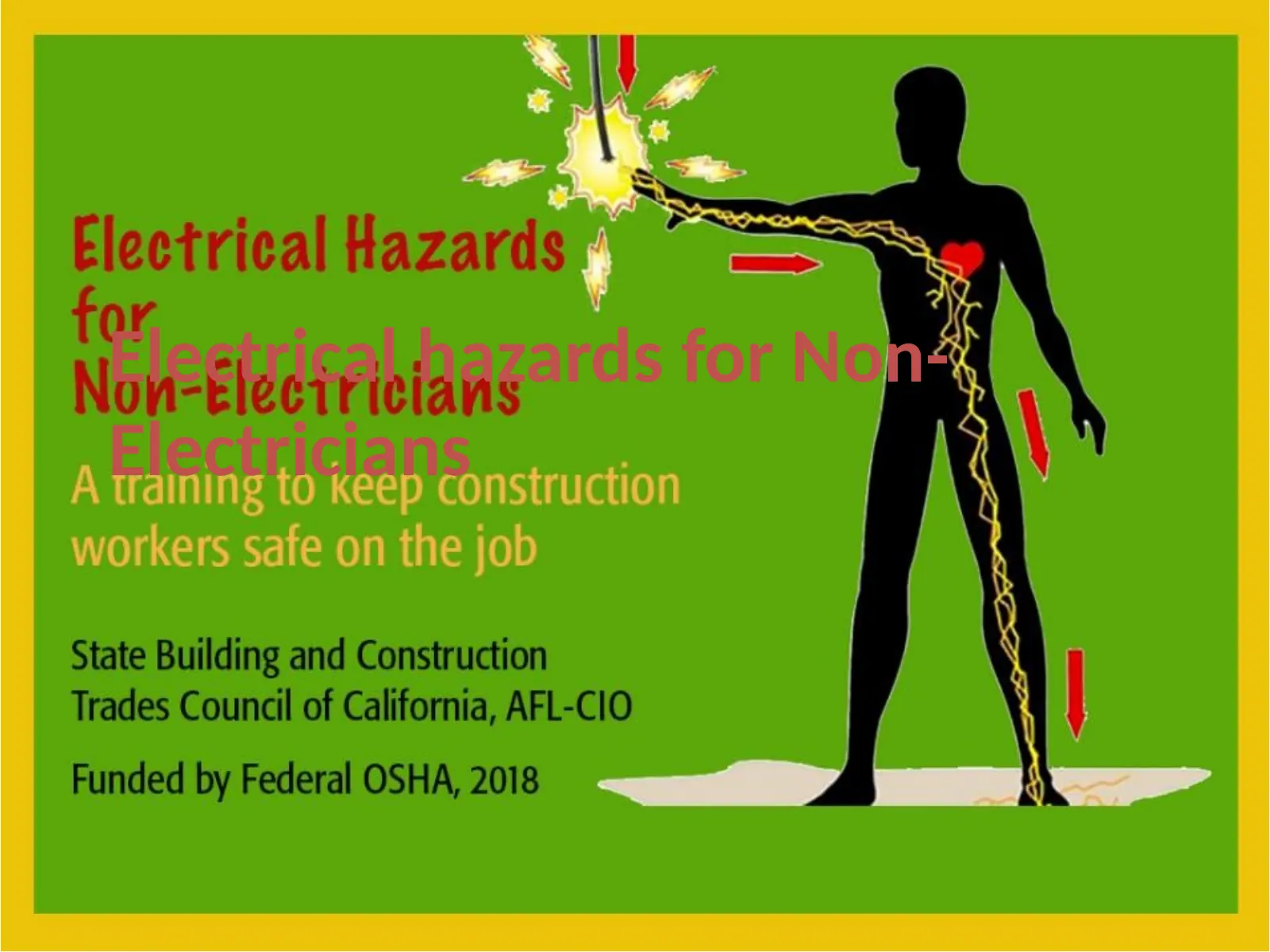
Electrical Hazards for Non-Electricians
Electrical hazard awareness for construction workers who are not electricians, from the State Building and Construction Trades Council of California.
Slide text
· 104 slides · by State Building Construction Trade Council
The words on each slide as the author wrote them, read from the file by software so they can be searched. Layout, pictures and tables are not shown here: the slides above and the download are the original.
- Slide 1
Electrical hazards for Non- Electricians
- Slide 2
Acknowledgements
- Funded by OSHA
- This material was produced under grant SH-31244-SH7 from the Occupational Safety and Health Administration, U.S. Department of Labor. It does not necessarily reflect the views or policies of the U.S. Department of Labor, nor does mention of trade names, commercial products, or organizations imply endorsement by the U.S. Government.
- We thank the following organizations for:
- Providing technical assistance with developing this training
- International Brotherhood of Electrical Workers (IBEW)
- UC Berkeley Labor Occupational Health Program (LOHP)
- Cal/OSHA
- Federal OSHA
- Sharing photos, video, training material
- CA Dept. of Industrial Relations—Commission on Health and Safety and Workers’ Compensation (WOSHTEP program)
- Center for Construction Research and Training (CPWR)
- WorkSafe BC (Canada)
- Slide 3
How often do you use electricity?
- Any electrical incidents or accidents?
- Class Brainstorm:
- Questions or concerns about electricity at work?
- Slide 4
Electrocutions—3 rd leading cause of construction fatalities
- Electrical Hazards—among OSHA’s “Focus Four”
- Have you been trained?
- Slide 5
Course objectives:
- Increase electrical hazard awareness among non-electricians.
- By the end of this training, participants will be able to:
- Identify causes of electrical fatalities
- Understand basic electrical concepts and terms
- Describe how electricity can harm the body
- Recognize common electrical hazards
- Use best practices to work safely around electricity
- Will NOT teach how to do electrical work!
- Slide 6
Electrical incidents are caused by:
- Unsafe Conditions
- Unsafe Equipment
- Unsafe Acts
- Slide 7
Five electrical hazards covered
- Contact with live circuits: Power lines
- Lack of ground fault protection
- Missing or discontinuous path to ground
- Equipment not used in manner prescribed
- Improper use of extension and flexible cords
- Slide 8
Section 1: Electrical Fatality Trends in Construction
- Fatal injury data compiled by:
- What’s the first thing that comes to mind when you hear
- “Electrocution?”
- Slide 9
Good news…
- Slide 10
Bad news…
- Slide 11
More non-electrician fatalities
- Slide 12
- By age: Under 25
- have highest electrocution rate
- Slide 13
Main causes of electrocution
- Slide 14
Sources of electrocution
- Slide 15
“Electric parts” breakdown
- Electrocutions are PREVENTABLE!
- Slide 16
Section 2:
- Understanding Electricity Basics
- What IS electricity?
- Slide 17
Electricity is…
- Movement or flow of electrons from one atom to another
- Flow of current through a conductor
- Slide 18
5-Minute Buzz Group Activity
- Name That Term
- Slide 19
Some basic electrical terms
- CURRENT
- Movement or flow of electrical energy
- RESISTANCE
- Opposition to current flow
- CONDUCTOR
- Material through which current moves easily
- INSULATOR
- Material through which current does NOT move easily
- Slide 20
Examples of conductors
- Most metals: Copper, silver, gold and aluminum are excellent conductors
- Slide 21
Examples of Insulators
- Glass, rubber, plastic, dry wood, ceramics, paper
- #1 level of protection from electrical hazards
- Slide 22
Conductor, insulator or both???
- Water and air can be both under different conditions
- Unless totally “pure,” water is an excellent conductor and potentially dangerous in combo with electricity on-the-job.
- Air is a good insulator. But a big enough electrical charge can turn it into a conductor, as happens with lightning.
- Slide 23
Flow of electricity—loops and paths
- Electricity travels through circuits
- Current cannot flow through open circuits
- Switches open and close circuits
- Tools and devices powered by the circuit are the “load”
- Electricity flows back to the source
- Slide 24
Find the circuit components
- 1 Conductor • 2 Insulator
- 3 Current
- 4 Resistance
- Resistance any part of the circuit that has opposition to current flow
- Slide 25
Circuits and worker safety
- What do current, conductors, and circuits have to do with safety?
- Workers are injured or killed when they accidentally become part of energized electrical circuits!
- Slide 26
Electrical grounding—saves lives
- Proper grounding of circuits and devices protects workers
- Provides low-resistive path for current back to the source
- Without grounding, current may flow through you!!
- Slide 27
More electrical terms
- Voltage
- Pushes current through a conductor Volts = measure of electrical FORCE
- of electrical current
- Amperage Strength
- Amperes “amps” = measure current FLOW
- Wattage
- How much power is produced or consumed Watts = measure electric POWER
- Slide 28
Water comparison
- Low pressure = Low voltage = Less flow
- At constant pressure…
- More resistance = Less flow
- High pressure = High voltage = More flow
- Less resistance = More flow
- Slide 29
Volts/amps/watts and power tools
- Power tool labels tell you:
- Required voltage
- Current the tool draws
- Power the tool consumes
- Would you use these two tools at the same time on a 120V 15 amp circuit?
- Slide 30
Overcurrent protection
- Circuit breakers and fuses:
- Protect circuits from overload
- Detect current, if too much…
- Shut down circuit
- Designed to protect equipment, not people!
- Slide 31
Review and Questions
- Name three important things you learned in this section.
- Slide 32
Hazard Mapping Activity
- Slide 33
Section 3: Effects of Electricity on the Human Body
- How workers are exposed to electricity
- What happens when you contact electricity
- Most common injuries
- What to do if someone is injured
- Slide 34
Making dangerous contact
- Workers are injured or killed when they accidentally become part of a circuit
- Electrical shock happens when current passes through the body
- How do you become part of a circuit?
- Slide 35
How we become part of a circuit By touching:
- A live wire and another wire at a different potential in a circuit
- A live wire and an electrical ground
- An ungrounded metallic part energized by contact with an energized conductor
- Slide 36
Four main electrical-related injuries
- Electric shock
- Electrocutions
- Burns
- Falls
- Slide 37
Electric shock—from tingle to death
- Three factors affect severity of shock:
- PATH of the current through body
- AMOUNT of current
- LENGTH OF TIME body is in circuit
- Slide 38
Path through the body
- Current through the heart, lungs or nervous system--most dangerous
- Hand-to-hand across the chest
- Hands to feet
- Head contacting live conductor
- Slide 39
Current and exposure time
- As amount of current increases
- As length of exposure time increases
- Risk for injury and death increases
- Slide 40
Review of amps and volts
- Amperage “amps” measure?
- Flow of current through conductor
- Common household voltages?
- What’s a milliamp
- (mA)?
- Cal/OSHA standards:
- Low voltage = ? ≤ 600 volts High voltage = ? > 600 volts
- 1/1000 of an amp
- 120/240 volts
- Low voltage does not mean low hazard!
- Slide 41
It doesn’t take much to do harm
- © WorkSafeBC (Workers’ Compensation Board), used with permission
- Slide 42
Electrical injury signs and symptoms
- © WorkSafeBC (Workers’ Compensation Board), used with permission
- Slide 43
Duration of Exposure
- The longer electricity flows through your body, the more damage it can do
- In seconds and fractions of seconds
- 100 mA current applied for 3 seconds is as dangerous as 900 mA applied for 0.03 seconds
- Slide 44
Other factors: Voltage
- Greater voltages produce greater currents
- @600 V = current through body may be 4 amps!
- @500 V = resistance in skin breaks down
- @>600 V = breaks down electrical insulators
- High voltage
- violent muscular contractions and severe burns
- Slide 45
Body resistance and moisture
- What happens when resistance goes down?
- Slide 46
Burns
- Electricity causes 3 types of burns:
- Electrical
- Arc
- Thermal
- Slide 47
Electrical burns
- Extremely serious injuries
- Current through body generates heat
- Up to 5,000 ◦ F
- Typically occur on hands
- Damages: internal tissues, nerves, muscles, blood vessels, and organs
- We’re not going to show you the horrific photos here. Many images can be found online if you want to see them.
- Slide 48
Arc burns—what is “arcing”
- Slide 49
Arc flash and arc blast
- Release of dangerous thermal energy
- Extreme high temperatures up to 35,000 ◦ F
- That’s 3x hotter than the surface of the Sun!
- Intense bright light
- High voltage produces pressure waves creating a blast
- Slide 50
Electrical Hazards for Non- Electricians video
- Slide 51
Thermal contact burns
- Contact with overheated conductors
- Electricity is a common cause of fire
- Ignites clothing/flammable material
- Ignites explosive combustible vapors/gasses/dusts in air
- Slide 52
Falls—how is electricity related?
- Shock is the beginning of a chain of events
- Startle reaction
- Muscle contraction
- The shock may be minor—the fall may be deadly!
- Slide 53
What to do if someone gets shocked?
- Call 911
- Don’t touch worker in contact with energized circuit-- You could get shocked too!
- De-energize circuit if possible
- If not, use non-conductive object to push victim away from source of current
- Does not apply to high voltage lines
- Start CPR or other first aid.
- Slide 54
Quick Review of Concepts Learned
- Electrical hazards are
- The human body is
- So far…
- a leading cause of fatalities/injuries
- Low voltage doesn’t mean low hazard
- Severity of shock depends on amount of current, path through body, and duration
- a conductor of electricity
- Workers are exposed to electricity through accidental contact with live circuits
- Main electrical injuries are: electrocution, shock, burns, falls
- Slide 55
Section 4: Electrical Hazards
- Live circuits: Power Lines/Hidden Electrical
- Lack of ground fault protection
- Missing or discontinuous path to ground
- Equipment not used in manner prescribed
- Improper use of extension and flexible cords
- Slide 56
Hazard Assessment Model
- RECOGNIZE hazards
- EVALUATE risk
- CONTROL hazards
- Slide 57
Small Group Activity: Hazard Challenge—You’re the Expert
- 6 stations—6 teams
- Scenarios/case studies
- Identify the hazard
- Assess risk factors
- Brainstorm solutions
- Report back to class
- Slide 58
Hazard #1: Overhead Power Lines
- Power lines, transformers, converters are the primary source of electrocutions in construction (39% of deaths 2011-15)
- TEAM 1—Report Back
- Video case study
- Slide 59
WorkSafe BC video case study
- Slide 60
Why are power lines dangerous?
- High voltage—high current
- Not insulated
- Out of sight line— people don’t look up
- Current can arc
- Controlled by utility company, not job site
- Slide 61
WorkSafe BC video—A Bright Arc
- Slide 62
Power lines are all around
- Slide 63
Workers at risk near power lines
- Operating equipment (cranes,
- backhoes, dump trucks, concrete pumpers, aerial lifts/booms)
- Working on ground around equipment
- Elevated work (roofs, scaffolds,
- ladders)
- Using long-handled tools
- (cement finishing floats, aluminum extension poles)
- Slide 64
Best practices near overhead lines
- Assume lines are energized
- Inspect area before work begins
- Always maintain minimum distance of 10 feet
- Contact utility company—de-energize, guard, isolate or insulate lines
- Notify workers of hazards—provide training
- Assign dedicated spotter heavy equipment
- Post warning signs at ground level—use portable safety barriers
- Slide 65
Ladders near electrical circuits
- Aluminum
- Must be non-conductive (fiberglass or wood)
- Clean and dry
- Labeled by manufacturer
- Metal ladders are prohibited
- Slide 66
Underground power lines
- TEAM 2—Report Back
- Case Study: Laborer electrocuted when jackhammer strikes underground power line
- Slide 67
Underground line hazards
- Potential high voltage
- Can’t see them
- May be anywhere under construction site
- Slide 68
What is the risk?
- Without proper planning, these activities put workers at risk for electrocution.
- Excavation equipment contacting energized power line
- Handheld power equipment (concrete breakers/pneumatic drills) can penetrate insulation
- Hand digging with sharp tools (shovels/picks/pry bars) close to energized conductors
- Slide 69
Best practices near underground lines
- Assume lines are energized
- Call 811 at least 2 full days before
- digging to locate and mark lines
- Mark excavation area
- De-energize if possible
- Maintain utility locator marks and
- follow them
- Slide 70
Dig with care—hand digging
- Hand dig within 24 inches of each side of marked lines
- Use rounded or blunt-edged fiberglass handled shovel
- See the line with your own eyes
- Don’t use sharp tools or pry against a utility line
- Slide 71
What should you do if you contact a power line?
- If you have to get off equipment:
- Move equipment to break contact with circuit
- Stay on equipment, unless it’s not safe
- Call 911
- Warn other workers to stay at least 35 feet away
- Don’t run!
- Jump clear with both feet together
- Don’t touch any part of equipment when you’re on ground
- Shuffle away with small steps or hop away keeping feet together
- Slide 72
What if a co-worker hits a power line?
- Stay clear
- Call 911
- Don’t try to rescue victim
- Stay away until circuit is de-energized
- Slide 73
Hidden electrical hazards
- Energized conductors can be concealed in walls, floors, ceilings
- Drilling, cutting, demolition may expose workers to live circuits
- Energized conductors don’t look any different from de-energized
- Photo courtesy of L.Vergeront
- Slide 74
Employers must assess hazards
- These steps are required:
- Locate energized circuits, exposed or concealed, before work is begun
- Mark location of energized circuits
- Post warning signs
- Advise workers of location, hazards, and protective measures
- Slide 75
Best practice—de-energize circuits
- Lock Out/Tag Out (LOTO)
- Slide 76
Review Quiz
- Always maintain a minimum distance of
- 10 feet
- ___from
- overhead power lines.
- What should contractors do before digging?
- Call 811 to locate lines
- Always assume lines are what? Energized
- T/F Metal ladders are OK to use around
- FALSE! Only non-conductive
- electrical hazards.
- Best way De-energize
- to protect from live
- circuits
- them
- and
- LOTO is to do
- what?
- Slide 77
Hazards related to grounding
- A Quick Review
- Grounding
- Physical electrical connection to the earth
- Ground wire
- Conductor taking fault current safely to ground
- Resistance
- Opposition to current flow
- Ground fault
- Current flows through grounded connection, not through intended load
- Slide 78
Hazard #2
- Lack of ground fault protection
- TEAM 3—Report Back
- Case Study: Death due to lack of ground fault protection— journeyman HVAC worker
- Slide 79
Ground fault hazards and risk
- Widespread use of portable power tools/extension cords
- Electrical equipment, tools, and cords take heavy wear-and-tear daily in construction and may be damaged
- A break in grounding system not obvious to users
- Required safety devices not in place to protect workers
- Ground faults can cause current to flow through a worker to ground, resulting in shock or electrocution
- Slide 80
Required safety devices
- Ground Fault Circuit Interrupter (GFCI)
- Detects small current imbalances (5 mA)
- Shuts down circuit in 1/40 of a second
- Circuit breakers protect equipment, GFCIs protect YOU!
- Slide 81
Have you seen these on-the-job?
- Slide 82
OSHA and Cal/OSHA require:
- GFCIs on construction sites for all 120-volt AC single phase, 15- and 20-amp receptacles not part of permanent wiring
- OR
- A written
- “Assured Equipment Grounding
- Conductor Program”
- (AEGCP)
- Slide 83
Safe practices: ground fault hazards
- Know type of ground fault protection being used on-the-job
- Ask if GFCIs have been tested prior to use
- Identify the assigned qualified person
- Inspect equipment daily for defects and remove from service if damaged
- Speak-up if you notice: tools/cords overheating; GFCIs shutting off circuits; worn or frayed insulation on conductors
- USING A GFCI CAN SAVE YOUR LIFE
- Slide 84
Hazard#3
- Path to ground missing or discontinuous
- TEAM 4—Report Back
- Case Study: Short in power saw/ungrounded temporary power supply
- Slide 85
What’s wrong here?
- Slide 86
What are the risks?
- Missing ground prong on cord (broken or removed intentionally)
- Improper wiring; altered or damaged conductors or receptacles
- If circuit is not grounded, quickest/easiest path for current is through a worker's body
- Slide 87
Safe practices and solutions
- Ground all power systems, circuits, equipment
- Inspect electrical systems—insure path to ground is continuous
- Inspect tools and cords; remove defective equipment from service
- DO NOT REMOVE ground prongs
- Use double-insulated tools
- Slide 88
What does “double-insulated” mean?
- Manufactured to prevent live conductors from energizing parts of tool that you can touch.
- Non-metallic tool cases
- (usually plastic) protect user from electrocution
- Approved tools do not require grounding; have 2-prong plugs.
- Slide 89
Hazard #4
- Equipment not used in manner prescribed
- TEAM 5—Report Back
- Case Study: Electrical equipment in poor condition.
- Slide 90
Examples of misused equipment
- Slide 91
And more…
- Slide 92
Activities that put you at risk
- Disregarding manufacturer specifications
- Altering equipment/disabling grounding
- Using damaged equipment
- Ignoring signs of electrical problems
- Failing to speak-up about potential hazards
- Slide 93
Best practices
- Use equipment that meets OSHA standards
- Follow manufacturers’ instructions
- Do not modify equipment
- Use approved covers on electrical panels and boxes
- Close unused openings in cabinets, boxes and fittings
- Slide 94
Hazard #5 Improper use of extension and flexible cords
- TEAM 6—Report Back
- Case Studies:
- Flexible cord not 3-wire, hard service variety
- No strain relief
- Slide 95
Would you use these?
- Slide 96
What’s wrong with these cords?
- Slide 97
Safe work practices Extension cords
- Use factory assembled cord sets
- Use only 3-wire type with ground prong
- Continually audit cords on-site
- Discard frayed/damaged cords
- Use only cords rated for hard or extra-hard usage
- Slide 98
Where do I find usage codes? (and other good information)
- Must be indelibly marked every 1’ along length of cord
- Ratings from the National Electrical Code (NEC)
- Image courtesy of NABTU; used with permission
- Slide 99
Two more safety requirements
- Use only cords equipped Use cords rated for correct with strain relief
- level of amperage
- Sample manufacturer info:
- The lower the wire gauge number, the bigger the conductor
- Slide 100
Don’t abuse your power cords! Things you should NEVER do:
- Jerk on cord to unplug
- Pull or strain cords
- Carry tool by the cord
- Break off ground prong
- Tie cords in tight knots
- Allow vehicles to drive over
- Slide 101
Do the right thing!
- Watch for hazards
- Recognize risks
- Use safe practices
- Speak-up if you identify a hazard
- Slide 102
Use of material and duplication
- Material may be used for non-commercial, instructional, educational purposes ONLY
- Fees may not be charged for this material
- While every effort has been made to ensure information is current and accurate, the grantee does not assume any liability for errors or omissions
- 10 2
- Slide 103
Work safely around electricity and enjoy a healthy career in the trades
- Thank you for attending this training
- Slide 104
Safety and Health HUB safety.sbctc.org
- 1 0 4
More on Electrocution
ppt
20 slidesFocus Four: Electrocution Hazard Recognition
OSHA's official Construction Focus Four slide deck on electrocution hazards: overhead lines, contact with energized sources, improper use of cords and tools.
U.S. Department of Labor, OSHAPublic domain
pdf
83 slidesFocus Four: Electrocution Hazards Instructor Guide
OSHA instructor guide/lesson plan for the Focus Four electrocution module.
U.S. Department of Labor, OSHAPublic domain
pdf
9 slidesFocus Four: Electrocution Student Handouts
Student handouts including the Focus Four electrocution safety tips, toolbox talks and the Electrical Safety QuickCard.
U.S. Department of Labor, OSHAPublic domain