1 / 137Use ← → to flip
Electrical Hazards in Construction
Southern Illinois University electrical hazards in construction course.
Slide text
· 137 slides · by Southern Illinois University
The words on each slide as the author wrote them, read from the file by software so they can be searched. Layout, pictures and tables are not shown here: the slides above and the download are the original.
- Slide 1
Electrical Hazards in Construction
- A Language and Literacy Appropriate Safety
- Training
- This material was produced under a grant (SH-05044-SH8) from the Occupational Safety and Health Administration, U.S. Department of Labor. It does not necessarily reflect the views or policies of the U.S. Department of Labor, nor does mention of trade names, commercial products, or organizations imply endorsement by the U.S. Government.
- Slide 2
Disclaimer
- No legal advice is offered or implied, and no attorney-client
- relationship is intended or established. If legal advice or other expert assistance is required, the services of a competent professional should be sought.
- It is the responsibility of the employer and its employees to comply with all pertinent OSHA rules and regulations in the jurisdiction in which they work.
- Slide 3
Objectives
- Understand basic concepts of electricity
- Recognize major types of electrical hazards in construction workplaces
- Identify and prevent electrical accidents at construction sites
- Slide 4
Step-by-Step Training Agenda
- Sign Up
- Pre-Test
- Basic Terms
- Case Study
- Training Modules
- Electrical Hazards
- Case Study
- Electrical Incidents
- Post-Test
- Hazards Prevention
- Feedback Survey
- Slide 5
Sign-In
- It is time to fill out the sign-in sheet
- Slide 6
Pre-Test
- Please Begin Pre-Test (15 Minutes)
- Slide 7
Pre-Test
- Please Submit Pre-Test
- Slide 8
Training Modules Overview
- Section I: Basic Terms and Case Study
- Worker Rights under OSH Act
- Electrical Hazards Statistics
- Basic Terms of Electricity
- A Case Study Discussion
- Section II: Electrical Hazards (BESAFE)
- Electrical Burn
- Electrocution
- Electrical Shock
- Electrical Arc Flash
- Electrical Fire
- Electrical Explosion
- Slide 9
Training Modules Overview
- Section III: Electrical Incidents in Construction
- Contact with Power Lines
- Lack of Ground-Fault Protection
- Path to Ground Missing or Discontinuous
- Equipment Not Used in Manner Prescribed
- Improper Use of Extension or Flexible Cords
- Contact with Energized Sources
- Slide 10
Training Modules Overview
- Section IV: Electrical Hazards Prevention
- Maintain Safe Distance from Overhead Power Lines
- Use Ground-Fault Circuit Interrupters (GFCI)
- Inspect Portable Tools and Extension Cords
- Use Power Tools and Equipment as Designed
- Follow Lockout/Tagout Procedures
- Personal Protective Equipment
- Isolate Electrical Parts
- Slide 11
Training Modules Overview
- Section 1: Basic Terms and Case Study
- Worker Rights under OSHA Act
- Electrical Hazard Statistics
- Basic Terms of Electricity
- A Case Study Discussion
- Section 2: Electrical Hazards (BESAFE)
- Section 3: Electrical Incidents in Construction
- Section 4: Electrical Hazards Prevention
- Slide 12
Worker Rights Under the OSH Act
- Workers have rights to
- Working condition without a risk of serious harm
- Review employer’s records of work injuries and illnesses
- Get a copy of their medical records
- Receive information and training about hazards and prevention methods, and the OSHA standards
- Slide 13
Worker Rights Under the OSH Act
- Workers have rights to
- File a complaint asking OSHA to inspect workplace
- OSHA will keep all identities confidential
- Exercise rights under the law without retaliation
- If a worker is retaliated against for using their rights, the worker must file a complaint with OSHA as soon as possible (no later than 30 days)
- Slide 14
Worker Rights Under the OSH Act
- OSHA electrical safety standard for construction industry, in Title 29, Code of Federal Regulations (29 CFR 1926), mandates that “The employer shall instruct each employee in the recognition and avoidance of unsafe conditions and the regulations applicable to his work environment to control or eliminate any hazards or other exposure to illness or injury”.
- Slide 15
Electrical Hazard Statistics
- According to U.S. Department of Labor, electrocution is top 3 causes of death in 2017
- Falls – 381 deaths, Stuck by Object – 80 deaths
- Electrocutions – 71 deaths (a death per 5 days)
- Caught-in/between – 50 deaths
- Workers are unaware of potential hazards
- Safety training instruct workers safety knowledge
- Safety knowledge reduces or eliminate risks of injury
- Safety Knowledge is Life !
- Slide 16
Basic Terms
- Electron: a particle with negative charge
- Current: electrons movement
- (1 ampere = 6×10 19 electrons moving per second)
- No voltage across electrons
- Electrons move randomly
- No current flow
- Current flow
- Electron flow
- Slide 17
Basic Terms
- Voltage: a force to push electron movement
- Resistance: an obstacle to restrict electron movement
- Voltage
- Cable
- (conductor)
- Resistance
- High voltage or low resistance make high current
- Slide 18
Basic Terms
- Conductor: little resistance to electron movement
- Insulator: high resistance to electron movement
- Conductor
- Little obstacle
- All electrons pass through conductor
- Insulator
- Strong obstacle
- No or few electrons pass through insulator
- Slide 19
Basic Terms
- Please group these materials into correct category
- Metal
- Conductor
- dry wood
- Rubber
- Wet wood
- Glass
- Insulator
- Ceramic
- Slide 20
Basic Terms
- Please group these materials into correct category
- Metal
- Ceramic
- Glass
- Wet wood
- Rubber
- Conductor
- dry wood
- Insulator
- Slide 21
Cable structures with conductors or insulators
- Basic Terms
- Copper
- (conductor)
- Plastic cable
- (insulator)
- Copper
- (conductor)
- Plastic
- cable
- (insulator)
- Protective sheath
- Slide 22
Basic Terms
- Electrical Circuit: a complete path of current
- Voltage
- Cable
- (conductor)
- Resistance
- Open current conduction
- path
- can
- stop
- current
- Slide 23
Current always flows through least-resistant path Voltage
- Basic Terms
- Voltage
- current
- Resistance
- Resistance
- current
- Switch
- Switch
- After closing the switch, all current flows through the switch due to its lower resistance
- Slide 24
Electrical Hazard Symbols
- These symbols tell you if the situation in the picture is safe or not safe during this training.
- Safe
- Not safe
- Slide 25
A Case Study Discussion
- Fallen Power Lines
- A driver inside this car
- Picture Source: https://www.youtube.com/watch?time_continue=317&v=fLVzvMTgGDY
- A car hits an electricity pole, so downed power lines touch the car. A driver is inside of this car. Video -This Might Shock You: Downed Power Line
- Slide 26
A Case Study Discussion 1
- Q1: Can people touch down power lines by hand?
- Answer: No
- Always assume that down power lines are live and energized
- Transmission
- Distribution
- Subtransmission
- 500Kv
- 230Kv
- 138Kv
- 69Kv
- 7-13Kv
- Slide 27
A Case Study Discussion 2
- Q2: If people touch down power lines by skin, how much current will flow through a human body?
- Video - Electrical Shock
- Answer: assume the power line voltage is 7Kv
- Human Body
- Resistance
- Current (assume 7Kv)
- Wet skin
- 1K ohms
- 7 (unit: A)
- Dry skin
- 100~600K ohms
- 11~70 (unit: mA)
- Slide 28
A Case Study Discussion
- Consequences if current flow through human body
- Current in Human
- Body
- Reaction
- 5 mA
- Wet or Dry hand
- 6-25 mA (Women)
- 9-30 mA (men)
- Slight shock, not painful but disturbing; average individual can let go.
- Painful shock, loss of muscular control Body freeze
- 50-150 mA
- Extreme pain, respiratory arrest, severe muscular contractions. Death is possible.
- 1-4.3 A
- Heart stop, muscular contraction, nerve damage, death likely
- 10 A
- Cardiac arrest, severe burns, death probable
- Slide 29
A Case Study Discussion 3
- Q3: Can people touch down power lines by a stick, pole, or broom?
- Answer: No
- Not safe to use traditional non-conducting materials to touch power lines.
- Slide 30
A Case Study Discussion 4
- Q4: Can the car driver touch car frame or metal parts?
- Answer: No
- Metal frame of the car would be charged with electricity
- Slide 31
A Case Study Discussion 5
- Q5: What is safe distance from fallen power lines?
- Answer: At least 35 feet (for voltage up to 750Kv)
- ?? Feet
- Slide 32
A Case Study Discussion 6
- Q6: If car starts fire, can the driver leaves?
- Answer: Yes, but very carefully
- Electricity spreads outward through the ground
- Step potential creates large voltage differences to shock
- Step
- Potential
- Slide 33
A Case Study Discussion
- Step potential
- ΔV=V 1 -V 2
- Voltage
- Potential
- Distribution
- V 1
- V 2
- The Point of Touch
- Step size: 1 feet
- Step voltage could be up to 744 V, assume the potential of the point of touch is 5.7 KV
- Slide 34
A Case Study Discussion 7
- Q7: How to leave car without electrical shocks? Answer: Small step for little step potential
- Shuffle away
- No large step
- Shock resistance
- More Details
- shoes
- Put hands at your sides, jump completely.
- No touch car and ground at the same time.
- Put feet together, take tiny steps without lifting feet .
- Slide 35
A Case Study Discussion 8
- Q8: What distance is safely away from power lines?
- Answer:
- Depends on the power line voltage (see next slide)
- ?? feet
- 10 feet rule for voltage up to 50Kv
- Always use maximum possible distance to avoid accidental touch
- Slide 36
A Case Study Discussion
- Voltage (nominal,
- Kv, alternating current)
- <=50
- 50-200
- 200-350
- 350-500
- Minimum clearance distance (feet)
- 500-750
- 750-1000
- >1000
- Determined by utility owner/operator or a registered professional engineer
- Slide 37
A Case Study Discussion
- Date
- Place
- What happen?
- Injury
- A boom truck contacted
- December
- Michigan overhead power lines
- 2018
- Electrocuted
- (died)
- North A boom truck contacted Carolina overhead power lines
- Electric
- Shocked (died)
- May 2018
- Slide 38
A Case Study Discussion
- Date
- July 2018
- June, 2018
- Place
- Ohio
- Kentucky
- What happen?
- Injury
- A crane touched a power line
- Electrocuted
- (died)
- A dump truck struck power lines, the driver got out of the truck and was electrocuted.
- He tried to help the truck driver.
- (died)
- Shocked
- Slide 39
Other Reported Accidents
- Source: https://www.osha.gov/pls/imis/accidentsearch.search
- Event Description
- Employee touches aluminum ladder to overhead power line
- Employee is electrocuted and killed after touching live power lines
- Employee is found unresponsive and may have been electrocuted
- Employee comes into contact with power line while trimming
- Employee is shocked when comes into contact with live power lines
- Employee touches live energized parts within a power generator
- Slide 40
Training Modules Agenda
- Section 1: Basic Terms and Case Study
- Section 2: Electrical Hazards (BESAFE)
- Electrical Burn
- Electrocution
- Electrical Shock
- Electrical Arc Flash
- Electrical Fire
- Electrical Explosion
- Section 3: Electrical Incidents in Construction
- Section 4: Electrical Hazards Prevention
- Slide 41
- Warning: The pictures in next few slides deal with injuries and death related to electrical accidents and might be disturbing to some people.
- Slide 42
Electrical Burn
- Most common
- shock-related injury
- Electrical energy is
- transformed into heat
- Source: OSHA’s Electrical Incidents eTool
- Immediate medical
- attention is needed
- Don’t wear jewelry
- (ring, necklace, bracelet )
- Slide 43
Electrical Burn
- Burns around current entrance point
- Entrance Wound
- Burns around current exit point
- Exit Wound
- An accident report Source: OSHA’s Electrical Incidents eTool
- Two workers troubleshoot power outage. Worker #1 was holding a flashlight while worker #2 tested a 7,200 volt transformer. Worker #1 came close to or contacted live electrical parts, and was burned to arm, hand, and chest.
- Slide 44
Electrocution
- A serious injury caused by electrical shock
- 71 workers died from electrocution in 2017
- 7.3% of total deaths in construction in 2017
- Video - What Really Happe ns To Your Body When You 're Electrocuted?
- Source: OSHA’s Focus-four
- Slide 45
Electrical Shock
- Low voltage does not imply low hazard
- Electrical shock injury depends on
- current path
- current amount
- body contact time
- Source: OSHA’s Electrical Incidents eTool
- What is the most dangerous path for electricity shock through body? Head, Heart, or feet?
- Answer: Heart. A current of 50mA flowing through heart triggers cardiac arrest
- Slide 46
Electrocution
- If current > 75mA, death occurs in few minutes if no defibrillator in use
- 75 mA is not much current – a small power drill uses 30 times as much current as killing current
- Worst case: current flows through heart
- Defibrillator in use
- Slide 47
Electrical Shock
- Electricity travels in closed circuits.
- Shock results when the body becomes part of the electrical circuit.
- current
- current
- ground
- Touches both wires of a circuit
- Touches ground and one wire of a circuit
- current
- ground
- Touches ground and a faulted energized appliance
- Slide 48
Electrical Shock
- Electric current leaves intended path and travels through ionized air to one conductor, or to ground
- Could happen by carelessly touching electrical equipment or switches
- Slide 49
Electrical Arc Flash
- What causes an electrical arc flash?
- Accidental contact
- Equipment failure due to poor maintenance Faulty installation
- Material failure or corrosion
- Release of heat, bright light, gases, vapors
- Slide 50
Electrical Arc Flash
- An accident report
- Employees changed out a breaker in a 480-volt, 2000-amp, 3-phase system that was not de-energized. Employees did not wear PPE to protect from arc flash. One employee shorted out the system when his wrench, while connecting a conductor to one leg of the three phases, causing a short circuit and subsequent arc flash. The employee died.
- Slide 51
Electrical Arc Flash
- OSHA requires warning labels in energized equipment
- OSHA Regulation: 1926.403, 1926.416
- Warning
- Arc Flash Hazard
- Appropriate PPE Required
- Failure to Comply can
- Result in Death or Injury
- Switchboards
- Panel boards
- Industry control panels
- Disconnect switches
- Slide 52
Electrical Fire
- Possible reason: insulation jacket of cords is broken
- Cords run through sharp objects, doors or windows
- Damage insulation jacket of cords
- Sparks or over-heat for fire
- Slide 53
Electrical Fire
- Do not put water on electrical fire
- electricity spreads to workers (electrical shock)
- Video - Electrical Fire
- Which fire extinguishers are for electrical fire?
- Dry
- Chemical
- Powder
- Carbon Dioxide
- Water
- Foam
- Slide 54
Electrical Explosion
- Sudden release of energy when electricity ignites an explosive mixture of material
- Heat radiation, pressure wave
- Molten or fragmented metal flies in all directions
- Video - Electrical Explosion
- Picture Source: https://www.youtube.com/watch?v=cH9Zfq6zjgY
- Slide 55
Training Modules Agenda
- Section 1: Basic Terms and Case Study
- Section 2: Electrical Hazards (BESAFE)
- Section 3: Electrical Incidents in Construction
- Contact with Power Lines
- Lack of Ground-Fault Protection
- Path to Ground Missing or Discontinuous
- Equipment Not Used in Manner Prescribed
- Improper Use of Extension or Flexible Cords
- Contact with Energized Sources
- Section 4: Electrical Hazards Prevention
- Slide 56
Incident 1: Contact with Power Lines
- Q9: What are potential electrical hazards below?
- Overhead Power Line
- Sand pile
- Water gun or hose
- Answer:
- Never spraying water near power lines.
- A circuit may be formed and shock persons
- Slide 57
Incident 1: Contact with Power Lines
- Q10:What are potential electrical hazards below?
- Painting
- Building
- Power Line
- Lift Basket
- Answer: possible contact with power line, fall hazard
- Slide 58
Incident 1: Contact with Power Lines
- Q11: Are power lines well insulated to prevent electric shock?
- Answer: No. Power lines are not insulated.
- A bird safely stop on power lines, because it always perches on a single wire, and its two feet are at the same electrical potential so no current being formed.
- Slide 59
Energized vs. Deenergized Work
- Energized Work Methods
- Insulating gloves
- insulating live line tools
- Live line/bare hand techniques
- Insulating Protective Equipment (IPE)
- Slide 60
Energized vs. Deenergized Work
- Helicopter Transfering Lineman to Wire
- Slide 61
Incident 1: Contact with Power Lines
- Video - Electrocution/Work Safely with La dders Near Power Lines
- Slide 62
Incident 2: Lack of Ground-Fault Protection
- Current flows through an unintended path (human body) to ground
- Energized Tool
- current
- Ground-Fault
- ground
- Slide 63
Incident 2: Lack of Ground-Fault Protection
- Video - What is Ground? Earth Ground/Earthing
- Slide 64
Incident 2: Lack of Ground-Fault Protection
- Below show examples of good or bad grounding
- Improper Grounding
- Proper Grounding
- Slide 65
Incident 2: Lack of Ground-Fault Protection
- When receptacles are not protected by GFCI
- Slide 66
Incident 3: Path to Ground Missing or Discontinuous
- Ground path is loose or broken
- prong missing
- prong loose
- OSHA Regulation: 1926.405
- Slide 67
Incident 3: Path to Ground Missing or Discontinuous
- Q12: If bottom 3-prong outlet is occupied, break the ground pin of plug to fit 2-prong outlet?
- 2-prong outlet
- 3-prong plug
- 3-prong outlet
- Slide 68
Do Not use hand-held non-double-insulated electric tools Dangerous !
- Incident 3: Path to Ground Missing or Discontinuous
- Faulty current
- may travel through a worker’s body
- Drill
- Circular Saw
- Grinder
- ON
- OFF
- Planer
- Sander
- Slide 69
Incident 4: Equipment not Used in Manner Prescribed
- No use damaged electric
- tools or worn cords
- OSHA Regulation: 1926.405
- No use indoor only
- equipment outdoors
- Plug
- Caution: Indoor use only
- Grinder
- Slide 70
No use wrong-rating circuit breakers or fuses for over-current protection
- Incident 4: Equipment not Used in Manner Prescribed
- OFF OFF OFF OFF
- ON
- ON ON
- ON
- Circuit Breaker Box
- Slide 71
Incident 5: Improper Use of Extension or Flexible Cords
- For temporary use, not for permanent wiring
- Cords are improperly wired directly to circuits
- GFCIs should be used for fault protection
- Slide 72
No use extension or flexible cords in moisture or wet places
- Incident 5: Improper Use of Extension or Flexible Cords
- Bathrooms
- Kitchens
- Basements
- Laundry room
- Slide 73
Incident 6: Contact with Energized Sources
- Slide 74
Training Modules Agenda
- Section 1: Basic Terms and Case Study
- Section 2: Electrical Hazards (BESAFE)
- Section 3: Electrical Incidents in Construction
- Section 4: Electrical Hazards Prevention
- Maintain Safe Distance from Overhead Power Lines
- Use Ground-Fault Circuit Interrupters (GFCI)
- Inspect Portable Tools and Extension Cords
- Use Power Tools and Equipment as Designed
- Follow Lockout/Tagout Procedures
- Personal Protective Equipment
- Isolate Electrical Parts
- Slide 75
Maintain Safe Distance from Overhead Power Lines
- OSHA Regulation: 1926.600; 1926.416
- Slide 76
Maintain Safe Distance from Overhead Power Lines
- OSHA Regulation: 1926.600; 1926.416
- Slide 77
Maintain Safe Distance from Overhead Power Lines
- Contact utilities to de-energize overhead or buried power lines
- OSHA Regulation: 1926.961
- Slide 78
Maintain Safe Distance from Overhead Power Lines
- Use non-conductive
- wood or fiberglass ladder
- Put warning signs
- OSHA Regulation: 1926.1408
- OSHA Regulation: 1926.1053
- Slide 79
Maintain Safe Distance from Overhead Power Lines
- Survey construction site
- No materials/equipment placed under power lines
- OSHA Regulation: 1926.850
- OSHA Regulation: 1926.1408
- Power Lines
- Slide 80
Use Ground-Fault Circuit Interrupters (GFCIs)
- A GFCI is a circuit breaker which shuts off power when it senses ground faults
- Test and reset every
- GFCI before you use
- OSHA Regulation: 1926.404
- Reset Button
- Test Button
- Slide 81
Use Ground-Fault Circuit Interrupters (GFCIs)
- Types of GFCIs for construction applications
- Receptacle type Portable type
- Cord-connected type
- OSHA Regulation: 1926.404
- Slide 82
Use Ground-Fault Circuit Interrupters (GFCIs)
- Use GFCIs on all 120-volt, single-phase, 15-and 20-ampere receptacles
- Always use GFCIs in flexible or extension cords
- OSHA Regulation: 1926.404
- Slide 83
Use Ground-Fault Circuit Interrupters (GFCIs)
- OSHA’s Regulation for Construction Industry
- 1926.404(b)(1)(ii) Ground-fault circuit interrupters. All
- 120-volt, single-phase 15- and 20-ampere receptacle outlets on construction sites, which are not a part of the permanent wiring of the building or structure and which are in use by employees, shall have approved ground-fault circuit interrupters for personnel protection.
- Slide 84
Use Ground-Fault Circuit Interrupters (GFCIs)
- OSHA’s Regulation for General Industry
- 1910.304(b)(3)(ii) Ground-fault circuit interrupters. All
- 125-volt, single-phase, 15-, 20-, and 30-ampere receptacle outlets that are not part of the permanent wiring of the building or structure and that are in use by personnel shall have
- ground-fault
- circuit-interrupter
- protection
- for
- personnel.
- Slide 85
Use Ground-Fault Circuit Interrupters (GFCIs)
- Circuit Breaker vs. GFCI
- Operation
- What to Protect
- Circuit Breaker
- GFCI
- Automatic
- Electrical circuit
- Automatic Human body
- Current imbalance
- Damaged caused between going to
- What hazards to by overload or and returning from
- Protect
- short circuit
- electrical
- equipment
- Slide 86
Use Ground-Fault Circuit Interrupters (GFCIs)
- Use double-insulated hand-held tools
- OSHA Regulation: 1926.302
- Double Insulation Symbol
- Non-conducting plastics
- No metallic case
- Reduce ground-fault risk and avoid electrical shocks
- Slide 87
Use Grounding Rod
- Enable a low-resistance path to the earth
- Fault current does not flow through human body
- OSHA Regulation: 1926.962
- Grounding
- Rod
- Ground Clamp
- 6-8 feet deep
- Energized Tool
- Ground-
- Fault
- Ground Soil
- Slide 88
Inspect Portable Tools and Extension Cords
- OSHA Regulation: 1926.1412
- Visually inspect electrical equipment before use
- Take any defective equipment out of service
- If there any cracks or broken?
- Damaged insulation in flexible cords
- Slide 89
Inspect Portable Tools and Extension Cords
- Inspect frayed, cut, or broken wires
- Exposed metal in damaged cords is dangerous
- No repair cords with tape
- OSHA Regulation: 1926.1412
- Slide 90
Inspect Portable Tools and Extension Cords
- OSHA Regulation: 1926.416
- No cords through sharp objects
- Keep cords far way from nails, staples, screws
- Do not run extension cords across walkways
- Slide 91
Inspect Portable Tools and Extension Cords
- American wire gauge (AWG) measures wire size or diameter
- Electrical
- AWG Current
- Rating
- 13 A
- 20 A
- 30 A
- 8 6
- 40 A 55 A
- Typical Usage
- Extension cords Small appliances Window HVAC, clothes dryers Central HVAC Electric Furnace
- Slide 92
Inspect Portable Tools and Extension Cords
- Choose right wire size
- Under-sized wire
- Excessive power loss
- Temperature heats up for fire risk
- Do not overload the socket
- OSHA Regulation: 1926.405
- Slide 93
Inspect Portable Tools and Extension Cords
- OSHA requires flexible cords to be rated for hard or extra-hard
- Hard codes: S, ST, SO, STO, SJ, SJO, SJTO
- OSHA Regulation: 1926.405
- Slide 94
Use Power Tools and Equipment as Designed
- Use only equipment that is approved to meet
- OSHA standards
- Use all equipment according to manufacturer’s instruction
- Remove damaged tools from use
- OSHA Regulation: 1926.1417
- Slide 95
Use Power Tools and Equipment as Designed
- Q13: Should you pull the plug or the cable?
- Plug
- Cable
- Answer: When you disconnect the power plug from the outlet, always pull the plug (not the cable).
- Slide 96
Use Power Tools and Equipment as Designed
- Use correct-rating circuit breakers or fuses for over-current protection
- 30-amp circuit breaker
- 15-amp receptacle
- OSHA Regulation: 1926.449
- No overload protection because it will not trip
- Slide 97
Use Power Tools and Equipment as Designed
- Temporary lighting
- Receptacles shall be of
- the grounding type.
- Be equipped with heavy duty electric cords
- OSHA Regulation: 1926.405
- Slide 98
Use Power Tools and Equipment as Designed
- Temporary lighting
- Do not suspend by their electrical cords
- Cords must be protected from damage, bulbs must be guarded
- Must be equipped with overcurrent protection such as fuses or circuit breakers
- OSHA Regulation: 1926.405
- Slide 99
Follow Lockout/Tagout Procedures
- Apply locks to power source after de-energizing
- Tag deactivated controls
- OSHA Regulation: 1926.417
- Slide 100
Follow Lockout/Tagout Procedures
- Tag de-energized equipment and circuits at all points where they can be energized
- Tags must identify equipment or circuits being worked on
- OSHA Regulation: 1926.417
- Slide 101
Follow Lockout/Tagout Procedures
- Video - Case Study: Overhead Crane Se rvicing and Maintenance
- Slide 102
Personal Protective Equipment
- Wear proper personal protective equipment (PPE)
- Safety glasses
- Face shields
- Insulating gloves
- Insulating sleeves
- Safety shoes
- Hard hats
- Flame resistant clothing
- OSHA Regulation: 1
- OSHA has special PPE
- 926.28
- requirements for electrical hazards 1926.100
- Slide 103
Personal Protective Equipment
- NFPA 70E is an standard for electrical safety
- NFPA (National Fire Protection Association)
- Help avoid injuries and fatalities due to electrical hazards
- OSHA approaches NFPA 70E from both a standards perspective and an enforcement perspective.
- Assist in complying with OSHA 1910 Subpart S and OS HA 1926 Subpart K
- Slide 104
2018 edition of NFPA
- 70E: Table 1307.(C)(15)
- (c)
- Slide 105
Personal Protective Equipment
- Not any PPE device works for everyone
- OSHA Regulation: 1926.28, 1926.100
- For example, types of hard hats
- Class of Hard Hat
- Electrical Voltage Protection
- Class G (General)
- 2,200 volts
- Class E (Electrical)
- 20,000 volts
- Class C (Conductive)
- No electrical hazards protection
- OSHA PPE Requirement
- Slide 106
Do not wear metal hard hats near electrical lines
- Personal Protective Equipment
- Class C Hard Hat
- Class E/G Hard Hat
- OSHA Regulation for Hard Hat Usage: 1926.100
- Slide 107
Personal Protective Equipment
- A label of certification shows its class type
- Class C Hard Hat
- Class A/B Hard Hat
- Slide 108
Isolate Electrical Parts
- Use guards or barriers
- Replace covers
- Guard live parts of electric equipment operating at 50 volts or more against accidental contact
- Class
- C Hard
- Hat
- OSHA
- Regulation:
- 1926.403(i)(2)(i)
- Class A/B Hard Hat
- Slide 109
Isolate Electrical Parts
- Conductors going into them must be protected, and unused openings must be closed.
- Slide 110
Isolate Electrical Parts
- Junction boxes, pull boxes, and fittings must have approved covers
- Unused openings in boxes, cabinets, and fittings must be closed
- OSHA Regulation: 1926.405(b)(2)
- Slide 111
Training Modules Summary
- Hazard Recognition
- Prevention Methods
- Contact with power lines
- Effective safety training
- Lack of ground-fault Inspect all tools before use
- No touch fallen power lines
- protection
- Path to ground missing or Proper grounding
- Use GFCIs with all tools
- discontinuous
- Equipment not used in
- Lockout or tagout
- Proper use of flexible cords
- manner prescribed
- Improper use of extension Do not use damaged tools
- No work in wet conditions
- and flexible cords
- Contact with energized Wear PPE
- Isolate electrical parts
- sources
- Slide 112
Training Modules Summary
- Worker to Build a Safe Working Environment
- Good sense and aware of electrical hazard recognition
- Don’t work alone, multiple workers together
- Don’t work overtime to make your body tired
- Only work on the tasks that a worker is qualified
- Pre-job hazard analysis (OSHA booklet)
- Slide 113
Training Modules Summary
- Job hazard analysis form from OSHA booklet
- Slide 114
Training Modules Summary
- Worker to Build a Safe Working Environment
- Lock out or tag out active circuits and equipment
- Inspect and test circuits before using them
- Know what to do if an electrical accident occurs
- Know how to shut off to de-energize equipment
- Know the location for circuit switches or breakers
- Slide 115
Case Study
- What electrical hazards can you find below?
- Slide 116
Case Study
- What electrical hazards can you find below?
- Tr a ffic ligh ts
- Slide 117
Case Study
- What electrical hazards can you find below?
- Slide 118
Case Study
- A w or ker cou ld
- Slide 119
Case Study
- What electrical hazards can you find below?
- Slide 120
Case Study
- Slide 121
Case Study
- What electrical hazards can you find below?
- Slide 122
Case Study
- Openings not closed
- Panel boards have no dead front
- No GFCI
- Boxes not covered
- System not grounded
- Slide 123
Case Study
- What electrical hazards can you find below?
- Slide 124
Case Study
- Distance between scaffold and power line less than 10 feet
- Slide 125
Case Study
- What electrical hazards can you find below?
- Slide 126
Case Study
- Damaged extension cord
- Use 3-prong plug in 2-prong outlet, no grounding
- Slide 127
Case Study
- What electrical hazards can you find below?
- Slide 128
Case Study
- Ground pin is missing
- Slide 129
Case Study
- What electrical hazards can you find below?
- Slide 130
Case Study
- Flexible cords pass through doorway
- (a pinch point)
- Slide 131
Case Study
- What lessons do we learn from this accident?
- A construction worker is manually digging holes, and the project stops due to rain. After the rain stops, the worker returns to dig. Because the electrical wire that is connected to a pull box is not protected, the insulation layer of wire is abraded by the pull box, causing the pull box, lifting machine, wire rope, and bucket to be charged. The worker carried out construction without any inspection. When he touched the charged bucket, he was subjected to a strong electric shock and died.
- Slide 132
Case Study
- Workers spray solar panels for cleaning on wet building roof. Workers stand on a roof, they have the same elevation as power lines
- 12Kv High Voltage Lines
- Aluminum pole
- Worker #2
- Spray
- Any potential electrical hazards?
- Worker #1
- Slide 133
Any Questions?
- Slide 134
Post-Test
- Please Begin Post-Test (15 Minutes)
- Slide 135
Feedback Survey
- Please fill in the feedback survey
- (Hand in the training package to the trainer)
- Slide 136
Post-Test Solution
- Interactive Post-Test Q/A Session
- Slide 137
The End
- Thank you!
More on Electrocution
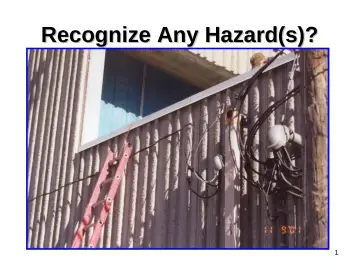
ppt
20 slidesFocus Four: Electrocution Hazard Recognition
OSHA's official Construction Focus Four slide deck on electrocution hazards: overhead lines, contact with energized sources, improper use of cords and tools.
U.S. Department of Labor, OSHAPublic domain
pdf
83 slidesFocus Four: Electrocution Hazards Instructor Guide
OSHA instructor guide/lesson plan for the Focus Four electrocution module.
U.S. Department of Labor, OSHAPublic domain
pdf
9 slidesFocus Four: Electrocution Student Handouts
Student handouts including the Focus Four electrocution safety tips, toolbox talks and the Electrical Safety QuickCard.
U.S. Department of Labor, OSHAPublic domain