1 / 115Use ← → to flip
Electrical Hazards in Construction
Electrical hazards in construction from the Chicagoland Construction Safety Council: electrical basics, overhead lines, GFCIs, cords and lockout.
Slide text
· 115 slides · by Chicagoland Construction Safety Council
The words on each slide as the author wrote them, read from the file by software so they can be searched. Layout, pictures and tables are not shown here: the slides above and the download are the original.
- Slide 1
OSHA Disclaimer
- This material was produced under grant number SH-31209-SH7 from the Occupational Safety and Health Administration, U.S. Department of Labor. It does not necessarily reflect the views or policies of the U.S. Department of Labor, nor does mention of trade names, commercial products, or organizations imply endorsement by the U.S. Government.
- Slide 2
Electrical Hazards in Construction
- Created by:
- Construction Safety Council
- Slide 3
Course Topics…
- OSHA
- Introduction to electrical hazards and how shocks occur
- Recognition and avoidance of common electrical hazards
- Overhead and underground power lines.
- Ground fault protection
- Extension cords and tools
- Lockout/Tagout
- Electrical safety-related work practices
- PPE
- Slide 4
Pre-Test
- Slide 5
Introduction to Electrical Hazards
- Types of electrical injuries
- OSHA’s Focus Four
- How shocks occur
- Factors affecting severity of electrical shock
- Arc blast hazards
- The basics of electricity
- Slide 6
Electrical Injuries
- There are four main types of electrical injuries:
- Electrocution (death due to electrical shock);
- Electrical shock;
- Burns (Arc Blast); and,
- Falls.
- Slide 7
OSHA Focus Four
- 1. Falls
- 2. Caught-in-Between
- 3. Struck-by
- 4. Electrocution
- Slide 8
How Shocks Occur
- Contact with one wire of an energized circuit and the ground.
- Contact with a metallic part in contact with an energized wire while also in contact with the ground.
- Contacts with both wires of an energized circuit.
- Slide 9
Effect of Current on Body
- Current Level
- (in milliamperes)
- Probable Effect on Human Body
- 1 mA
- Perception level. Slight tingling sensation. Still dangerous under certain conditions.
- 5 mA
- Slight shock felt – not painful but disturbing. Average individual can let go. However, strong involuntary reactions to shocks in this range may lead to injuries.
- 6-30 mA
- Painful shock, muscular control is lost. This is called the freezing current or “let-go” range.
- 50-150 mA
- Extreme pain, respiratory arrest, severe muscular contractions. Individual cannot let go. Death is possible.
- 1000-4,300 mA
- Ventricular fibrillation (the rhythmic pumping action of the heart ceases). Muscular contraction and nerve damage occur. Death is most likely.
- 10,000 mA
- Cardiac arrest, severe burns and probable death.
- 15,000 mA
- Lowest overcurrent at which a typical fuse or circuit breaker opens a circuit!
- Slide 10
Arc Flash
- Dust
- Dropping tools
- Accidental touching
- Condensation
- Material failure
- Corrosion
- Faulty Installation
- Burns (Non FR clothing can burn onto skin)
- Fire (could spread rapidly through building)
- Flying objects (often molten metal)
- Blast pressure (upwards of 2,000 lbs. / ft²)
- Sound Blast (noise can reach 140 dB – loud as a gun)
- Heat (upwards of 35,000 degrees F)
- Slide 11
Arc Flash Suit
- Complete arc-rated clothing and equipment system that covers the entire body, except for the hands and feet.
- Slide 12
Arc Rating (cal/cm²)
- Arc Thermal Performance Value (ATPV)
- Energy of Breakopen Threshold (EBT)
- Slide 13
Electrical Basics
- Voltage
- Current
- Resistance
- Ground
- Slide 14
Voltage
- Force or pressure that causes electricity to flow through a conductor and is measured in volts (V).
- Slide 15
Voltage, Nominal (as defined by the NFPA 70: National
- Electric Code)
- A nominal value assigned to a circuit or system for the purpose of conveniently designating its voltage class (e.g., 120/240 volts, 480Y/277 volts, 600 volts).
- Slide 16
Current Thresholds
- < 50 V
- Below OSHA threshold for guarding requirements. Most common equipment includes phone, cable TV, fire alarm and other communication systems.
- 50 V
- OSHA threshold for guarding of live parts, “live parts of electric equipment operating at 50 volts or more shall be guarded against accidental contact…”
- 110/120 V
- Common household voltage present at the receptacle outlet.
- 240 V
- What is delivered to a home then split into two opposing circuits operating at 110/120 volts each. Some large appliances require the full 240 volts to operate.
- 208 or 480 V
- 3-phase power systems, more typically found in commercial or industrial applications for large motors and other equipment.
- 277 V
- Used for powering lighting equipment in commercial or industrial operations.
- < 600 V
- OSHA threshold for what is considered low voltage.
- 600 V
- OSHA threshold for what is considered high voltage.
- Slide 17
Current
- Flow of electrons from a source of voltage through a conductor and is measured in amperes (Amps).
- AC/DC
- Slide 18
Voltage – Current Illustration
- Slide 19
Resistance
- Factors that determine resistance:
- What it is made of
- Its size & length
- Its temperature
- Slide 20
Ohm’s Law
- Slide 21
Ohm’s Law - Example
- 110 volt circuit
- "Under dry conditions, the resistance offered by the human body may be as high as 100,000 ohms. Wet or broken skin may drop the body's resistance to 1,000 ohms," - NIOSH
- Slide 22
1 mA of Current on Body Effects
- Current Level
- (in milliamperes)
- Probable Effect on Human Body
- Perception level. Slight tingling sensation. Still dangerous under certain conditions.
- 5 mA
- Slight shock felt – not painful but disturbing. Average individual can let go. However, strong involuntary reactions to shocks in this range may lead to injuries.
- 6-30 mA
- Painful shock, muscular control is lost. This is called the freezing current or “let-go” range.
- 50-150 mA
- Extreme pain, respiratory arrest, severe muscular contractions. Individual cannot let go. Death is possible.
- 1000-4,300 mA
- Ventricular fibrillation (the rhythmic pumping action of the heart ceases). Muscular contraction and nerve damage occur. Death is most likely.
- 10,000 mA
- Cardiac arrest, severe burns and probable death.
- 15,000 mA
- Lowest overcurrent at which a typical fuse or circuit breaker opens a circuit!
- Slide 23
Introduction to OSHA
- OSHA’s purpose and employer duty to provide a safe place of employment
- Employer/employee rights & responsibilities under the OSHAct
- Refusing to work because conditions are dangerous
- OSHA’s multi-employer worksite citation policy
- Rights as a whistleblower
- OSHA policy on providing and paying for personal protective equipment
- Reporting of fatalities and catastrophes
- OSHA and NFPA industry consensus standards for electrical work
- Qualified person
- Slide 24
General Duty Clause
- (a)
- (b)
- Each employer
- Shall furnish to each of his employees employment and a place of employment which are free from recognized hazards that are causing or are likely to cause death or serious physical harm to his employees.
- Shall comply with occupational safety and health standards promulgated under this Act.
- Each employee shall comply with occupational safety and health standards and all rules, regulations, and orders issued pursuant to this Act which are applicable to his own actions and conduct.
- Slide 25
OSHA Standard Reference: 1910.335(a) (1)(i)
- “Employees working in areas where there are potential electrical hazards shall be provided with, and shall use, electrical protective equipment that is appropriate for the specific parts of the body to be protected and for the work to be performed.”
- Slide 26
Job Safety and Health Poster
- Slide 27
Refusing to Work because Conditions are Dangerous
- Ask your employer to correct the hazard;
- Ask your employer for other work;
- Tell your employer that you won’t perform the work unless and until the hazard is corrected; and
- Remain at the worksite until ordered to leave by your employer.
- Slide 28
OSHA’s Multi-Employer Worksite Citation Policy
- The Creating Employer
- The Exposing Employer
- The Correcting Employer
- The Controlling Employer
- Slide 29
Rights as a Whistleblower
- Slide 30
Employers must Provide and Pay for most PPE
- Employer Obligations
- Perform a “hazard assessment” of the workplace to identify and control physical and health hazards.
- Identify and provide appropriate PPE for employees.
- Train employees in the use and care of the PPE.
- Maintain PPE, including replacing worn or damaged PPE.
- Periodically review, update and evaluate the effectiveness of the PPE program.
- Worker Responsibility:
- Properly wear PPE.
- Attend training sessions on PPE.
- Care for, clean and maintain PPE.
- Inform a supervisor of the need to repair or replace PPE.
- NOTE: The employer must pay for replacement PPE, except when the employee has lost or intentionally damaged the PPE.
- Slide 31
Reporting of Fatalities and Catastrophes
- Employers must report all work related fatalities within eight (8) hours.
- All work-related inpatient hospitalizations, all amputations and all losses of an eye within 24 hours.
- Slide 32
OSHA & NFPA Electrical Standards
- 29 CFR 1910 Subpart S
- 29 CFR 1926 Subpart K
- NFPA 70E: Standard for Electrical Safety in the Workplace
- Slide 33
Qualified Person (OSHA) – 29 CFR 1910.399
- One who has received training in and has demonstrated skills and knowledge in the construction and operation of electric equipment and installations and the hazards involved.
- Slide 34
OSHA Lockout/Tagout (Control of Hazardous Energy)
- 29 CFR 1910.147(b)
- Affected employee. An employee whose job requires him/her to operate or use a machine or equipment on which servicing or maintenance is being performed under lockout or tagout, or whose job requires him/her to work in an area in which such servicing or maintenance is being performed.
- Authorized employee. A person who locks out or tags out machines or equipment in order to perform servicing or maintenance on that machine or equipment. An affected employee becomes an authorized employee when that employee's duties include performing servicing or maintenance covered under this section.
- Slide 35
Qualified Person (NFPA 70E)
- Such persons shall also be familiar with the proper use of the special precautionary techniques, applicable electrical policies and procedures, PPE, insulating and shielding materials, and insulated tools and test equipment.
- 1. Skills and techniques necessary to distinguish exposed energized electrical conductors and circuit parts from other parts of electrical equipment.
- 2. Skills and techniques necessary to determine the nominal voltage of exposed energized electrical conductors and circuit parts.
- 3. Approach distances specified in NFPA 70E Tables and the corresponding voltages to which the qualified person will be exposed.
- 4. Decision-making process necessary to be able to do the following:
- a) b) c) d)
- Perform the job safety planning
- Identify electrical hazards
- Assess the associated risk
- Select the appropriate risk control methods from the hierarchy of controls, including personal protective equipment.
- Slide 36
Approach Boundaries (NFPA 70E – 2018)
- Nominal System Voltage (AC) Range
- Limited Approach Boundary
- Restricted Approach
- Boundary²
- Exposed Movable
- Conductor¹
- Exposed Fixed Circuit Part
- Not Specified
- 50 – 150 volts
- 10 ft 0 in.
- 3 ft 6 in.
- Avoid Contact
- 151 – 750 volts
- 10 ft 0 in.
- 3 ft 6 in.
- 1 ft 0 in.
- 751 – 15,000 volts
- 10 ft 0 in.
- 5 ft 0 in.
- 2 ft 2 in.
- Less than 50 volts
- Slide 37
Overhead & Underground Power Lines
- Identify OSHA's power line safety standards, specifically clearance distances for both known and unknown voltages.
- List the options for compliance if working in close proximity to an overhead power line.
- Prepare planning documentation that complies with OSHA's encroachment/electrocution prevention requirements to include procedures to be followed in the event of a power line contact.
- Slide 38
Examples of Equipment That Can Contact Power Lines:
- Aluminum paint rollers
- Backhoes
- Concrete pumpers
- Cranes
- Long-handled cement finishing floats
- Metal building materials
- Metal ladders
- Raised dump truck beds
- Scaffolds
- Slide 39
Insulated Sleeve
- Slide 40
Types of Power Lines
- Slide 41
Underground Power Lines – Call Before You Dig!
- 29 CFR 1926.651(b)(1). The estimated location of utility installations or any other underground installation that may be encountered during excavation work must be determined prior to opening an excavation.
- 29 CFR 1926.416(a)(2). In work areas where the exact location of underground electric powerlines is unknown, employees using jack-hammers, bars, or other hand tools which may contact a line shall be provided with insulated protective gloves.
- Slide 42
General Electrical Requirements
- 29 CFR 1926.416(a)(3). Before work is begun the employer shall ascertain by inquiry or direct observation, or by instruments, whether any part of an energized electric power circuit, exposed or concealed, is so located that the performance of the work may bring any person, tool, or machine into physical or electrical contact with the electric power circuit. The employer shall post and maintain proper warning signs where such a circuit exists. The employer shall advise employees of the location of such lines, the hazards involved, and the protective measures to be taken.
- Slide 43
Underground Utility Marking Codes/Colors
- Hand dig or use other non-intrusive means within required “Tolerance Zone” (varies by State), 18” – 24” on either side of the utility.
- Watch out for utility corridors, utilities buried side-by-side and take into consideration diameter of large pipes.
- Use the National 811 phone number to call for utility locates.
- Slide 44
Utility Corridors
- Slide 45
Vacuum Excavation
- Slide 46
Mobile Cranes and Power Lines
- Construction equipment that can hoist, lower and horizontally move a suspended load.
- Slide 47
Crane Work Zone (Power Line Safety)
- 29 CFR 1926.1408(a)(1). Identify the work zone by either:
- Demarcating boundaries (such as with flags, or a device such as a range limit device or range control warning device) and prohibiting the operator from operating the equipment past those boundaries, or
- Defining the work zone as the area 360 degrees around the equipment, up to the equipment's maximum working radius.
- Slide 48
Power Line Safety
- 20 Foot Rule…
- If any part of the equipment, load line or load (including rigging and lifting accessories), if operated up to the equipment's maximum working radius in the work zone, cannot get closer than 20 feet to an overhead power line, then no further precautions may be taken.
- Slide 49
Grounded Power Line
- Slide 50
Table A
- Slide 51
Nonconductive
- Property of not becoming energized.
- High dielectric properties offering a high resistance to the passage of current under the conditions of use.
- Polypropylene Rope
- Clean & Dry
- High-voltage Rated Rubber Gloves
- Slide 52
Dedicated Spotter
- Be equipped with a visual aid to assist in identifying the minimum clearance distance.
- Be positioned to effectively gauge the clearance distance.
- Able to communicate directly with the operator.
- Give timely information to the operator.
- Trained!
- Slide 53
Employee Training for Power Lines
- Information regarding the danger of simultaneously touching the equipment and ground.
- The importance to the operator's safety of remaining inside the cab.
- The safest means of evacuating from equipment that may be energized.
- The danger of the potentially energized zone around the equipment (step potential).
- The need for crew in the area to avoid approaching or touching the equipment and the load.
- Safe clearance distance from power lines.
- The limitations of an insulating link/device, proximity alarm, and range control (and similar) device, if used.
- How to properly ground equipment and the limitations of grounding.
- Slide 54
Warning Stickers
- Two on the outside of equipment.
- One inside cab.
- Slide 55
Fatal Fact – Discussion #1
- Read and discuss fatal fact.
- Slide 56
Fatal Fact – Discussion #2
- Read and discuss fatal fact.
- Slide 57
Fatal Fact – Discussion #3
- Read and discuss fatal fact.
- Slide 58
Ground Fault Protection
- Explain what a ground fault is and what makes it a dangerous condition
- Employer’s responsibility for providing ground fault protection on job sites
- Requirements for ground fault circuit interrupter use, limitations and testing
- Slide 59
Ground Fault
- Slide 60
What is a GFCI?
- Fast-acting circuit breaker that senses small imbalances in the circuit caused by current leakage to ground and, in a fraction of a second, shuts off the electricity.
- Slide 61
29 CFR 1926.404(b)(1). Ground fault protection
- Required on all 120-volt, single-phase 15- and 20-ampere receptacle outlets on construction sites, which are not a part of the permanent wiring of the building or structure and which are in use by employees.
- Slide 62
Double-Insulated Tools
- Tool enclosure is completely non-conducting
- No ground “Earth” wire
- Identified by a double square symbol
- Slide 63
Assured Equipment Grounding Conductor Program
- A continuity test to ensure that the equipment-grounding conductor is electrically continuous.
- A polarity test to ensure that the equipment-grounding conductor is connected to its proper terminal.
- Slide 64
Fatal Fact – Discussion #4
- Read and discuss fatal fact.
- Slide 65
Extension Cords, Tools & Other Equipment
- Types of extension cords, their markings, proper use and how to inspect for damage
- Path to ground missing or discontinuous
- Improper use of flexible and extension cords
- Common misuses of equipment
- Slide 66
Selecting and Using the Right Extension Cord
- U.S., American Wire Gauge (AWG)
- #18 AWG - Lamp cords (sometimes #16).
- #16 AWG - A step up from lamp cords. The most commonly used general-purpose cord gauge (used for work lights, electric trimmers, etc.) Not for high-power loads. Not recommended for construction work.
- #14 AWG - Minimum size recommended for construction work.
- #12 AWG - Heavy use, such as large power tools.
- #10 AWG - Large loads.
- Slide 67
29 CFR 1926.405(a)(2)(ii)(J). Extension Cords
- Cord sets used with portable tools and appliances must be of the three-wire, grounding type; and flexible cords must be designed for hard or extra-hard usage.
- “S” (hard service)
- “SJ” the J is for “junior”
- Slide 68
Extension Cord Markings
- Thermoplastic insulation, instead of a rubber-type material Thermoplastic elastomer insulation (more rubber-like than thermoplastic)
- Oil resistant
- Moisture and sunlight resistant
- Slide 69
Cord Repair
- Do not repair extension cords by replacing the ends. This will cause the cord to not maintain its approval for what its intended use is. For example, what was once “W” moisture and sunlight resistant cord will no longer be water tight if the plug was replaced.
- Slide 70
OSHA's Nationally Recognized Testing
- Laboratory (NRTL) Program
- 29 CFR 1926.403(a). Approval
- All electrical conductors and equipment shall be approved.
- Slide 71
Two-prong Receptacle Adapter
- Never use an adapter that will make a three-prong cord fit into a two prong receptacle.
- Slide 72
Path to Ground Missing or Discontinuous
- 29 CFR 1926.404(f)(6) – Grounding path.
- The path to ground from circuits, equipment, and enclosures shall be permanent and continuous.
- Slide 73
Cord and Tool Inspection
- Slide 74
Look
- Slide 75
Equipment Not Used in Manner Prescribed
- Do not repair electrical cords with tape! Any repairs must return the equipment to the state in which it was initially approved
- Slide 76
- Do not use multi-receptacle boxes designed to be mounted by fitting them with a power cord and placing them on the floor.
- Slide 77
29 CFR 1926.302(a)(2)
- The use of electric cords for hoisting or lowering tools shall not be permitted.
- Slide 78
29 CFR 1926.405(a)(2)(ii)(I)
- Flexible cords and cables shall be protected from damage. Sharp corners and projections shall be avoided.
- Slide 79
Power Tools
- 29 CFR 1926.200(h). Accident
- Prevention Tags
- Shall be used as a temporary means of warning employees of an existing hazard, such as defective tools.
- Slide 80
Lockout/Tagout
- What is hazardous energy?
- What are the harmful effects of hazardous energy?
- Elements of a Lockout/Tagout program (OSHA)
- Electrical Safety-Related Work Practices (NFPA 70E)
- Slide 81
Construction Industry Standards (OSHA)
- 29 CFR 1926.417(a). Controls that are to be deactivated during the course of work on energized or deenergized equipment or circuits shall be tagged.
- 29 CFR 1926.417(b). Equipment or circuits that are deenergized shall be rendered inoperative and shall have tags attached at all points where such equipment or circuits can be energized.
- 29 CFR 1926.417(c). Tags shall be placed to identify plainly the equipment or circuits being worked on.
- Slide 82
Energy Control Program (OSHA) – 29 CFR 1910.147
- Lockout/Tagout program requirements:
- If an energy isolating device is capable of being locked out, the employer's energy control program shall utilize lockout, unless the employer can demonstrate that the utilization of a tagout system will provide full employee protection.
- If an energy isolating device is not capable of being locked out, the employer's energy control program shall utilize a tagout system.
- When a tagout device is used on an energy isolating device which is capable of being locked out, the tagout device shall be attached at the same location that the lockout device would have been attached, and the employer shall demonstrate that the tagout program will provide a level of safety equivalent to that obtained by using a lockout program.
- Slide 83
Capable of Being Locked Out
- An energy isolating device is capable of being locked out if it has a hasp or other means of attachment to which, or through which, a lock can be affixed, or it has a locking mechanism built into it.
- Slide 84
Lockout/Tagout Devices
- Slide 85
Lockout/Tagout Materials and Hardware
- Durable
- Standardized
- Substantial
- Identifiable
- Slide 86
Fatal Fact – Discussion #5
- Read and discuss fatal fact.
- Slide 87
Electrical Safety-Related Work Practices
- Hierarchy of risk control methods
- Job safety planning and job briefing
- Host and contract employers’ responsibilities
- Shock risk assessment
- Arc flash risk assessment and equipment labeling
- Emergency response training
- Test instruments and equipment – ABC’s of Multimeter safety
- Energized electrical work permit
- Slide 88
29 CFR 1910.333(a). "General."
- Safety-related work practices shall be employed to prevent electric shock or other injuries resulting from either direct or indirect electrical contacts, when work is performed near or on equipment or circuits which are or may be energized. The specific safety-related work practices shall be consistent with the nature and extent of the associated electrical hazards.
- Slide 89
Hierarchy of Risk Control Methods
- 1. Elimination
- 2. Substitution
- 3. Engineering controls
- 4. Awareness
- 5. Administrative controls
- 6. PPE
- Slide 90
Electrical Safety Work Practices (1)
- Option 1: Deenergize (Lockout/Tagout)
- 29 CFR 1910.333(a)(1). Live parts to which an employee may be exposed shall be deenergized before the employee works on or near them, unless the employer can demonstrate that deenergizing introduces additional or increased hazards or is infeasible due to equipment design or operational limitations.
- Slide 91
Examples of Increased or Additional Hazards
- Interruption of life support equipment
- Deactivation of emergency alarm systems
- Shutdown of hazardous location ventilation equipment
- Removal of illumination for an area
- Slide 92
Examples of Infeasibility
- Infeasibility due to equipment design or operational limitations include testing of electric circuits that can only be performed with the circuit energized and work on circuits that form an integral part of a continuous industrial process in a chemical plant that would otherwise need to be completely shut down in order to permit work on one circuit or piece of equipment.
- Slide 93
Electrical Safety Work Practices (2)
- Option 2: Work On or Near Energized Parts
- 29 CFR 1910.333(a)(2). If the exposed live parts are not deenergized (i.e., for reasons of increased or additional hazards or infeasibility), other safety-related work practices shall be used to protect employees who may be exposed to the electrical hazards involved. Such work practices shall protect employees against contact with energized circuit parts directly with any part of their body or indirectly through some other conductive object. The work practices that are used shall be suitable for the conditions under which the work is to be performed and for the voltage level of the exposed electric conductors or circuit parts.
- Slide 94
Job Safety Planning
- 1. Be completed by a qualified person
- 2. Be documented
- 3. Include the following information:
- a) Description of the job and the individual tasks
- b) Identification of the electrical hazards associated with each task
- c) A shock risk assessment for tasks involving a shock hazard
- d) An arc flash risk assessment for tasks involving an arc flash hazard
- e) Work procedures involved, special precautions, and energy source controls
- Slide 95
Job Briefing
- The job briefing shall cover the job safety plan and the information on the energized electrical work permit, if a permit is required.
- Slide 96
Host and Contract Employers’ Responsibilities
- Host Employer
- The host employer must inform contract employers of the known hazards related to the contract employer’s work. Additional information on hazards that might not be recognized by the contract employer or its employees must also be provided.
- The host employer shall report observed contract employer-related violations to the contract employer.
- Slide 97
Host and Contract Employers’ Responsibilities Continued
- Contract Employer
- The contract employer must ensure that each of his or her employees is instructed in the hazards communicated to the contract employer by the host employer. This instruction shall be in addition to the qualified person training already received.
- The contract employer shall ensure that each of his or her employees follows the work practices and safety-related work rules required by the host employer.
- Slide 98
Shock Risk Assessment (NFPA 70E – 2018)
- Limited Approach Boundary
- Restricted Approach Boundary
- Arc Flash Hazard Analysis
- Slide 99
Approach Boundaries (NFPA 70E)
- Slide 100
Arc Flash Risk Assessment (NFPA 70E
- 2018)
- An arc flash hazard exists when working within a distance at which incident energy equals 1.2 cal/cm².
- Three main reasons for performing an arc flash risk assessment:
- 1. To identify arc flash hazards.
- 2. To estimate the likelihood of occurrence of injury or damage to health and the potential severity of injury or damage to health.
- 3. To determine if additional protective measures are required, including the use of PPE.
- Slide 101
Equipment Labeling (NFPA 70E – 2018)
- 1. Nominal system voltage
- 2. Arc flash boundary
- 3. At least one of the following:
- a) Available incident energy and the corresponding working distance, or the arc flash PPE category in Table 130.7(C)(15)(a) or Table 130.7(C)(15)(b) for the equipment, but not both.
- b) Minimum arc rating of clothing.
- c) Site-specific level of PPE.
- Slide 102
Emergency Response Training (NFPA 70E
- 2018)
- Contact Release
- First Aid, Emergency Response, and Resuscitation
- Slide 103
Test Instruments and Equipment
- Use
- 29 CFR 1910.334(c)(1). Only qualified persons may perform testing work on electric circuits or equipment.
- Visual Inspection
- 29 CFR 1910.334(c)(2). Test instruments and equipment and all associated test leads, cables, power cords, probes, and connectors shall be visually inspected for external defects and damage before the equipment is used. Rating of Equipment
- 29 CFR 1910.334(c)(3). Test instruments and equipment and their accessories shall be rated for the circuits and equipment to which they will be connected and shall be designed for the environment in which they will be used.
- Slide 104
Multimeter Safety Checklist
- Check for cracked or oily cases
- Check for broken input jacks
- Check category rating
- Check that any replacement fuses and leads are approved by the manufacturer
- Slide 105
ABC of Multimeter Safety
- Slide 106
Energized Electrical Work Permit (NFPA 70E – 2018)
- When work is performed on energized electrical equipment, an energized electrical work permit shall be required and documented under the any of following conditions:
- When work is performed within the restricted approach boundary.
- When the employee interacts with the equipment when conductors or circuit parts are not exposed but an increased likelihood of injury from an exposure to an arc flash hazard exists.
- Slide 107
Personal Protective Equipment
- Safeguards for personnel protection
- Arc flash suit – arc rating
- Arc flash PPE categories
- Care and maintenance of arc-rated clothing and arc-rated arc flash suits
- Voltage rated tools
- Slide 108
Safeguards for Personnel Protection (OSHA) – 29 CFR 1910.335
- Rubber insulating protective equipment shall be maintained in a safe, reliable condition and shall be periodically inspected or tested. (See OSHA TABLE I-5-RUBBER INSULATING EQUIPMENT, TEST INTERVALS.)
- If the insulating capability of protective equipment may be subject to damage during use, the insulating material shall be protected. (For example, an outer covering of leather is required for the protection of rubber insulating material.)
- Slide 109
Personnel Protection (OSHA) – 29 CFR 1910.335
- Employees shall wear nonconductive head protection wherever there is a danger of head injury from electric shock or burns due to contact with exposed energized parts.
- Employees shall wear protective equipment for the eyes or face wherever there is danger of injury to the eyes or face from electric arcs or flashes or from flying objects resulting from electrical explosion.
- Slide 110
OSHA Table I-5-Rubber Insulating Equipment, Test Intervals
- Slide 111
Arc Flash Suit – Arc Rating
- Arc Flash Suit (NFPA 70E – 2018) is a complete arc-rated clothing and equipment system that covers the entire body, except for the hands and feet. An arc flash suit may include pants or overalls, a jacket or a coverall, and a beekeeper-type hood fitted with a face shield.
- Slide 112
Underwear
- No acetate
- No Nylon
- No polyester
- No Polypropylene
- No Spandex
- Slide 113
Voltage Rated Tools
- Slide 114
Fatal Fact – Discussion #6
- Read and discuss fatal fact.
- Slide 115
Post -Test
- Thank you!
More on Electrocution
ppt
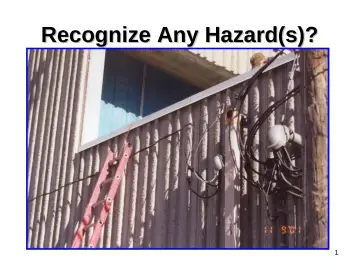
20 slidesFocus Four: Electrocution Hazard Recognition
OSHA's official Construction Focus Four slide deck on electrocution hazards: overhead lines, contact with energized sources, improper use of cords and tools.
U.S. Department of Labor, OSHAPublic domain
pdf
83 slidesFocus Four: Electrocution Hazards Instructor Guide
OSHA instructor guide/lesson plan for the Focus Four electrocution module.
U.S. Department of Labor, OSHAPublic domain
pdf
9 slidesFocus Four: Electrocution Student Handouts
Student handouts including the Focus Four electrocution safety tips, toolbox talks and the Electrical Safety QuickCard.
U.S. Department of Labor, OSHAPublic domain