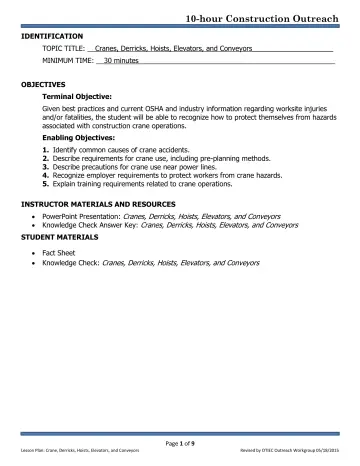
OSHA's own 10-hour Construction Outreach deck on crane hazards: power lines, load charts, rigging, signal persons and inspections (2015 edition).
Slide text
· 32 slides · by U.S. Department of Labor, OSHA (with the OTIEC Outreach Workgroup)
The words on each slide as the author wrote them, read from the file by software so they can be searched. Layout, pictures and tables are not shown here: the slides above and the download are the original.
- Slide 1
Cranes
- 10-Hour Construction Outreach
- Slide 2
- Slide 3
Cranes
- Discuss “Big Blue” crane collapse
- Case Study
- https://www.osha.gov/dcsp/success_stories/compliance_assistance/abbott/abbott_casestudies/slide30.html
- Slide 4
- Slide 5
Cranes
- Lesson Overview
- Common Causes of Crane Accidents
- Crane Use
- Crane Use Near Power Lines
- Employer Requirements
- Training Requirements
- Slide 6
Common Causes of Crane Accidents
- Four Major Types of Crane Accidents
- 1. Contact with power lines
- 2. Overturns
- 3. Mechanical Failures
- 4. Falls
- Slide 7
Common Causes of Crane Accidents
- Reasons accidents occur:
- 1. Poor Load Planning/Instability
- 2. Lack of communication
- 3. Lack of training
- 4. Inadequate maintenance or inspection of equipment
- Slide 8
Hazardous Environments for Crane Operations
- 1. Improper loading rating
- 2. Excessive speeds
- 3. No hand signals
- 4. Inadequate inspection and maintenance
- 5. Unguarded parts
- 6. Unguarded swinging radius
- 7. Working too close to power lines
- 8. Improper exhaust systems
- 9. Shattered windows
- 10. No steps or guardrails on walkways
- 11. No boom angle indicator
- 12. Not using outriggers
- Slide 9
Load Capacity – Speed - Warnings
- Make sure the crane operator can see the:
- Rated Load Capacities
- Operating Speeds
- Special Hazard Warning
- Instructions
- Operator’s manual
- Source: OSHA
- Slide 10
Hand Signals
- Source: Federal Register - OSHA
- Slide 11
- Slide 12
Swing Radius
- Stay out of the swing radius of the crane.
- Make sure there are barrier guards showing the swing radius.
- Source: OSHA
- Slide 13
Operator Visibility
- Make sure broken windows or other obstructions do not prevent the operator from seeing.
- Source: OSHA
- Slide 14
Guardrails
- Runways and steps need to have guardrails, handholds and slip resistant surfaces.
- Source: OSHA
- Slide 15
Guardrails
- Use ladders to get to the upper portion of the cab.
- Source: OSHA
- Slide 16
Crane Use
- 1. Capacities and limitations of the crane and job site restrictions.
- 2. Operators, signal persons, and riggers – qualifications/certifications
- 3. Level the crane and check the support surface
- 4. Check for power line precautions
- 5. Communicate hoisting activities in work area
- 6. Barricade swing area
- 7. Maintenance and inspection
- 8. Identify safe store and pick up/put down area for materials and machinery
- Slide 17
Crane Operations
- 1. Load capacity/speed of operation
- 2. Weight of load
- 3. Basic lifting principles
- 4. Hand signals
- 5. Power lines
- 6. Swing radius
- 7. Suspended loads
- Slide 18
Crane Use Near Power Lines
- Boom or crane contact with energized power lines accounts for nearly 45% of crane accidents.
- Source: NIOSH
- Slide 19
Crane Use Near Power Lines
- Pre-operational requirements:
- 1. Identify work zone
- 2. Determine proximity to power lines, if closer than 20 feet, if so, must do one of the following three:
- a. De-energize and ground
- b. Ensure no part of equipment, load line, or load gets closer than 20 feet to power line
- c. Determine line’s voltage and minimum approach distance permitted under Table A.
- Slide 20
Crane Use Near Power Lines
- Pre-operational requirements:
- TABLE A – MINIMUM CLEARANCE DISTANCES
- Voltage (nominal, kV, alternating current)
- Minimum Clearance Distance (feet)
- up to 50
- over 50 to 200
- over 200 to 350
- over 350 to 500
- over 500 to 750
- over 750 to 1,000
- Over 1,000
- (as established by the utility owner/operator or qualified registered professional engineer who is a qualified person with respect to electrical power transmission and distribution)
- Slide 21
Employer Requirements
- Comply with all applicable employer requirements.
- Designate a competent person to inspect all machinery and equipment prior to each use.
- Slide 22
Training Requirements
- 1. Employer must provide training
- 2. Training administration
- Slide 23
Hazard Recognition
- Slide 24
- Slide 25
- Slide 26
- Slide 27
- Slide 28
Knowledge Check
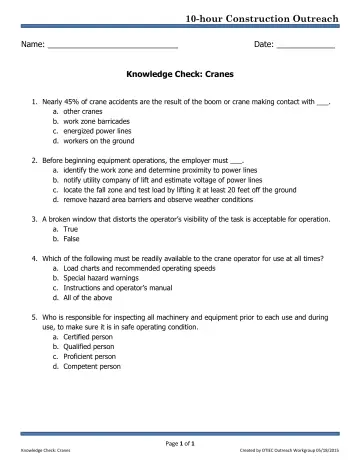
- 1. Nearly 45% of crane accidents are the result of the boom or crane making contact with __.
- a. other cranes
- b. work zone barricades
- c. energized power lines
- d. workers on the ground
- Slide 29
Knowledge Check
- 2. Before beginning equipment operations, the employer must ___.
- a. identify the work zone and determine proximity to power lines
- b. notify utility company of lift and estimate voltage of power lines
- c. locate the fall zone and test load by lifting it at least 20 feet off the ground
- d. remove hazard area barriers and observe weather conditions
- Slide 30
Knowledge Check
- 3. A broken window that distorts the operator’s visibility of the task is acceptable for operation.
- a. True
- b. False
- b. False
- Slide 31
Knowledge Check
- 4. Which of the following must be readily available to the crane operator for use at all times?
- a. Load charts and recommended operating speeds
- b. Special hazard warnings
- c. Instructions and operator’s manual
- d. All of the above
- Slide 32
Knowledge Check
- 5. Who is responsible for inspecting all machinery and equipment prior to each use and during use, to make sure it is in safe operating condition?
- a. Certified person
- b. Qualified person
- c. Proficient person
- d. Competent person