1 / 9Use ← → to flip
Cranes, Derricks, Hoists, Elevators, and Conveyors: Lesson Plan (OSHA 10-Hour Construction Outreach)
Instructor lesson plan with objectives, timing and teaching procedures for the OSHA cranes, derricks, hoists, elevators, and conveyors outreach deck.
Page text
· 9 pages · by U.S. Department of Labor, OSHA (with the OTIEC Outreach Workgroup)
The words on each page as the author wrote them, read from the file by software so they can be searched. Layout, pictures and tables are not shown here: the pages above and the download are the original.
- Page 1
IDENTIFICATION
- TOPIC TITLE: __Cranes, Derricks, Hoists, Elevators, and Conveyors___
- MINIMUM TIME: __30 minutes___
- OBJECTIVES
- Terminal Objective:
- Given best practices and current OSHA and industry information regarding worksite injuries and/or fatalities, the student will be able to recognize how to protect themselves from hazards associated with construction crane operations.
- Enabling Objectives:
- 1. Identify common causes of crane accidents.
- 2. Describe requirements for crane use, including pre-planning methods.
- 3. Describe precautions for crane use near power lines.
- 4. Recognize employer requirements to protect workers from crane hazards.
- 5. Explain training requirements related to crane operations.
- INSTRUCTOR MATERIALS AND RESOURCES
- PowerPoint Presentation: Cranes, Derricks, Hoists, Elevators, and Conveyors Knowledge Check Answer Key: Cranes, Derricks, Hoists, Elevators, and Conveyors
- STUDENT MATERIALS
- Fact Sheet
- Knowledge Check: Cranes, Derricks, Hoists, Elevators, and Conveyors
- Page 2
TEACHING PROCEDURES ---Preparation, Presentation, Application, Evaluation
- Anticipatory Set (Focus Attention/Gain Interest)
- Estimated Time: ?? hours
- Key Points
- Methods
- Discuss case study of “Big Blue” crane collapse.
- PPT slides #1 – #5
- https://www.osha.gov/dcsp/success_stories/compliance_assistance/abbott/abbott_casestudies/slide30.html
- Video Clip
- Presentation (Instruction)___
- Key Points
- I.
- Common Causes of Crane Accidents
- Case study
- Methods
- PPT slides #6 – #15
- A. Four major types of crane accidents
- 1. Contact with power lines
- 2. Overturns
- 3. Mechanical failures
- 4. Falls
- B. Reasons accidents occur
- 1. Instability – instability of crane, instability of load, poor ground conditions, etc.
- 2. Lack of communication between operator and ground personnel
- 3. Lack of training
- 4. Inadequate maintenance or inspection of equipment
- C. Conditions and actions that create hazardous environments for crane operations
- 1. Improper loading rating
- 2. Excessive speeds
- Page 3
3. No hand signals
- 4. Inadequate inspection and maintenance
- 5. Unguarded parts
- 6. Unguarded swinging radius
- 7. Working too close to power lines
- 8. Improper exhaust system
- 9. Shattered windows
- 10. No steps or guardrails on walkways
- 11. No boom angle indicator
- 12. Not using outriggers
- II.
- Crane Use
- PPT slides #16 – #17
- A. Pre-planning performed before operating a crane on a job site
- 1. Know the capacities and limitations of the crane and the restrictions of the job site.
- 2. Operators, signal persons, and riggers must meet qualifications/certifications of their job.
- 3. Level the crane and ensure support surface is firm and able to support the load.
- 4. Contact power line owners and determine necessary precautions to avoid power lines.
- 5. Make sure that any workers who might be in close proximity are aware of hoisting activities.
- 6. Barricade areas within the swing radius of the crane.
- 7. Ensure that all proper maintenance and inspections of the crane have been conducted.
- 8. Determine where the safe areas on the site are to store and pick up/put down materials and place the machinery.
- B. Crane Operations
- 1. Load capacity/speed of operation – make sure that the crane operator can see the rated load capacity and the proper operating speeds and is aware of any hazard warnings or instructions. Operators are not allowed to use cell phones while working on a crane, except when communicating with the signal person.
- Page 4
- 2. Weight of load – determine the weight of the load and use this information to calculate the proper way to lift and move the load. The maximum load that can be lifted can be limited by these factors:
- a. Unlevel ground or crane
- b. High winds
- c. Side loads or lifts
- d. Not using outriggers
- e. Lifting over the side
- f. Use of extensions, jibs
- g. Limits of the wire rope, slings, or lifting devices being used
- 3. Basic lifting principles – use these to govern a crane’s mobility and safety during lifting operations. These principles are:
- a. Center of gravity
- b. Leverage
- c. Stability
- d. Structural integrity
- 4. Hand signals – an illustration of signals must be posted in the vicinity of the hoisting operation. The signal person must meet OSHA’s qualification requirements. A signal person is required when any of the following conditions apply:
- a. Point of operation is not in full view of operator
- b. Operator’s view is obstructed in the direction the equipment is traveling
- c. Either the operator or the person handling the load determines a signal person is needed for safety concerns
- 5. Power lines – stay clear of power lines.
- 6. Swing radius – stay out of the swing radius of the crane and make sure that there are barricades restricting access within the swing radius area.
- 7. Suspended loads – keep the load as close as possible to the ground when picking up and carrying a load.
- All employees must stay clear of any load being lifted or suspended and shall not work any suspended load.
- Page 5
III. Crane Use Near Power Lines
- A. Boom or crane contact with energized power lines accounts for nearly 45% of crane accidents
- B. Pre-operational requirements
- 1. Identify work zone
- 2. Determine if any part of crane, load line, or load could get closer than 20 feet to a power line if operated at maximum working radius in the work zone. If so, must meet requirements in one of three options:
- a. De-energize and ground
- b. Ensure no part of equipment, load line, or load gets closer than 20 feet to power line
- c. Determine line’s voltage and minimum approach distance permitted under Table A.
- TABLE A – MINIMUM CLEARANCE
- DISTANCES
- Voltage
- Minimum Clearance
- (nominal, kV,
- Distance (feet)
- alternating
- current)
- up to 50
- over 50 to 200
- over 200 to 350
- over 350 to 500
- over 500 to 750
- over 750 to 1,000
- Over 1,000
- IV.
- (as established by the utility owner/operator or qualified registered professional engineer who is a qualified person with respect to electrical power transmission and distribution)
- Employer Requirements
- PPT slide #21
- A. Comply with all applicable employer requirements related to:
- 1. Assembly/Disassembly of crane
- 2. Power line safety
- Page 6
- 3. Procedures applicable to the operational functions of equipment, including attachments
- 4. Qualifications/certifications of:
- a. Crane operator
- b. Signal person
- c. Rigger
- 5. Other applicable OSHA requirements, including
- a. Training requirements
- b. Inspection requirements
- B. Designate a competent person to inspect all machinery and equipment prior to each use, and during use, to make sure it is in safe operating condition
- C. Comply with manufacturers’ requirements and recommendations for cranes and related equipment.
- PPT slide #22
- V.
- Training Requirements
- A. Employer must provide training
- 1. Overhead power lines
- 2. Signal persons
- 3. Operators
- 4. Competent persons and qualified persons
- 5. Crush/pinch points
- 6. Tag-out
- B. Training administration
- 1. Evaluate employees’ understanding of information provided in training
- 2. Provide refresher training
- 3. Provide training at no cost to employee
- Page 7
Application (How students apply what they learn) __
- Estimated Time: ?? hours
- Key Points
- Methods
- Show pictures of cranes operations and have students identify hazards associated with those operations.
- PPT slides #23 – #27
- Evaluation/Summary
- Key Points
- Methods
- Knowledge Check: Cranes, Derricks, Hoists, Elevators, and Conveyors .
- PPT slides #28 – #31
- References
- OSHA Standard: 29 CFR 1926 Subpart CC (1926.1400 to 1926.1442) https://www.osha.gov/pls/oshaweb/owasrch.search_form?p_doc_type=STANDARDS&p_toc_level=1 &p_keyvalue=Construction
- 1926 Subpart CC – Cranes and Derricks in Construction
- 1926.1400 - Scope.
- 1926.1401 - Definitions.
- 1926.1402 - Ground conditions.
- 1926.1403 - Assembly/Disassembly--selection of manufacturer or employer procedures.
- 1926.1404 - Assembly/Disassembly--general requirements (applies to all assembly and disassembly operations).
- 1926.1405 - Disassembly--additional requirements for dismantling of booms and jibs (applies to both the use of manufacturer procedures and employer procedures).
- 1926.1406 - Assembly/Disassembly--employer procedures--general requirements.
- 1926.1407 - Power line safety (up to 350 kV)--assembly and disassembly.
- 1926.1408 - Power line safety (up to 350 kV)--equipment operations.
- Page 8
- 1926.1409 - Power line safety (over 350 kV).
- 1926.1410 - Power line safety (all voltages)--equipment operations closer than the Table A zone.
- 1926.1411 - Power line safety--while traveling under or near power lines with no load.
- 1926.1412 - Inspections.
- 1926.1413 - Wire rope--inspection.
- 1926.1414 - Wire rope--selection and installation criteria.
- 1926.1415 - Safety devices.
- 1926.1416 - Operational aids.
- 1926.1417 - Operation.
- 1926.1418 - Authority to stop operation.
- 1926.1419 - Signals--general requirements.
- 1926.1420 - Signals--radio, telephone or other electronic transmission of signals.
- 1926.1421 - Signals--voice signals--additional requirements.
- 1926.1422 - Signals--hand signal chart.
- 1926.1423 - Fall protection.
- 1926.1424 - Work area control.
- 1926.1425 - Keeping clear of the load.
- 1926.1426 - Free fall and controlled load lowering.
- 1926.1427 - Operator qualification and certification.
- 1926.1428 - Signal person qualifications.
- 1926.1429 - Qualifications of maintenance & repair employees.
- 1926.1430 - Training.
- 1926.1431 - Hoisting personnel.
- 1926.1432 - Multiple-crane/derrick lifts--supplemental requirements.
- 1926.1433 - Design, construction and testing.
- 1926.1434 - Equipment modifications.
- 1926.1435 - Tower cranes.
- 1926.1436 - Derricks.
- 1926.1437 - Floating cranes/derricks and land cranes/derricks on barges.
- 1926.1438 - Overhead & gantry cranes.
- 1926.1439 - Dedicated pile drivers.
- 1926.1440 - Sideboom cranes.
- Page 9
- 1926.1441 - Equipment with a rated hoisting/lifting capacity of 2,000 pounds or less.
- 1926.1442 - Severability.
- 1926 Subpart CC App A - Standard Hand Signals
- 1926 Subpart CC App B - Assembly/Disassembly--Sample Procedures for Minimizing the Risk of Unintended Dangerous Boom Movement
- 1926 Subpart CC App C - Operator Certification--Written Examination--Technical Knowledge Criteria
- OSHA Publications
- https://www.osha.gov/pls/publications/publication.athruz?pType=Industry&pID=62
- Crane Modifications (1993, April 19) (English: HTML)
- Cranes and Derricks in Construction – Small Entity Compliance Guide for the
- Final Rule (OSHA 3433 - 2014) 96 pages (English: PDF)
- Cranes and Derricks in Construction: Subpart CC: Wire Rope - Inspection
- (OSHA FS-3635 - 2013) (English: HTML PDF)
- Cranes and Derricks in Construction: Assembly and Disassembly, Subpart CC
- Fact Sheet (English: HTML PDF)
- Cranes and Derricks in Construction: Operator Qualification and Certification, Subpart CC Fact Sheet (English: HTML PDF)
- Cranes and Derricks in Construction: Qualified Rigger, Subpart CC Fact Sheet
- (English: HTML PDF)
- Cranes and Derricks in Construction: Signal Person Qualification, Subpart CC
- Sling Safety (OSHA 3072 - 1996) (English: HTML PDF)
- Truck Cranes (1989, May 2) (English: HTML)
- Use of Improperly Sized Wedges and Sockets in Boom Anchor Systems
- (1992, July 13) (English: HTML)
- Vehicle-mounted Elevating and Rotating Devices
- (1990, September 14) (English: HTML)
- OSHA References/Resources
- Cranes (topic in Steel Erection eTool) https://www.osha.gov/SLTC/etools/steelerection/cranes.html
More on Cranes
pptx
32 slidesCranes, Derricks, Hoists, Elevators, and Conveyors (OSHA 10-Hour Construction Outreach)
OSHA's own 10-hour Construction Outreach deck on crane hazards: power lines, load charts, rigging, signal persons and inspections (2015 edition).
U.S. Department of Labor, OSHA (with the OTIEC Outreach Workgroup)ArchivedPublic domain
pdf
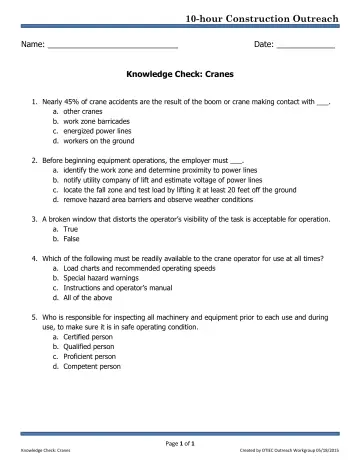
1 slidesCranes, Derricks, Hoists, Elevators, and Conveyors: Knowledge Check (OSHA 10-Hour Construction Outreach)
Student knowledge-check quiz that accompanies the OSHA cranes, derricks, hoists, elevators, and conveyors outreach deck.
U.S. Department of Labor, OSHA (with the OTIEC Outreach Workgroup)ArchivedPublic domain

pptx
198 slidesAdvance Rigging Principles
In-depth rigging principles course from the National Association of Tower Erectors; long and advanced, so choose slides selectively.
National Association of Tower ErectorsOSHA Harwood grant