1 / 3Use ← → to flip
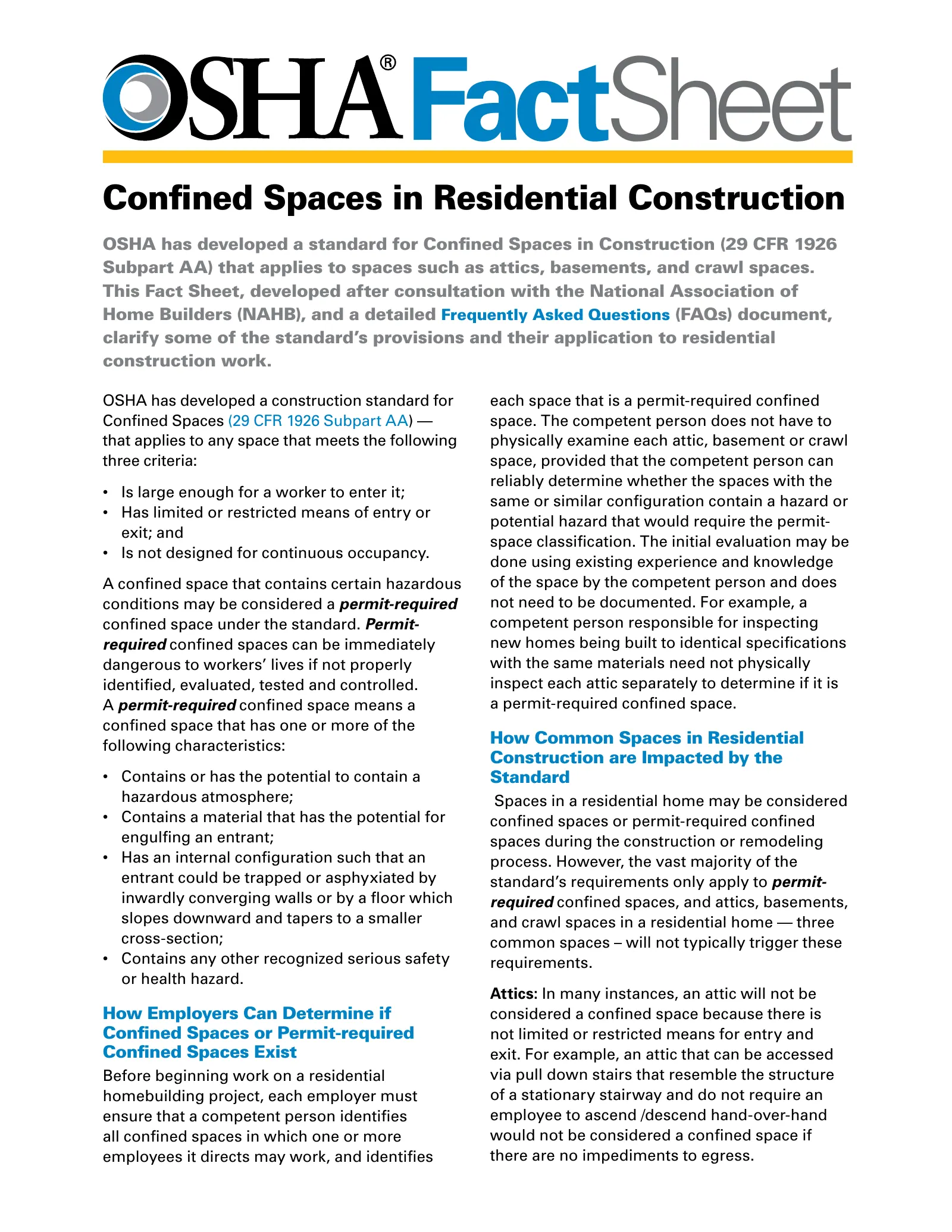
Confined Spaces in Residential Construction Fact Sheet (OSHA 3914)
OSHA fact sheet on attics, crawl spaces and other residential confined spaces.
Page text
· 3 pages · by U.S. Department of Labor, OSHA
The words on each page as the author wrote them, read from the file by software so they can be searched. Layout, pictures and tables are not shown here: the pages above and the download are the original.
- Page 1
FactSheet
- Confined Spaces in Residential Construction
- OSHA has developed a standard for Confined Spaces in Construction (29 CFR 1926 Subpart AA) that applies to spaces such as attics, basements, and crawl spaces. This Fact Sheet, developed after consultation with the National Association of Home Builders (NAHB), and a detailed Frequently Asked Questions (FAQs) document, clarify some of the standard’s provisions and their application to residential construction work.
- OSHA has developed a construction standard for Confined Spaces (29 CFR 1926 Subpart AA) — that applies to any space that meets the following three criteria:
- Is large enough for a worker to enter it;
- Has limited or restricted means of entry or exit; and
- Is not designed for continuous occupancy.
- A confined space that contains certain hazardous conditions may be considered a permit-required confined space under the standard. Permitrequired confined spaces can be immediately dangerous to workers’ lives if not properly identified, evaluated, tested and controlled.
- A permit-required confined space means a confined space that has one or more of the following characteristics:
- Contains or has the potential to contain a hazardous atmosphere;
- Contains a material that has the potential for engulfing an entrant;
- Has an internal configuration such that an entrant could be trapped or asphyxiated by inwardly converging walls or by a floor which slopes downward and tapers to a smaller cross-section;
- Contains any other recognized serious safety or health hazard.
- How Employers Can Determine if
- Confined Spaces or Permit-required
- Confined Spaces Exist
- Before beginning work on a residential homebuilding project, each employer must ensure that a competent person identifies all confined spaces in which one or more employees it directs may work, and identifies each space that is a permit-required confined space. The competent person does not have to physically examine each attic, basement or crawl space, provided that the competent person can reliably determine whether the spaces with the same or similar configuration contain a hazard or potential hazard that would require the permitspace classification. The initial evaluation may be done using existing experience and knowledge of the space by the competent person and does not need to be documented. For example, a competent person responsible for inspecting new homes being built to identical specifications with the same materials need not physically inspect each attic separately to determine if it is a permit-required confined space.
- How Common Spaces in Residential
- Construction are Impacted by the Standard
- Spaces in a residential home may be considered confined spaces or permit-required confined spaces during the construction or remodeling process. However, the vast majority of the standard’s requirements only apply to permitrequired confined spaces, and attics, basements, and crawl spaces in a residential home — three common spaces – will not typically trigger these requirements.
- Attics: In many instances, an attic will not be considered a confined space because there is not limited or restricted means for entry and exit. For example, an attic that can be accessed via pull down stairs that resemble the structure of a stationary stairway and do not require an employee to ascend /descend hand-over-hand would not be considered a confined space if there are no impediments to egress.
- Page 2
- Attics that are determined to be confined spaces would generally not be permit-required confined spaces because they typically do not contain the types of hazards or potential hazards that make a confined space a permit-required confined space (those that could impair an entrant’s ability to exist the space without assistance).
- However, extreme heat in an attic can be considered a serious physical hazard such that the attic could be considered permit-required confined space. OSHA has not quantified how hot it must be to trigger the permit-required confined spaces requirements. However, heat that is extreme enough to cause heat exhaustion (e.g., dizziness, headaches, severe sweating, cramps) may impede an entrant’s ability to exit the attic without assistance and would make a confined space permit-required.
- Basements: Basements in a residential home that are designed for continuous occupancy by a homeowner are not considered confined spaces under the standard, provided the basement is configured as designed (e.g., has permanent stairs, a walk-out entry/exit, or an egress window installed).
- Crawl Spaces: Crawl spaces in a residential home will not typically trigger the majority of the requirements of the standard unless they contain a physical hazard such as an exposed active electric wire.
- For Employers
- Regardless of the area, the competent person needs to pay particular attention to acute health hazards that may be present when assessing confined spaces, such as toxic (carbon monoxide), flammable, or explosive atmospheres. Safety Data Sheets (SDSs) must be maintained and reviewed to fully assess potential hazards prior to worker entry into a confined space to determine whether it is a permit-required space.
- owns or manages the property, then it is both a controlling employer and a host employer).
- Entry employer (Sub Contractor): Any employer who decides that an employee it directs will enter a permit-required confined space.
- The standard makes the controlling contractor the primary point of contact for information about permit-required confined spaces at the work site. The controlling contractor passes information it has about permit-required confined spaces at the work site on to the employers whose workers will enter the spaces (entry employers).
- Likewise, entry employers must give the controlling contractor information about their entry program and hazards they encounter in the space, and the controlling contractor passes that information on to other entry employers. The controlling contractor is also responsible for making sure that employers outside a space know not to create hazards in the space, and that workers from different entry employers working in a space at the same time do not create hazards for each other.
- Host/Controlling Employer Obligations
- Before entry operations begin, a host employer with the following information must provide it to the controlling contractor:
- Location of each known permit-required confined space;
- Hazards or potential hazards in each space or the reason it is a permit-required confined space; and
- Any precautions that the host employer or any previous controlling contractor/entry employer implemented for the protection of workers in the permit-required confined space.
- Employers’ obligations under the standard will depend, in part, on what “type” of employer they are. However, most of the obligations in the standard apply to entry employers.
- Host employer: The employer who owns or manages the property where the construction work is taking place.
- Controlling contractor: The employer who has overall responsibility for construction at the worksite (note that if the controlling contractor
- Note: The above diagram shows the information flow and coordination between these employers
- Page 3
- The multi-employer communication requirements only apply to host employers with employees who work at the worksite, regardless of when those workers are at the site and only apply to permit-required confined spaces. In addition, beyond this duties discussed above, host employers and controlling contractors are not responsible for compliance with the permitrequired confined space program provisions of the standard if they have no reason to anticipate that the employees they direct will enter a permit-required confined space.
- Training: The standard requires employers to ensure that their workers know about the existence and location of, and dangers posed by, each permit-required confined space, and that they may not enter such spaces without authorization. Entry employers must train workers involved in permitrequired confined space operations so that they can perform their duties safely and understand the hazards in permit spaces and the methods used to isolate, control or protect workers. Workers not authorized to perform entry rescues must be trained on the dangers of attempting such rescues.
- Entry Employer Obligations
- Written permit-required confined space entry program: The permit-required confined space program must establish a system for preparing, using, and canceling entry permits, which are written or printed documents that allow and control entry into permit spaces.
- Inform employees: If a workplace contains a permit-required confined space, the entry employer must inform workers in the vicinity of each space of the location and danger posed by that space. This can be done by posting and positioning warning signs at each possible point of entry, or by other equally effective means. The employer must also either take steps to prevent its employees from entering that space or ensure that entry only occurs through a permit program or as otherwise allowed by the standard (alternative entry procedures).
- Personal Protective Equipment: Entry employers allowing an employee to enter a permit space must attempt to eliminate or isolate the hazards in the space. When engineering and workpractice controls do not adequately protect employees, they must assess the space to determine what personal protective equipment (PPE) is needed to protect workers. Entry employers must provide workers with the required PPE and proper training on its use and about any related hazards before the work starts.
- Rescue: Entry employers must ensure that properly trained rescue and emergency services are available before entry into permit-required confined spaces. For a full discussion of an entry employer’s obligations to provide rescue, see OSHA’s Fact Sheet entitled: Is 911 your Confined Space Rescue Plan?
- Resources
- For additional information see OSHA’s
- Confined Spaces in Construction webpage at www.osha.gov/confinedspaces.
- How to Contact OSHA
- For questions or to get information or advice, to find out how to contact OSHA’s free on-site consultation program, order publications, report a fatality or severe injury, or to file a confidential complaint, visit www.osha.gov or call 1-800-321- OSHA (6742).
- This fact sheet was developed by OSHA after consultation with NAHB. It does not impose any new compliance requirements. For a comprehensive list of compliance requirements of OSHA standards or regulations, refer to Title 29 of the Code of Federal Regulations. This information will be made available to sensory-impaired individuals upon request. The voice phone is (202) 693-1999; teletypewriter (TTY) number: 1-877-889-5627.
- DOC FS-3914 06/2017
More on Confined Spaces
pptx
59 slidesConfined Spaces Hazards in Construction
Confined space hazards under the construction confined space rule (Subpart AA), from Western Iowa Tech Community College.
Western Iowa Technical Community CollegeOSHA Harwood grant
pptx
87 slidesConfined Spaces
Construction confined space awareness from Workers Defense Project.
Workers Defense ProjectOSHA Harwood grant

pptx
66 slidesConfined Space Entry Training
Confined space entry training for water/wastewater utility and construction workers from the Alaska Native Tribal Health Consortium.
The Alaska Native Tribal Health ConsortiumOSHA Harwood grant