1 / 3Use ← → to flip
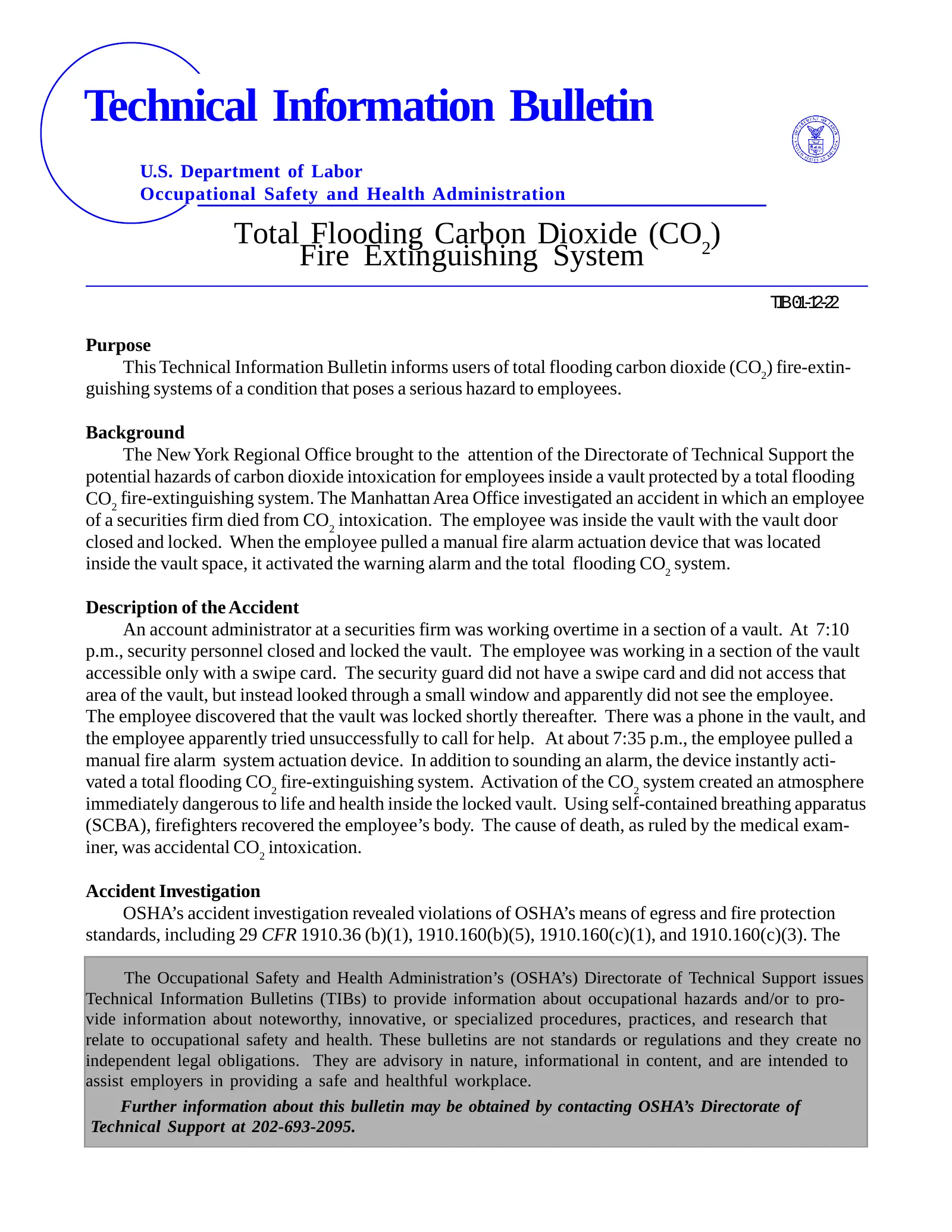
Total Flooding Carbon Dioxide (CO2) Fire Extinguishing System (OSHA TIB 12-22-2001)
OSHA fact sheet or bulletin, for General Industry classes.
Page text
· 3 pages · by U.S. Department of Labor, OSHA
The words on each page as the author wrote them, read from the file by software so they can be searched. Layout, pictures and tables are not shown here: the pages above and the download are the original.
- Page 1
Technical Information Bulletin
- U.S. Department of Labor
- Occupational Safety and Health Administration
- Total Flooding Carbon Dioxide (CO 2 )
- Fire Extinguishing System
- TIB 01-12-22
- Purpose
- This Technical Information Bulletin informs users of total flooding carbon dioxide (CO 2 ) fire-extin-
- guishing systems of a condition that poses a serious hazard to employees.
- Background
- The New York Regional Office brought to the attention of the Directorate of Technical Support the potential hazards of carbon dioxide intoxication for employees inside a vault protected by a total flooding
- CO 2 fire-extinguishing system. The Manhattan Area Office investigated an accident in which an employee of a securities firm died from CO 2 intoxication. The employee was inside the vault with the vault door
- closed and locked. When the employee pulled a manual fire alarm actuation device that was located
- inside the vault space, it activated the warning alarm and the total flooding CO 2 system.
- Description of the Accident
- An account administrator at a securities firm was working overtime in a section of a vault. At 7:10 p.m., security personnel closed and locked the vault. The employee was working in a section of the vault accessible only with a swipe card. The security guard did not have a swipe card and did not access that area of the vault, but instead looked through a small window and apparently did not see the employee. The employee discovered that the vault was locked shortly thereafter. There was a phone in the vault, and the employee apparently tried unsuccessfully to call for help. At about 7:35 p.m., the employee pulled a manual fire alarm system actuation device. In addition to sounding an alarm, the device instantly acti-
- vated a total flooding CO 2 fire-extinguishing system. Activation of the CO 2 system created an atmosphere
- immediately dangerous to life and health inside the locked vault. Using self-contained breathing apparatus (SCBA), firefighters recovered the employee’s body. The cause of death, as ruled by the medical exam-
- iner, was accidental CO 2 intoxication.
- Accident Investigation
- OSHA’s accident investigation revealed violations of OSHA’s means of egress and fire protection standards, including 29 CFR 1910.36 (b)(1), 1910.160(b)(5), 1910.160(c)(1), and 1910.160(c)(3). The
- The Occupational Safety and Health Administration’s (OSHA’s) Directorate of Technical Support issues Technical Information Bulletins (TIBs) to provide information about occupational hazards and/or to provide information about noteworthy, innovative, or specialized procedures, practices, and research that relate to occupational safety and health. These bulletins are not standards or regulations and they create no independent legal obligations. They are advisory in nature, informational in content, and are intended to assist employers in providing a safe and healthful workplace.
- Further information about this bulletin may be obtained by contacting OSHA’s Directorate of Technical Support at 202-693-2095.
- Page 2
case in this accident, there is an immediate discharge of the CO 2 .
- National Fire Protection Association (NFPA) standard on carbon dioxide extinguishing systems (NFPA- 12, 2000) also addresses these conditions.
- The investigation found that the extinguishing system was interlocked with the vault door. The system would only discharge if the door was shut. The manual pull station was located inside the vault. Pulling
- the device with the door open sounds the alarm; however, no CO 2 is discharged until the vault door is
- closed. There were no warning signs at the entrance to the vault indicating the hazard of the total flooding
- CO 2 system. There also was no label on the pull station to indicate that once activated, there would be a discharge of total flooding CO 2 into the vault and to describe the resultant hazard to personnel.
- The employer explained that the system’s configuration was intended to permit employees to pull the manual actuation device, exit the vault, and close the door behind them. The employer further explained that the pull station was installed inside the space to prevent employees from activating the system while others were in the vault. However, if the manual station is pulled when the door is already shut, as was the
- The NFPA-12, 2000 standard requires that the normal manual controls for the CO 2 system actuation
- be located for easy accessibility at all times, including the time of fire. It does not specify whether the location should be inside or outside of the protected space. The 18 th edition of the NFPA Fire Protection Handbook requires that the manual controls be located to avoid confusion, and they must be clearly
- labeled with safe operating procedures. However, it also contains schematics for a total flooding CO 2
- system that depict the manual actuation device outside of the protected space and next to the entrance. During the rescue operation, a problem arose when the fire department needed quick access to the vault space. Firefighters were unable to execute a rescue until a securities firm employee was able to open the vault door.
- Conclusions
- The employer did not meet the requirements of 29 CFR 1910.160 and NFPA-12 standards that require: a warning be posted at the entrance to the vault space, as well as inside the vault, regarding the
- function of the total flooding CO 2 system and its hazards to personnel; warning signs be posted at the manual actuation station to warn employees about the hazards associated with the total flooding CO 2
- system; employees who work inside vault spaces be trained with respect to the potential hazard in the protected spaces and the proper safety precautions to be observed before manually actuating the system. Further, the employer did not provide an emergency action plan in accordance with 29 CFR 1910.38, and did not provide a pre-discharge employee alarm in accordance with 29 CFR 1910.160 that complies with 29 CFR 1910.165. Finally, NFPA-12, 2000 requires, in part, that means be provided for the “prompt rescue of any trapped personnel.” The employer failed to meet this requirement.
- Recommendations
- Fixed CO 2 extinguishing systems should be installed and maintained in accordance with NFPA-12,
- 2000 standards.
- Equip the pull station device, installed inside a vault, with a control circuit to ensure that actuating the
- pull station will initiate activation of the CO 2 fire-extinguishing system only if the vault door is open at the time of actuation and that no discharge of CO 2 will occur until the vault door is subsequently closed.
- In addition, the control circuit should disable the manual pull station from activating the extinguishing system if the vault door is already closed.
- Ensure that employees have safe and readily available means of evacuation. In unique situations, such as those associated with vaults, alternative protective means such as an emergency intercom system, sign-in log, video or manual-surveillance, and a procedure to ensure that all other employees have cleared all vault spaces before actuating the alarm and fire-extinguishing system and before closing the vault doors, should be communicated, implemented, and followed.
- Page 3
systems which can present CO 2 intoxication and suffocation hazards to employees.
- Post emergency numbers near vault and enclosed space telephones.
- Install signs at the entrance to and inside the protected space indicating the presence of extinguishing
- Properly mark/label pull stations and other actuation devices to indicate their function and the potential hazard to personnel.
- Insure that total flooding systems have a pre-discharge alarm which provides employees with sufficient time to safely exit the space.
- Train all employees with respect to: the type of systems installed in the workplace, the hazards involved, proper activation in case of emergency, and the correct response to audible and visual pre-discharge alarms. Provide training for non-English speaking employees in languages understood by the affected employees and other individuals that may be exposed to the hazard.
- Provide a system or device that can be secured in the closed position to prevent accidental or deliberate discharge when persons not familiar with the system (outside vendors and contractors) and its operation are present in a protected space.
- 29 CFR 1910.160(b)(6) requires annual inspection to check that the system is maintained in good operating condition. We also recommend inspection of the system for compliance with NFPA and OSHA requirements.
- If the total flooding CO 2 extinguishing systems are installed by employers to meet a particular OSHA
- standard, employers must:
- comply with provisions of 29 CFR 1910.162, Fixed extinguishing systems, gaseous agent;
- comply with provisions of 29 CFR 1910.160, Fixed extinguishing systems, general. Among the requirements in this standard is the obligation in Paragraph 29 CFR 1910.160 (b)(17) that requires employers to, “provide and assure the use of PPE needed for immediate rescue.” Employers will need to designate and train individuals how to properly wear an SCBA and perform rescue.
- Additional Information
- NFPA-12, Section 1-6, Personnel Safety, contains requirements to protect personnel.
- NFPA-12, Appendix A-1-6, “The steps and safeguards necessary to prevent injury or death to personnel in areas whose atmospheres will be made hazardous by the discharge of carbon dioxide … ” is not a part of the requirements of NFPA-12. It is presented for informational purposes only. However, the appendix includes provisions which can be used to safeguard personnel and prevent injury or death.
- U.S. Environmental Protection Agency report, “Carbon Dioxide as a Fire Suppressant: Examining the
- Risks,” contains valuable information for raising awareness and promoting the responsible use of CO 2
- fire suppression systems. See http://www.epa.gov.
More on Exit Routes & Fire
pptx
54 slidesExit Routes, Emergency Action Plans, Fire Prevention Plans, and Fire Protection (OSHA 10-Hour General Industry Outreach)
OSHA's general industry outreach deck on exits, emergency plans, fire prevention and extinguishers (2017); adapt for construction sites.
U.S. Department of Labor, OSHAPublic domain
pdf
15 slidesExit Routes, Emergency Action Plans, Fire Prevention Plans, and Fire Protection: Lesson Plan (OSHA 10-Hour General Industry Outreach)
Instructor lesson plan (objectives, timing, teaching steps) for the OSHA General Industry exit routes, emergency action plans, fire prevention plans, and fire protection outreach deck.
U.S. Department of Labor, OSHA (with the OTIEC Outreach Workgroup)Public domain
pdf
2 slidesExit Routes, Emergency Action Plans, Fire Prevention Plans, and Fire Protection: Knowledge Check (OSHA 10-Hour General Industry Outreach)
Student knowledge-check quiz for the OSHA General Industry exit routes, emergency action plans, fire prevention plans, and fire protection outreach deck.
U.S. Department of Labor, OSHA (with the OTIEC Outreach Workgroup)Public domain