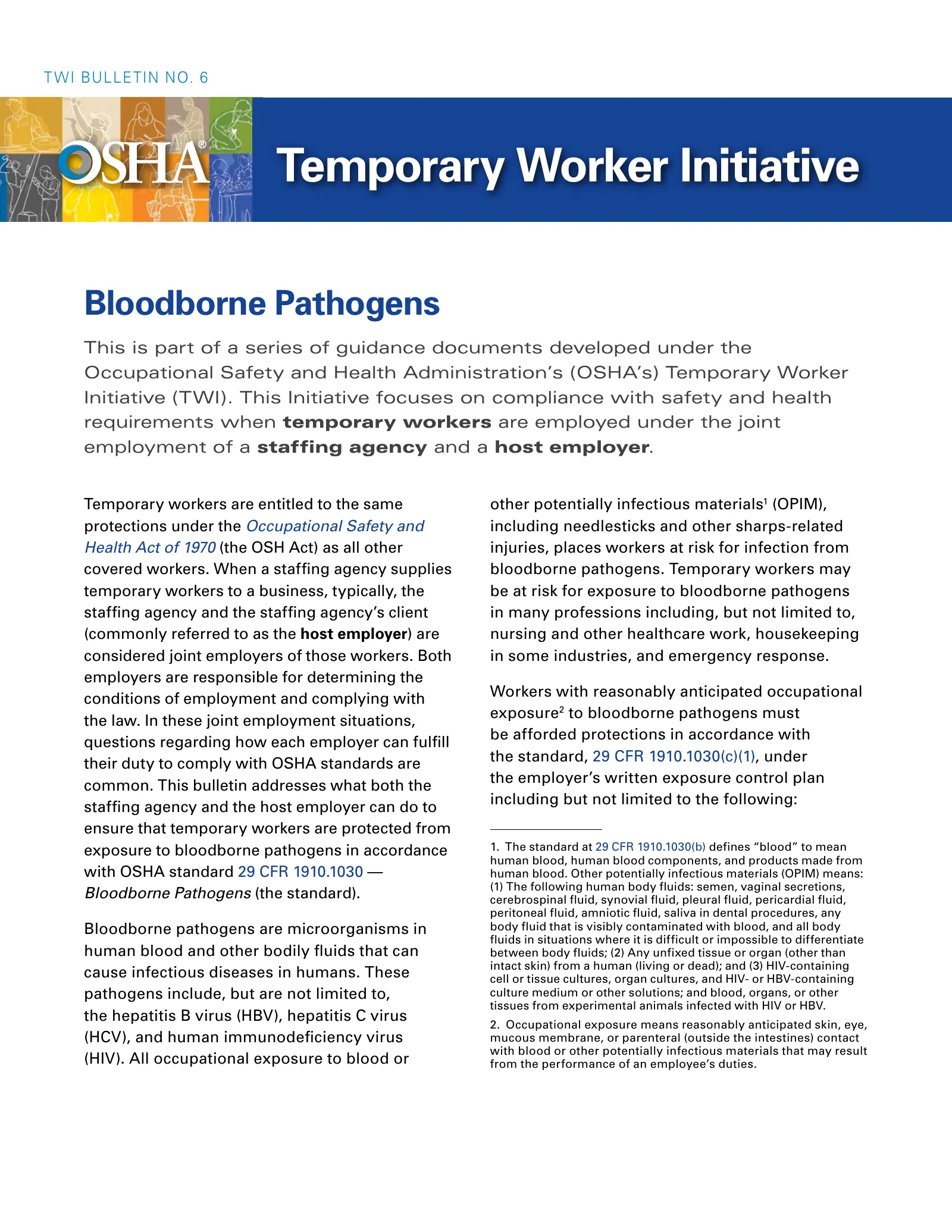
1 / 4Use ← → to flip
Temporary Worker Initiative (TWI) Bulletin No. 6 - Bloodborne Pathogens (OSHA 3888)
OSHA fact sheet or bulletin, for General Industry classes.
Page text
· 4 pages · by U.S. Department of Labor, OSHA
The words on each page as the author wrote them, read from the file by software so they can be searched. Layout, pictures and tables are not shown here: the pages above and the download are the original.
- Page 1
Temporary Worker Initiative
- T WI BULLETIN NO. 6
- Bloodborne Pathogens
- This is part of a series of guidance documents developed under the Occupational Safety and Health Administration’s (OSHA’s) Temporary Worker Initiative (TWI). This Initiative focuses on compliance with safety and health requirements when temporary workers are employed under the joint employment of a staffing agency and a host employer.
- Temporary workers are entitled to the same protections under the Occupational Safety and Health Act of 1970 (the OSH Act) as all other covered workers. When a staffing agency supplies temporary workers to a business, typically, the staffing agency and the staffing agency’s client (commonly referred to as the host employer) are considered joint employers of those workers. Both employers are responsible for determining the conditions of employment and complying with the law. In these joint employment situations, questions regarding how each employer can fulfill their duty to comply with OSHA standards are common. This bulletin addresses what both the staffing agency and the host employer can do to ensure that temporary workers are protected from exposure to bloodborne pathogens in accordance with OSHA standard 29 CFR 1910.1030 — Bloodborne Pathogens (the standard).
- Bloodborne pathogens are microorganisms in human blood and other bodily fluids that can cause infectious diseases in humans. These pathogens include, but are not limited to, the hepatitis B virus (HBV), hepatitis C virus (HCV), and human immunodeficiency virus (HIV). All occupational exposure to blood or other potentially infectious materials 1 (OPIM), including needlesticks and other sharps-related injuries, places workers at risk for infection from bloodborne pathogens. Temporary workers may be at risk for exposure to bloodborne pathogens in many professions including, but not limited to, nursing and other healthcare work, housekeeping in some industries, and emergency response.
- Workers with reasonably anticipated occupational exposure 2 to bloodborne pathogens must be afforded protections in accordance with the standard, 29 CFR 1910.1030(c)(1), under the employer’s written exposure control plan including but not limited to the following:
- 1. The standard at 29 CFR 1910.1030(b) defines “blood” to mean human blood, human blood components, and products made from human blood. Other potentially infectious materials (OPIM) means:
- (1) The following human body fluids: semen, vaginal secretions, cerebrospinal fluid, synovial fluid, pleural fluid, pericardial fluid, peritoneal fluid, amniotic fluid, saliva in dental procedures, any body fluid that is visibly contaminated with blood, and all body fluids in situations where it is difficult or impossible to differentiate between body fluids; (2) Any unfixed tissue or organ (other than intact skin) from a human (living or dead); and (3) HIV-containing cell or tissue cultures, organ cultures, and HIV- or HBV-containing culture medium or other solutions; and blood, organs, or other tissues from experimental animals infected with HIV or HBV.
- 2. Occupational exposure means reasonably anticipated skin, eye, mucous membrane, or parenteral (outside the intestines) contact with blood or other potentially infectious materials that may result from the performance of an employee’s duties.
- Page 2
Staffing Agency Responsibilities
- Exposure determination;
- Universal precautions, engineering and work practice controls, personal protective equipment, and housekeeping;
- Procedures for HIV and HBV research laboratories and production facilities if applicable;
- Hepatitis B vaccination and post-exposure follow-up;
- Procedures for evaluating circumstances surrounding an exposure incident;
- Communication of hazards including information and training; and
- Recordkeeping, including a sharps injury log if applicable.
- In addition, the employer who has day-to-day supervision over the temporary workers, typically the host employer, is required to maintain a log of occupational injuries and illnesses under
- 29 CFR 1904 3 and to record injuries and illnesses of temporary workers on that log. The Bloodborne
- Pathogens standard requires that this employer must also maintain a sharps injury log for the recording of percutaneous (through the skin) injuries from contaminated sharps and to record such injuries occurring to temporary workers on that log.
- The host employer must communicate and coordinate with the staffing agency to ensure compliance with the standard’s provisions, particularly regarding post-exposure evaluation and follow-up. It is also the host employer’s obligation to take reasonable measures to ensure that the staffing agency has complied with its responsibilities for hepatitis B vaccination, postexposure evaluation and follow-up, medical and training records retention, and generic training.
- As joint employers, both the host and the staffing agency are responsible for ensuring that the temporary employee is properly protected against bloodborne pathogens. However, the employers may decide that a division of the compliance responsibility may be appropriate. In doing so, the staffing agency and host employer should jointly review the task assignments and job hazards to include temporary workers in an exposure control plan. The details of the protections to be provided can be clearly established in the contract language between the employers. While the employers may agree to divide responsibilities, neither employer may avoid its ultimate responsibilities under the OSH Act by shifting responsibilities to the other employer.
- The staffing agency whose employees have reasonably anticipated occupational exposure to blood or OPIM is responsible for providing generic bloodborne pathogen information and training, ensuring that the temporary workers are provided with the required vaccinations and followup, providing proper post-exposure evaluation and follow-up after an exposure incident, and retaining applicable medical and training records in accordance with 1910.1030(h). The staffing agency is also responsible for (1) violations occurring at the workplace about which the staffing agency actually knew and where the staffing agency failed to take reasonable steps to have the host employer correct the violation and (2) pervasive serious violations occurring at the workplace about which the staffing agency could have known with the exercise of reasonable diligence. See OSHA Directive,
- CPL 02-02-069, Enforcement Procedures for the Occupational Exposure to Bloodborne Pathogens, paragraph XI.B, Personnel Services.
- Host Employer Responsibilities
- Generally, the host employer has the primary responsibility for developing and implementing a written exposure control plan at the worksite because the host employer creates and controls the work processes at the facility and is most familiar with tasks having the potential for occupational exposure to bloodborne pathogens. The host employer is also typically responsible for providing site-specific bloodborne pathogens training and personal protective equipment, which should be equivalent to that given to the host’s own employees in the same job classifications. The host employer also has the primary responsibility for controlling hazardous conditions at its worksite, including ensuring that engineering and work practice controls, such as sharp injury protections, are in place.
- 3. www.osha.gov/temp_workers/OSHA_TWI_Bulletin.pdf
- Page 3
Example Scenario *
- An urban out-patient surgical center, Eastern SC, Inc. (ESC) needs housekeeping workers to clean (e.g., change linens, empty trash) and resupply surgical suites and recovery rooms during an exceptionally busy period of the year. The company contracts with a personnel service, HKMed Staffing, which employs medical care staff and service employees. These employees are assigned to work at hospitals and other healthcare facilities to perform housekeeping duties. Compliance with safety and health requirements is mentioned in HKMed’s contract with ESC, including coverage for the temporary workers under both ESC’s and HKMed’s bloodborne pathogens exposure control plans. The contract states that HKMed will provide temporary workers who have hepatitis B vaccinations and basic bloodborne pathogens training and that ESC will provide site-specific bloodborne pathogens training, work practice and engineering controls, and personal protective equipment to those temporary workers.
- HKMed assigns five temporary workers to ESC. Before sending the workers to the ESC worksite, the staffing agency plays a generic bloodborne pathogens training video for them that includes general information on hazards associated with blood and OPIM, information on the hepatitis B vaccinations, and what to do should an exposure incident occur. A question and answer period is also included in the training. In addition, HKMed ensures that each worker is offered or has had the hepatitis B vaccination series.
- At the worksite, the ESC human resources representative assigns the temporary workers to the surgical and recovery areas to clean the rooms, including changing linen and restocking. The workers are provided with limited site-specific training. They are not provided with an explanation of ESC’s exposure control plan, but are shown where to access housekeeping and general medical supplies, where to access regulated waste containers for waste containing visible blood, and where the sharps containers are located for the disposal of used needles. They are instructed not to handle any sharps containers and to notify one of the nurses if a sharps container is full. Utility gloves and appropriate disinfecting and cleaning supplies are made available to the workers in the supply area.
- A temporary worker mentions to the ESC human resources representative that oftentimes the sharps containers are full and that used sharps are sometimes found on top of the container and around patient areas. The ESC human resources representative tells the worker that the center is understaffed and she will look into it. The worker also notifies his HKMed supervisor of this situation. HKMed tells the worker to be careful. A week after the notification, one of the temporary workers experiences a needlestick while placing a used needle found in dirty bed linens into an overflowing sharps container. ESC immediately recorded the incident on the needlestick injury log and notified HKMed. HKMed sent the worker for post-exposure evaluation and follow-up.
- Analysis
- Eastern SC and HKMed have a joint responsibility to ensure that the temporary workers are protected from occupational exposure to blood and OPIM. Since ESC controls the worksite, it is responsible for controlling occupational exposure to blood and OPIM by considering and using safer medical devices, ensuring sharps are properly disposed, and ensuring that used sharps containers are properly maintained. ESC also must provide site-specific bloodborne pathogens training, which in this scenario was inadequate. ESC may be subject to OSHA citations under the methods of compliance, housekeeping, and information and training sections of the
- Page 4
State Plans
- standard. HKMed also has a responsibility to take reasonable steps to ensure the protection of its workers, particularly after being notified about problems with the disposal of sharps. HKMed should have contacted ESC to discuss its concerns and remedy the situation. Thus, HKMed may also be subject to OSHA citations under the housekeeping section of the standard.
- Both employers took some appropriate actions with respect to the needlestick injury. Prior to starting the work, HKMed ensured that the workers were vaccinated for hepatitis B and provided generic bloodborne pathogens training. Also, HKMed ensured that the injured worker was immediately provided post-exposure evaluation and follow-up. In addition, ESC appropriately recorded the incident on the needlestick injury log.
- *The company names used in this scenario are fictitious. Any resemblance to real companies is entirely coincidental.
- Twenty-eight states and U.S. territories have their own OSHA-approved occupational safety and health programs called State Plans. State Plans have and enforce their own occupational safety and health standards that are required to be at least as effective as OSHA’s, but may have different or additional requirements. A list of the State Plans and more information is available at www.osha.gov/dcsp/osp.
- How Can OSHA Help?
- Workers have a right to a safe workplace. If you think your job is unsafe or you have questions, contact OSHA at 1-800-321-OSHA (6742). It’s confidential. We can help. For other valuable worker protection information, such as Workers’ Rights, Employer Responsibilities and other services OSHA offers, visit OSHA’s Workers’ page at www.osha.gov/workers.
- For information on Temporary Workers visit
- OSHA’s Temporary Workers’ page at www.osha.gov/temp_workers.
- The OSH Act prohibits employers from retaliating against their employees for exercising their rights under the OSH Act. These rights include raising a workplace health and safety concern with the employer, reporting an injury or illness, filing an OSHA complaint, and participating in an inspection or talking to an inspector. If workers have been retaliated or discriminated against for exercising their rights, they must file a complaint with OSHA within 30 days of the alleged adverse action to preserve their rights under section 11(c). For more information, please visit www.whistleblowers.gov.
- OSHA also provides help to employers. OSHA’s On-site Consultation Program offers free and confidential occupational safety and health services to small and medium-sized businesses in all states and several territories, with priority given to high-hazard worksites. On-site Consultation services are separate from enforcement and do not result in penalties or citations. Consultants from state agencies or universities work with employers to identify workplace hazards, provide advice on compliance with OSHA standards, and assist in establishing and improving safety and health management systems. To locate the OSHA On-site Consultation Program nearest you, call 1-800-321- 6742 (OSHA) or visit www.osha.gov/consultation.
- For more information
- Occupational
- Safety and Health
- Administration
- www.osha.gov (800) 321-OSHA (6742)
- U.S. Department of Labor
- OSHA 3888-09 2016
- Disclaimer: This bulletin is not a standard or regulation, and it creates no new legal obligations. It contains recommendations as well as descriptions of mandatory safety and health standards. The recommendations are advisory in nature, informational in content, and are intended to assist employers in providing a safe and healthful workplace. The Occupational Safety and Health Act requires employers to comply with safety and health standards and regulations promulgated by OSHA or by a state with an OSHA-approved state plan. In addition, the OSH Act’s General Duty Clause, Section 5(a)(1), requires employers to provide their employees with a workplace free from recognized hazards likely to cause death or serious physical harm.
More on Bloodborne Pathogens
pptx
44 slidesBloodborne Pathogens (OSHA 10-Hour General Industry Outreach)
OSHA's own 10-hour General Industry Outreach deck on bloodborne pathogens (v. 03-01-17), editable PowerPoint with trainer notes.
U.S. Department of Labor, OSHA (with the OTIEC Outreach Workgroup)Public domain
pdf
10 slidesBloodborne Pathogens: Lesson Plan (OSHA 10-Hour General Industry Outreach)
Instructor lesson plan (objectives, timing, teaching steps) for the OSHA General Industry bloodborne pathogens outreach deck.
U.S. Department of Labor, OSHA (with the OTIEC Outreach Workgroup)Public domain
pdf
2 slidesBloodborne Pathogens: Knowledge Check (OSHA 10-Hour General Industry Outreach)
Student knowledge-check quiz for the OSHA General Industry bloodborne pathogens outreach deck.
U.S. Department of Labor, OSHA (with the OTIEC Outreach Workgroup)Public domain