1 / 10Use ← → to flip
Bloodborne Pathogens: Lesson Plan (OSHA 10-Hour General Industry Outreach)
Instructor lesson plan (objectives, timing, teaching steps) for the OSHA General Industry bloodborne pathogens outreach deck.
Page text
· 10 pages · by U.S. Department of Labor, OSHA (with the OTIEC Outreach Workgroup)
The words on each page as the author wrote them, read from the file by software so they can be searched. Layout, pictures and tables are not shown here: the pages above and the download are the original.
- Page 1
IDENTIFICATION
- TOPIC TITLE: ___Bloodborne Pathogens___
- MINIMUM TIME: __30 minutes___
- OBJECTIVES
- Terminal Objective:
- Given current OSHA and industry information regarding general industry worksite i llnesses, injuries, and/or fatalities, the student will be a ble t o recognize how to protect themselves fr om hazards a ssociated with bloodborne pathogens.
- Enabling Objectives:
- 1. Define bloodborne pathogens.
- 2. Identify workers who are at risk of exposure to bloodborne pathogens.
- 3. Identify key aspects of a Bloodborne Pathogen Exposure Control Plan.
- 4. Describe methods for controlling exposure to bloodborne pathogens.
- 5. Describe steps to take when exposed to a bloodborne pathogen.
- INSTRUCTOR MATERIALS AND RESOURCES
- PowerPoint presentation: Bloodborne Pathogens
- Knowledge Check Answer Key: Bloodborne Pathogens
- STUDENT MATERIALS
- OSHA Fact Sheet: OSHA’s Bloodborne Pathogens Standard Knowledge Check: Bloodborne Pathogens
- Page 2
TEACHING PROCEDURES ---Preparation, Presentation, Application, Evaluation
- Anticipatory Set (Focus Attention/Gain Interest)
- Estimated Time: ?? ho urs
- Key Points
- Methods
- In 2014, an outbreak of Ebola Virus Disease (EVD), formerly known as Ebola Hemorrhagic Fever (EHF), brought worldwide attention to concerns about a global epidemic. EHF is an example of a bloodborne pathogen that is a severe and often deadly disease. As stated by OSHA, “currently, most workers in the U.S. are unlikely to encounter Ebola virus or individuals with Ebola Hemorrhagic Fever (EHF).” However, Ebola is not the only bloodborne pathogen to which occupational exposure is a potential risk.
- Slides #1 - #3
- In 1981, the HIV/AIDs epidemic breaks out in the U.S; by 2013, more than 1.2 million people were living with HIV.
- https://npin.cdc.gov/pages/hiv-and-aidstimeline#1980
- In 2016, an outbreak of the Zika virus was reported and, as of February 8, 2017, a total of 5,001 cases have been reported in the United States.
- The CDC estimates that 5.6 million workers in the healthcare industry and related occupations are at risk of occupational exposure to bloodborne pathogens, including human immunodeficiency virus (HIV), hepatitis B virus (HBV), hepatitis C virus (HCV), and others. All occupational exposure to blood or other potentially infectious materials (OPIM) places workers at risk for infection from bloodborne pathogens.
- Presentation (Instruction)___
- Key Points
- I.
- What are bloodborne pathogens?
- A. OSHA’s definition [29 CFR 1910.1030(b)]
- 1. “Pathogenic microorganisms that are present in human blood and can cause disease in humans.” https://www.osha.gov/SLTC/bloodbornepathogens/recognition.html https://www.cdc.gov/zika/geo/unitedstates.html
- Methods
- Instructor-led discussions
- Slides #4 - #9
- 2. “These pathogens include, but are not limited to Hepatitis B Virus (HBV) and Human Immunodeficiency Virus (HIV).”
- Page 3
B. Bloodborne pathogens of primary concern:
- http://www.cdc.gov/DiseasesConditions/az/a.ht ml
- 1. Hepatitis B Virus (HBV)
- a. Causes serious liver disease (Hepatitis B), which can become a chronic condition that causes permanent scarring of liver, leading to liver failure or liver cancer; estimated 2,000-4,000 deaths per year in U.S.
- b. Symptoms: fever, fatigue, loss of appetite, nausea, vomiting, abdominal pain, dark urine, joint pain, jaundice
- c. HBV is much more transmissible than HIV; risk of infection from single needlestick is 6%-30% (CDC 1997)
- d. 50% of infected people are unaware that they have HBV
- e. HBV can survive for at least one week in dried blood on environmental surfaces or contaminated needles and instruments
- 2. Hepatitis C Virus (HCV)
- a. Causes chronic illness (Hepatitis C); attacks the liver and leads to inflammation; chronic infection develops in 75%-85% of patients, with 70% developing active liver disease (CDC n.d.); can result in long-term health problems, even death
- c. Approximately 3.2 million people infected in U.S.; most have no symptoms and don’t know they are infected until decades later when liver damage shows up in routine tests.
- 3. Human Immunodeficiency Virus (HIV)
- a. Causes Acquired Immunodeficiency Syndrome (AIDS); attacks the immune system cells, weakening and eventually destroying the immune system, and, thus, leaving the body at higher risk of developing more serious conditions such as pneumonia or cancer; nearly 7,000 people died from HIV/AIDS in U.S. in 2013
- b. Estimated that more than 1.1 million people are living with HIV; close to 1 in 5 are unaware they are infected; once infected, human body cannot get rid of the HIV completely – infected for life
- Page 4
- c. Some people experience flu-like symptoms (fever, chills, rash, night sweats, muscle aches, sore throat, fatigue, swollen lymph nodes, or mouth ulcers) 2-4 weeks after infection, while others may not feel sick
- d. HIV does not survive long and cannot reproduce outside a human host
- D. Other bloodborne diseases – caused by viruses or bacteria; circulate in blood for prolonged periods during at least some phases and, therefore, capable of being transmitted through blood or other potentially infectious materials; most are rare in the U.S.
- (North Carolina Department of Labor 2010) http://www.nclabor.com/osha/etta/indguide/ig7.pdf
- 1. Hepatitis D (HDV)
- 2. Syphilis
- 3. Malaria
- 4. Babesiosis
- 5. Brucellosis
- 6. Leptospirosis
- 7. Arboviral infections
- 8. Relapsing fever
- 9. Creutzfeldt-Jakob disease
- 10. Human T-lymphotropic virus type I
- 11. Viral hemorrhagic fever
- II. Who is at risk of exposure?
- A. Contamination sources
- 1. Blood – human blood, human blood components, and products made from human blood
- Instructor-led discussion
- Slides # 10 - #14
- 2. Other potentially infectious materials (OPIM)
- a. Human body fluids
- i.
- 29 CFR 1910.1030(b)
- Semen
- ii. Vaginal secretions
- iii. Cerebrospinal fluid
- iv. Synovial fluid
- v. Pleural fluid
- Page 5
- vi. Pericardial fluid
- vii. Peritoneal fluid
- viii. Amniotic fluid
- ix. Saliva
- x. Any body fluid visibly contaminated with blood
- xi. All body fluids which are difficult/impossible to differentiate between fluids
- b. Any unfixed tissue or organ (other than intact skin) from a human (living or dead)
- c. HIV-containing cell or tissue cultures, organ cultures, and HIV- or HBV-containing culture medium or other solutions
- d. Blood, organs, or other tissues from experimental animals infected with HIV or HBV
- B. Spread of bloodborne pathogens - primarily through: (American Red Cross 2001)
- 1. Direct contact – infected blood or body fluid (mucous) from one person is transferred directly to another person http://www.in.gov/isdh/files/BBP_American_Re d_Cross_Fact_Sheet_xp s(1).pdf
- 2. Indirect contact – a person touches an object that contains the blood/body fluid of an infected person
- 3. Respiratory transmission – person inhales respiratory droplets from an infected person (through cough or sneeze)
- 4. Vector-borne transmission – person’s skin is penetrated by a bite (or other means) from an organism carrying the disease (mosquitoes, ticks, etc.)
- C. How exposure occurs
- 1. Needlesticks – most common
- 2. Cuts from other contaminated sharps (scalpels, broken glass, broken capillary tubes, dental wires, etc.)
- 3. Contact of mucous membranes or broken skin with contaminated blood or OPIM
- D. Occupations at risk
- 1. First responders
- 2. Housekeeping personnel in some industries https://www.osha.gov/SLTC/bloodbornepathogens/recognition.html
- 3. Nurses and other healthcare personnel
- Page 6
- 4. CDC estimates 5.6 million workers in healthcare industry and related occupations are at risk; all occupational exposure to blood or OPIM places workers at risk for infection from bloodborne pathogens.
- III. Bloodborne Exposure Control Plan
- A. Establish an exposure control plan
- 1. Written plan to eliminate or minimize occupational exposures
- Instructor-led discussion
- Slides #15 - #17
- 2. Review and update the plan
- a. At least annually
- b. Whenever new or modified tasks/procedures affect occupational exposure
- c. New/revised employee positions with occupational exposure
- B. Required elements [1910.1030(c)(1)(ii)]
- 1. Exposure determination
- a. Job classifications with occupational exposure
- b. Tasks and procedures for occupational exposure
- 2. Schedule and method of implementation
- a. Methods of compliance [29 CFR 1910.1030(d)]
- b. HIV and HBV Research Laboratories and Production Facilities [29 CFR 1910.1030(e)]
- c. Hepatitis V Vaccination and Post-Exposure Evaluation and Follow-up [29 CFR 1910.1030(f)]
- d. Communication of Hazards to Employees
- [29 CFR 1910.1030(g)]
- e. Recordkeeping [29 CFR 1910.1030(h)]
- 3. Procedure for evaluation of exposure incidents
- C. Accessible to employees
- D. Reviewed and updated annually or when new/modified tasks and procedures are implemented.
- Page 7
IV. Eliminating exposures
- Instructor-led discussion
- A. Universal precautions
- Slides #18 - #30
- 1. Treat all blood and bodily fluids as if they are contaminated
- 2. Use proper clean-up and decontamination procedures
- B. Engineering and work practice controls
- 1. Safer medical devices
- 2. Sharps disposal containers https://www.osha.gov/SLTC/etools/hospital/hazards/infection/infection.html
- 3. Hand hygiene
- C. Personal protective equipment
- 1. Includes, but not limited to:
- a. Gloves
- b. Mask
- c. Aprons, smocks, or gowns
- d. Face shields
- e. Mouthpieces
- f. Safety glasses
- g. CPR pocket masks
- 2. No cost to employee
- 3. Employer’s and employees’ responsibilities
- D. Housekeeping
- 1. Appropriate written schedule for cleaning and decontamination based on location, type of surface, type of soil and tasks or procedures being performed
- 2. Broken glassware which may be contaminated shall not be picked up with hands; mechanical means only, such as brush and dustpan, tongs, or forceps
- 3. Decontamination procedures
- a. Wear protective gloves
- b. Use appropriate disinfectant
- c. Clean and disinfect contaminated equipment and work surfaces
- d. Thoroughly wash up immediately after exposure
- e. Properly dispose of contaminated PPE, towels, rags, etc.
- Page 8
- 4. Removal of regulated wasted
- a. Dispose of regulated waste in closable, leak-proof red or biohazard labeled bags or containers
- b. Dispose of contaminated sharps in closeable, punctureresistant, leak-proof, red or biohazard-labeled containers
- 5. Laundry – must be bagged or containerized at the location where it was used
- E. Training
- 1. All employees with occupational exposure to blood or OPIM
- 2. Employees who are trained in first aid and CPR
- 3. Must be no cost to employees and during working hours
- 4. Provided at time of initial assignment and at least annually thereafter or whenever new or modified tasks are implemented
- F. Vaccinations
- 1. Hepatitis B Vaccination
- a. Offered to all potentially exposed employees
- b. Provided at no cost to employees (within 10 days to employees with occupational exposure)
- c. Declination form
- 2. No vaccine for Hepatitis C or HIV
- V. Steps to take when exposure occurs
- A. Exposure incident – specific eye, mouth, or other mucous me mbrane non-intact skin, parenteral contact with blood or OPIM that results from the performance of an employee’s duties
- Instructor-led discussion
- Slides #31 - #34
- B. Immediate actions
- 1. Wash exposed area with soap and water
- 2. Flush splashes to nose, mouth, or skin with water
- 3. Irrigate eyes with water and saline
- C. Report exposure immediately
- D. Immediately make available to exposed worker a confidential medical evaluation and follow-up
- 1. Document route(s) of exposure and circumstances of exposure incident
- Page 9
2. Identify and document source individual, unless infeasible or prohibited
- 3. Collect and test blood for HBV and HIV serological status
- 4. When medically indicated, U.S. Public Health Service recommends post-exposure prophylaxis
- 5. Counseling
- 6. Evaluation of reported illness
- Application (How students apply what they learn) __
- Key Points
- Estimated Time: ?? ho urs
- Methods
- Practice proper procedures for the following:
- Removing gloves
- Washing hands
- Cleaning up contaminated substance
- Evaluation/Summary
- Key Points
- Methods
- Complete Knowledge Check.
- Slides #35 - #45
- References
- OSHA Standard
- 1910.1030 - Bloodborne pathogens.
- 1910.1030 App A - Hepatitis B Vaccine Declination (Mandatory)
- Page 10
OSHA Publications
- Bloodborne Pathogen Exposure Incidents Fact Sheet (2011) (English: HTML PDF*)
- Hepatitis B Vaccination Protection Fact Sheet (2011) (English: HTML PDF*)
- OSHA's Bloodborne Pathogens Standard Fact Sheet (2011) (English: HTML PDF*)
- Personal Protective Equipment (PPE) Reduces Exposure to Bloodborne Pathogens Fact Sheet
- Protecting Yourself When Handling Contaminated Sharps Fact Sheet (2011) (English: HTML PDF*)
- Model Plans and Programs for the OSHA Bloodborne Pathogens and Hazard Communications Standards (OSHA 3186 - 2003) (English: HTML PDF*)
- Catheters: Securing Medical Catheters Fact Sheet (English: PDF*)
- Disposal of Contaminated Needles and Blood Tube Holders Used for Phlebotomy (2003, Oct. 15)
- Ebola: Cleaning and Decontamination of Ebola on Surfaces Fact Sheet (OSHA FS 3756 - 2016)
- Potential for Occupational Exposure to Bloodborne Pathogens From Cleaning Needles Used in Allergy Testing Procedures (1995, September 21) (English: HTML)
- Use of Blunt-Tip Suture Needles to Decrease Percutaneous Injuries to Surgical Personnel . OSHA
- (2011) (English: HTML PDF*)
- (English: HTML PDF*)
- (English: PDF*)
- and the National Institute for Occupational Safety and Health (NIOSH) Publication No. 2008-101, (2007, October). Supersedes NIOSH Publication 2007–132. (English: HTML)
- OSHA References/Resources
- Hospital eTool, including Bloodborne Pathogens (2002); https://www.osha.gov/SLTC/etools/hospital/index.html
- Hospital Expert Advisors https://www.osha.gov/SLTC/etools/hospital/expert/expert.html
More on Bloodborne Pathogens
pptx
44 slidesBloodborne Pathogens (OSHA 10-Hour General Industry Outreach)
OSHA's own 10-hour General Industry Outreach deck on bloodborne pathogens (v. 03-01-17), editable PowerPoint with trainer notes.
U.S. Department of Labor, OSHA (with the OTIEC Outreach Workgroup)Public domain
pdf
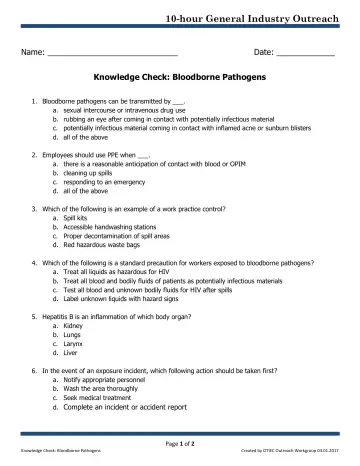
2 slidesBloodborne Pathogens: Knowledge Check (OSHA 10-Hour General Industry Outreach)
Student knowledge-check quiz for the OSHA General Industry bloodborne pathogens outreach deck.
U.S. Department of Labor, OSHA (with the OTIEC Outreach Workgroup)Public domain
pdfes
44 slidesPatógenos transmisibles por sangre (Capacitación de Extensión de 10 horas de OSHA, Industria General)
Spanish edition of OSHA's 10-hour General Industry Outreach deck on bloodborne pathogens (PDF slides; OSHA does not publish an editable Spanish PowerPoint).
U.S. Department of Labor, OSHA (with the OTIEC Outreach Workgroup)Public domain