1 / 2Use ← → to flip
Bloodborne Pathogens - Personal Protective Equipment (PPE) Reduces Exposure to Bloodborne Pathogens Fact Sheet
OSHA fact sheet or bulletin, for General Industry classes.
Page text
· 2 pages · by U.S. Department of Labor, OSHA
The words on each page as the author wrote them, read from the file by software so they can be searched. Layout, pictures and tables are not shown here: the pages above and the download are the original.
- Page 1
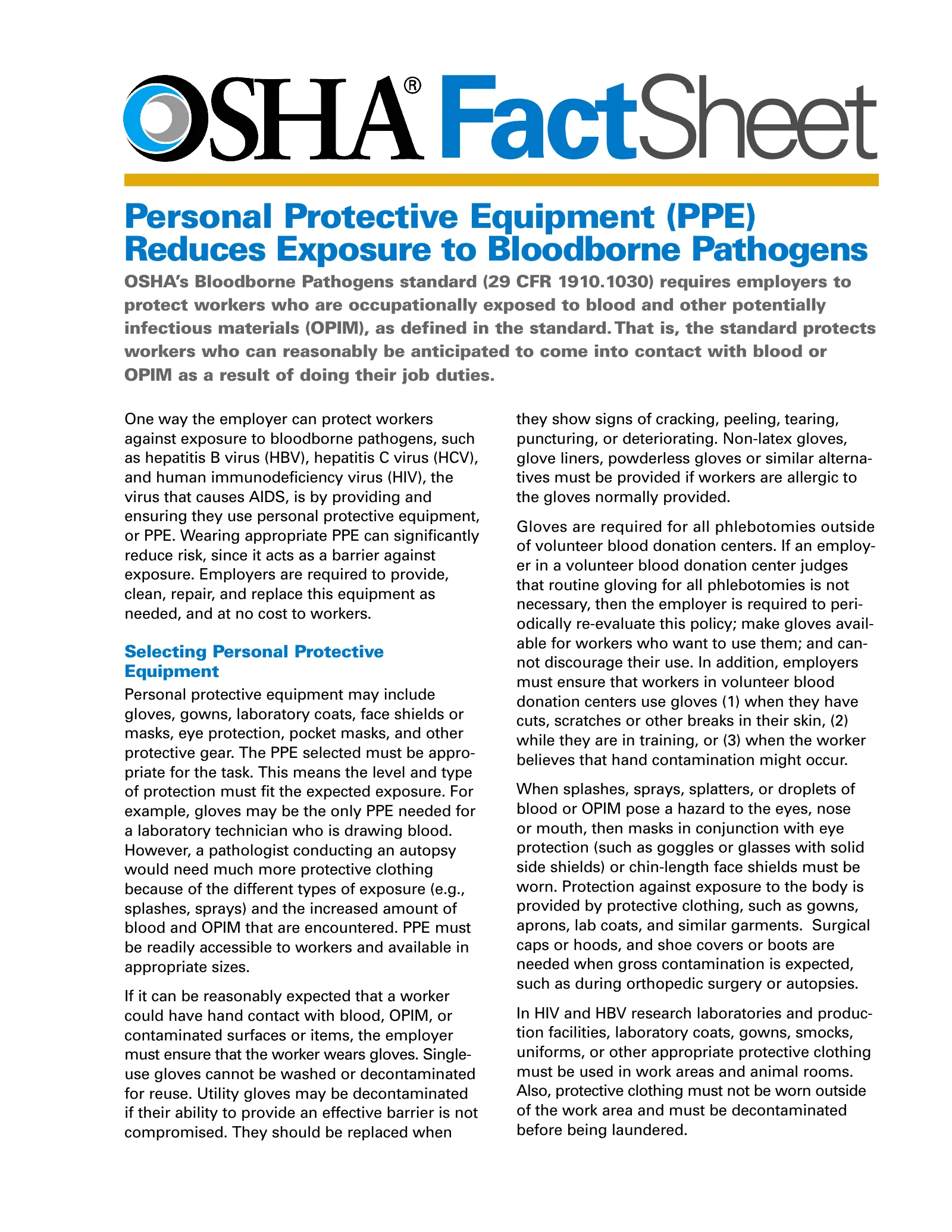
FactSheet
- Personal Protective Equipment (PPE) Reduces Exposure to Bloodborne Pathogens
- OSHA’s Bloodborne Pathogens standard (29 CFR 1910.1030) requires employers to protect workers who are occupationally exposed to blood and other potentially infectious materials (OPIM), as defined in the standard. That is, the standard protects workers who can reasonably be anticipated to come into contact with blood or OPIM as a result of doing their job duties.
- One way the employer can protect workers against exposure to bloodborne pathogens, such as hepatitis B virus (HBV), hepatitis C virus (HCV), and human immunodeficiency virus (HIV), the virus that causes AIDS, is by providing and ensuring they use personal protective equipment, or PPE. Wearing appropriate PPE can significantly reduce risk, since it acts as a barrier against exposure. Employers are required to provide, clean, repair, and replace this equipment as needed, and at no cost to workers.
- Selecting Personal Protective
- Equipment
- Personal protective equipment may include gloves, gowns, laboratory coats, face shields or masks, eye protection, pocket masks, and other protective gear. The PPE selected must be appropriate for the task. This means the level and type of protection must fit the expected exposure. For example, gloves may be the only PPE needed for a laboratory technician who is drawing blood. However, a pathologist conducting an autopsy would need much more protective clothing because of the different types of exposure (e.g., splashes, sprays) and the increased amount of blood and OPIM that are encountered. PPE must be readily accessible to workers and available in appropriate sizes.
- If it can be reasonably expected that a worker could have hand contact with blood, OPIM, or contaminated surfaces or items, the employer must ensure that the worker wears gloves. Single-use gloves cannot be washed or decontaminated for reuse. Utility gloves may be decontaminated if their ability to provide an effective barrier is not compromised. They should be replaced when they show signs of cracking, peeling, tearing, puncturing, or deteriorating. Non-latex gloves, glove liners, powderless gloves or similar alternatives must be provided if workers are allergic to the gloves normally provided.
- Gloves are required for all phlebotomies outside of volunteer blood donation centers. If an employer in a volunteer blood donation center judges that routine gloving for all phlebotomies is not necessary, then the employer is required to periodically re-evaluate this policy; make gloves available for workers who want to use them; and cannot discourage their use. In addition, employers must ensure that workers in volunteer blood donation centers use gloves (1) when they have cuts, scratches or other breaks in their skin, (2) while they are in training, or (3) when the worker believes that hand contamination might occur.
- When splashes, sprays, splatters, or droplets of blood or OPIM pose a hazard to the eyes, nose or mouth, then masks in conjunction with eye protection (such as goggles or glasses with solid side shields) or chin-length face shields must be worn. Protection against exposure to the body is provided by protective clothing, such as gowns, aprons, lab coats, and similar garments. Surgical caps or hoods, and shoe covers or boots are needed when gross contamination is expected, such as during orthopedic surgery or autopsies.
- In HIV and HBV research laboratories and production facilities, laboratory coats, gowns, smocks, uniforms, or other appropriate protective clothing must be used in work areas and animal rooms. Also, protective clothing must not be worn outside of the work area and must be decontaminated before being laundered.
- Page 2
Exception to Use of Personal Protective
- Equipment
- A worker may choose, temporarily and briefly, under rare and extraordinary circumstances, to forego use of personal protective equipment. It must be the worker’s professional judgment that using the personal protective equipment would prevent the delivery of health care or public safety services or would pose an increased hazard to the safety of the worker or coworker. When such a situation occurs, the employer is required to investigate and document the circumstances to determine if there is a way to avoid it from happening again in the future. Employers and workers should be aware that this is not a blanket exemption to the requirement to use PPE. OSHA expects that this will be an extremely rare occurrence.
- Decontaminating and Disposing of Personal Protective Equipment work area. If a garment is penetrated by blood or OPIM, it must be removed immediately or as soon as feasible. Once PPE is removed, it must be placed in an appropriately designated area or container for storage, washing, decontamination, or disposal. In addition, employers must ensure that workers wash their hands immediately or as soon as feasible after removal of gloves or other personal protective equipment.
- Additional Information
- For more information, go to OSHA’s Bloodborne Pathogens and Needlestick Prevention Safety and Health Topics web page at: https://www.osha.gov/SLTC/bloodbornepathogens/index.html.
- To file a complaint by phone, report an emergency, or get OSHA advice, assistance, or products, contact your nearest OSHA office under the “U.S. Department of Labor” listing in your phone book, or call us toll-free at (800) 321-OSHA (6742).
- Employers must ensure that workers remove personal protective equipment before leaving the
- This is one in a series of informational fact sheets highlighting OSHA programs, policies or standards. It does not impose any new compliance requirements. For a comprehensive list of compliance requirements of OSHA standards or regulations, refer to Title 29 of the Code of Federal Regulations. This information will be made available to sensory-impaired individuals upon request. The voice phone is (202) 693-1999; teletypewriter (TTY) number: (877) 889-5627.
- For assistance, contact us. We can help. It’s confidential.
- Occupational Safety
- and Health Administration www.osha.gov 1-800-321-6742
- DSG 1/2011
More on Bloodborne Pathogens
pptx
44 slidesBloodborne Pathogens (OSHA 10-Hour General Industry Outreach)
OSHA's own 10-hour General Industry Outreach deck on bloodborne pathogens (v. 03-01-17), editable PowerPoint with trainer notes.
U.S. Department of Labor, OSHA (with the OTIEC Outreach Workgroup)Public domain
pdf
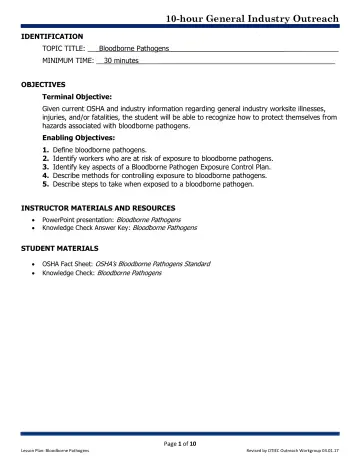
10 slidesBloodborne Pathogens: Lesson Plan (OSHA 10-Hour General Industry Outreach)
Instructor lesson plan (objectives, timing, teaching steps) for the OSHA General Industry bloodborne pathogens outreach deck.
U.S. Department of Labor, OSHA (with the OTIEC Outreach Workgroup)Public domain
pdf
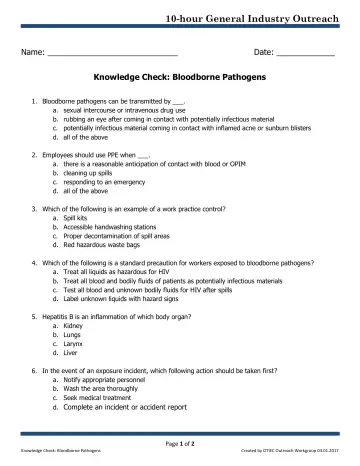
2 slidesBloodborne Pathogens: Knowledge Check (OSHA 10-Hour General Industry Outreach)
Student knowledge-check quiz for the OSHA General Industry bloodborne pathogens outreach deck.
U.S. Department of Labor, OSHA (with the OTIEC Outreach Workgroup)Public domain