OSHA fact sheet or bulletin, for General Industry classes.
Page text
· 2 pages · by U.S. Department of Labor, OSHA
The words on each page as the author wrote them, read from the file by software so they can be searched. Layout, pictures and tables are not shown here: the pages above and the download are the original.
- Page 1
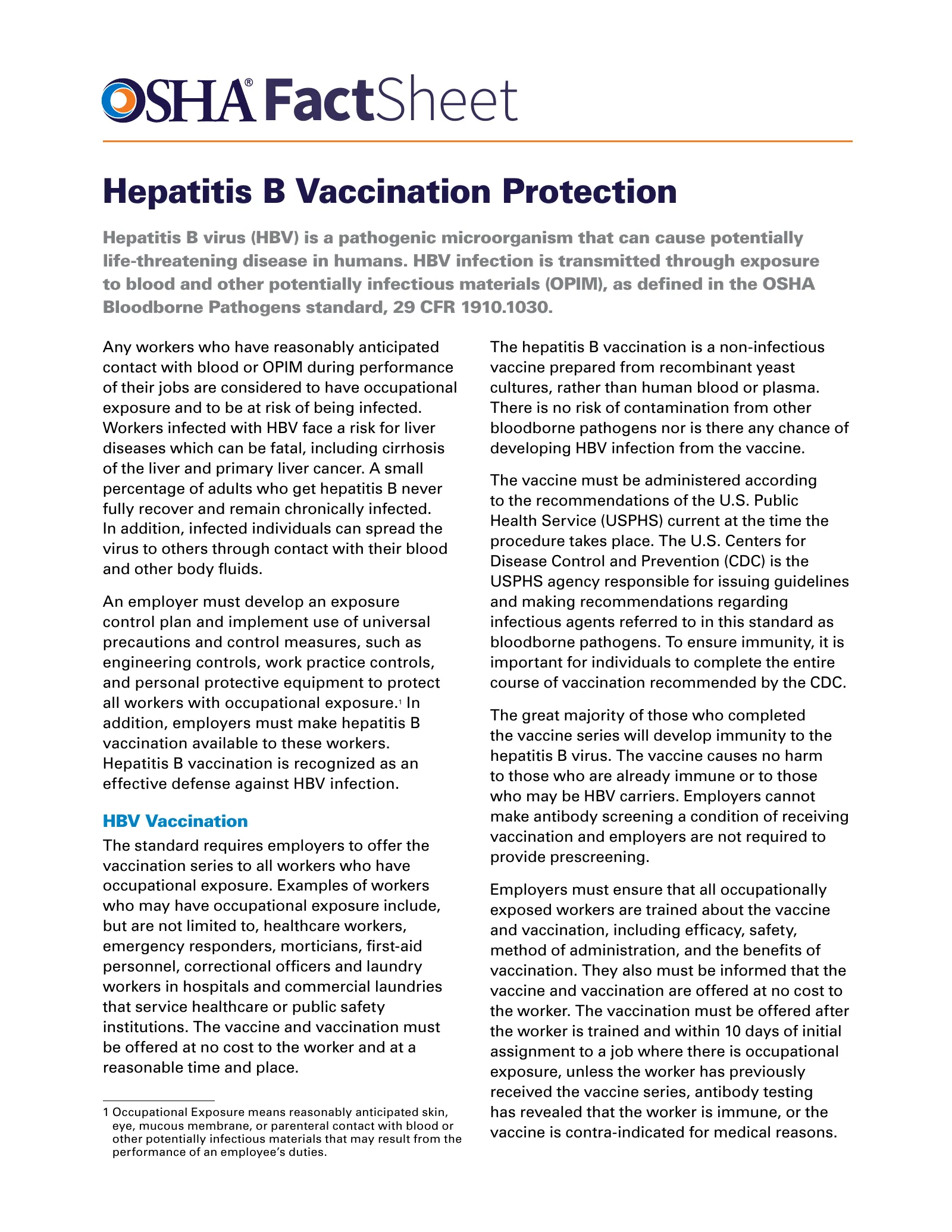
FactSheet
- Hepatitis B Vaccination Protection
- Hepatitis B virus (HBV) is a pathogenic microorganism that can cause potentially life-threatening disease in humans. HBV infection is transmitted through exposure to blood and other potentially infectious materials (OPIM), as defined in the OSHA Bloodborne Pathogens standard, 29 CFR 1910.1030.
- Any workers who have reasonably anticipated contact with blood or OPIM during performance of their jobs are considered to have occupational exposure and to be at risk of being infected. Workers infected with HBV face a risk for liver diseases which can be fatal, including cirrhosis of the liver and primary liver cancer. A small percentage of adults who get hepatitis B never fully recover and remain chronically infected.
- In addition, infected individuals can spread the virus to others through contact with their blood and other body fluids.
- An employer must develop an exposure control plan and implement use of universal precautions and control measures, such as engineering controls, work practice controls, and personal protective equipment to protect all workers with occupational exposure. 1 In addition, employers must make hepatitis B vaccination available to these workers. Hepatitis B vaccination is recognized as an effective defense against HBV infection.
- HBV Vaccination
- The standard requires employers to offer the vaccination series to all workers who have occupational exposure. Examples of workers who may have occupational exposure include, but are not limited to, healthcare workers, emergency responders, morticians, first-aid personnel, correctional officers and laundry workers in hospitals and commercial laundries that service healthcare or public safety institutions. The vaccine and vaccination must be offered at no cost to the worker and at a reasonable time and place.
- 1 Occupational Exposure means reasonably anticipated skin, eye, mucous membrane, or parenteral contact with blood or other potentially infectious materials that may result from the performance of an employee’s duties.
- The hepatitis B vaccination is a non-infectious vaccine prepared from recombinant yeast cultures, rather than human blood or plasma.
- There is no risk of contamination from other bloodborne pathogens nor is there any chance of developing HBV infection from the vaccine.
- The vaccine must be administered according to the recommendations of the U.S. Public Health Service (USPHS) current at the time the procedure takes place. The U.S. Centers for Disease Control and Prevention (CDC) is the USPHS agency responsible for issuing guidelines and making recommendations regarding infectious agents referred to in this standard as bloodborne pathogens. To ensure immunity, it is important for individuals to complete the entire course of vaccination recommended by the CDC.
- The great majority of those who completed the vaccine series will develop immunity to the hepatitis B virus. The vaccine causes no harm to those who are already immune or to those who may be HBV carriers. Employers cannot make antibody screening a condition of receiving vaccination and employers are not required to provide prescreening.
- Employers must ensure that all occupationally exposed workers are trained about the vaccine and vaccination, including efficacy, safety, method of administration, and the benefits of vaccination. They also must be informed that the vaccine and vaccination are offered at no cost to the worker. The vaccination must be offered after the worker is trained and within 10 days of initial assignment to a job where there is occupational exposure, unless the worker has previously received the vaccine series, antibody testing has revealed that the worker is immune, or the vaccine is contra-indicated for medical reasons.
- Page 2
- OSHA notes that CDC recommends accepting only written, dated records as evidence of hepatitis B vaccination and suggests antibody testing upon hire or matriculation for healthcare workers who have documentation of a complete HBV vaccine series in the past. The employer must obtain a written opinion from the licensed healthcare professional within 15 days after the vaccination evaluation is completed. This written opinion is limited to whether hepatitis B vaccination is indicated for the worker and if the worker has received the vaccination.
- remains at risk of acquiring hepatitis B. The form also states that if a worker initially declines to receive the vaccine, but later decides to accept it, the employer is required to make it available, at no cost, provided the worker is still occupationally exposed.
- Declining the Vaccination
- OSHA’s mission is to assure America’s workers have safe and healthful working conditions free from unlawful retaliation. For more information, visit osha.gov or call OSHA at 1-800-321-OSHA (6742).
- Employers must ensure that workers who decline vaccination sign a declination form.
- The purpose of this is to encourage greater participation in the vaccination program by stating that a worker declining the vaccination
- Additional Information
- For more information, go to OSHA’s Bloodborne Pathogens and Needlestick Prevention Safety and Health Topics web page.
- How to Contact OSHA
- This is one in a series of informational fact sheets highlighting OSHA programs, policies or standards. It does not impose any new compliance requirements. For a comprehensive list of compliance requirements of OSHA standards or regulations, refer to Title 29 of the Code of Federal Regulations. This information will be made available to sensory-impaired individuals upon request. The voice phone is (202) 693-1999.
- DSG FS-4504 6/2026