1 / 92Use ← → to flip
Part 3: Bloodborne Pathogens: Prevention
Part 3 of the Idaho State University bloodborne pathogens course.
Slide text
· 92 slides · by Idaho State University
The words on each slide as the author wrote them, read from the file by software so they can be searched. Layout, pictures and tables are not shown here: the slides above and the download are the original.
- Slide 1
BLOODBORNE PATHOGENS
- “Prevention”
- Part 3 of 4
- Standard 29 CFR 1910.1030
- Produced by
- Idaho State University
- Office of Workforce Training workforcetraining.isu.edu
- Slide 2
- “This material was produced under grant SH20849SHO from the Occupational Safety and Health Administration, U.S. Department of Labor. It does not necessarily reflect the views or policies of the U.S. Department of Labor, nor does mention of trade names, commercial products, or organizations imply endorsement by the U.S. Government.”
- Slide 3
- Work
- Work associated associated risks
- risks
- Splash mucous membranes (eyes, nose, mouth)
- Permeable membrane – microbes can move through
- Contaminated sharp objects
- Exposure of non-intact skin (wounds, rashes)
- Slide 4
- Work
- Work associated associated risks
- risks
- Splash mucous membranes (eyes, nose, mouth)
- Permeable membrane – microbes can move through
- Contaminated sharp objects
- Exposure of non-intact skin (wounds, rashes)
- Slide 5
- Work
- Work associated associated risks
- risks
- Splash mucous membranes (eyes, nose, mouth)
- Permeable membrane – microbes can move through
- Contaminated sharp objects
- Exposure of non-intact skin (wounds, rashes)
- Slide 6
Equipment, risks
- Removed tissues
- Work associated
- supplies or tools contaminated with blood or OPIM
- Direct handling or contact with Human blood or OPIM
- or organ contaminated with blood or OPIM
- Contamination
- Sources
- Cultures containing bloodborne pathogens
- Slide 7
Equipment, risks
- Removed tissues
- Work associated
- supplies or tools contaminated with blood or OPIM
- Direct handling or contact with Human blood or OPIM
- or organ contaminated with blood or OPIM
- Contamination
- Sources
- Cultures containing bloodborne pathogens
- Slide 8
Equipment, risks
- Removed tissues
- Work associated
- supplies or tools contaminated with blood or OPIM
- Direct handling or contact with Human blood or OPIM
- or organ contaminated with blood or OPIM
- Contamination
- Sources
- Cultures containing bloodborne pathogens
- Slide 9
Equipment, risks
- Removed tissues
- Work associated
- supplies or tools contaminated with blood or OPIM
- Direct handling or contact with Human blood or OPIM
- or organ contaminated with blood or OPIM
- Contamination
- Sources
- Cultures containing bloodborne pathogens
- Slide 10
How do YOU prevent exposure? Work associated risks
- STANDARD PRECAUTIONS!
- AKA universal precautions
- Assumption:
- ALL blood or OPIM is infectious!!
- Slide 11
Basis of Standard Precautions: Work associated risks
- Engineering controls
- Safe work practices
- Personal protective equipment
- All intended to keep you and those around you safe!
- Slide 12
Basis of Standard Precautions: Work associated risks
- Engineering controls
- Safe work practices
- Personal protective equipment
- All intended to keep you and those around you safe!
- Slide 13
Basis of Standard Precautions: Work associated risks
- Engineering controls
- Safe work practices
- Personal protective equipment
- All intended to keep you and those around you safe!
- Slide 14
Basis of Standard Precautions: Work associated risks
- Engineering controls
- Safe work practices
- Personal protective equipment
- All intended to keep you and those around you safe!
- Slide 15
Engineering Controls Examples: associated risks Work
- Safety needles/syringes Sharps container Cleanable work surfaces
- Leak-proof containers ‘Hands off’ lids and hand hygiene tools Blood spill kits
- Adapted equipment, instruments, devices
- Slide 16
- Safe Work Practices Work
- associated risks
- Examples:
- No eating, drinking, applying makeup or smoking in areas where blood or OPIM are a risk
- Correct personal and hand hygiene
- Cough etiquette
- Plan before doing
- Care of environment
- Hepatitis B vaccination
- Proper handling of biological waste (including spills/disposal of biological waste)
- Strategies to prevent exposure to BBP
- Slide 17
Safe Work Practices
- No eating, drinking, applying makeup or smoking in areas where blood or OPIM are a risk
- Work associated risks
- Strategies to prevent exposure to BBP
- Slide 18
Safe Work Practices
- No eating, drinking, applying makeup or smoking in areas where blood or OPIM are a risk
- Work associated risks
- Strategies to prevent exposure to BBP
- Slide 19
Safe Work Practices
- Personal and hand hygiene
- Work associated risks
- Strategies to prevent exposure to BBP
- Slide 20
Work associated risks
- Toilet seats
- Genitalia
- Ground
- Bottom of shoes
- Highly contaminated
- (100,000 microbes per inch)
- Sterile
- (microbe free)
- Autoclave
- Chemical sterilization
- Surfaces that have not been cleaned within 24 hours
- Any surface coming in contact with highly contaminated items
- Contaminated
- (10,000 microbes per inch)
- Clean/ Disinfected (100 microbes per inch)
- Chemical disinfectants
- Freshly laundered linen
- Hands after washing
- Medical gloves
- Slide 21
Work associated risks
- Toilet seats
- Genitalia
- Ground
- Bottom of shoes
- Highly contaminated
- (100,000 microbes per inch)
- Sterile
- (microbe free)
- Autoclave
- Chemical sterilization
- Surfaces that have not been cleaned within 24 hours
- Any surface coming in contact with highly contaminated items
- Contaminated
- (10,000 microbes per inch)
- Clean/ Disinfected (100 microbes per inch)
- Chemical disinfectants
- Freshly laundered linen
- Hands after washing
- Medical gloves
- Slide 22
Personal Hygiene Work associated risks
- Poor personal hygiene significantly increases the number of microbes in the surrounding area...
- Microbes that can cause infection!
- Slide 23
Hand Hygiene Work associated risks
- Visibly dirty/contaminated:
- Soap and water!
- At least 15 seconds of rubbing all hand surfaces
- Frequently missed:
- Under/around nails
- In creases of knuckles
- Wrist
- Creases in palms of hands
- Under rings/watch
- Slide 24
- Work
- associated
- risks
- NOT visibly
- dirty/contaminated
- Hand gel x 3 applications
- Rub on all hand surfaces until dry
- At least 60% alcohol
- Remember ‘anti-bacterial’
- NOT anti-viral... Anti-fungal... or anti-protozoan...
- Soap and water after three applications
- Slide 25
Safe Work Practices
- Work associated risks
- Cough
- Etiquette
- Strategies to prevent exposure to BBP
- Slide 26
Safe Work Practices
- Plan before doing...
- Strategies to prevent exposure to BBP
- Slide 27
Safe Work Practices
- Care of the environment
- Work associated risks
- Strategies to prevent exposure to BBP
- Slide 28
Safe Work Practices
- Care of the environment
- Work associated risks
- Strategies to prevent exposure to BBP
- Slide 29
Safe Work Practices
- Care of the environment
- Work associated risks
- Strategies to prevent exposure to BBP
- Slide 30
Safe Work Practices
- Care of the environment
- Work associated risks
- Strategies to prevent exposure to BBP
- Slide 31
- Decontamination of equipment & surfaces
- Work
- associated
- risks
- Infection Control Today: Know your surface! (htt
- p://www.infectioncontrol.com )
- Influenced by:
- # of people
- Amount of activity
- Air circulation
- Amount of moisture
- Presence of materials that promote microbial growth
- Orientation of surface (horizontal/vertical)
- All work surfaces cleanable?
- Microbes thrive:
- Moist
- Warm
- Dark
- Little air flow
- Slide 32
- Decontamination of equipment & surfaces
- Work
- associated
- risks
- Infection Control Today: Know your surface! (htt
- p://www.infectioncontrol.com )
- Influenced by:
- # of people
- Amount of activity
- Air circulation
- Amount of moisture
- Presence of materials that promote microbial growth
- Orientation of surface (horizontal/vertical)
- All work surfaces cleanable?
- Microbes thrive:
- Moist
- Warm
- Dark
- Little air flow
- Slide 33
Disinfectants:
- Many lists of disinfectants based on type of work environment.
- Slide 34
Disinfectants:
- Many lists of disinfectants based on type of work environment.
- Disinfectants are not equal!
- Slide 35
Disinfectants:
- Many lists of disinfectants based on type of work environment.
- Disinfectants are not equal!
- Type of solution to use for bloodborne pathogen contamination:
- Medical grade chemicals (Chlorhexidine; Cavicide)
- Fresh 10:1 water to bleach solution
- NOT alcohol – dries too fast
- Slide 36
Disinfectants:
- Many lists of disinfectants based on type of work environment.
- Disinfectants are not equal!
- Type of solution to use for bloodborne pathogen contamination:
- Medical grade chemicals (Chlorhexidine; Cavicide)
- Fresh 10:1 water to bleach solution
- NOT alcohol – dries too fast
- Employer should have list of areas to be cleaned, interval of cleaning and who is assigned to clean
- Slide 37
Disinfectants:
- Many lists of disinfectants based on type of work environment.
- Disinfectants are not equal!
- Type of solution to use for bloodborne pathogen contamination:
- Medical grade chemicals (Chlorhexidine; Cavicide)
- Fresh 10:1 water to bleach solution
- NOT alcohol – dries too fast
- Employer should have list of areas to be cleaned, interval of cleaning and who is assigned to clean
- Follow manufacturer instructions for contact time!
- Slide 38
Safe Work Practices
- Hepatitis
- Vaccination
- Work associated risks
- Occupational infection rates have dropped 95% since the vaccine became standard (1982)
- Strategies to prevent exposure to BBP
- Slide 39
Safe Work Practices
- Hepatitis B Vaccination
- dose series risks
- Work Three
- associated
- Initial dose – w/in 10 days of hire One month after initial dose
- Six months after initial dose
- Strategies to prevent exposure to BBP
- Slide 40
Safe Work Practices
- Hepatitis B Vaccination
- Three dose series
- Work Initial
- associated
- risks
- dose – w/in 10 days of hire
- One month after initial dose Six months after initial dose
- Booster not required
- Check immunity if exposed (blood test)
- May give additional hep B vaccine or medication that stimulates immune system
- Strategies to prevent exposure to BBP
- Slide 41
Safe Work Practices
- Hepatitis B Vaccination
- Three dose series
- Work Initial
- associated
- risks
- dose – w/in 10 days of hire
- One month after initial dose Six months after initial dose
- Booster not required
- Check immunity if exposed (blood test)
- May give additional hep B vaccine or medication that stimulates immune system
- Can decline (assume liability) – but can also change mind
- Strategies to prevent exposure to BBP
- Slide 42
Safe Work Practices
- Hepatitis B Vaccination
- Three dose series
- Work Initial
- associated
- risks
- dose – w/in 10 days of hire
- One month after initial dose Six months after initial dose
- Booster not required
- Check immunity if exposed (blood test)
- May give additional hep B vaccine or medication that stimulates immune system
- Can decline (assume liability) – but can also change mind
- No cost to employee
- Strategies to prevent exposure to BBP
- Slide 43
Safe Work Practices
- Handling, disposing of, labeling and transport of biohazard
- Biohazard: A biological agent or condition that is a hazard to humans or the environment (Merriam-Webster online)
- Sources:
- Human (or animal) blood
- Human (or animal) OPIM
- Infected human waste
- Used sharps
- Laboratory/clinical waste contaminated with blood, tissues, cells or OPIM
- Slide 44
NOT O.P.I. M
- Slide 45
Handling, disposing of, labeling and transport of biohazard
- Biohazard: A biological agent or condition that is a hazard to humans or the environment (Merriam-Webster online)
- Sources:
- Human (or animal) blood
- Human (or animal) OPIM
- Infected human waste
- Used sharps
- Laboratory/clinical waste contaminated with blood, tissues, cells or OPIM
- Slide 46
Sharp Safety
- Sharp: Any instrument or device that can cut or puncture skin
- Medical: Needles, scalpals, etc.
- Non-medical: Glass, razors, metal, wires, etc.
- Slide 47
Sharp Safety
- Sharp: Any instrument or device that can cut or puncture skin
- Medical: Needles, scalpals, lab pipette’s etc.
- Non-medical: Glass, razors, metal, wires, etc.
- Place needles directly into a sharps container
- Slide 48
Sharp Safety
- Sharp: Any instrument or device that can cut or puncture skin
- Medical: Needles, scalpals, etc.
- Non-medical: Glass, razors, metal, wires, etc.
- Place needles directly into a sharps container
- Place ANY sharp in a rigid, puncture proof container
- Slide 49
Sharp Safety
- Sharp: Any instrument or device that can cut or puncture skin
- Medical: Needles, scalpals, etc.
- Non-medical: Glass, razors, metal, wires, etc.
- Place needles directly into a sharps container
- Place ANY sharp in a rigid, puncture proof container
- Never allow hand to enter ‘dip’ opening
- Replace sharps container when ¾ full
- DON’T overfill
- Never attempt to re-open a closed sharps container
- Slide 50
Sharp Safety
- Sharp: Any instrument or device that can cut or puncture skin
- Medical: Needles, scalpals, etc.
- Non-medical: Glass, razors, metal, wires, etc.
- Place needles directly into a sharps container
- Place ANY sharp in a rigid, puncture proof container
- Never allow hand to enter ‘dip’ opening
- Replace sharps container when ¾ full
- DON’T overfill
- Never attempt to re-open a closed sharps container
- Avoid recapping – if you must, use a cap holder or the scoop method and use one hand!
- Slide 51
- Handling, disposing of, labeling and transporting laboratory or clinical waste contaminated with blood, tissues, cells or OPIM
- Wear appropriate personal protective equipment when handling biological waste
- Slide 52
- Handling, disposing of, labeling and transporting laboratory or clinical waste contaminated with blood, tissues, cells or OPIM
- Wear appropriate personal protective equipment when handling biological waste
- Infectious or pathogenic waste must be labeled and held in a closed/covered leak-proof container & may not be stored greater than 24 hrs before moving from clinical areas
- Slide 53
- Handling, disposing of, labeling and transporting laboratory or clinical waste contaminated with blood, tissues, cells or OPIM
- Wear appropriate personal protective equipment when handling biological waste
- Infectious or pathogenic waste must be labeled and held in a closed/covered leak-proof container & may not be stored > than 24 hrs before moving from public or clinical areas
- Double bag if outside of first bag is contaminated
- Slide 54
- Handling, disposing of, labeling and transporting laboratory or clinical waste contaminated with blood, tissues, cells or OPIM
- Wear appropriate personal protective equipment when handling biological waste
- Infectious or pathogenic waste must be labeled and held in a closed/covered leak-proof container & may not be stored > than 24 hrs before moving from public or clinical areas
- Double bag if outside of first bag is contaminated
- Medical sharps in labeled sharps container: Rigid, leakproof, closeable
- Slide 55
- Handling, disposing of, labeling and transporting laboratory or clinical waste contaminated with blood, tissues, cells or OPIM
- Wear appropriate personal protective equipment when handling biological waste
- Infectious or pathogenic waste must be labeled and held in a closed/covered leak-proof container & may not be stored > than 24 hrs before moving from public or clinical areas
- Double bag if outside of first bag is contaminated
- Medical sharps in labeled sharps container: Rigid, leakproof, closeable
- Do not put liquids into biohazard bags
- Slide 56
- Biohazard may be stored onsite for up to 30 days if the storage area is locked, kept tidy and labeled as a biohazard storage area
- Slide 57
- Biohazard may be stored onsite for up to 30 days if the storage area is locked, kept tidy and labeled as a biohazard storage area
- Do not mix biohazard with other types of waste
- Radioactive
- Chemical
- Drugs
- Slide 58
- Biohazard may be stored onsite for up to 30 days if the storage area is locked, kept tidy and labeled as a biohazard storage area
- Do not mix biohazard with other types of waste
- Radioactive
- Chemical
- Drugs
- Regular Trash?
- No red bags
- No sharps containers
- Nothing with a biohazard warning label
- Slide 59
- Biohazard may be stored onsite for up to 30 days if the storage area is locked, kept tidy and labeled as a biohazard storage area
- Do not mix biohazard with other types of waste
- Radioactive
- Chemical
- Drugs
- Regular Trash?
- No red bags
- No sharps boxes
- Nothing with a biohazard warning label
- Laws about transport of biohazard – know them before transporting (Transportation Department)
- Slide 60
Basis of Standard Precautions: Work associated risks
- Engineering controls
- Safe work practices
- Personal protective equipment
- All intended to keep you and those around you safe!
- Slide 61
- Personal protective equipment (PPE)
- Work
- associated risks
- Gloves
- Body coverings
- Mouth, nose, eye protection Ventilation device (mouthpiece) Footwear
- Slide 62
Employer responsibilities for PPE:
- Work
- associated
- risks
- ANY setting where there is a risk of exposure to blood or OPIM
- Slide 63
Employer responsibilities for PPE:
- Work
- associated
- risks
- ANY setting where there is a risk of exposure to blood or OPIM
- Supplied by employer – even individual needs
- Slide 64
- Employer responsibilities for PPE:
- Work
- associated
- risks
- ANY setting where there is a risk of exposure to blood or OPIM
- Supplied by employer – even individual needs
- Must:
- Be stored in a clean, dry area
- Be available (informed employees) Fit
- Be appropriate for the task Cleaned or disposed of properly
- Slide 65
Gloves
- Know associated
- your size before needing
- Work
- risks
- Slide 66
- Gloves
- Know your
- size before needing
- Work
- associated
- risks
- Medical grade for biohazard (not utility)
- Slide 67
- Gloves
- Know your
- size before needing
- Work
- associated
- risks
- Medical grade for biohazard (not utility) Single use, disposable
- Slide 68
- Gloves
- Know your
- size before needing
- Work
- associated
- risks
- Medical grade for biohazard (not utility) Single use, disposable
- Application easy – inspect for holes/damage
- Slide 69
- Gloves
- Know your
- size before needing
- Work
- associated
- risks
- Medical grade for biohazard (not utility) Single use, disposable
- Application easy – inspect for holes/damage Removal of contaminated gloves
- Slide 70
Grab associated
- Gloves
- OUTSIDE of the first
- glove at wrist and pull off
- Work
- risks
- Place that glove in the palm of the gloved hand.
- Push fingers INSIDE cuff of second glove and pull off and over other glove
- Dispose in biohazard container
- Wash hands immediately
- Slide 71
- Gloves
- Know your
- size before needing
- Work
- associated
- risks
- Medical grade for biohazard (not utility) Single use, disposable
- Application easy – inspect for holes/damage Removal of contaminated gloves:
- Grab OUTSIDE of the first glove at wrist and pull off Place that glove in the palm of the gloved hand.
- Push fingers INSIDE cuff of second glove and pull off and over other glove
- Dispose in biohazard container
- Wash hands immediately
- Public perception: ALL gloves are contaminated
- Slide 72
Work associated risks
- OSHA:
- Gloves. Gloves shall be worn when it can be reasonably anticipated that the employee may have hand contact with blood, other potentially infectious materials, mucous membranes, and non-intact skin; when performing vascular access procedures except as specified in paragraph (d)(3)(ix)(D); and when handling or touching contaminated items or surfaces.
- Slide 73
Work associated risks
- OSHA:
- Gloves. Gloves shall be worn when it can be reasonably anticipated that the employee may have hand contact with blood, other potentially infectious materials, mucous membranes, and non-intact skin; when performing vascular access procedures except as specified in paragraph (d)(3)(ix)(D); and when handling or touching contaminated items or surfaces.
- Disposable (single use) gloves such as surgical or examination gloves, shall be replaced as soon as practical when contaminated or as soon as feasible if they are torn, punctured, or when their ability to function as a barrier is compromised.
- Slide 74
Work associated risks
- OSHA:
- Gloves. Gloves shall be worn when it can be reasonably anticipated that the employee may have hand contact with blood, other potentially infectious materials, mucous membranes, and non-intact skin; when performing vascular access procedures except as specified in paragraph (d)(3)(ix)(D); and when handling or touching contaminated items or surfaces.
- Disposable (single use) gloves such as surgical or examination gloves, shall be replaced as soon as practical when contaminated or as soon as feasible if they are torn, punctured, or when their ability to function as a barrier is compromised.
- Disposable (single use) gloves shall not be washed or decontaminated for re-use.
- Slide 75
Latex Allergy
- Becoming more common
- Repeated exposure to latex
- Symptoms start mild – skin irritation
- Progress over time to mild allergy symptoms: Hives, runny nose, itchy eyes or nose, irritated throat
- Anaphylactic shock possible
- Options:
- To avoid development of an allergy, wear gloves only when needed
- Nitrile or vinyl gloves
- Slide 76
- OSHA: The employer shall ensure that appropriate personal protective equipment in the appropriate sizes is readily accessible at the worksite or is issued to employees. Hypoallergenic gloves, glove liners, powderless gloves, or other similar alternatives shall be readily accessible to those employees who are allergic to the gloves normally provided.
- Slide 77
Body Coverings
- Gowns, associated
- aprons, hair covers, shoe covers, etc.
- Work
- risks
- Disposable – single use Moisture resistant – NOT proof
- Slide 78
Work associated risks
- OSHA:
- Gowns, Aprons, and Other Protective Body Clothing. Appropriate protective clothing such as, but not limited to, gowns, aprons, lab coats, clinic jackets, or similar outer garments shall be worn in occupational exposure situations. The type and characteristics will depend upon the task and degree of exposure anticipated
- Slide 79
Work associated risks
- Masks & Eyewear
- Protect eyes, nose, mouth
- Masks:
- Various types of masks – standard, face shield type, type with very small pores (N-95 respirator)
- Tie masks or masks with loop around ears Contaminated when wet
- Goggles are cleansed between use
- Slide 80
Work associated risks
- OSHA:
- Masks, Eye Protection, and Face Shields. Masks in combination with eye protection devices, such as goggles or glasses with solid side shields, or chin-length face shields, shall be worn whenever splashes, spray, spatter, or droplets of blood or other potentially infectious materials may be generated and eye, nose, or mouth contamination can be reasonably anticipated.
- Slide 81
Work associated risks
- ALL
- Outside contaminated
- Inside not contaminated UNLESS wet
- Slide 82
Isolation room/Isolation precautions
- Work associated risks
- Slide 83
Work associated risks
- Slide 84
- Work
- associated risks
- OSHA RULE:
- PPE must not be worn in any common or public area
- Slide 85
- Work
- associated risks
- OSHA RULE:
- PPE must not be worn in any common or public area
- HEALTHCARE RULES IF PERSON IS KNOWN TO HAVE A TRANSMISSION-BASED INFECTION:
- Outside a patient room the PERSON wears protective equipment
- Slide 86
- Work
- associated risks
- OSHA RULE:
- PPE must not be worn in any common or public area
- HEALTHCARE RULES IF PERSON IS KNOWN TO HAVE A TRANSMISSION-BASED INFECTION:
- Outside a patient room the PERSON wears protective equipment
- To enter a patient room the WORKER wears protective equipment
- Slide 87
- Correct rule application
- Work
- associated risks
- At hospital EMS personnel:
- Apply gown/mask/gloves before entering patient room
- Slide 88
- Correct rule application
- Work
- associated risks
- At hospital EMS personnel:
- Apply gown/mask/gloves before entering patient room
- Enter room and assist person to apply mask
- Slide 89
- Correct rule application
- Work
- associated risks
- At hospital EMS personnel:
- Apply gown/mask/gloves before entering patient room
- Enter room and assist person to apply mask
- At doorway remove protective equipment – gloves, gown, mask – and wash
- Slide 90
- Correct rule application
- Work
- associated risks
- At hospital EMS personnel:
- Apply gown/mask/gloves before entering patient room
- Enter room and assist person to apply mask
- At doorway remove protective equipment – gloves, gown, mask – and wash
- At nursing home EMS personnel:
- Apply equipment before entering resident room
- Enter room, assist person to remove mask
- At doorway remove protective equipment (gloves, gown, mask) & wash
- Slide 91
Work associated risks
- DEFENSIVE – NOT!
- Six didn’t catch error?
- Embarrassed, not defensive
- Called fire captain
- Presented at regional paramedic meeting
- At first defensive...then grateful
- Slide 92
OSHA BBP STANDARD
- Work associated risks
More on Bloodborne Pathogens
pptx
44 slidesBloodborne Pathogens (OSHA 10-Hour General Industry Outreach)
OSHA's own 10-hour General Industry Outreach deck on bloodborne pathogens (v. 03-01-17), editable PowerPoint with trainer notes.
U.S. Department of Labor, OSHA (with the OTIEC Outreach Workgroup)Public domain
pdf
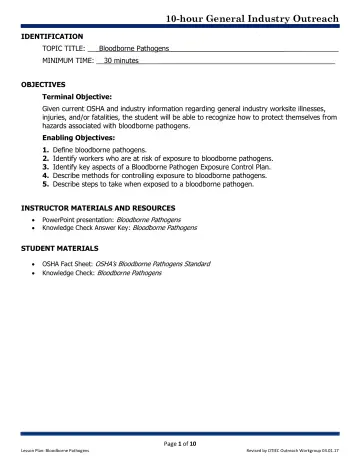
10 slidesBloodborne Pathogens: Lesson Plan (OSHA 10-Hour General Industry Outreach)
Instructor lesson plan (objectives, timing, teaching steps) for the OSHA General Industry bloodborne pathogens outreach deck.
U.S. Department of Labor, OSHA (with the OTIEC Outreach Workgroup)Public domain
pdf
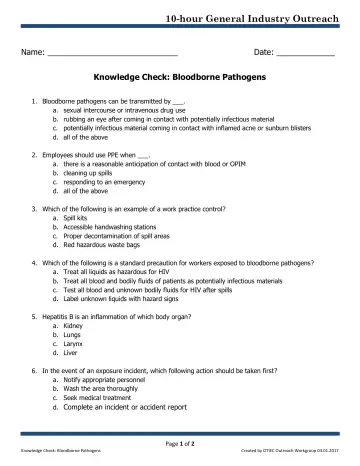
2 slidesBloodborne Pathogens: Knowledge Check (OSHA 10-Hour General Industry Outreach)
Student knowledge-check quiz for the OSHA General Industry bloodborne pathogens outreach deck.
U.S. Department of Labor, OSHA (with the OTIEC Outreach Workgroup)Public domain