1 / 59Use ← → to flip
Fall Protection for General Industry
Fall protection for general industry from Miami Dade College (2015, predates the 2017 rule update).
Slide text
· 59 slides · by Miami Dade College
The words on each slide as the author wrote them, read from the file by software so they can be searched. Layout, pictures and tables are not shown here: the slides above and the download are the original.
- Slide 1
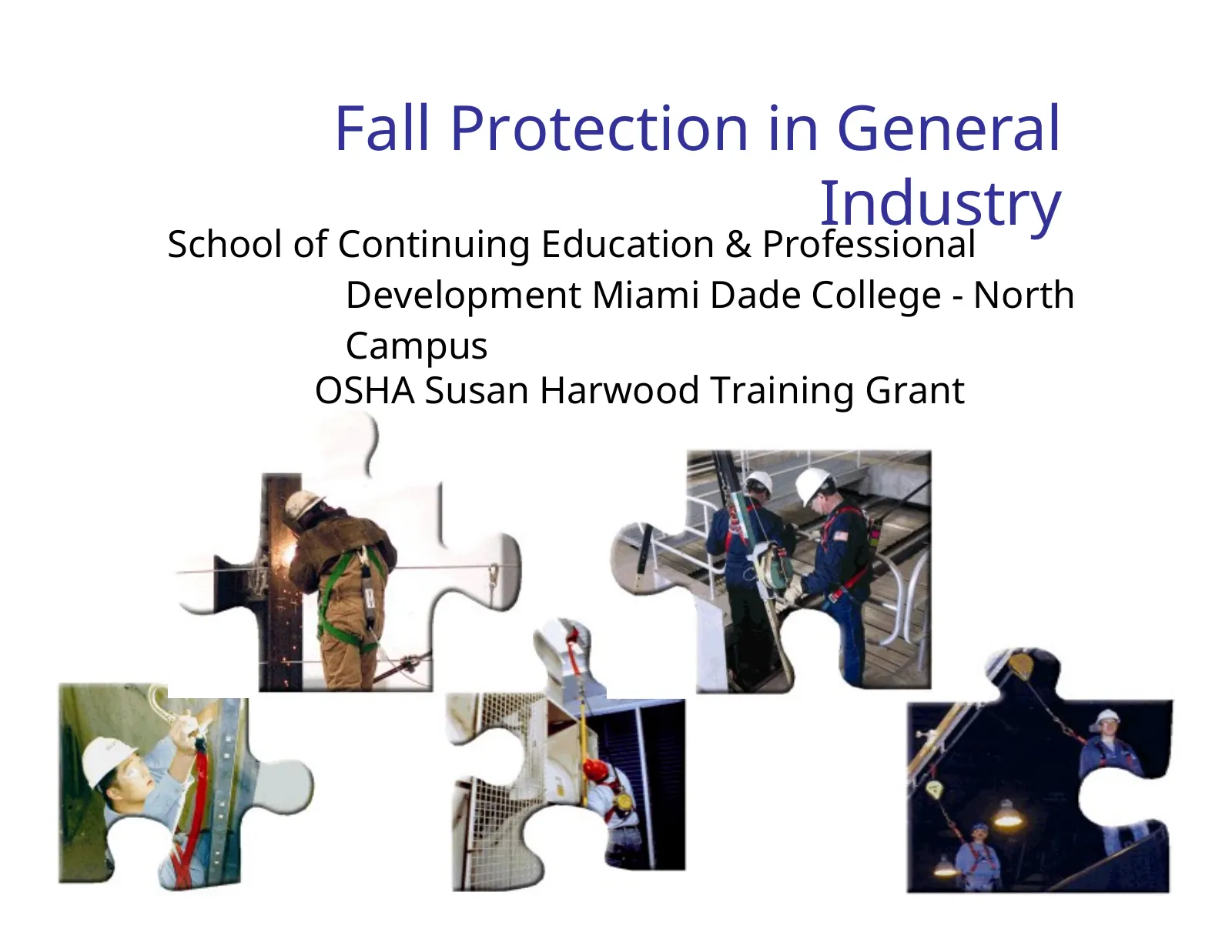
Fall Protection in General
- Industry
- School of Continuing Education & Professional Development Miami Dade College - North Campus
- OSHA Susan Harwood Training Grant
- Slide 2
DISCLAIMER
- This material was produced under grant # SH-27618-SH5 from the Occupational Safety and Health Administration, U.S. Department of Labor. It does not necessarily reflect the views or policies of the
- U. S. Department of Labor, nor does mention of trade names, commercial products, or organizations imply endorsement by the U. S. Government. The U.S. Government does not warrant or assume any legal liability or responsibility for the accuracy, completeness, or usefulness of any information, apparatus, product, or process disclosed.
- COPYRIGHT INFORMATION: This material is the copyrighted property of Miami Dade College.
- By federal regulation, OSHA reserves a license to use and disseminate such material for the purpose of promoting safety and health in the workplace. Miami Dade College hereby authorizes employers and workplace safety and health professionals to use this material, distributed by or through OSHA, in their workplaces or practices in accordance with the guidance contained in the material.
- To this end, permission is granted to use such copyrighted material solely for non-commercial, instructional, personal, or scholarly purposes. The material may be used and incorporated into other workplace safety and health programs on the condition that no fee may be charged for the subsequent use of the material. Use of the material for any other purpose, particularly commercial use, without the prior, express written permission of the copyright owner/s is prohibited. Furthermore, any modification to the material is prohibited without the prior, express written permission of the copyright owners.
- OSHA - Susan Harwood Training Grant
- Slide 3
Results of a Fall
- The average fatal fall is only 6 feet
- A 6’ foot fall generates over 3,200 lb of force – that is the approximate weight of an average midsize car
- A fall from 10 feet has an 4 out of 5 probability of causing death or permanent injury
- A fall from 11 feet has an 8.5 out of 10 chance of causing death
- Slide 4
What Happens in the Industry?
- Analysis of incidents from a Fortune 500 Company:
- When a slip, trip, or other fall happens
- 77% of the time the fall incident results in an OSHA Recordable injury or higher
- 50% of the time, the fall is to the same level
- 72% of the walking or working surfaces had sources of contamination (water, product, etc.) that were slipped on
- 50% of the walking or working surfaces had sources of contamination (nails, pipes, etc.) that were tripped over
- 36% of the time, the fall is to a lower level
- 16% of the time, the fall involves stairs
- 19% of the time, the fall involves a ladder
- Slide 5
What Happens in a Fall with a 1.8 m (6 ft) lanyard?
- Time
- Physical Response
- Free-Fall Distance
- Velocity
- 0.1 sec
- Unaware
- 5.1 cm (2 in)
- 1.0 m/s (3.3 ft/s)
- 0.2 sec
- Aware
- 20.3 cm (8 in)
- 2.13 m/s (7 ft/s)
- 0.5 sec
- Start to Move
- 1.22 m (4 ft)
- 4.88 m/s (16 ft/s)
- 0.61 sec
- Slight Movement
- 1.83 m (6 ft)
- 5.97 m/s (19.6 ft/s)
- 0.7 sec
- Impact
- 2.41 m (7.9 ft)
- 7.01 m/s (23 ft/s)
- 0.9 sec
- Rebound
- 3.96 m (13 ft)
- 8.84 m/s (29 ft/s)
- 1.0 sec
- Suspend
- 4.9 m (16 ft)
- 9.75 m/s (32 ft/s)
- Slide 6
What is a Fall Hazard?
- Types of Fall
- Hazards:
- Falls to a lower level
- Falls to the same level
- Falls to a higher level
- Slips & Trips
- Slide 7
Training Objectives
- Recognition of Fall Hazards
- Review of Applicable Standards/Regulations
- Basic Fall Prevention Principles
- Basic Fall Protection Principles
- Inspection Principles
- Rescue Principles
- Slide 8
Regulatory Summary
- Occupational Safety and Health Administration (OSHA) Regulations
- American National Standards Institute (ANSI) Regulations
- Canadian Safety Associates (CSA) Regulations
- Slide 9
Regulatory Summary - OSHA General Industry
- Subpart D, Walking/Working
- Surfaces Fixed Ladders, Ladder
- (d) (5)
- (j) (4)
- Safety Devices Scaffolding,
- Boatswain’s Chairs
- Subpart F
- Powered Platforms
- 1910.66
- 1910.66, Appendix C
- Personal Fall Arrest
- Systems
- Subpart J, Confined Space
- 1910.146
- Subpart R, Special Industries
- 1910.267
- Agricultural Operations
- Telecommunications
- 1910.268 Electric Power Generation, Transmission and Distribution 1910.269
- OSHA’s Regulations for Marine Terminals and Longshoring
- Marine Terminals
- Longshoring
- 1917
- 1918
- Slide 10
Regulatory Summary - OSHA Construction
- Subpart
- E,
- Personal
- Equipment
- Protective
- Safety
- Belts,
- 1926.104 1926.105
- Linelines, and Lanyards Safety
- Nets
- Subpart L,
- 1926.450-454
- Scaffolding
- Boatswain’s
- Chair
- Subpart M, Fall Protection
- Scope, Application,
- Definitions Duty to Have
- Fall Protection
- 1926.500 1926.501 1926.502 1926.503
- Fall Protection Systems Criteria and Practices Training Requirements
- Subpart R, Steel
- 1926.750
- Erection Fall
- Protection
- Subpart X, Ladders
- 1926.1053
- Slide 11
Most Common U.S. Requirements • > 1.2 meters (4 feet) above
- the working surface for general tasks
- OSHA 1910 - General Industry
- > 1.8 meters (6 feet) above the working surface for construction or demolition tasks
- OSHA 1926 - Construction
- Slide 12
Most Common U.S. Requirements
- Within 1.8 meters (6 feet) of the roof edge
- Slide 13
Solution Choices
- Use the Hierarchy of Control
- Engineering
- Administrative
- Personal Protective Equipment
- Slide 14
Engineering
- Eliminate The Risk
- Avoid working at height where possible or locate plant and equipment in safe locations where there’s no risk of a fall.
- After all, if you’re not at height, gravity has much less pull.
- Slide 15
Administrative
- Guard The Hazard
- W hen working at height is essential, ensure that workers aren’t exposed to unnecessary risks by providing a parapet or guardrail to eliminate fall hazards.
- Slide 16
Personal Protective Equipment
- Protect The Worker
- If it’s not possible to eliminate the risk of falling, use the appropriate fall protection system to help minimize the consequences of a fall. This is achievable through either a fall arrest or fall restraint system.
- Slide 17
Commonly Used Terms
- “Fall Restraint” and “Fall Arrest” are commonly used terms in the industry. Identifying the difference between the two is crucial in terms of understanding where and why a particular system should be used.
- FALL RESTRAIN
- Used when looking to prevent workers from reaching a point where a fall could happen. It’s generally suited for persons who need to work at the edge of a hazard – for example, maintaining gutters along the edge of a roof.
- FALL ARREST
- Comes into consideration when a worker can access a point at which a fall can occur. A fall arrest system will safely arrest a fall, which would then be followed by the appropriate rescue procedure.
- Slide 18
Examples
- Slide 19
Examples
- Slide 20
Examples
- Slide 21
Examples
- Slide 22
Examples
- Slide 23
Examples
- Slide 24
Examples
- Slide 25
Examples
- Slide 26
Fall Hazard Analysis
- Before finding a solution – the hazard must be evaluated.
- Use Hazard or Risk Prediction --
- What are the conditions
- and behaviors to consider?
- How will we get to the work area?
- What are the hazards below the work area?
- How high is the work area?
- Are there holes or openings below or around the work area?
- Are there slip or trip hazards around the work area?
- How difficult is it to rescue someone if they fall?
- Slide 27
Picture
- Slide 28
Fall Hazard Solutions
- Once fall hazards are identified – work on options for solution
- Apply the Hierarchy of Control – first prevent, then protect
- What are my options for Fall Restrain?
- What are my options for Fall Arrest?
- Slide 29
Fall Prevention Options
- Platforms and Railings Lifts
- Scaffolding
- Ladders
- Fall Restraint Systems Mobile Stairs
- Slide 30
Fall Prevention Options – Ladders
- Is this correct ladder usage?
- Slide 31
Fall Prevention Options – Fall Restraint
- Fall Restraint System
- Used with a fully body harness and anchorage
- Considered a Collective System
- Advantages and Disadvantages?
- Slide 32
Fall Protection Options – Personal Protective Equipment
- Full Body Harness
- Energy Absorbing Lanyard
- Self-Retracting Lanyard
- Connectors
- Ladder Climbing Devices
- Vertical Lifeline
- Horizontal Lifeline
- These have specific design and performance requirements, some are established, and some must be engineered.
- All these require additional training and background.
- Slide 33
Personal Protective Equipment – Full Body Harness
- Full Body
- Harness
- Leg closures
- No metal above the waist for electrical work
- Back D-ring for fall arrest
- Front D-ring for rescue
- Side D’s for positionin g
- Kevlar for
- Slide 34
Personal Protective Equipment – Connectors
- Connectors -
- Double locking snap hooks
- Locking Carabiners – use with horizontal lifelines
- Slide 35
Personal Protective Equipment – Energy Absorbing Lanyard
- Energy
- Absorbing
- Lanyard
- Energy
- absorber
- shock pack
- Double locking snap hooks, or locking carabiner
- Minimal length
- for the work – no longer than 1.8 m (6 feet)
- Slide 36
Fall Protection Background – Forces
- Maximum Arresting Force
- Force on the body caused by stopping a fall
- Maximum is 1,800 lb. by law
- Minimum force causing body damage = 2,700 lb.
- All PPE is designed for a maximum free fall distance of 6 feet and a maximum arresting force of 1,800 lb.
- YOUR GOAL:
- Minimize the free fall distance to reduce arresting force
- Slide 37
Self-Retracting
- Personal Protective Equipment – Self-Retracting Lanyard
- Double locking snap
- Lanyard
- hooks
- Minimizes free fall distance
- Maintain overhead anchorage
- Slide 38
Personal Protective Equipment – Ladder Climbing
- Device
- Ladder Climbing Device --
- Used with Fixed Ladders
- Used with a full body harness
- Minimal length
- lanyard connected
- in front
- Slide 39
Personal Protective Equipment – Vertical Lifeline
- Vertical
- Lifelines
- Rope Grabs
- Slide 40
Horizontal Lifelines
- Personal Protective Equipment – Horizontal Lifeline
- Requires a Qualified
- Person for engineering or anchorage certification
- Slide 41
Fall Protection Background – Personal Protective Equipment
- What all do we consider before using PPE?
- Free-Fall Distance
- Total Fall Distance
- Maximum Arresting Force
- Anchorage Point Strength and Location
- Strength and Location Type of PPE Desired
- Best combination for the Work at Heights task
- Slide 42
Fall Protection Background – Anchorage Points
- Characterist ics
- Meets the strength requireme nt
- Identified
- Available for routine work
- Easy to use
- Who specifies
- Slide 43
Fall Protection Background – Anchorage Points
- Reviewed and certified by a qualified engineer
- Can use both temporary and permanent anchorage points
- Ensure that the anchorage point is high enough for the PPE selected
- Slide 44
Fall Protection Background – Anchorage Points
- What if I don’t have an identified anchorage point?
- Use a building structural
- beam (>
- 30 cm (12 inches) deep and distance between supports < 7.5 m (25 ft))
- What if I don’t know what force my anchorage point will hold?
- Minimize the arresting force
- Engineers need time to do their work – pre- planning is key!
- Slide 45
Fall Protection Background – Anchorage Points Equipment
- Strength Requirement
- 0.9 m (3 ft) energy absorbing lanyard
- 1.8 m (6 ft) energy absorbing lanyard
- Self-Retracting Lanyard
- Vertical Lifeline
- Horizontal Lifeline
- 22.2 kN (5,000 lbf) or 2 times the Maximum Arresting Force (MAF)
- 13.3 kN (3,000 lbf) or 2 times the Maximum Arresting Force (MAF)
- 22.2 kN (5,000 lbf) or 2 times the Maximum Arresting Force (MAF) using < or = 0.9 m (3 ft) lanyard Minimum of 22.2 kN (5,000 lbf) or 2 times the Maximum Arresting Force (MAF)
- Slide 46
Personal Protective Equipment – Formal
- Inspection
- Inspection/Maintenance --
- Frequency
- Who?
- Documentation?
- What do we do with bad equipment?
- Slide 47
Personal Protective Equipment – Formal
- Inspection
- What do we inspect for?
- signs of wear;
- cut or frayed
- edges;
- damaged grommets,
- burns,
- broken stitches,
- distorted snap hooks,
- loose or distorted rivets
- Slide 48
Points of Formal Inspection
- 1. Labels
- 2. Stitching
- 3. Fabric Components
- 4. Plastic Components
- 5. Metal Components
- Slide 49
Personal Protective Equipment – Formal
- Inspection
- Manufacturer’s Formal Inspection Forms
- Model Number
- Serial Number
- Inspector
- Inspection Date
- Date Made is Date of Manufacture
- Disposition – left until last after inspection is complete
- Inspection Points
- Slide 50
Fabric Harness
- Personal Protective Equipment
- Inspection Points of Full Body
- Parts
- Webbing
- Stitching
- Metallic Parts
- D-Rings/Oval Rings
- Buckles/Adjusters/
- Grommets
- Plastic Parts
- Back D-ring Locator
- Strap Collar
- Labels
- Tool Belt Support Clips
- Slide 51
Examples of PPE Failures
- Heat damage
- Slide 52
Examples of PPE Failures
- Separation of layers – stitching was broken
- Slide 53
Examples of PPE Failures
- Outside plastic cover is damaged – inside exposed
- Stretching due to force or heat – incorrect shape
- Slide 54
Examples of PPE Failures
- Damage due to spark or heat – surface damaged
- Buckling damage
- Slide 55
Examples of PPE Failures
- Slide 56
Fall Protection - Rescue Plan
- Each time PPE is used, there must be a rescue plan!
- You must be able to rescue someone in a minimum amount of time.
- Identify the normal conditions and allowances.
- Define the plan during the Hazard and Risk Prediction.
- Slide 57
Rescue Equipment
- Rescue Cradle
- Person is rescued in a physically neutral position.
- Full Body Harness
- May be different
- Allows longer suspension
- Anthron
- Self-Rescue
- Great in a panic
- Rescue Equipment Kits
- Rescue Utility Set
- Rescue Hoist
- Confined Space Application
- Able to reset
- Slide 58
Review
- Fall Hazard scenarios have options
- Fall Prevention
- Fall Protection
- Must choose which solution works best for your work situation
- Inspection
- Training
- Rescue
- Slide 59
Questions?
More on Fall Protection
pptx
31 slidesFall Protection (OSHA 10-Hour General Industry Outreach)
OSHA's own 10-hour General Industry Outreach deck on fall protection (v. 03-01-17), editable PowerPoint with trainer notes.
U.S. Department of Labor, OSHA (with the OTIEC Outreach Workgroup)Public domain
pdf
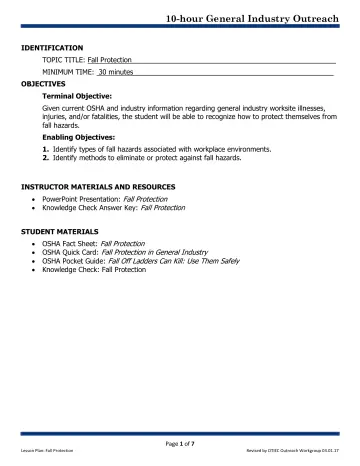
7 slidesFall Protection: Lesson Plan (OSHA 10-Hour General Industry Outreach)
Instructor lesson plan (objectives, timing, teaching steps) for the OSHA General Industry fall protection outreach deck.
U.S. Department of Labor, OSHA (with the OTIEC Outreach Workgroup)Public domain
pdf
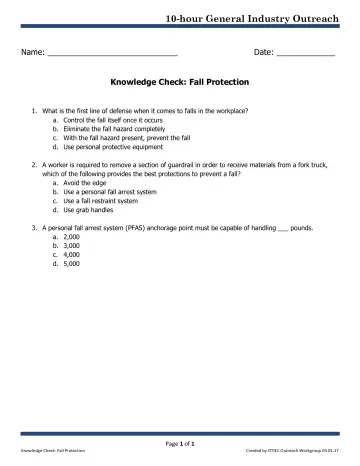
1 slidesFall Protection: Knowledge Check (OSHA 10-Hour General Industry Outreach)
Student knowledge-check quiz for the OSHA General Industry fall protection outreach deck.
U.S. Department of Labor, OSHA (with the OTIEC Outreach Workgroup)Public domain