1 / 7Use ← → to flip
Fall Protection: Lesson Plan (OSHA 10-Hour General Industry Outreach)
Instructor lesson plan (objectives, timing, teaching steps) for the OSHA General Industry fall protection outreach deck.
Page text
· 7 pages · by U.S. Department of Labor, OSHA (with the OTIEC Outreach Workgroup)
The words on each page as the author wrote them, read from the file by software so they can be searched. Layout, pictures and tables are not shown here: the pages above and the download are the original.
- Page 1
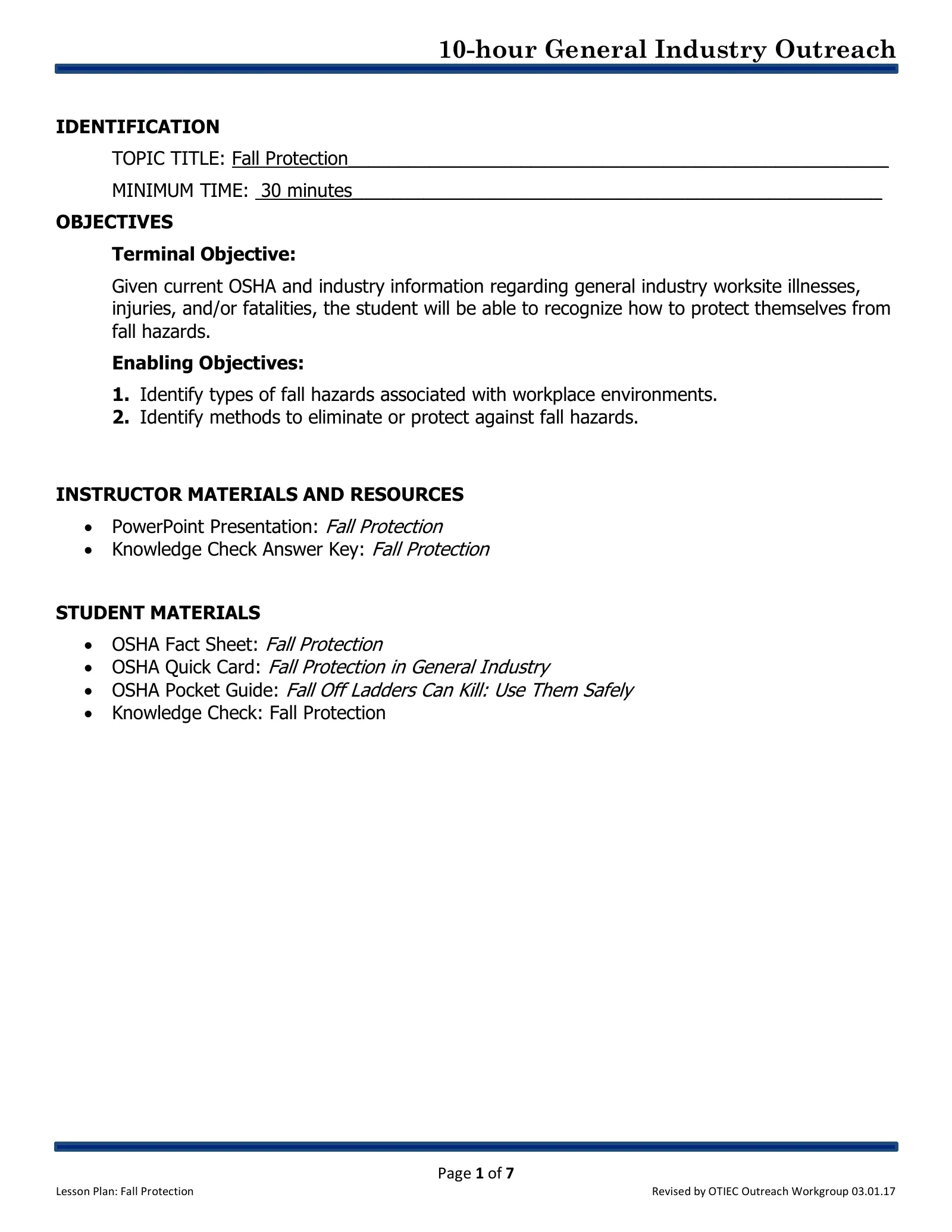
IDENTIFICATION
- TOPIC TITLE: Fall Protection___
- MINIMUM TIME: 30 mi nutes___
- OBJECTIVES
- Terminal Objective:
- Given current OSHA and industry information regarding general industry worksite illnesses, injuries, and/or fatalities, the student will be able to recognize how to protect themselves from fall hazards.
- Enabling Objectives:
- 1. Identify types of fall hazards associated with workplace environments.
- 2. Identify methods to eliminate or protect against fall hazards.
- INSTRUCTOR MATERIALS AND RESOURCES
- PowerPoint Presentation: Fall Protection
- Knowledge Check Answer Key: Fall Protection
- STUDENT MATERIALS
- OSHA Fact Sheet: Fall Protection
- OSHA Quick Card: Fall Protection in General Industry
- OSHA Pocket Guide: Fall Off Ladders Can Kill: Use Them Safely Knowledge Check: Fall Protection
- Page 2
TEACHING PROCEDURES ---Preparation, Presentation, Application, Evaluation
- Anticipatory Set (Focus Attention/Gain Interest)
- Estimated Time: ?? ho urs
- Key Points
- Methods
- NIOSH In-house FACE Report 2001-06
- Slide #2
- “An 18-year-old male sporting-goods retail-store worker (the victim) died from a head injury after falling approximately 12 feet from the top of a shelving unit. When the incident happened, the victim was in the process of retrieving a large, heavy box from the top shelf of an H-frame shelving unit. A witness reported that as the victim leaned over and grasped the box by its nylon shipping bands, one of the bands broke and the victim fell backwards off the H-frame to the concrete floor. A registered nurse (RN) who was shopping in the store witnessed the incident, and rendered cardiopulmonary resuscitation (CPR) to the victim. The store's manager called 911 and emergency rescue personnel and police arrived within minutes. The victim was life-flighted to a nearby trauma center where he died later that day from his injuries.”
- Case S tudy
- Falls are among the most common causes of serious work-related injuries and deaths. Employers must take measures in their workplaces to prevent employees from falling off overhead platforms, elevated work stations or into holes in the floor and walls.
- Slides #3 - #4
- Review lesson objectives.
- Slide #5
- Presentation (Instruction)___
- Estimated Time: ?? hours
- http://www.cdc.gov/niosh/face/In-house/full200106.html
- Key Points
- Methods
- I.
- Slides #6 - #8
- Types of fall hazards - common general industry fall hazards
- A. Overhead platforms or runways
- B. Elevated work stations
- C. Floor openings
- D. Wall openings
- E. Shelving units
- F. Storage tanks
- G. Industrial production-related units
- Page 3
II. Eliminating or protecting against general industry fall hazards
- Slides #9 - #11
- A. Eliminate the fall hazard – elimination of fall hazards is the first line of defense against falls from heights. This requires a review of the facility as well as the assigned work tasks. This is a proactive and not reactive approach. Examples would be:
- 1. Work from the ground if possible – examples:
- a. If a worker has to access the top of a tank to take a gauge reading, moving a tank gauge to ground level would engineer out the hazard.
- b. Use a drone equipped with a camera to inspect at heights
- 2. Covers – covering floor openings is a very effective way to eliminate a fall hazard, especially if access to the hole is rarely necessary.
- a. Must be designed to withstand the potential load that may be placed upon them. For example, a 36”x 36” floor-hole cover that will only experience foot traffic would be much different than one experiencing fork truck traffic.
- b. Must be secured (bolted, hinged, latched, locked) to prevent accidental displacement.
- c. The employer should communicate who is authorized to open and/or remove the cover and that when the cover is opened or removed another means of protection is necessary.
- B. Prevent the fall – prevention of fall hazards is the second line of defense when fall hazards cannot be entirely eliminated.
- Slides #12 - #14
- 1. Involves ma king changes t o the workplace to preclude the need to rely on the employee’s behavior, and personal protective equipment to prevent falls.
- 2. Prevents the employee from direct and unprotected exposure to the fall hazard.
- Page 4
3. These techniques prevent the fall before the onset. Examples would be:
- a. Guardrails – guardrail systems are vertical barriers consisting of top rails, midrails, and intermediate vertical members. Guardrail systems can also be combined with toe-boards, which are barriers that prevent materials and equipment from dropping to lower levels.
- b. Fences/barricades – fences/barricades prevent unauthorized employee exposure to fall hazards. Employers should communicate who is authorized to access this area; when exposed to the fall hazard another means of protection is necessary.
- c. Personal fall restraint systems – consists of an anchor, connectors, and a body harness or a body belt. Unlike the personal fall-arrest system (designed to stop a fall), the fall-restraint systems prevent a fall. The fall-restraint system’s anchor must support at least 3,000 pounds. Otherwise, it must be designed, installed, and used under the supervision of a qualified person.
- C. Control the fall – control of falls is the last line of defense. It should be considered only after determining that the fall hazard cannot be eliminated or prevented. Fall controls include:
- Slides #15 - #21
- 1. Personal fall arrest systems
- a. Consists of an anchor, connectors, and a body harness that work together to stop one from falling and to minimize the arrest force.
- b. Other system components may include a lanyard, a deceleration device, and a lifeline.
- c. The personal fall-arrest system is effective only if you know how all of the components work together to arrest the fall.
- 2. Positioning devices
- a. Enables the worker to work with both hands free on a surface such as a wall or other vertical structure.
- b. Typically used as protection for concrete form work and placing rebar.
- Page 5
- c. The difference between a positioning-device system and a personal fall-arrest system is that the positioning device system supports the worker on an elevated surface and limits a fall to two feet
- 3. Safety net systems
- a. Consist of mesh nets, panels, and connecting components.
- b. Typically used as protection for those who work
- 25 feet or more above lower levels.
- III. Employer Requirements – comply with all applicable
- OSHA standards related to fall protection, including:
- Slides #22 - #24
- A. Training requirements
- 1. Fall hazards associated with facility and work
- 2. Protection methods
- 3. Proper/safe use of PFAS, positioning, or fall restraint systems
- 4. Applicable OSHA standards
- B. Inspection requirements
- 1. Employer
- a. Inspect workplace for existing/potential hazards
- b. Fall hazard controls used (guardrails, covers, grates, and anchorage points)
- 2. Employee – inspect PFAS, positioning, and restraint hardware before each use
- C. Rescue requirements
- 1. PFAS requires a rescue plan
- 2. Employer must develop and communicate rescue plan to all involved
- Page 6
Application (How students apply what they learn) __
- Key Points
- Estimated Time: ?? ho urs
- Methods
- Show pictures of general industry fall hazards. Have students identify any unsafe actions or conditions and discuss related best practices.
- Evaluation/Summary
- Slides #25 - #28
- Estimated Time: 1 hour
- Key Points
- Methods
- Knowledge Che ck: Fall protection
- Slides 2 9-31
- References
- OSHA Standard
- 1910.28 - Duty to have fall protection and falling object protection.
- 1910.29 - Fall protection systems and falling object protection-criteria and practices.
- 1910.140 - Personal fall protection systems.
- 1910 Subpart I App C - Personal Fall Protection Systems Non-Mandatory Guidelines.
- 1910 Subpart I App D - Test Methods and Procedures for Personal Fall Protection Systems Non-Mandatory Guidelines.
- OSHA Publications
- Compatibility of Personal Fall Protection System Components
- Fall From a Telecommunications Tower: Fatal Facts
- Fall from Derrick: Fatal Facts
- (OSHA 3617-2012) (English: PDF*)
- (2003, September 22) (English: HTML PDF*)
- (OSHA 3710 - 2014) (English: PDF*)
- Page 7
Fall Prevention Fact Sheet
- (OSHA 3545 - 2012) (Polish: PDF*) (OSHA 3534 - 2012) (Spanish: HTML PDF*)
- (OSHA 3533 - 2012) (English: HTML PDF*)
- Fall Prevention Poster
- (OSHA 3531-04 - 2012) (English: HTML PDF*)
- (OSHA 3532-04 - 2012) (Spanish: HTML PDF*)
- Fall Prevention Wallet Card
- (OSHA 3557 - 2012) (English: PDF*) (OSHA 3664 - 2013) (Portuguese: PDF*)
- (OSHA 3564 - 2012) (Spanish: PDF*)
- Fall Prevention: Training Guide - A Lesson Plan for Employers
- (OSHA 3666 - 2014) (English PDF*) (OSHA 3727 - 2014) (Spanish PDF*)
- Fall P rotection in General I ndustry QuickCard TM
- (OSHA 3257 - 2010) (English: PDF*) (OSHA 3257 - 2010) (Spanish: PDF*)
- Fall Protection Safety for Commercial Fishing Fact Sheet
- 2011 (English: HTML PDF*)
- General Industry Walking-Working Surfaces and Fall Protection; Final Rule Fact Sheet (FS-3903-2016) (English: PDF*)
- Guardrail System for Tunnel Form Stripping Platform
- (2006, August 8) (English: HTML PDF*)
- Hazards of Misusing Wire Form Anchorage Connectors for Fall Protection (2004, September 1) (English: HTML PDF*)
- OSHA References/Resources
- Fall Protection . OSHA Safety and Health Topics. https://www.osha.gov/SLTC/fallprotection/
- Work Surface Hazard Results in Slip and Fall . OSHA video (2005).
- Scaffolding . OSHA etool (2017). https://www.osha.gov/SLTC/etools/scaffolding/index.html https://www.osha.gov/video/shipyard_accidents/05_fall_drowning.html
More on Fall Protection
pptx
31 slidesFall Protection (OSHA 10-Hour General Industry Outreach)
OSHA's own 10-hour General Industry Outreach deck on fall protection (v. 03-01-17), editable PowerPoint with trainer notes.
U.S. Department of Labor, OSHA (with the OTIEC Outreach Workgroup)Public domain
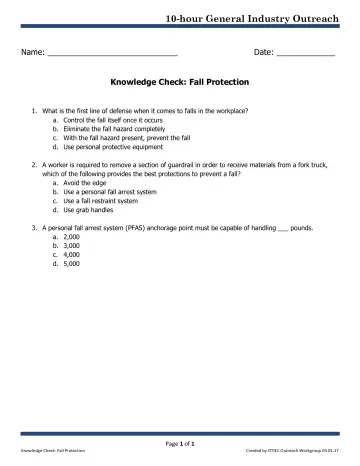
pdf
1 slidesFall Protection: Knowledge Check (OSHA 10-Hour General Industry Outreach)
Student knowledge-check quiz for the OSHA General Industry fall protection outreach deck.
U.S. Department of Labor, OSHA (with the OTIEC Outreach Workgroup)Public domain
pdfes
31 slidesProtección contra caídas (Capacitación de Extensión de 10 horas de OSHA, Industria General)
Spanish edition of OSHA's 10-hour General Industry Outreach deck on fall protection (PDF slides; OSHA does not publish an editable Spanish PowerPoint).
U.S. Department of Labor, OSHA (with the OTIEC Outreach Workgroup)Public domain