OSHA's own 10-hour General Industry Outreach deck on fall protection (v. 03-01-17), editable PowerPoint with trainer notes.
Slide text
· 31 slides · by U.S. Department of Labor, OSHA (with the OTIEC Outreach Workgroup)
The words on each slide as the author wrote them, read from the file by software so they can be searched. Layout, pictures and tables are not shown here: the slides above and the download are the original.
- Slide 1
Fall Protection
- OSHA 10-hour Outreach Training
- General Industry
- Slide 2
Introduction
- Fatal Fall
- Eighteen-Year-Old Sporting Goods Retail Store Worker Dies in a Fall From a Shelving Unit - Pennsylvania
- NIOSH In-house FACE Report 2001-06
- Slide 3
Introduction
- Slips, trips, and falls make up the majority of general industry accidents
- Are second only to motor vehicle crashes
- Slide 4
Introduction
- Unless working on a ladder, scaffold or scissor lift, OSHA requires fall protection when exposed to a
- 4-foot fall or greater.
- Source: OSHA
- Slide 5
Introduction
- Lesson Objectives
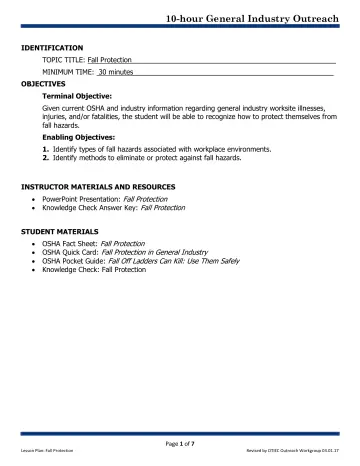
- 1. Identify types of fall hazards associated with workplace environments.
- 2. Identify methods to eliminate or protect against fall hazards.
- Slide 6
Common Fall Hazards
- Overhead Platforms
- Overhead Runways
- Elevated Work Stations
- Source of photos:
- OSHA
- Slide 7
Common Fall Hazards
- Floor Openings/Pits
- Wall Openings
- Shelving Units
- Source of photos:
- OSHA
- Slide 8
Common Fall Hazards
- Stationary Storage Tanks
- Tanker Trucks
- Industrial Production Units
- Source:
- WVU
- Source: OSHA
- Slide 9
Fall Hazard Controls
- Hierarchy of Fall Hazard Control:
- First line of defense
- Eliminate the fall hazard
- Second line of defense
- Prevent the fall
- Third and last resort
- Control the fall
- Slide 10
Fall Hazard Controls
- Eliminate fall hazards
- work from the ground
- Source:
- WVU
- Gauge at top of tank moved to ground level
- Use drone, equipped with camera, for inspections at heights
- Slide 11
Fall Hazard Controls
- Eliminate fall hazards – hole covers/grates
- Source:
- WVU
- Very effective way to eliminate a fall hazard.
- Designed to withstand intended load.
- Secured-bolted, hinged, latched, locked
- Slide 12
Fall Hazard Controls
- Prevent the fall – guardrails
- Standard railing
- Top rail, mid rail, and posts
- Height from upper surface of top rail to floor level is 42” (+/ − 3”)
- Mid-rail height is 21”
- Source: OSHA
- Standard toeboard
- 3.5” high
- Not more than ¼” clearance above the floor
- Slide 13
Fall Hazard Controls
- Prevent the fall – fences and barricades
- Source:
- WVU
- Prevents unauthorized employee exposure to fall hazard
- Employer authorizes access
- Authorized personnel must then be protected from the fall hazards within
- Slide 14
Fall Hazard Controls
- Prevent the fall – personal all restraint
- Source: OSHA
- Prevent falls by keeping worker from reaching fall hazard
- Comprised of a body belt or body harness, an anchorage, connectors
- Often used when section of guardrail or hole cover is temporarily removed
- Slide 15
Fall Hazard Controls
- Know the A, B, Cs of Personal Fall Arrest Systems
- Anchorages
- Body harness
- Components
- Source: Honeywell/Miller; used with permission.
- (connectors like snaphooks or Dee-rings, connection points, lanyards, deceleration devices, lifelines, etc.)
- Installed, used, and maintained according to the manufacturer
- Slide 16
Fall Hazard Controls
- PFAS – temporary anchorage
- Slide 17
Fall Hazard Controls
- PFAS – permanent anchorage
- Slide 18
- Slide 19
Fall Hazard Controls
- PFAS – connecting components
- Slide 20
Fall Hazard Controls
- Control the fall – positioning devices
- Source: OSHA
- Consists of a body belt and connecting device
- Keeps workers from falling, while allowing their hands to be free to perform work
- Slide 21
Fall Hazard Controls
- Control the fall – safety net systems
- Source: OSHA
- Consists of specially designed mesh nets, panels, and connecting components
- Must be designed, installed and maintained properly
- Slide 22
Employer Requirements
- Training – your employer must train you on the following:
- Fall hazards associated with your facility and your work
- Methods used to protect you from those hazards
- Proper and safe use of any personal fall arrest, positioning, or fall restraint systems
- Applicable OSHA standards
- Slide 23
Employer Requirements
- Inspection
- Your employer must inspect the:
- workplace for existing and potential fall hazards
- fall hazard controls used; such as guardrails, covers, grates, and anchorage points
- You must inspect your PFAS, Positioning and Fall Restraint hardware before each use.
- Slide 24
Employer Requirements
- Rescue
- Source: OSHA
- Personal Fall Arrest Systems require a rescue plan
- Employer must develop and communicate the rescue plan to all involved
- Slide 25
- Slide 26
- Slide 27
- Slide 28
- Slide 29
Knowledge Check
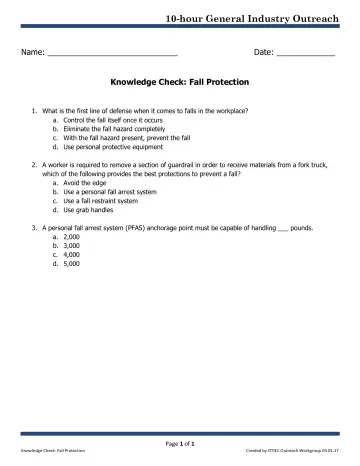
- 1. What is the first line of defense when it comes to falls in the workplace?
- a. Control the fall itself once it occurs
- b. Eliminate the fall hazard completely
- c. With the fall hazard present, prevent the fall.
- d. Use personal protective equipment
- Answer: b. Eliminate the fall hazard completely
- Slide 30
Knowledge Check
- 2. A worker is required to remove a section of guardrail in order to receive materials from a fork truck; which of the following provides the best protections to prevent a fall?
- a. Avoid the edge
- b. Use a personal fall arrest system
- c. Use a fall restraint system
- d. Use grab handles
- Answer: c. Use a fall restraint system
- Slide 31
Knowledge Check
- 3. A personal fall arrest system (PFAS) anchorage point must be capable of handling ___ pounds.
- a. 2,000
- b. 3,000
- c. 4,000
- d. 5,000
- Answer: d. 5,000