1 / 8Use ← → to flip
Scaffolds: Lesson Plan (OSHA 10-Hour Construction Outreach)
Instructor lesson plan with objectives, timing and teaching procedures for the OSHA scaffolds outreach deck.
Page text
· 8 pages · by U.S. Department of Labor, OSHA (with the OTIEC Outreach Workgroup)
The words on each page as the author wrote them, read from the file by software so they can be searched. Layout, pictures and tables are not shown here: the pages above and the download are the original.
- Page 1
IDENTIFICATION
- TOPIC TITLE: ___Scaffolds___
- MINIMUM TIME: ___30 minutes___
- OBJECTIVES
- Terminal Objective:
- Given best practices and current OSHA and industry information regarding worksite injuries and/or fatalities, the student will be able to recognize how to protect themselves from hazards associated with scaffolds.
- Enabling Objectives:
- 1. Describe the role of a competent person related to scaffolding.
- 2. Identify the types of scaffolds commonly used on construction sites.
- 3. Describe hazards associated with scaffolds.
- 4. Discuss methods to prevent hazards associated with scaffolds.
- 5. Recognize employer requirements to protect workers from scaffold hazards.
- INSTRUCTOR MATERIALS AND RESOURCES
- PowerPoint Presentation: Scaffolds
- Knowledge Check Answer Key: Scaffolds
- STUDENT MATERIALS
- Knowledge Check: Scaffolds
- Fact Sheet
- Page 2
TEACHING PROCEDURES ---Preparation, Presentation, Application, Evaluation
- Anticipatory Set (Focus Attention/Gain Interest)
- Estimated Time: ?? hours
- Key Points
- Methods
- Approximately 65% of construction workers frequently work on scaffolds. Scaffold-related accidents account for approximately 4,500 injuries and 50 fatalities every year.
- PPT slides #1 – #3
- “In a Bureau of Labor and Statistics (BLS) study, 72% of workers injured in scaffold accidents attributed the accident either to the planking or support giving way, or to the employee slipping or being struck by a falling object.” (OSHA SLTC) https://www.osha.gov/SLTC/scaffolding/index.html
- Presentation (Instruction)___
- Key Points
- Methods
- I.
- Competent person
- PPT slides #4 – #5
- A. Must oversee assembly and disassembly of scaffolds, inspection of scaffolds, and safe use of scaffolds.
- B. Must train all employees who erect, disassemble, move, operate, repair, maintain, inspect, or work on scaffolds.
- C. Process for determining and designating an employee as the competent person with regard to the type of scaffold to be used.
- II.
- Basic types of scaffolds
- PPT slide #6
- A. Supported scaffold
- 1. Rests on the ground and is supported by rigid legs, poles, frames, or outriggers
- 2. Usually made of metal poles or systems or of wood
- Page 3
B. Suspended scaffold
- 1. Consists of platforms that are suspended from above by ropes or some other type of non-rigid support
- 2. Can have a single suspension point or a double suspension point
- C. Aerial lifts
- 1. Includes vehicle-mounted or self-propelled elevating work platforms that are used to elevate personnel
- 2. May be made of metal, wood, fiberglass reinforced plastic, or other material
- 3. May be powered or manually operated
- III.
- Hazards associated with scaffolds
- PPT slide #7
- A. Falls – slips, unsafe access, lack of fall protection, or failure of scaffold platforms or planks are factors that lead to fall incidents.
- B. Falling object(s) – materials, debris, or tools may fall from a scaffold at any time and hit workers below.
- C. Electrical hazards – work on scaffolds near power lines exposes workers to electric shock or electrocution.
- D. Collapse hazards – scaffolds can collapse if not secured, level, or stable or if they are overloaded.
- E. Planking hazards – planks that are in poor condition (cracked, dry-rot, or otherwise weakened) or planks that are not placed properly are hazardous due to potential for failure or for people/objects to fall through them.
- F. Weather conditions – rain, snow, wind, lightning
- G. Collisions or struck by a construction vehicle or MV which could lead to tip-over
- Page 4
- IV.
- Eliminating or reducing scaffolding hazards
- A. Proper access
- 1. Must be provided when platforms are more than two feet above or below a point of access
- 2. Examples of permitted access include ladders, stair towers, ramps, and walkways
- 3. Do not access work surface by climbing on crossbraces or using unapproved ladder like ends
- B. Guardrails
- 1. Must be installed on open sides and ends of scaffolds
- 2. A guardrail or PFAS must be used if work platform is more than 14 inches away from work
- 3. Toprails
- a. supported scaffolds manufactured or placed in service after 1/1/2000: must be between 38-45 inches above the platform surface
- b. all suspended or supported scaffolds manufactured or placed in service before
- 1/1/2000, where both a guardrail and
- PFAS are used, must be 36-45 inches
- 4. Mid-rails
- a. Must be installed halfway between toprail and scaffold platform when used
- b. Cross-bracings used as mid-rails must be between 20-30 inches above platform
- C. Personal Fall Arrest System (PFAS)
- 1. PFAS – consists of anchorage, connectors, and body harness; may include a lanyard, deceleration device, lifeline, or combination of these
- 2. Type of fall protection depends on kind of scaffold being used
- 3. Inspect prior to each use
- 4. Should not allow a free-fall of more than 6 feet;
- there should be prompt rescue after a fall
- 5. Requirements for use of crossbracing as part of guardrail system
- Page 5
D. Protection from falling objects
- 1. When there is potential for tools, materials, equipment, or other objects to fall from a scaffold and strike workers below, protection must be provided.
- 2. Methods of providing protection:
- a. Barricades
- b. Toeboards
- c. Screens or paneling
- d. Canopy or mesh nets
- e. Placement of large, heavy objects
- 3. Wear a hardhat when working around or below scaffolds
- E. Protection from electrical hazards
- 1. Scaffolds should not be erected, used, dismantled, altered, or moved such that they or any conductive material handled on them might come closer to exposed or energized power lines than as follows:
- a. Insulated lines – minimum distance based on voltage
- i. Less than 300 volts – 3 feet
- ii. 300 volts to 50 kilovolts – 10 feet
- iii. More than 50 kilovolts – 10 feet plus 0.4 inches for each 1 kV over
- 50 kV
- b. Uninsulated lines – minimum distance based on voltage
- i. Less than 50 kV – 10 feet
- ii. More than 50 kV – 10 feet plus
- 0.4 inches for each 1 kV over
- 50 kV
- 2. Scaffolds can be closer to power lines than specified where necessary to perform work, but only after the utility company or electrical system operator is notified and do one of the following:
- a. De-energize or relocate the line.
- b. Install protective coverings to prevent contact with the lines.
- F. Moving scaffolds
- 1. Workers cannot be on scaffold when it is being moved unless the:
- a. ground surface is level,
- Page 6
- b. height of the scaffold is not more than twice the width, and
- c. outriggers are installed on both sides of the scaffold for additional leverage.
- 2. Workers cannot be on a part of the scaffold that is outside of the wheel base and a competent person has to be on site when the scaffold is being moved.
- G. Safe Scaffold Construction and Disassembly
- 1. Use appropriate scaffold construction methods.
- a. Meet platform requirements
- b. Component pieces must match
- c. Erect on stable and level ground
- d. Lock wheels and braces
- e. Meet requirements for height of scaffold to base ratio
- f. Base plates/mudsills
- g. Requirements for a professional engineer
- (PE)
- 2. Provide proper scaffold access.
- 3. Use a competent person.
- V.
- Employer Requirements
- PPT slide #17
- A. Comply with OSHA standards related to scaffolds, including
- 1. Training requirements
- 2. Inspection requirements
- 3. Designating a Competent Person who is appropriately trained and experienced
- B. Comply with manufacturers’ requirements and recommendations for scaffolding equipment.
- C. Ensure scaffold is constructed according to plans designed by the Qualified Person
- Page 7
Application (How students apply what they learn) __
- Estimated Time: ?? hours
- Key Points
- Methods
- Show pictures of jobsite activities. Have students identify hazards and corrective measures needed.
- PPT slides #18 – #22
- Evaluation/Summary
- Key Points
- Methods
- Summarize key points
- PPT slides #23 – #26
- Knowledge Check: Scaffolds
- References
- OSHA Standard:
- https://www.osha.gov/pls/oshaweb/owasrch.search_form?p_doc_type=STANDARDS&p_toc_level =1&p_keyvalue=Construction
- 1926 Subpart L - Scaffolds
- 1926.450 - Scope, application and definitions applicable to this subpart.
- 1926.451 - General requirements.
- 1926.452 - Additional requirements applicable to specific types of scaffolds.
- 1926.453 - Aerial lifts.
- 1926.454 - Training requirements.
- 1926 Subpart L App A - Scaffold Specifications
- 1926 Subpart L App B - Criteria for Determining the Feasibility of Providing Safe Access and Fall Protection for Scaffold Erectors and Dismantlers
- 1926 Subpart L App C - List of National Consensus Standards.
- 1926 Subpart L App D - List of Training Topics for Scaffold Erectors and Dismantlers.
- 1926 Subpart L App E - Drawings and Illustrations.
- Page 8
OSHA Publications
- A Guide to Scaffold Use in the Construction Industry (OSHA 3150 – 2002 [Revised])
- (English: HTML PDF) https://www.osha.gov/pls/publications/publication.athruz?pType=Industry&pID=188
- Safety Standards for Scaffolds Used in the Construction Industry, https://www.osha.gov/dte/library/scaffolds/summary.html
- OSHA References/Resources
- Scaffolding , Safety and Health Topics, OSHA https://www.osha.gov/SLTC/scaffolding/construction.html
- Scaffolding eTool , OSHA eTools, https://www.osha.gov/SLTC/etools/scaffolding/index.html
- Falls: Improper Scaffold Construction , OSHA Construction eTool, https://www.osha.gov/SLTC/etools/construction/falls/improper_scaffolds.html
- Scaffolding , OSHA PPT, Handouts, and Speaker Notes, https://www.osha.gov/dte/library/scaffolds/scaffolding/index.html
- Scaffolding Collapse, Welder Falls (2005), OSHA video, https://www.osha.gov/video/shipyard_accidents/06_scaffold_erection_accident.html
More on Scaffolds
pptx
26 slidesScaffolds (OSHA 10-Hour Construction Outreach)
OSHA's own 10-hour Construction Outreach deck on scaffold hazards: falls, collapse, falling objects and electrocution (2015 edition).
U.S. Department of Labor, OSHA (with the OTIEC Outreach Workgroup)ArchivedPublic domain
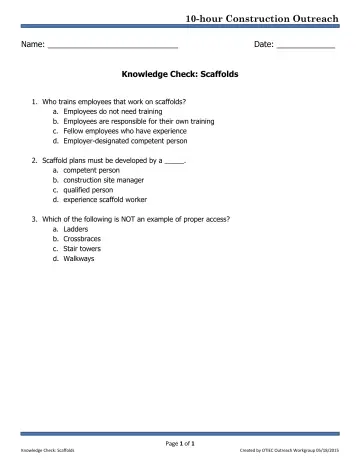
pdf
1 slidesScaffolds: Knowledge Check (OSHA 10-Hour Construction Outreach)
Student knowledge-check quiz that accompanies the OSHA scaffolds outreach deck.
U.S. Department of Labor, OSHA (with the OTIEC Outreach Workgroup)ArchivedPublic domain
pptx
56 slidesScaffolds (Residential Construction)
Scaffold safety module from the Job-Site Safety Institute residential construction course.
Job-Site Safety InstituteOSHA Harwood grant