1 / 56Use ← → to flip
Scaffolds (Residential Construction)
Scaffold safety module from the Job-Site Safety Institute residential construction course.
Slide text
· 56 slides · by Job-Site Safety Institute
The words on each slide as the author wrote them, read from the file by software so they can be searched. Layout, pictures and tables are not shown here: the slides above and the download are the original.
- Slide 1
Section 3
- SCAFFOLDS
- Slide 2
Disclaimer
- This material was produced under grant number SH-31198-SH7 from the Occupational Safety and Health Administration, U.S. Department of Labor. It does not necessarily reflect the views or policies of the U.S. Department of Labor, nor does mention of trade names, commercial products, or organizations imply endorsement by the U.S. Government.
- This presentation is intended to discuss Federal Regulations only - your individual State requirements may be more stringent as many states operate their own state OSHA and they may have adopted construction standards that are different from information presented in this training. If you live in a state with an OSHA approved state plan, you should contact your local administrator for further information on the standards applicable in your state.
- These materials are meant for informational purposes only.
- No representation is made as to the thoroughness of the presentation.
- Slide 3
Disclaimer , cont.
- It is not the intent to provide compliance-based training in this presentation, the intent is more to address hazard awareness in the residential construction (i.e. home building) industry, and to recognize the overlapping hazards present in many construction workplaces.
- Photos shown in this presentation may depict situations that are not in compliance with applicable OSHA/safety requirements.
- No legal advice is offered or implied, and no attorney-client relationship is intended or established. If legal advice or other expert assistance is required the services of a competent professional person should be sought.
- It is the responsibility of the employer and its employees to comply with all pertinent OSHA/safety rules and regulations in the jurisdiction in which they work.
- Slide 4
Copyright Information © 2018
- This material is the copyrighted property of the Job-Site Safety Institute and the National Association of Home Builders. By federal regulation, OSHA reserves a license to use and disseminate such material for the purpose of promoting safety and health in the workplace. The Job-Site Safety Institute and the National Association of Home Builders hereby authorizes employers and workplace safety and health professionals to use this material, distributed by or through OSHA, in their workplaces or practices in accordance with the guidance contained in the material.
- To this end, permission is granted to use such copyrighted material solely for non-commercial, instructional, personal, or scholarly purposes. The material may be used and incorporated into other workplace safety and health programs on the condition that no fee may be charged for the subsequent use of the material. Use of the material for any other purpose, particularly commercial use, without the prior, express written permission of the copyright owner/s is prohibited. Furthermore, any modification to the material is prohibited without the prior, express written permission of the copyright owners.
- Slide 5
Learning Objectives: Section 3
- Identify general requirements for safely building and using scaffolds.
- Identify competent person responsibilities.
- How to access scaffolds safely.
- Determine proper fall protection including guardrails and personal fall arrest systems.
- Identify safety requirements applicable to specific types of scaffolds.
- Slide 6
- Scaffolds
- Slide 7
Scaffolding
- A safe alternative to using ladders is to use:
- Interior and Exterior Scaffolding
- Aerial Lifts
- ...if OSHA requirements and safety practices are followed.
- Slide 8
Types of Scaffolding
- Three basic types:
- Supported scaffolds -- platforms supported by rigid, load bearing members, such as poles, legs, frames, & outrigger.
- Suspended scaffolds -- platforms suspended by ropes or other non-rigid, overhead support.
- Aerial Lifts -- such as “cherry pickers” or “boom trucks”.
- Slide 9
Competent Person Requirements
- Designated by the employer.
- Has the knowledge and experience required to identify existing and predictable hazards.
- Has authority to eliminate unsafe working conditions.
- Has authority to stop work if unsafe conditions exists.
- Slide 10
Competent Person Requirements
- Train employees who erect, dismantle, move, or alter scaffolds.
- Determine if it is safe for employees to work on or from a scaffold during storms or high winds.
- Inspect scaffolds and scaffold components for visible defects before each work shift.
- Slide 11
Scaffold Inspection
- Competent person
- inspects scaffolds for visible defects before each shift and after any alterations
- Defective parts must be
- immediately repaired
- Slide 12
Types of Common Scaffolds
- Fabricated Frame
- Scaffold
- Slide 13
Types of Common Scaffolds
- Pump-Jack
- Scaffold
- Slide 14
Types of Common Scaffolds
- Ladder-Jack
- Scaffold
- Slide 15
Types of Common Scaffolds
- Interior-Mobile Scaffold
- Slide 16
Types of Common Scaffolds
- Trestle Scaffold
- Slide 17
Types of Common Scaffolds
- Top-Plate
- Scaffold
- Slide 18
Interior and Exterior Scaffolding
- Job-built scaffolding that is improperly constructed is extremely hazardous.
- Various types and brands of interior and exterior scaffolding are commercially available.
- Always, follow the manufacturer’s safety instructions.
- Slide 19
Common Hazards on Jobsites
- Defective wood planks and inadequate planking overhang.
- Unsafe access to scaffold.
- Cross bracing not adequate.
- Inadequate footings.
- Bridging of scaffolds.
- Working within 10 feet of overhead power lines (discuss in greater detail)
- Slide 20
Training Requirements
- All employees must be trained prior to working on
- scaffolds.
- Qualified person must conduct the training and include the following:
- Electrical Hazards
- Fall Protection
- Falling Object Protection
- Proper Use
- Material Handling
- Load-carrying Capacities
- Slide 21
Basic Requirements
- Scaffolding that is 10 ft. or higher must be equipped with guardrails.
- A competent person must supervise the set-up and take down of all scaffolding.
- Scaffolding must be fully planked, and planks must be secured so they cannot move.
- Slide 22
Basic Requirements
- Erect/dismantle all scaffolds according to the manufacturer's Instructions
- Capacity
- Must support 4x Intended Load
- Stable Footings
- Base Plate, Screw Jacks & Mudsills
- Slide 23
Basic Requirements
- Scaffolds must be capable of supporting its own weight and at least 4 times the anticipated load.
- Expected load includes:
- Workers
- Equipment
- Tools
- Materials
- Slide 24
Requirements on Jobsites
- Front edge of all platforms must be within 14” of face of work (i.e., structure).
- Slide 25
Requirements on Jobsites
- Planks – must extend 6’’ to 12” past the end of supports or be cleated.
- Slide 26
Requirements on Jobsites
- Base Plate & Mudsill are Required
- Slide 27
Requirements on Jobsites
- Masonry Bricks &
- Blocks are not acceptable scaffold bases.
- Slide 28
Requirements on Jobsites
- Each platform on all working levels must be fully planked and secured to prevent movement.
- No more than a 1” space between decking/platform units and upright supports.
- Wood scaffold planks must be nominal 2” x 10”.
- Must be Scaffold Grade Planks or equivalent.
- Slide 29
Scaffold Access
- Ladders needed if access to scaffold is more than 2 feet.
- Do not climb cross bracing.
- Place ladders securely.
- Ladders must be positioned so they will not tip the scaffold.
- OSHA permits direct access from another scaffold, structure, or personnel hoist.
- Slide 30
Scaffold Access
- Ladders needed if
- access to scaffold is more than 2 feet.
- Slide 31
Guardrail Requirements- Scaffolds
- Toprails Between 38” and 45” High
- Guardrails to 200 lbs/Midrails to min. 75 lbs – 150 lbs depending on Toprail capacity.
- Cross Bracing OK as Guardrail if Between 20” and
- 30” for Midrail 38” to 48” for Toprail
- Protect from Falling Objects
- All Workers on Scaffolds MUST Wear Hard Hats
- Slide 32
Cross Bracing OK as Top Rail
- Cross Bracing OK as Toprail
- Toprail
- Midrail
- Slide 33
Identify the Hazards
- How many hazards
- do you see in this photo?
- Slide 34
Identify the Hazards
- How many hazards
- do you see in this photo?
- Slide 35
Identify the Hazards
- How many hazards
- do you see in this photo?
- Slide 36
Identify the Hazards
- How many hazards
- do you see in this photo?
- Slide 37
Identify the Hazards
- How many hazards
- do you see in this photo?
- Slide 38
Identify the Hazards
- How many hazards
- do you see in this photo?
- Slide 39
Identify the Hazards
- How many hazards
- do you see in this photo?
- Slide 40
Identify the Hazards
- How many hazards
- do you see in this photo?
- Slide 41
Identify the Hazards
- How many hazards
- do you see in this photo?
- Slide 42
Identify the Hazards
- Slide 43
Identify the Hazards
- Slide 44
Identify the Hazards
- Slide 45
Safe Practices - Fully Planked Scaffold
- Slide 46
Safe Practices – Pump-Jack Scaffold
- Slide 47
PFAS Used with Ladder Jack Scaffold
- Slide 48
Aerial Lifts
- Aerial lifts (e.g., JLG boom lift) or approved personnel lift
- baskets on rough terrain forklifts is a safe alternative to working from:
- Ladders, or
- other types of scaffolding.
- An aerial lift can be used for the installations of:
- windows
- soffit
- fascia
- gutters
- siding
- Slide 49
Aerial Lifts, cont .
- Slide 50
Aerial Lifts, cont .
- Slide 51
Aerial Lifts, cont.
- The competent person should:
- Restrict operation of aerial lifts or forklift vehicles to trained and authorized personnel.
- Use only commercially built personnel baskets designed for lifting workers.
- Follow the American National Standards Institute’s (ANSI) standards for using personnel lift baskets.
- Make certain that homemade boxes lifted by a forklift are not used—homemade boxes are unacceptable.
- Slide 52
- Aerial Lifts, cont.
- When in the lift:
- Wear a full body harness.
- Attach the lanyard to the boom or an approved anchor point inside the basket.
- Slide 53
Proper use of PFAS in Basket
- Slide 54
Aerial Lifts, cont.
- When in the lift:
- Always stand on the floor of the basket.
- Do not sit or climb on the edge of the basket, lean over the edge, or climb out of the basket.
- Do not use a ladder or other objects to increase reach.
- Slide 55
Aerial Lifts, cont.
- When operating the lift:
- Stay at the controls at all times.
- Do not move the vehicle while a person is in the elevated basket.
- Only use the equipment when it is on stable and level ground.
- Maintain the required minimum clearance of 10 ft. (3
- m) from power lines carrying 50 kilovolts or less.
- Slide 56
Why a harness is necessary.
More on Scaffolds
pptx
26 slidesScaffolds (OSHA 10-Hour Construction Outreach)
OSHA's own 10-hour Construction Outreach deck on scaffold hazards: falls, collapse, falling objects and electrocution (2015 edition).
U.S. Department of Labor, OSHA (with the OTIEC Outreach Workgroup)ArchivedPublic domain
pdf
8 slidesScaffolds: Lesson Plan (OSHA 10-Hour Construction Outreach)
Instructor lesson plan with objectives, timing and teaching procedures for the OSHA scaffolds outreach deck.
U.S. Department of Labor, OSHA (with the OTIEC Outreach Workgroup)ArchivedPublic domain
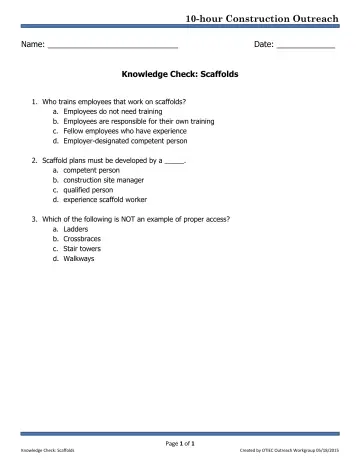
pdf
1 slidesScaffolds: Knowledge Check (OSHA 10-Hour Construction Outreach)
Student knowledge-check quiz that accompanies the OSHA scaffolds outreach deck.
U.S. Department of Labor, OSHA (with the OTIEC Outreach Workgroup)ArchivedPublic domain