OSHA's own 10-hour Construction Outreach deck on scaffold hazards: falls, collapse, falling objects and electrocution (2015 edition).
Slide text
· 26 slides · by U.S. Department of Labor, OSHA (with the OTIEC Outreach Workgroup)
The words on each slide as the author wrote them, read from the file by software so they can be searched. Layout, pictures and tables are not shown here: the slides above and the download are the original.
- Slide 1
Scaffolds
- 10-Hour Construction Outreach
- Slide 2
Scaffolds
- source: www.elcosh.org/NIOSH/John Rekus
- Slide 3
Scaffolds
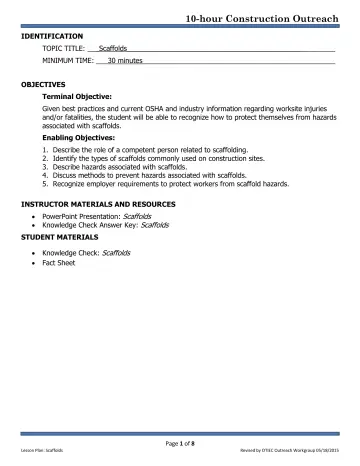
- Lesson Overview
- Competent person
- Basic types of scaffolds
- Scaffold hazards
- Methods of protecting against scaffold hazards
- Employer requirements
- NIOSH/John Rekus/elcosh.org
- Slide 4
Competent Person
- Oversees assembly, disassembly, inspection, and safe use of scaffolds
- Trains all employees who erect, disassemble, move, operate, repair, maintain, inspect, or work on scaffolds
- Source: OSHA
- Slide 5
Competent Person
- Process for designating an employee as the competent person:
- Employer appointed
- Capability to identify hazards
- Executes qualified person design
- Authority to take prompt corrective action
- Slide 6
Basic Types of Scaffolds
- Suspended
- Supported
- Aerial lifts
- Slide 7
Hazards Associated with Scaffolds
- Falls
- Falling object(s)
- Electrical hazards
- Collapse hazards
- Planking hazards
- Weather conditions
- Collisions or struck-by
- Source: OSHA
- Slide 8
Reducing and Eliminating Hazards
- Proper access
- Guardrails
- Personal Fall Arrest System (PFAS)
- Protection from falling objects
- Protection from electrical hazards
- Precautions for moving scaffolds
- Safe scaffold construction and disassembly
- Slide 9
Proper Access
- Required when platforms are more than two feet above or below a point of access
- Examples of permitted access - ladders, stair towers, ramps, walkways
- Do not use crossbraces or unapproved ladder-like ends for access
- Slide 10
Guardrails
- Must be installed on open sides and ends of scaffolds
- If front edge (working edge) is more than 14 inches from work, guardrail and/or PFAS system must be used
- Slide 11
Guardrails
- Toprails
- Supported scaffolds manufactured or placed in service after 1/1/2000 must be 38-45” above platform
- Midrails
- When used
- Halfway between toprail and scaffold platform
- Crossbracing, when used as a toprail or midrail, must meet certain height requirements
- Slide 12
Personal Fall Arrest System (PFAS)
- Components
- Selection of fall protection
- Engineering or qualified person design
- When to inspect
- Free-fall limit
- Source: OSHA
- Slide 13
Protection From Falling Objects
- Protection must be provided when there is potential of being struck by falling objects
- Methods of protection
- Barricades, toeboards, screens or paneling, canopy or mesh nets, placement of large, heavy objects
- Source: OSHA
- Wear a hardhat when working around or below scaffolds
- Slide 14
Protection From Electrical Hazards
- Minimum distance based on voltage
- Insulated lines
- Uninsulated lines
- When exceeding minimum distance as necessary to perform work, utility company must be notified to
- De-energize or relocate line OR
- Install protective coverings to prevent contact
- Source: OSHA
- Slide 15
Moving Scaffolds
- Workers may only be on moving scaffold when
- Level ground surface
- Height to width ratio
- Outriggers installed on both sides
- Standing inside the wheel base
- Competent person onsite
- Source: OSHA
- Slide 16
Safe Scaffold Construction and Disassembly
- Appropriate scaffold construction methods
- Provide proper scaffold access
- Use a competent person
- Manufacturers’ instructions
- Slide 17
Employer Requirements
- Comply with OSHA standards related to scaffolds
- Training
- Inspection
- Designating competent person
- Comply with manufacturers’ requirements and recommendations
- Follow plans designed by qualified person
- Slide 18
Scaffold Hazard Recognition
- Identify hazards and solutions
- Source: www.elcosh/org/OTI/Southwest Education Center
- Slide 19
Scaffold Hazard Recognition
- Identify hazards and solutions
- Source: www.elcosh/org/OTI/Southwest Education Center
- Slide 20
Scaffold Hazard Recognition
- Identify hazards and solutions
- Source: www.elcosh/org/OTI/Southwest Education Center
- Slide 21
Scaffold Hazard Recognition
- Identify hazards and solutions
- Source: www.elcosh/org/OTI/Southwest Education Center
- Slide 22
Scaffold Hazard Recognition
- Identify hazards and solutions
- Source: www.elcosh/org/OTI/Southwest Education Center
- Slide 23
Always Remember
- Employers must
- Designate a competent person for scaffold
- Ensure that employees are trained in proper assembly, disassembly, and use of scaffolds
- Utilize strategies to prevent and reduce scaffold hazards
- www.elcosh.org/Steve Clark/Laborers
- Slide 24
Knowledge Check
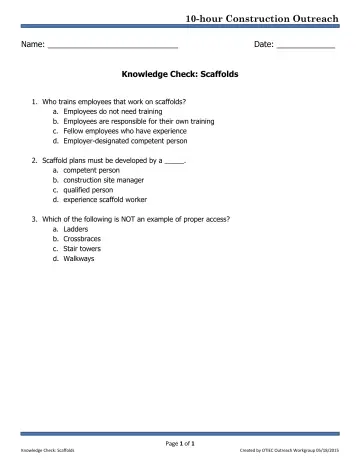
- 1. Who trains employees that work on scaffolds?
- a. Employees do not need training
- b. Employees are responsible for their own training
- c. Fellow employees who have experience
- d. Employer-designated competent person
- Slide 25
Knowledge Check
- 2. Scaffolds must be designed by a ___.
- a. Competent person
- b. Construction site manager
- c. Qualified person
- d. Experienced scaffold worker
- Slide 26
Knowledge Check
- 3. Which of the following is NOT an example of proper access?
- a. Ladders
- b. Crossbraces
- c. Stair towers
- d. Walkways