1 / 54Use ← → to flip
Safety and Health Programs (OSHA 10-Hour General Industry Outreach)
OSHA's own 10-hour General Industry Outreach deck on safety and health programs (v. 03-01-17), editable PowerPoint with trainer notes.
Slide text
· 53 of 54 slides · by U.S. Department of Labor, OSHA (with the OTIEC Outreach Workgroup)
The words on each slide as the author wrote them, read from the file by software so they can be searched. Layout, pictures and tables are not shown here: the slides above and the download are the original.
- Slide 1
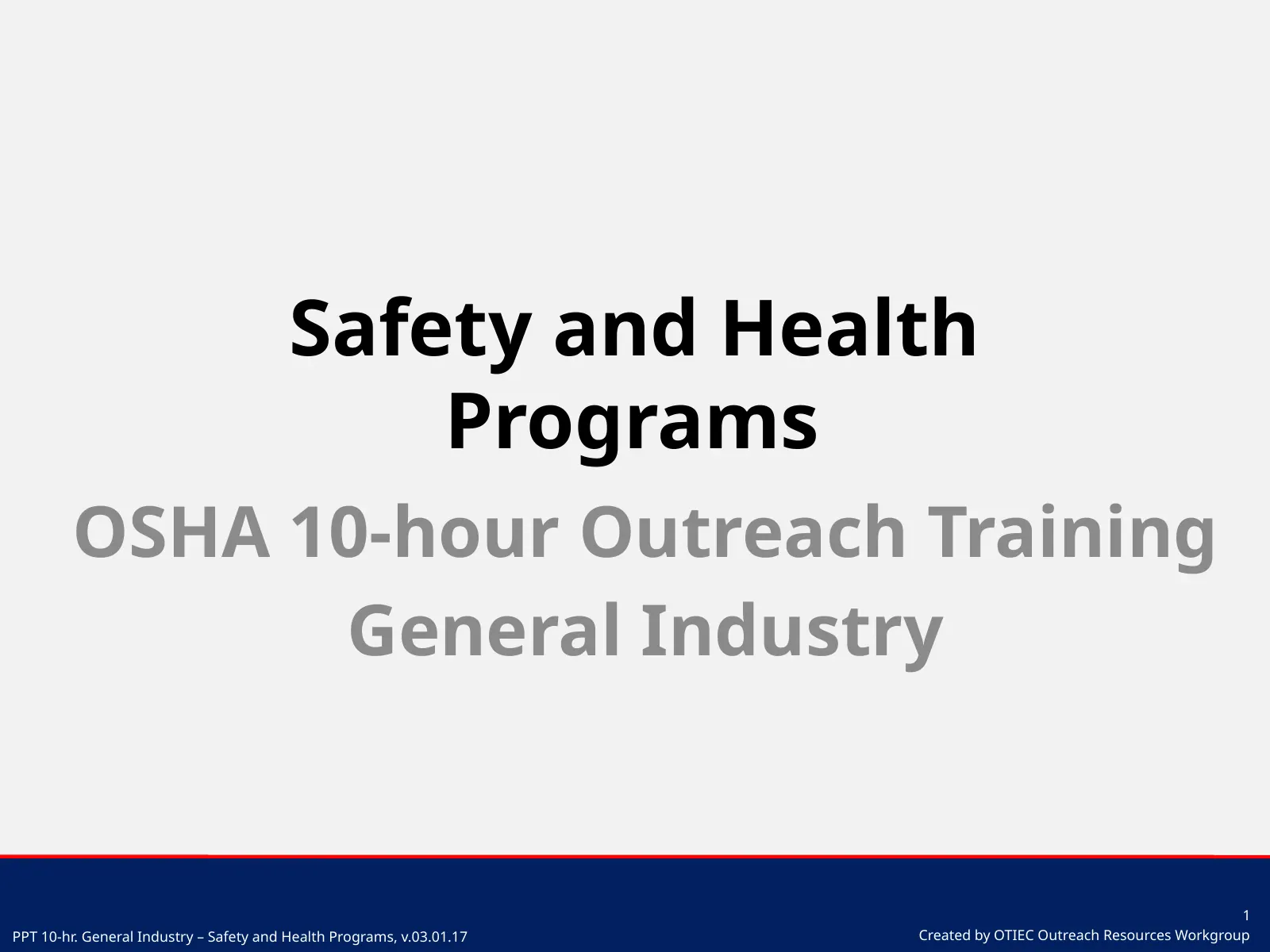
Safety and Health
- Programs
- OSHA 10-hour Outreach Training
- General Industry
- Slide 2
Introduction
- Each year, thousands of workers die as a result of exposure to hazards in the workplace. Safety and Health Programs can help reduce these fatalities through a proactive approach to finding and fixing hazards before they cause injury, illness, or death.
- Slide 3
Introduction
- Lesson objectives:
- 1. Recognize the costs of workplace accidents.
- 2. Recognize benefits of implementing an effective safety and health program.
- 3. Describe the elements of an effective safety and health program.
- 4. Identify three methods to prevent workplace hazards.
- Slide 4
Costs of Accidents
- Direct costs:
- Cost of treatment
- Cost of physician and hospital
- Cost of medications
- Cost of medical equipment
- Source: NIOSH
- Slide 5
Costs of Accidents
- Indirect costs:
- Schedule delays
- Lower morale
- Increased Absenteeism
- Poor Customer Relations
- Re-training
- Slide 6
Benefits of Safety & Health Programs
- Pros of Safety and Health Programs
- Cons of Safety and Health Programs
- Source: OSHA
- Slide 7
Benefits of Safety & Health Programs
- Benefits may include:
- Improvements in product, process, and service quality
- Better morale
- Improved recruiting and retention
- More favorable image and reputation
- Source: OSHA
- Slide 8
- Source: OSHA
- Slide 9
Management Leadership
- Action Item 1: Communicate your commitment to Safety and Health Programs
- How to accomplish it:
- Establish a written safety and health policy statement signed by top management
- Communicate the policy to all workers, contractors, unions, supplier, visitors, customers, etc.
- Slide 10
Management Leadership
- Action Item 2: Define program goals and expectations
- How to accomplish it:
- Establish realistic, attainable and measurable goals that demonstrate progress toward improving safety and health
- Develop safety and health plans
- Slide 11
Management Leadership
- Action Item 3: Allocate Resources
- How to accomplish it:
- Integrate safety and health into planning and budgeting
- Allow time in workers schedule for participation
- Slide 12
Management Leadership
- Action Item 4: Expect Performance
- How to accomplish it:
- Define and communicate responsibilities and authorities for accountability
- Set an example for workers by following the same procedures
- Slide 13
- Source: OSHA
- Slide 14
Worker Participation
- Action Item 1: Encourage workers to report safety and health concerns
- How to accomplish it:
- Establish a process to report injuries, near misses and other safety and health concerns
- Empower workers to temporarily suspend work they feel is unsafe
- Slide 15
Worker Participation
- Action Item 2: Encourage participation in the program
- How to accomplish it:
- Provide positive reinforcement to workers who participate
- Maintain an open-door policy, inviting workers to speak to managers about safety and health
- Slide 16
Worker Participation
- Action Item 3: Involve workers in all aspects of the program
- To accomplish, allow workers to be involved in:
- Developing a program
- Reporting hazards and developing solutions
- Analyzing hazards
- Defining safe work practices
- Conducting site inspections
- Participating in incident/near-miss investigations
- Serving as trainers
- Developing and evaluating training programs
- Slide 17
Worker Participation
- Action Item 4: Give workers access to safety and health information
- To accomplish, give workers information they need to understand safety and health hazards:
- Safety Data Sheets
- Injury Illness Data
- Results of exposure monitoring
- Slide 18
Worker Participation
- Action Item 5: Remove barriers to participation
- How to accomplish it:
- Ensure workers from all levels of the organization can participate regardless of skill level, education, or language
- Ensure policies and programs do not discourage worker participation
- Slide 19
- Source: OSHA
- Slide 21
Hazard Identification
- Action Item 1: Collect existing information about workplace hazards
- How to accomplish it:
- Collect, organize and review information to determine what types of hazards are present and workers exposed
- Slide 22
Hazard Identification
- Action Item 2: Inspect the workplace
- How to accomplish it:
- Routine inspections of workflow, equipment, materials and talk to workers
- Use checklists
- Slide 23
Hazard Identification
- Action Item 3: Conduct Incident Investigations
- How to accomplish it:
- Develop a plan and procedure to begin investigation immediately after an incident or near miss.
- Conduct root cause analysis and investigate with a team.
- Slide 24
Hazard Identification
- Action Item 4: Identify hazards associated with emergency and non-routine situations
- How to accomplish it:
- Assess foreseeable emergency scenarios or non-routine tasks
- Conduct “table top” exercises to help you plan and test your response plan and procedures
- Slide 25
Hazard Identification
- Action Item 5: Characterize the nature of identified hazards, determine the controls to be implemented and prioritize the hazards for control
- How to accomplish it:
- Evaluate each hazard by considering the severity of potential outcomes, the likelihood that an event will occur and the number of workers exposed
- Prioritize hazards so that the greatest risks are addressed first
- Use interim control measures to protect workers until more permanent solutions can be implemented
- Slide 26
- Source: OSHA
- Slide 27
Hazard Prevention and Control
- Action Item 1: Identify control options
- How to accomplish it:
- Review literature, OSHA standards, NIOSH publications, etc. for potential control measures
- Get input from workers, safety consultants, or investigate other workplaces with similar hazards
- Slide 28
Hazard Prevention and Control
- Action Item 2: Select controls
- How to accomplish it:
- Select controls using the hierarchy of controls
- Use a combination when no single method fully protects the worker
- Slide 29
Hazard Prevention and Control
- Action Item 3: Develop and update a hazard control plan
- How to accomplish it:
- List hazards in order of priority, assign responsibility to a person(s), establish a target completion date.
- Plan how to track progress and verification of implementation
- Slide 30
Hazard Prevention and Control
- Action Item 4: Select controls for emergency and non-routine operations
- How to accomplish it:
- Develop procedures to control hazards during these situations.
- Assign responsibility for implementing the plan and conduct emergency drills.
- Slide 31
Hazard Prevention and Control
- Action Item 5: Implement selected controls in the workplace
- How to accomplish it:
- Implement controls starting with highest priority, however, regardless of priority employers must protect workers from recognized serious hazards
- Slide 32
Hazard Prevention and Control
- Action Item 6: Follow up to confirm that controls are effective
- How to accomplish it:
- Conduct regular inspections of controls, confirm that work practices are being followed.
- Track progress and implementation
- Slide 33
- Source: OSHA
- Slide 34
Education and Training
- Action Item 1: Provide program awareness training
- How to accomplish it:
- Provide training to all managers, supervisors and workers as well as contractors and temporary workers on: safety policies and procedures, program functions, emergencies, injury illness reporting, and their rights under the OSH Act
- Ensure the training is provided in a language and literacy level that all workers can understand
- Slide 35
Education and Training
- Action Item 2: Train workers on specific roles and responsibilities in the safety and health program
- How to accomplish it:
- Instruct workers with specific roles within the safety and health program on how they should carry out those responsibilities
- Provide opportunities for workers to ask questions and offer feedback during training
- Slide 36
Education and Training
- Action Item 3: Train workers on hazard identification and controls
- How to accomplish it:
- Train managers and works on techniques for identifying hazards; such as job hazard analysis
- Have workers demonstrate they can recognize hazards and understand why controls are in place
- Provide training on new tasks and new assignments
- Provide training where required by specific OSHA standards such as; hazard communication and lockout/tagout
- Slide 37
- Source: OSHA
- Slide 38
Program Evaluation
- Action Item 1: Verify the program is implemented and is operating
- How to accomplish it:
- Verify the core elements of the program are fully met and key processes are in place and implemented
- Verify injuries are being reported, inspections are conducted, progress is being tracked in controlling identified hazards to ensure control measures are effective and data collected to monitor the programs performance
- Slide 39
Program Evaluation
- Action Item 2: Correct program deficiencies and identify opportunities to improve
- How
- to accomplish it:
- Proactively seek input from managers, workers, supervisors and other stakeholders on how you can improve the program
- Determine whether changes in equipment, facilities, material, personnel or work practices trigger any need for changes in the program
- Determine whether the metrics and goals are still relevant and how you could change them to more effectively drive improvements
- Slide 40
- Source: OSHA
- Slide 41
Multi-Employer Worksites
- Action Item 1: Management Leadership
- How to accomplish it:
- Provide a copy of the safety and health policy to all contractors
- Before beginning on-site work, clarify each employer’s responsibilities and obligations, such as;
- Providing training
- Selecting, providing and maintaining PPE
- Recording and reporting any injuries or illnesses Procedures for communication between host employer and all contractors
- Slide 42
Multi-Employer Worksites
- Action Item 2: Worker Participation
- How to accomplish it:
- Encourage employees to raise safety concerns
- Identify and remove any obstacles to their participation in a program or reporting
- Slide 43
Multi-Employer Worksites
- Action Item 3: Hazard Identification and Assessment
- How to accomplish it:
- Host employer performs a worksite hazard assessment and shares the results
- Contractors perform pre-job hazard assessments of the work they will perform
- Slide 44
Multi-Employer Worksites
- Action Item 4: Hazard Prevention and Control
- How to accomplish it:
- Before beginning work, the host employer gives contractors information about programs and procedures to control workers’ exposure to hazards
- Slide 45
Multi-Employer Worksites
- Action Item 5: Education and Training
- How to accomplish it:
- The host employer and contractor identify any qualifications and certifications required by the workers
- Temporary and contract workers also receive appropriate hazard and standard specific training
- Slide 46
Multi-Employer Worksites
- Action Item 6: Program Evaluation and Improvement
- How to accomplish it:
- Exchange data on metrics tracks and use this data to evaluate the program’s effectiveness
- All contractors should participate in these evaluations
- Sharing the results of the evaluations with contractors, subcontractors and temporary staffing agencies who can then inform the affected workers of the results
- Slide 47
Prevent/Control Workplace Hazards
- Methods to prevent/control workplace hazards:
- Benefits of effective controls
- Protect workers from hazards
- Help avoid injuries, illnesses, and incidents
- Minimize/eliminate safety and health risks
- Help employers provide safe/healthful working conditions
- Source: OSHA
- Slide 48
Prevent/Control Workplace Hazards
- Involve workers
- Understand conditions that create hazards
- Insights into how hazards can be controlled
- Source of photos: OSHA
- Slide 49
Prevent/Control Workplace Hazards
- Identify and evaluate options
- Source: NIOSH
- Slide 50
Prevent/Control Workplace Hazards
- Use a hazard control plan
- Develop plans with measures to protect workers during emergencies and non-routine activities
- Evaluate effectiveness of existing controls and review new technologies
- Slide 51
Summary
- OSHA encourages employers to create a proactive approach for finding and fixing hazards in the workplace.
- An effective safety and health program increases worker involvement, management commitment and allows employers to better manager their resources, personnel and environment.
- Slide 52
Knowledge Check
- 1. Which of the following is a benefit from implementing an effective safety and health program?
- a. Higher morale of the workforce
- b. Improved company reputation
- c. Lower Worker Compensation Insurance rates
- d. All of the above
- Answer: d. All of the above
- Slide 53
Knowledge Check
- 2. Which of the following is a direct cost of an accident?
- a. Lost production
- b. Retraining of new workers
- c. Physicians examination
- d. Poor customer relations
- Answer: c. Physicians examinations
- Slide 54
Knowledge Check
- 3. Employers must correct all identified hazards; however, which of the following hazards should the employer work to correct first?
- a. Guard missing on a piece of equipment, used every 6 months
- b. Broken rung on ladder, used daily by the entire crew
- c. Loose handrail on a dozer, used by a single equipment operator
- d. Wet floor by an eyewash station, in a path not travelled by personnel
- Answer: b. Broken rung on ladder used daily by the entire crew
More on Programs
pdf
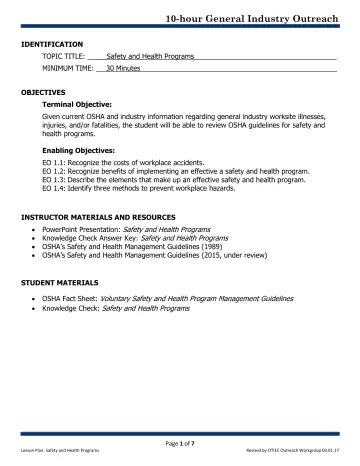
7 slidesSafety and Health Programs: Lesson Plan (OSHA 10-Hour General Industry Outreach)
Instructor lesson plan (objectives, timing, teaching steps) for the OSHA General Industry safety and health programs outreach deck.
U.S. Department of Labor, OSHA (with the OTIEC Outreach Workgroup)Public domain
pdf
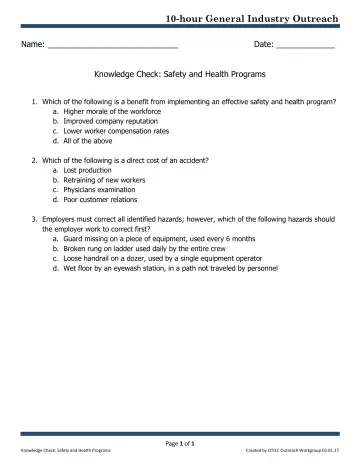
1 slidesSafety and Health Programs: Knowledge Check (OSHA 10-Hour General Industry Outreach)
Student knowledge-check quiz for the OSHA General Industry safety and health programs outreach deck.
U.S. Department of Labor, OSHA (with the OTIEC Outreach Workgroup)Public domain
pdfes
54 slidesProgramas de seguridad y salud (Capacitación de Extensión de 10 horas de OSHA, Industria General)
Spanish edition of OSHA's 10-hour General Industry Outreach deck on safety and health programs (PDF slides; OSHA does not publish an editable Spanish PowerPoint).
U.S. Department of Labor, OSHA (with the OTIEC Outreach Workgroup)Public domain