1 / 7Use ← → to flip
Safety and Health Programs: Lesson Plan (OSHA 10-Hour General Industry Outreach)
Instructor lesson plan (objectives, timing, teaching steps) for the OSHA General Industry safety and health programs outreach deck.
Page text
· 7 pages · by U.S. Department of Labor, OSHA (with the OTIEC Outreach Workgroup)
The words on each page as the author wrote them, read from the file by software so they can be searched. Layout, pictures and tables are not shown here: the pages above and the download are the original.
- Page 1
IDENTIFICATION
- TOPIC TITLE: ___Safety and Health Programs___
- MINIMUM TIME: _ _30 Minutes___
- OBJECTIVES
- Terminal Objective:
- Given current OSHA and industry information regarding general industry worksite illnesses, injuries, and/or fatalities, the student will be able to review OSHA guidelines for safety and health programs.
- Enabling Objectives:
- EO 1.1: Recognize the costs of workplace accidents.
- EO 1.2: Recognize benefits of implementing an effective a safety and health program. EO 1.3: Describe the elements that make up an effective safety and health program. EO 1.4: Identify three methods to p revent workplace hazards.
- INSTRUCTOR MATERIALS AND RESOURCES
- PowerPoint Presentation: Safety and Health Programs
- Knowledge Check Answer Key: Safety and Health Programs
- OSHA’s Safety and Health Management Guidelines (1989)
- OSHA’s Safety and Health Management Guidelines (2015, under review)
- STUDENT MATERIALS
- OSHA Fact Sheet: Voluntary Safety and Health Program Management Guidelines Knowledge Check: Safety and Health Programs
- Page 2
TEACHING PROCEDURES ---Preparation, Presentation, Application, Evaluation
- Anticipatory Set (Focus Attention/ Gain I nterest)
- Estim ated Tim e: ?? hours
- Key Points
- Methods
- Each year, t housands of workers die as a result of exposure to hazards in the workplace.
- Slides #1 - #3
- OSHA encourages employers to create a proactive approach for finding and fixing hazards before they cause injury, illness or death. By implementing safety and health programs, employers of all sizes can better manage their resources, personnel and environment.
- Safety and health programs increase worker involvement and management commitment for improved safety in the workplace.
- Review lesson objectives.
- P resentation (I nstruction)___
- Key Points
- Methods
- I.
- Costs of Accidents
- A. Direct costs
- 1. Treatment
- 2. Physician and hospital
- 3. Medications
- 4. Medical equipment
- B. Indirect costs
- 1. Schedule delays
- 2. Lower morale
- 3. Increased absenteeism
- 4. Poor customer relations
- 5. Damaged equipment
- Slides #4 - #5
- II.
- Benefits of Safety and Health Programs
- A. Improvements in product, process, and service
- B. Better workplace morale
- C. Improved recruitment and retention
- D. More favorable image and reputation
- Slides #6 - #7
- Page 3
- III.
- Elements of Safety and Health Programs
- Slides #8 - #46
- A. Management Leadership
- 1. Commitment
- a. Establish written safety and health policy
- b. Communicate policy
- 2. Goals and Expectations
- a. Establish realistic, attainable, and measurable goals
- b. Develop safety and health plans
- 3. Resources
- a. Integrate into planning and budgeting
- b. Allow time for workers to participate
- 4. Performance
- a. Communicate responsibilities and authorities for accountability
- b. Set an example
- B. Worker Participation
- 1. Report safety and health concerns
- a. Establish reporting processes
- b. Empower workers (temporary work-stop if unsafe)
- 2. Encourage participation in program
- a. Provide positive reinforcement
- b. Maintain an open-door policy
- 3. Involve workers in all aspects of program
- a. Program development
- b. Hazard reports and solutions
- c. Hazard analysis
- d. Safe work practices
- e. Site inspections
- f. Incident/near-miss investigations
- g. Training
- h. Training program development/evaluation
- 4. Access to safety and health information
- a. Safety data sheets
- b. Injury/Illness data
- c. Results of exposure monitoring
- Page 4
- 5. Remove barriers to participation
- a. Participation from all levels – regardless of skill level, education, or language
- b. Policies/programs don’t discourage participation
- C. Hazard Identification and Assessment
- 1. Collect existing information
- 2. Inspect the workplace
- a. Routine inspections
- b. Checklists
- 3. Conduct incident investigations
- a. Plan/procedures for investigations
- b. Root cause analysis and team investigation
- 4. Identify emergency and non-routine situations
- a. Assess foreseeable emergency scenarios or non-routine tasks
- b. Conduct “table top” exercises
- 5. Characterize hazards and determine controls
- a. Evaluate each hazard – severity and likelihood
- b. Prioritize hazards
- c. Use interim control measures
- D. Hazard Prevention and Control
- 1. Identify control options
- 2. Select controls
- 3. Develop/update hazard control plan
- 4. Select controls for emergency and non-emergency operations
- 5. Implement controls
- 6. Follow up on effectiveness of controls
- E. Education and Training
- 1. Provide program awareness training
- a. All managers, supervisors, workers; also, contractors and temporary workers
- b. Safety policies and procedures, program functions, emergencies, injury/illness reporting,
- Rights under the OSH Act
- c. Appropriate language and literacy level
- 2. Specific roles and responsibilities of workers
- 3. Hazard identification and controls
- Page 5
F. Program Evaluation and Improvement
- 1. Verify implementation and operation of program
- 2. Correct deficiencies and identify opportunities for improvement
- G. Multi-Employer Worksites
- 1. Management leadership
- a. Provide safety and health policy to all contractors
- b. Clarify each employer’s responsibilities and obligations before beginning work
- 2. Worker participation
- a. Encourage participation
- b. Remove obstacles
- 3. Hazard identification and assessment
- a. Host – performs/shares worksite hazard assessment
- b. Contractors – performs pre-job hazard assessment
- 4. Hazard prevention and control – communicate programs/procedures to control hazards
- 5. Education and training
- a. Host and contractor(s) – identify required worker qualifications and certifications
- b. Train temporary and contract workers
- 6. Program evaluation and improvement
- a. Exchange/use data to evaluate program effectiveness
- b. Participation by all contractors
- c. Share results
- IV.
- Methods to Prevent/Control Workplace Hazards
- A. Involve workers
- 1. Best understanding of conditions that create hazards
- 2. Best insights into how hazards can be controlled
- B. Identify and evaluation options for controlling hazards
- 1. Hierarchy of controls
- a. Elimination – physically remove the hazard
- b. Substitution – replace the hazard
- Slides #47 - #50
- Page 6
- c. Engineering controls – isolate people from the hazard
- d. Administrative controls – change the way people work
- e. Personal Protective Equipment – protect the worker with PPE
- 2. Avoid selecting controls that may introduce new hazards
- 3. Use a combination of controls when no single method fully protects workers
- C. Use a hazard control plan
- D. Develop plans with measures to protect workers during emergencies and non-routine activities
- E. Evaluate effectiveness of existing controls and review new technologies
- Application (How students apply w hat they learn) __
- Key Points
- Estim ated Tim e: ?? hours
- Methods
- Job Safety Analysis; Have students evaluate hazards, determining what controls should be implemented before work begins.
- Evaluation/ Sum m ary
- Key Points
- Methods
- Summarize key points
- Slides #51 - #54
- Knowledge Check: Safety and Health Programs
- Page 7
R eferences___
- OSHA Publications
- Recommended Practices for Safety and Health Programs (OSHA #3885, October 2016) https://www.osha.gov/shpguidelines/docs/OSHA_SHP_Recommended_Practices.pdf
- Safety and Health Management Guidelines (1989) https://www.osha.gov/pls/oshaweb/owadisp.show_document?p_table=FEDERAL_REGISTER&p_id=12909
- Safety and Health Management Guidelines (2015, under review) https://www.osha.gov/shpmguidelines/SHPM_guidelines.pdf
- Voluntary Safety and Health Program Management Guidelines https://www.osha.gov/pls/oshaweb/owadisp.show_document?p_table=FEDERAL_REGISTER&p_id=12909
- Job Hazard Analysis
- https://www.osha.gov/Publications/osha3071.pdf?utm_source=rss&utm_medium=rss&utm_ca mpaign=job-hazard-analysis-13
- OSHA References/Resources
- Sample Programs
- https://www.osha.gov/dcsp/compliance_assistance/sampleprograms.html
- Safety and Health Program E-tools https://www.osha.gov/SLTC/etools/safetyhealth/
- Injury and Illness Prevention Video https://www.osha.gov/dsg/topics/safetyhealth/i2p2video.html
- Hazard Identification Training Tool https://www.osha.gov/hazfinder/
More on Programs
pptx
54 slidesSafety and Health Programs (OSHA 10-Hour General Industry Outreach)
OSHA's own 10-hour General Industry Outreach deck on safety and health programs (v. 03-01-17), editable PowerPoint with trainer notes.
U.S. Department of Labor, OSHA (with the OTIEC Outreach Workgroup)Public domain
pdf
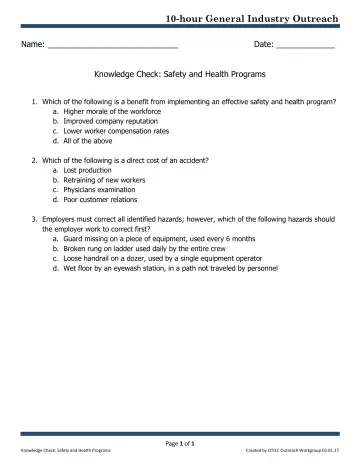
1 slidesSafety and Health Programs: Knowledge Check (OSHA 10-Hour General Industry Outreach)
Student knowledge-check quiz for the OSHA General Industry safety and health programs outreach deck.
U.S. Department of Labor, OSHA (with the OTIEC Outreach Workgroup)Public domain
pdfes
54 slidesProgramas de seguridad y salud (Capacitación de Extensión de 10 horas de OSHA, Industria General)
Spanish edition of OSHA's 10-hour General Industry Outreach deck on safety and health programs (PDF slides; OSHA does not publish an editable Spanish PowerPoint).
U.S. Department of Labor, OSHA (with the OTIEC Outreach Workgroup)Public domain