1 / 47Use ← → to flip
Safety and Health Programs
TEEX deck on safety and health program management guidelines.
Slide text
· 47 slides · by Texas Engineering Extension Service
The words on each slide as the author wrote them, read from the file by software so they can be searched. Layout, pictures and tables are not shown here: the slides above and the download are the original.
- Slide 1
Safety and Health Programs
- MODULE 7
- Slide 2
Brainstorm
- What makes a good safety and health program?
- What does a good program do for you?
- Slide 3
Benefits of Effective Safety and Health Programs
- Reduce injuries & illnesses
- Improve morale & productivity
- Reduce workers’ compensation costs
- Show good faith efforts
- Slide 4
Exemplary Workplaces:
- Assign responsibility to managers, supervisors, and workers
- Inspect regularly to control hazards
- Train employees to recognize and avoid hazards
- Provide systematic policies, procedures and practices
- Slide 5
Safety and Health Program Guidelines
- Systematic policies and procedures
- Recognize hazards
- Protect employees
- Address all hazards
- Beyond law
- Including hazards caused by change
- More important to be effective than written
- Guidelines available from OSHA
- Slide 6
Major Elements
- Management commitment & employee involvement
- Worksite analysis
- Hazard prevention & control
- Safety and health training
- Slide 7
Management Commitment / Employee Involvement
- Slide 8
Management Commitment and Employee Involvement
- Management:
- Regards worker safety and health as a fundamental value
- Applies commitment to safety and health equally with other objectives
- Employees:
- Develop and express own commitment to safety for selves and others
- Slide 9
Management Commitment
- Management provides:
- Motivation/Leadership
- Resources
- Policy Statement
- Clear Goals & Objectives
- Employees commit to safety for selves and co-workers
- Slide 10
Management Commitment
- Demonstrated by:
- Being visibly involved at all levels
- Leading by example
- Assigning responsibilities and accountability at all levels
- Providing authority and resources to those responsible
- Communicating program goals
- Leading periodic reviews
- Slide 11
Employee Involvement
- Active roles:
- Workplace inspections
- Hazard analysis
- Developing safe work rules
- Training coworkers and new hires
- Loss or Near Loss investigations
- New equipment purchase / design / use
- Participating in program review
- Slide 12
Supervisor Responsibilities
- Analyze work
- to identify potential hazards in area of responsibility
- Maintain physical protections in work areas
- Reinforce employee training
- performance feedback
- enforcement of safe work practices
- Slide 13
- Worksite Analysis
- Slide 14
Worksite Analysis
- Examine the worksite and identify:
- Existing hazards
- Conditions & operations where changes might occur to create hazards
- Analyze the work & worksite to anticipate & prevent harmful occurrences
- Slide 15
Comprehensive Survey
- Conduct a comprehensive baseline survey
- Job Hazard Analysis
- Who may help you:
- OSHA Consultation Program
- Insurance companies
- Consultants
- Slide 16
Safety & Health Inspections
- Conduct regular site inspections (usually weekly)
- Establish daily work area inspection procedures
- Develop & use a checklist
- Provide a reliable hazard reporting system
- Employees notify management
- No fear of reprisal
- Timely & appropriate responses
- Slide 17
Additional Worksite Analysis
- Investigate accidents & “near misses”
- Identify causes & means for prevention
- Analyze injury & illness trends
- Identify & prevent common cause patterns
- Slide 18
- Hazard Prevention & Control
- Slide 19
Hazard Prevention & Control
- Recognition
- Determine that a hazard or potential hazard exists
- Elimination
- Where feasible, prevent hazards by effective design of job or jobsite
- Control
- If the hazard cannot be eliminated, use hazard controls
- Eliminate or control hazards in a timely manner
- Slide 20
Hazard Prevention & Control
- Hierarchy of controls:
- Engineering controls
- Administrative controls
- Personal protective equipment (PPE)
- Slide 21
Engineering Controls
- Remove Employee from Hazard
- Guards
- Barriers
- Work Area Design
- Slide 22
Administrative Controls
- Procedures
- Rotation
- Breaks
- Relief Workers
- Slide 23
Personal Protective Equipment
- Third line of defense relies on:
- Correct choice of equipment
- Correct usage
- Replacement and maintenance
- Awareness of when and why necessary
- Slide 24
Hazard Prevention Planning
- Facility & equipment maintenance
- Emergency planning
- Training & drills as needed
- Medical program
- First aid on site
- Physician & emergency care nearby
- Slide 25
- Safety & Health Training
- Slide 26
Safety & Health Training
- Address Safety & Health responsibilities of all personnel
- Incorporate it into other training & job performance/practice
- Slide 27
Safety & Health Orientation
- Employees must understand
- Hazards they may be exposed to
- Employee safety and health responsibilities
- Operating procedures and safeguards
- Exits and emergency procedures
- Orientation training must be given to
- site workers
- contract workers
- Slide 28
Safety & Health Training
- Documentation where required
- Reinforcing employee training:
- Continual feedback
- Refresher training as needed
- Slide 29
- Safety & Health Program Resources
- Slide 30
Resources Available
- OSHA Safety & Health Management Guidelines (Appendix A)
- Small Business Handbook
- Sample safety & health programs
- Compliance Assistance Quick Start
- Customize and apply to your situation!
- OSHA Consultation (OSHCON)
- Slide 31
- Related OSHA Programs
- Slide 32
OSHA Programs
- Alliances
- Strategic Partnerships
- VPP
- OSHA Consultation
- SHARP
- Slide 33
Alliances
- Organizations committed to workplace safety and health
- Collaborate with OSHA to prevent injuries and illnesses in the workplace
- Reach out to, educate, and lead the nation's employers and their employees in improving and advancing workplace safety and health.
- Slide 34
Benefits of an Alliance
- Build trusting, cooperative relationships with OSHA
- Network with others committed to workplace safety and health
- Leverage resources to maximize worker safety and health protection
- Gain recognition as proactive leaders in safety and health
- Slide 35
How Alliances Work
- OSHA and organization define, implement and meet short and long-term goals from three categories:
- Training and education
- Outreach and communication
- Promote the National Dialogue on Workplace Safety and Health
- Slide 36
Getting Started with Alliances
- National alliances
- Office of Outreach Services and Alliances (202) 693-2340
- Regional or local alliances
- OSHA regional office
- Region VI contacts: link
- State plan alliances also exist
- Slide 37
OSHA Strategic Partnerships (OSPP)
- Extended, voluntary, cooperative relationship
- Groups of employers, employees, and employee representatives
- May have 1 business or many stakeholders
- Common goal
- Plans for achieving goal
- Cooperation in implementation
- Most are small businesses <50 workers
- Slide 38
OSHA Strategic Partnerships
- Many focus on Strategic Plan areas of concern
- Areas of Emphasis
- Including Oil and Gas Field Services
- Targeted Areas and High Incident/Severity Areas
- Slide 39
Elements of Partnerships
- Must either
- Implement effective workplace safety and health management system or
- address a specific hazard
- Core elements required include
- Goals, strategies, performance measures
- Evaluation and OSHA verification
- Slide 40
Getting Started with Partnerships
- Contact OSHA
- National or regional contact information
- Identify goals, strategies, measures
- Identify partners
- Draft and submit application
- Slide 41
Voluntary Protection Program (VPP)
- Recognizes exemplary safety and health programs
- Cooperation: management, labor, OSHA
- Site with comprehensive safety and health management system implemented
- Removes routine inspections
- 13 VPP Star sites in SIC 13
- Slide 42
VPP Process
- Application and S&H program review
- Written program and onsite implementation
- Review by OSHA and SGE
- Levels available
- Star – exemplary, self-sufficient, safer than average; evaluations every 3-5 years
- Merit – potential to meet Star within 3 years; evaluations every 18-24 months
- Star Demonstration
- Slide 43
VPP Innovations
- Special Government Employees (SGE)
- Volunteers from other VPP sites
- Work with OSHA on onsite evaluations
- Mentoring
- Matching current and potential VPP sites
- Safety and Health Management course
- Slide 44
OSHA Consultation
- Separate from compliance inspectors
- Free, confidential services:
- Recognition of potential hazards
- Suggest methods and resources for solutions
- Help with safety and health program
- Written report
- Training/education
- Slide 45
OSHA Consultation
- Operated by states
- Obligation: commitment to correcting serious hazards
- Plan / schedule to control serious hazards
- Benefit: possible one-year exclusion from programmed inspections
- No results reported to inspectors
- Slide 46
Achievement Recognition Program (SH ARP)
- Operated by Consultation
- Small employers with exemplary safety and health management systems
- Exemption from programmed inspections for 1 year
- Renewable for 1-2 years with evaluations
- Slide 47
Getting Started with SHARP
- Request a consultation visit and survey
- Involve employees
- Correct hazards identified
- Maintain safety and health program meeting 1989 guidelines
- Lower injury/illness and lost workday rates below national average
- Notify consultation office before changes
More on Programs
pptx
54 slidesSafety and Health Programs (OSHA 10-Hour General Industry Outreach)
OSHA's own 10-hour General Industry Outreach deck on safety and health programs (v. 03-01-17), editable PowerPoint with trainer notes.
U.S. Department of Labor, OSHA (with the OTIEC Outreach Workgroup)Public domain
pdf
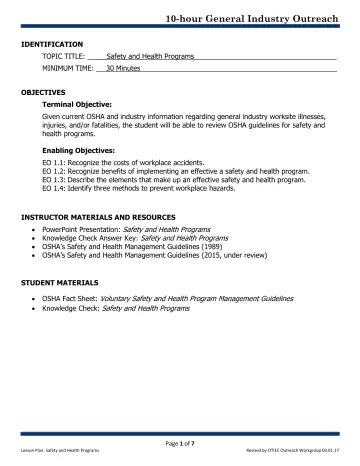
7 slidesSafety and Health Programs: Lesson Plan (OSHA 10-Hour General Industry Outreach)
Instructor lesson plan (objectives, timing, teaching steps) for the OSHA General Industry safety and health programs outreach deck.
U.S. Department of Labor, OSHA (with the OTIEC Outreach Workgroup)Public domain
pdf
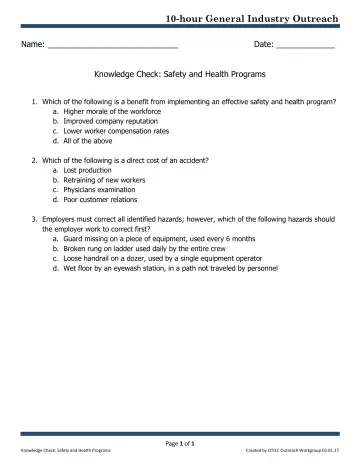
1 slidesSafety and Health Programs: Knowledge Check (OSHA 10-Hour General Industry Outreach)
Student knowledge-check quiz for the OSHA General Industry safety and health programs outreach deck.
U.S. Department of Labor, OSHA (with the OTIEC Outreach Workgroup)Public domain